Research into Digital Vehicle Key: Bluetooth Key Installations Soared by 244% in the First Seven Months of 2020
Our Digital Vehicle Key Industry Report, 2020 sorts out current digital key solutions and development trends.
In an era of intelligent vehicles, key is a new digital trait and has been not like what it used to be. Terminals like smartphones, smart watches and smart bracelets become carriers of vehicle keys, making people’s lives more convenient and creating more room for digital car life.
1. The less than 5% installation leaves space for rapid adoption
Digital key has three technology routes: Bluetooth Low Energy (BLE), Near Field Communication (NFC) and Ultra-wideband (UWB). Yet the overall installation is below 5%. Among them Bluetooth key finds broader application.
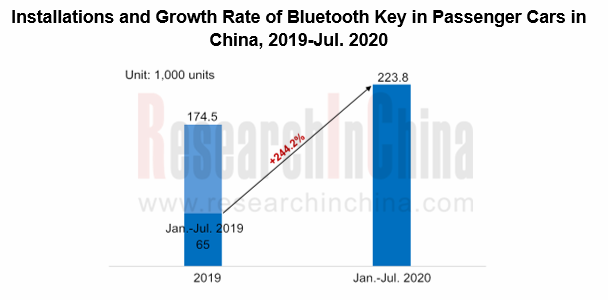
In the first seven months of 2020, Bluetooth key was mounted on roughly 220,000 passenger cars in China, a like-for-like spurt of 244%, with an installation rate of 3.3%, 1.6 percentage points higher than that in the prior-year period. Despite low installation in both volume and rate, Bluetooth key is roaring ahead.
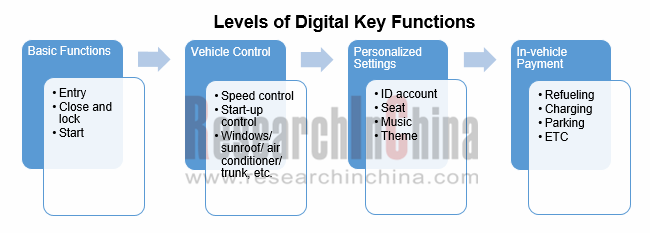
Apart from car lock/unlock and start-up capabilities, digital key enables personalized settings (e.g., seats, music and ID account), key sharing, vehicle trajectory record, and delivery to car. In future digital key will be an individualized element for cars and arouse much imagination.
2. Digital key is so beloved by Chinese automakers
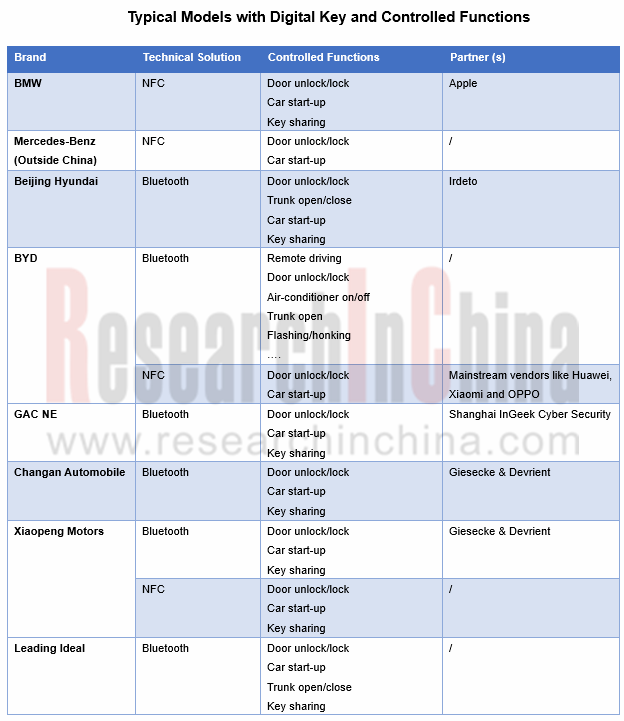
In China, local automakers more willingly embrace digital key. In Bluetooth key’s case, there were a total of 14 passenger car brands using such a key in China between January and July in 2020, including 10 homegrown ones with a combined 70% share in installation.
In 2014, BYD first introduced smartphone Bluetooth-based digital key which can lock and unlock cars without network. GAC NE, Xiaopeng Motors, Geely and Changan Automobile followed and rolled out Bluetooth or NFC-based key.
In April 2019, GAC NE unveiled its Bluetooth key-enabled car models -- AION.LX and AION.S. The key solution is co-developed by GAC NE and Shanghai InGeek Cyber Security Co., Ltd..
In September 2019, Xiaopeng Motors released a Bluetooth-based “financial-grade secure digital car key” (the identity authentication technology is developed with Alipay, with security performance subject to financial-grade standards of the Internet Finance Authentication Alliance (IFAA)).
In December 2019, BYD DiLink and Huawei Wallet jointly launched smartphone NFC-based car key.
Joint venture brands also followed suit. In particular, BMW and Beijing Hyundai, among others have stepped up efforts in digital key field in 2020, and plan adoption in full range of their future models.
In July 2020, BMW’s models began to be equipped with Apple CarKey, a NFC-based key solution.
In September 2020, the full family of new vehicles under Beijing Hyundai was outfitted with Irdeto Keystone, a Bluetooth key solution.
3. Established Tier1 suppliers and information security firms flock into the field
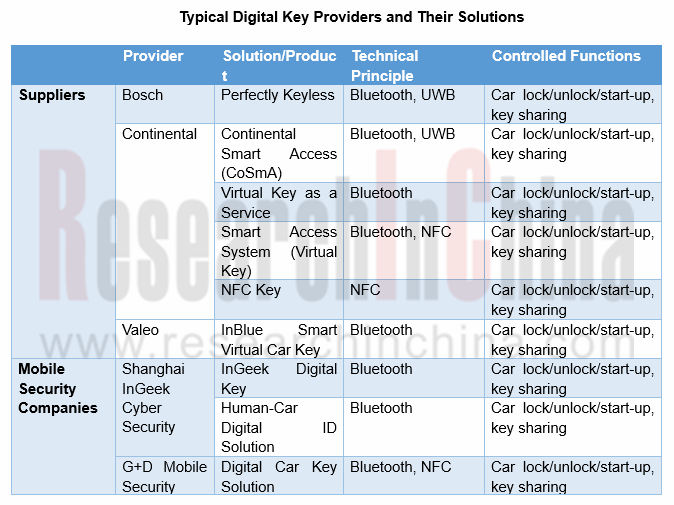
On the strength of technical expertise in common key, Tier1 suppliers like Bosch, Continental and Valeo have made a natural foray into digital key field.
In 2016, Valeo introduced InBlue, a smart virtual car key designed for shared mobility and fleet management and compatible with both Android and Apple phones.
In 2017, Bosch rolled out Perfectly Keyless, a digital key solution with which users can unlock, start or lock their cars via smartphone APP.
In August 2020, Continental launched new-generation CoSmA digital key based on ultra-wideband (UWB) technology. The system allows the car to be unlocked and the engine to be started without having to interact with the smartphone. It also enables remote control over the car via smartphone.
While bringing diversified and convenient experience to users, digital key poses a non-trivial security problem. Hacking at any links such as identity authentication, encryption algorithms, key storage, and data packet transmission will lead to a crash of the entire digital vehicle key security system. As a result, internet firms that are rooted in cyber security find vehicle information security a way to enter OEMs’ partnership system. Examples include foreign companies like Giesecke & Devrient (G+D) and Irdeto and Chinese peers such as Shanghai InGeek Cyber Security Co., Ltd. and Sichuan Zhongwang Safety and Environmental Protection Technology Consulting Co., Ltd..
4. BLE+NFC+UWB integrated solutions will come to the fore in future
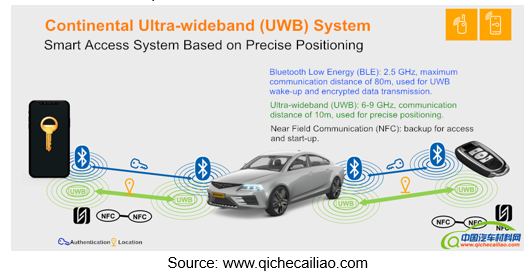
In current stage, the three digital key solutions (BLE, NFC and UWB) can lock, unlock and start cars independently. Integrating them into one terminal (e.g., smartphone and smart wearable device) will hold the trend. In an integrated solution, BLE, NFC and UWB work together but also play their own part in different scenarios: BLE used for vehicle wake-up and transmission authorization, UWB for locating where the user is after wake-up, and NFC as an alternative solution for car unlock and start-up in the case that mobile phone runs out of power.
Car Connectivity Consortium (CCC) is dedicated to cross-industry collaboration in developing global standards and solutions for smartphone and in-vehicle connectivity. The Board of Directors of CCC comes from Apple, BMW, GM, Honda, Hyundai, LG, Panasonic, Samsung and Volkswagen.
In May 2020, CCC announced rollout of Digital Key Release 2.0 specification.
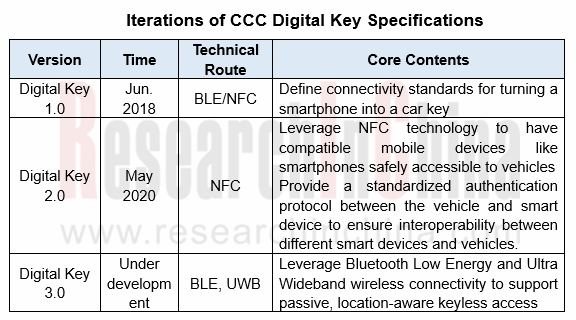
As below are capabilities enabled by Digital Key Release 2.0:
- Security and privacy equivalent to physical keys;
- Interoperability and user experience consistency across mobile devices and vehicles;
- Vehicle access, start, mobilization, and more;
- Owner pairing and key sharing with friends, with standard or custom entitlement profiles;
- Support for mobile devices in Battery Low Mode, where normal device operation is disabled.
The next generation of Digital Key, the Release 3.0 specification, is under development. It will leverage Bluetooth Low Energy and Ultra Wideband wireless connectivity to support passive, location-aware keyless access, providing vehicle owners with more convenience and new features.
Autonomous Driving Domain Controller and Central Computing Unit (CCU) Industry Report, 2026
Autonomous Driving Domain Controller (ADCU) Research: One-Chip CCU solutions are quickly available in vehicles
In China's passenger car market, autonomous driving systems involved in mass production ...
Automotive EMS and ECU Industry Research Report, 2026
Automotive EMS Research: The boundaries between EMS providers and Tier1 suppliers are becoming blurred, and the supply chain model is evolving from a linear chain to a networked structure
Mainstream ...
Automotive Microcontroller Unit (MCU) and Application Scenario Research Report, 2026
Automotive MCU Research: Increased demand for redundant security drives ASIL D-compliant MCU shipments to exceed 100 million units
In a vehicle EEA, MCUs are widely distributed in various functional ...
China Intelligent Cockpit Patent Analysis Report, 2026
Intelligent Cockpit Patent Research: Cockpit AI, In?vehicle Health, and Infotainment Are Upgrade to Scenario?based and Proactive Functions
From a patent perspective, this report explores the cutting?...
Research Report on Application of VLA Large Model in Automobiles and Robots, 2026
Research on Automotive and Robot VLA: Hybrid Architectures Become Mainstream, VLA Integrates with General World Models, and Reinforcement Learning Serves as Core Engine
Vision?Language?Action (VLA) m...
China Charging Infrastructure (Supercharging, Battery Swapping, V2G, etc.) and High-Performance Supercharging Battery Research Report, 2026
Charging and battery swapping research: as 5C+ supercharging vehicle models go into mass production, the pace of OEMs self-building supercharging networks quickens
800-1000V high-voltage platforms ar...
China Passenger Car Electronic Controlled Suspension Industry Report, 2026
Electronic Controlled Suspension Industry Research: As the First Year of Full Active Suspension Unfolds, Three Technical Routes Race Forward
1. Penetration Rate Surges Three Times, and Electronic Con...
Intelligent Driving SoC Research Report, 2026
Research on Intelligent Driving SoCs: Competition Focus Shifts to L3/L4 Embedded Hardware, and Computing Power of Flagship Vehicle Models Exceeds 1,000 TOPS
In terms of intelligent driving system in...
Automotive AI Large Model Technology Research Report, 2026
Automotive AI Large Model Research: Competition Shifts from "Who Has the Stronger Model" to "Who Boasts Higher Link Efficiency"
ResearchInChina released the Automotive AI Large Model Technology Resea...
Intelligent Vehicle Cockpit Domain Controller Research Report, 2026
Cockpit domain controller research: L3 AIDV intelligent cockpit domain controllers are entering a boom period
Driven by multiple factors such as the continuous evolution of the automotive central int...
Automotive Acoustic System (Audio, Multi-Channel) Industry Report, 2026
Automotive Acoustics Research: Multiple Channels, AI Tuning, and Self-Developed Algorithms Drive the Transformation of High-End Cockpit Sound Fields
I. Automotive Audio Hardware Solutions with 6–9 S...
Autonomous Driving Sensor Chip Research Report, 2026
Research on Autonomous Driving Sensor Chips: Deeply Perceiving the Physical World, Sensor Chips Are Playing A “Leading Role” in Intelligence
In 2026, the autonomous driving sensor chip industr...
Passenger Car Corner Module and Wheel‑Side Control System Research Report, 2026
Wheel-side control research: the “last mile” chassis innovation
Wheel-side control dismantles the traditional drive, braking, steering, and suspension control of the chassis from a "centralized" styl...
Embodied Artificial Intelligence (& Humanoid Robot) MCU Research Report, 2026
Research on Humanoid Robot MCUs: Evolution from General-Purpose Control to High-Value Dedicated Chip Solutions Integrated with Edge AI Functions
MCU (Microcontroller Unit) refers to a compact integra...
Intelligent Vehicle Zone Control Unit (ZCU) Research Report, 2026
ZCU Research: Cross-domain integrated ZCUs are becoming the edge computing nodes of the next-generation zonal architecture
Currently, the mainstream zonal architecture is mainly the quasi-central + z...
Automotive Cybersecurity and Data Security Research Report, 2026
Cybersecurity & Data Security Research: Intelligent Connected Vehicles Enter the Era of “Systematic Offense-Defense and AI-Defined Security”.
Centering on the panorama of intelligent connect...
Report on Breakthrough Strategies of OEMs and ADAS Tier 1 Suppliers for Overseas Layout of Intelligent Driving, 2026
Regulatory Breakthrough, Local System Establishment, OEMs Competing for NOA Layout: Overall Trends of China’s Intelligent Driving Overseas Layout in 2026
Research on overseas intelligent driving layo...
OEMs and Tier1s’ Intelligent Cockpit Platform (Hardware and Software) Innovation Strategy Research Report, 2026
Intelligent Cockpit Platform Research: multi-dimensional cockpit system architecture reconstruction for multi-agent collaboration and proactive intelligent services
The intelligent cockpit software s...