Research into Automotive Display: 10-Billion-Yuan Automotive Display Market Is Thriving.
In this report, those are analyzed and studied such as the market size, installation rate, display technology, development trends and suppliers of automotive displays (incl. cluster display, center console display, etc.).
The Center Console Display Shipments Rank First, and the Installation Rates of Rearview Mirror Displays, Rear Seat Entertainment Displays and Vehicle Control Displays Continue to Grow.
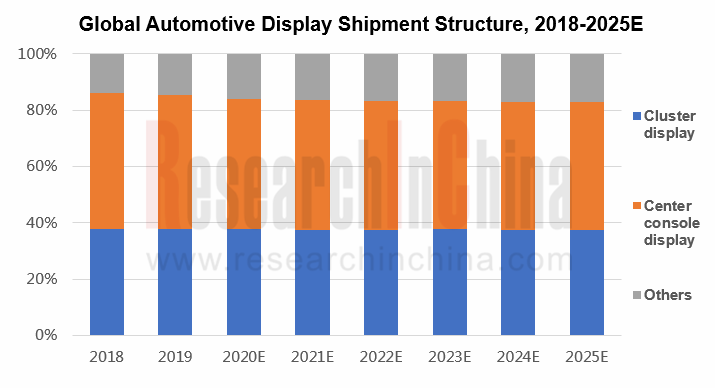
Being bound up with automobile sales, automotive display shipments worldwide edged down 1.5% year-on-year to approximately 159 million units in 2019 when auto sales continued a bearish trend. In 2020, the COVID-19 pandemic drags down global automobile sales (a like-for-like slump of 25.5% in H1 2020, and may recover a bit in H2 2020), with a projected year-on-year plunge of 20% or so. Against this, global automotive display shipments are expected to fall 12.1% year-on-year to 140 million units in 2020. In the long run, the automotive display market, however, will resume growth alongside intelligent connected vehicles at a gallop, with shipments projected to reach 180 million units by 2025.
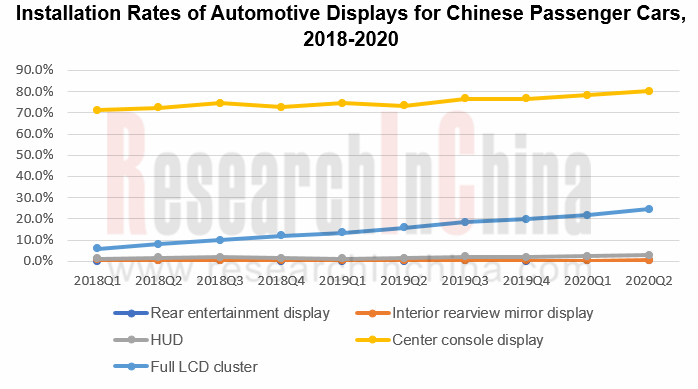
In the Chinese market, the installation rate of console displays exceeds 80%, while full LCD cluster displays see the fastest installation rate, accompanied by a marked rise in installation rates of rearview mirror displays, HUD, center console displays, among others.
In 2019, the automotive display shipments of global panel vendors grew concentrated ever, especially the top five’s rose by 4.3 percentage points. JDI led the pack in the market, while Tianma Microelectronics, the largest Chinese automotive panel supplier, took the third place in the world with its shipments growing at a far higher rate than those of JDI and LGD; however, BOE saw the quickest shipment growth rate as high as 73.2%. Chinese players are growing strong.
Automotive Display Technology: Given LCD Overcapacity, Suppliers Are Racing to Develop New Technologies such as AMOLED
LCD still prevails in the automotive display market, but Japanese and Korean panel makers led by JDI and LGD have been gearing from a-Si products to LTPS and even AMOLED to suit to the changing automotive demand.
Moreover, the rapid release of new LCD capacities will lead to a severer oversupply, ever lower prices and less meager profits, forcing vendors to cut production and seek for a transition and even a retreat from the LCD market.
BOE: it announced at the end of 2019 that it would stop investing in LCD capacity, but focus on OLED and next-generation Mini LED and Micro LED instead, with a plan to spawn Mini LED in Q4 2020.
LGD: It will stop production of LCD panels in South Korea before the end of 2021 to slash losses.
AUO: It trims LCD capacity and quickens to develop new products.
With the CASE (connected, autonomous, shared, electrified) trend in the automotive sector, automotive displays tend to be bigger, and in the form of conjugate displays and multi-displays. The rising of novel automotive displays such as vehicle control displays and curved displays has brought opportunities to Chinese vendors. Major suppliers have rolled out new technical solutions like AMOLED and Mini LED successively in 2020.
LGD: In February 2020, it provided a digital cockpit based on an OLED curved display for the new Cadillac Escalade. In June 2020, it announced that it will develop a retractable display before 2024.
Tianma Microelectronics: The ACRUS technology, debuted in January 2020, raises the contrast to over 30,000:1 by laminating LTPS double-layer panels.
Innolux: In July 2020, it launched a 29-inch free-form curved display incorporating a cluster board and a CID display, and planned to achieve mass production in 2022.
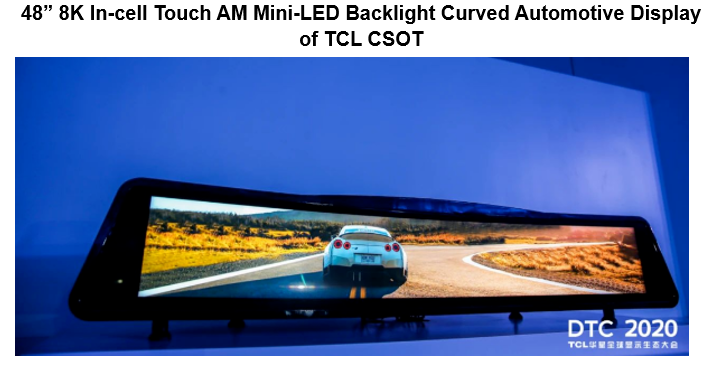
TCL CSOT: In October 2020, the 48” 8K In-cell Touch AM Mini-LED backlight curved automotive display was released, as the first 5096 partition AM Mini-LED backlight and 100% NTSC display in the automotive industry and the world’s first 6.7” AMOLED cloud scroll display.
Automotive Display Installation: Integrated Displays Grow a Standard Configuration, and OLED/AMOLED Displays Begin to Penetrate in High-end Cars.
At present, automotive dual-displays or even triple-displays represent a trend. A larger display spans the entire center console, featuring the functionality involved with the copilot. As per the center console display configuration of Chinese passenger cars in 2018-2020, the installation rate of multi-displays was up from 0.3% in 2018 to 1.3% in Q2 2020. The interiors of Mercedes-Benz, Volkswagen, Chang’an and other models in 2020 reveal that dual-displays have almost become the standard.
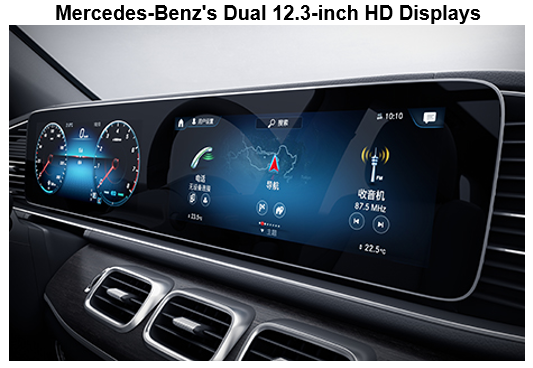
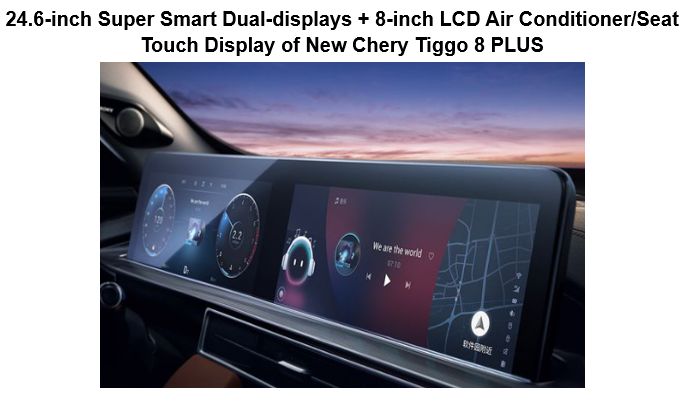
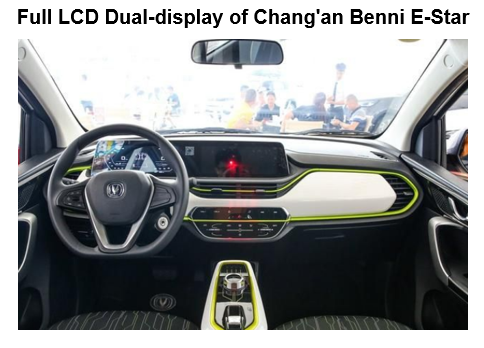
The multi-display layout is basically available in models priced above RMB150,000, except Chang'an Benni E-Star launched in April 2020, a mini-car priced below RMB100,000 that has full LCD cluster & center console dual-displays, signaling the penetration of dual-displays into the medium and low-end models.
With the evolvement of intelligent connectivity technology, cars are growing to be mobile smart terminals. In addition to cluster & center console dual displays, HUD, electronic rearview mirror displays, copilot recreation displays, rear seat entertainment displays, and transparent A-pillars have emerged. HOZON U, for instance, launched in 2019, is equipped with a vehicle control display and transparent A-pillars besides dual displays. ENOVATE ME7 unveiled in September 2020 carries 5 high-definition displays including a cluster display, a center console display, a copilot display and dual displays in the rear row.
According to the concept models released by OEMs, curved displays will shine in the automotive display field in future. Luxury brand cars and new energy vehicles are first making use of OLED displays.
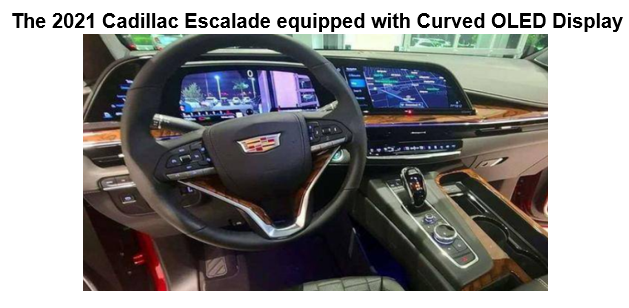
Previously, only small displays such as transparent A-pillars, and Audi virtual rearview mirror displays applied OLED. In 2020, some production models use OLED on large displays for center consoles and the copilot. Mercedes-Benz S-class launched in August 2020 is provided with a 12.8-inch OLED curved center console display; the 2021 Cadillac Escalade will be packed with the industry’s first large-size curved OLED cluster display; Nissan’s IMQ concept uses a 33.1-inch curved display; Audi-Aicon concept adopts a surrounded display.
Automotive Microcontroller Unit (MCU) and Application Scenario Research Report, 2026
Automotive MCU Research: Increased demand for redundant security drives ASIL D-compliant MCU shipments to exceed 100 million units
In a vehicle EEA, MCUs are widely distributed in various functional ...
China Intelligent Cockpit Patent Analysis Report, 2026
Intelligent Cockpit Patent Research: Cockpit AI, In?vehicle Health, and Infotainment Are Upgrade to Scenario?based and Proactive Functions
From a patent perspective, this report explores the cutting?...
Research Report on Application of VLA Large Model in Automobiles and Robots, 2026
Research on Automotive and Robot VLA: Hybrid Architectures Become Mainstream, VLA Integrates with General World Models, and Reinforcement Learning Serves as Core Engine
Vision?Language?Action (VLA) m...
China Charging Infrastructure (Supercharging, Battery Swapping, V2G, etc.) and High-Performance Supercharging Battery Research Report, 2026
Charging and battery swapping research: as 5C+ supercharging vehicle models go into mass production, the pace of OEMs self-building supercharging networks quickens
800-1000V high-voltage platforms ar...
China Passenger Car Electronic Controlled Suspension Industry Report, 2026
Electronic Controlled Suspension Industry Research: As the First Year of Full Active Suspension Unfolds, Three Technical Routes Race Forward
1. Penetration Rate Surges Three Times, and Electronic Con...
Intelligent Driving SoC Research Report, 2026
Research on Intelligent Driving SoCs: Competition Focus Shifts to L3/L4 Embedded Hardware, and Computing Power of Flagship Vehicle Models Exceeds 1,000 TOPS
In terms of intelligent driving system in...
Automotive AI Large Model Technology Research Report, 2026
Automotive AI Large Model Research: Competition Shifts from "Who Has the Stronger Model" to "Who Boasts Higher Link Efficiency"
ResearchInChina released the Automotive AI Large Model Technology Resea...
Intelligent Vehicle Cockpit Domain Controller Research Report, 2026
Cockpit domain controller research: L3 AIDV intelligent cockpit domain controllers are entering a boom period
Driven by multiple factors such as the continuous evolution of the automotive central int...
Automotive Acoustic System (Audio, Multi-Channel) Industry Report, 2026
Automotive Acoustics Research: Multiple Channels, AI Tuning, and Self-Developed Algorithms Drive the Transformation of High-End Cockpit Sound Fields
I. Automotive Audio Hardware Solutions with 6–9 S...
Autonomous Driving Sensor Chip Research Report, 2026
Research on Autonomous Driving Sensor Chips: Deeply Perceiving the Physical World, Sensor Chips Are Playing A “Leading Role” in Intelligence
In 2026, the autonomous driving sensor chip industr...
Passenger Car Corner Module and Wheel‑Side Control System Research Report, 2026
Wheel-side control research: the “last mile” chassis innovation
Wheel-side control dismantles the traditional drive, braking, steering, and suspension control of the chassis from a "centralized" styl...
Embodied Artificial Intelligence (& Humanoid Robot) MCU Research Report, 2026
Research on Humanoid Robot MCUs: Evolution from General-Purpose Control to High-Value Dedicated Chip Solutions Integrated with Edge AI Functions
MCU (Microcontroller Unit) refers to a compact integra...
Intelligent Vehicle Zone Control Unit (ZCU) Research Report, 2026
ZCU Research: Cross-domain integrated ZCUs are becoming the edge computing nodes of the next-generation zonal architecture
Currently, the mainstream zonal architecture is mainly the quasi-central + z...
Automotive Cybersecurity and Data Security Research Report, 2026
Cybersecurity & Data Security Research: Intelligent Connected Vehicles Enter the Era of “Systematic Offense-Defense and AI-Defined Security”.
Centering on the panorama of intelligent connect...
Report on Breakthrough Strategies of OEMs and ADAS Tier 1 Suppliers for Overseas Layout of Intelligent Driving, 2026
Regulatory Breakthrough, Local System Establishment, OEMs Competing for NOA Layout: Overall Trends of China’s Intelligent Driving Overseas Layout in 2026
Research on overseas intelligent driving layo...
OEMs and Tier1s’ Intelligent Cockpit Platform (Hardware and Software) Innovation Strategy Research Report, 2026
Intelligent Cockpit Platform Research: multi-dimensional cockpit system architecture reconstruction for multi-agent collaboration and proactive intelligent services
The intelligent cockpit software s...
Automotive AIOS Research Report, 2026
Automotive AIOS Research: Mass Production Solutions Are Implemented
Mass Production Solutions Are Implemented on A Small Scale.
In 2026, AIOS starts small-scale implementation, helping to improve v...
Automotive Telematics Service Provider (TSP) Research Report, 2026
TSP Research: Leading providers collectively turn to AI agents to provide all-scenario active services
Telematics Service Providers (TSPs) are the core hub of the telematics industry chain, connectin...