Amid “CASE” (connected, autonomous, shared and electrified) prospering in automotive sector, Chinese and joint venture auto brands are vying for connectivity and intelligence. In China, domestic brands have gained first-mover advantages in the country’s telematics market on the strength of local resources. In January 2019, joint venture brands were left behind by Chinese OEMs, with an 11.8 percentage points lower telematics penetration. Since 2019 their deploying telematics has been expedited: they endeavor to develop underlying technologies and seek partners, with roll-outs of more secure, more intelligent in-vehicle infotainment (IVI) systems; they also focus more on user experience and exert themselves to upgrade telematics capabilities by setting up joint ventures, or cooperating with BATH (Baidu, Alibaba, Tencent and Huawei) to answer Chinese customers’ needs for services from in-vehicle entertainment to mobility. In the first ten months of 2020, joint venture brands boasted a telematics installation of up to 49.8%, closing the gap with their Chinese peers (57.7%) to 7.9 percentage points.
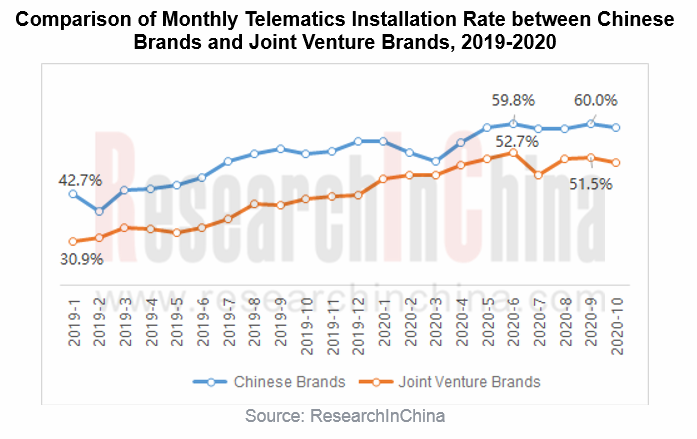
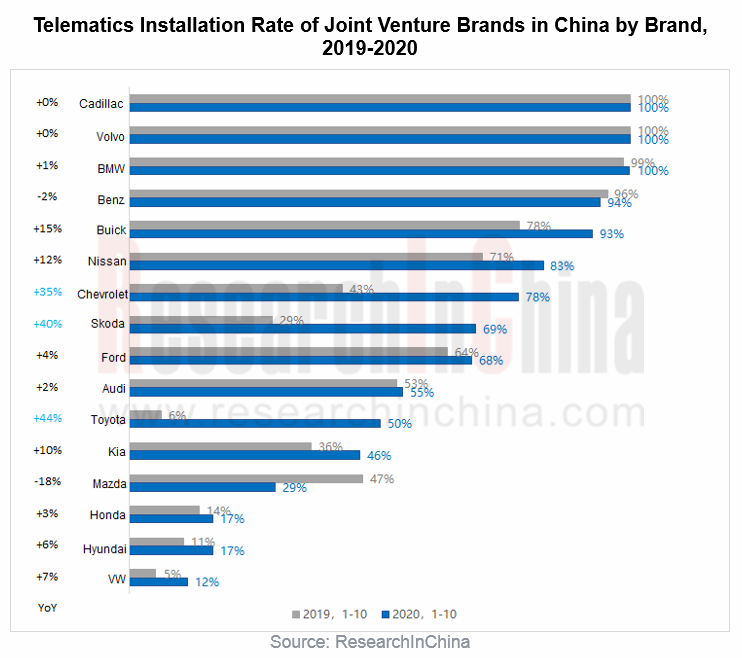
From January to October 2020, joint venture brands saw their installation of telematics jump by 14.3 percentage points from 35.6% in the prior-year period. Among them, the installation of Toyota, Chevrolet and Skoda all surged by over 30% on a like-on-like basis, because Toyota introduced Toyota Connect system into China in 2019, Chevrolet launched widely available MyLink+ system in the second half of 2018, and Skoda brought into use Skoda Connect system, a local telematics system for SAIC Volkswagen, in 2020.
In comparison, Audi and KIA post a relatively low installation, but they have set about deploying with great efforts. As an example, in December 2020 FAW Volkswagen Audi and Baidu Internet of Vehicles jointly released Audi Q2L T-Box; in October, Hyundai Kia forged a close partnership with Baidu on installation of Xiaodu In-Car OS in all future models planned to be sold in China and imported cars.
In future, joint venture automakers will head in the following directions:
1. It is estimated that their installation of telematics will outstrip 50% in 2020 and leap to around 70% in 2025.
2. They will deliver better use experience to cater to Chinese clientele who has developed a unique habit of using internet, as they partner closely with Chinese companies like BATH (Baidu, Alibaba, Tencent and Huawei) to introduce new features in their IVI systems, including short video, group driving, delivery to car, biometrics, WeChat vehicle version, applets, and Huawei APP.
3. Accelerate iteration and upgrade of telematics system. IVI systems of joint venture brands like Toyota and Honda have yet to offer OTA updates, while Tesla, NIO and Xiaopeng Motors already provide full vehicle FOTA capability. In the second half of 2020, the mass-adoption of OTA updates by joint venture OEMs such as BMW and SAIC GM was enabled.
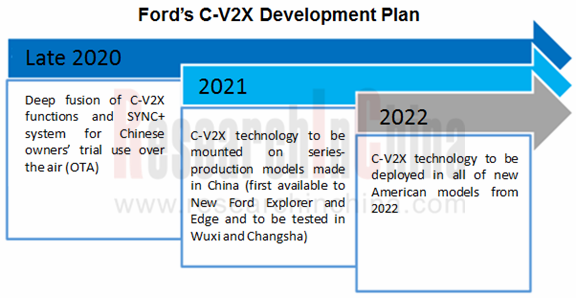
4. Apply V2X. For example, Buick has made it clear that its next-generation IVI system is to support V2X; Ford will roll out its first production model packing V2X capabilities in China in 2021.
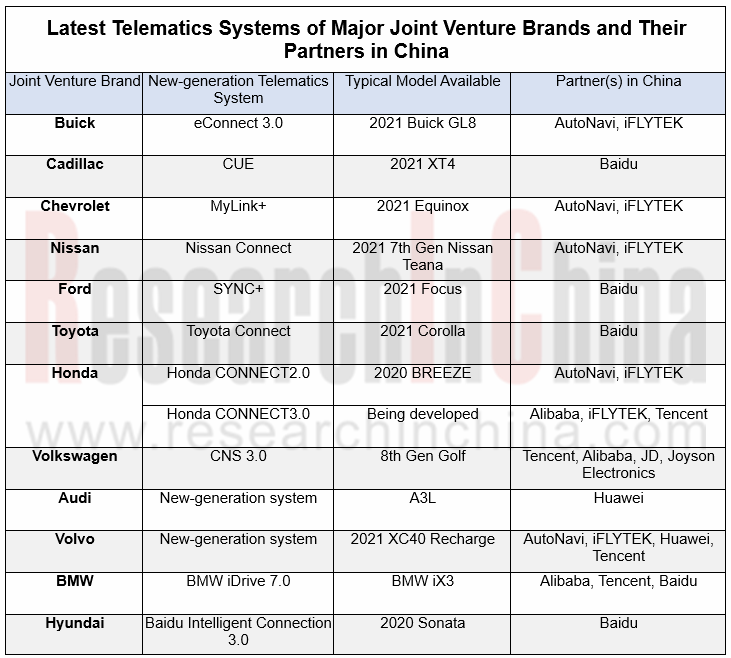
In October 2020, BMW China released its “Customer Centric Digitalization Strategy” where China will go first in research and development, products, and user experience on the vehicle end. BMW announced the latest iDrive 7.0 OTA update for about 750,000 cars worldwide from October 19, 2020 onwards, including roughly 200,000 units in China.
BMW unveils a range of IVI system features for the Chinese market this year, including Ximalaya FM (in April 2020), Ixigua Short Video and a parking lot indoor map (in July 2020), upcoming Tencent Mini Scenario (within 2020), and WeChat vehicle version (in future). On this basis, for Chinese customers, BMW has also designed My BMW APP, an exclusive APP launched in September 2020 and offering more than 60 capabilities under three categories --“Car Selection, Service, and Social Contact”.
In future, BMW China will push on with development and launch of digital experience products for China through its Chinese R&D teams (with 1,100-plus talents including more than 400 software staffs) and its digital service outfit -- LingYue Digital Information Technology Co., Ltd. founded in 2019.
In July 2020, Dongfeng Nissan released its “Intelligent Connected Future” Program which highlights the following: 1. to launch 8 car models carrying Nissan Connect in 2020; 2. to equip 80% of its models with telematics systems in 2021; 3. to iterate Nissan Connect for four times during 2020-2024.
Nissan Connect, one of the five core technologies of Nissan Intelligent Mobility, encompasses six functional sectors (e.g., Remote Online, Online Control and Online Resources) offering 59 capabilities, of which 12 are included in the Online Resources sector, such as online payment (WeChat, Alipay and UnionPay Online Payment), account bound with third-party APPs, smart refueling (supporting online payments), and vehicle safety functions (violation query, safe arrival reminder, vehicle health monitoring and maintenance reservation). As of November 2020, Nissan Connect has been available to nine of Nissan’s models (2021) including Kicks, Tiida, Sylphy Classic, Sylphy, Qashqai, X-Trail, Murano and Teana.
In April 2019, Ford China announced “Ford China 2.0” strategy which contains “330” Product Plan, Smart Technology Plan, China Partner Plan, China Innovation Plan and China Talent Plan, among which Smart Technology Plan involves: 1. launching the new SYNC+ in-vehicle infotainment system together with Baidu; 2. Equipping most of Ford and Lincoln brand new cars made in China with SYNC+ system from 2019; 3. spawning the first C-V2X-enabled model in China in 2021.
As for telematics, Ford has built SYNC+, its new-generation in-vehicle infotainment system built on Xiaodu In-Car OS for the Chinese market. The IVI system is a fusion of capabilities such as Baidu AI Voice Assistant, Baidu Navigation and Baidu Home To Vehicle, as well as infotainment features like iQiyi, QQ Music and Himalaya FM, and is connected with FordPass APP for “IVI system-smartphone-home” interconnection.
In November 2020, Volvo’s new-generation IVI system was first seen in XC40 BEV. The system runs Google Android Automotive OS, and packs Huawei’s HMS for Car intelligent in-vehicle cloud service (that offers such application services as Huawei APP Store, Huawei Quick APP, Huawei Assistant Service, My Car, Huawei Music, and Huawei Video), iFLYTEK’s voice technology, Tmall Genie Car-Home Interconnection and Tencent Aiquting, among others.
OTA updates will bring features like WeChat vehicle version to Volvo’s new-generation IVI system. Furthermore, Volvo will team up with Huawei and China Unicom to create a next-generation 5G intelligent telematics system.
Automotive Microcontroller Unit (MCU) and Application Scenario Research Report, 2026
Automotive MCU Research: Increased demand for redundant security drives ASIL D-compliant MCU shipments to exceed 100 million units
In a vehicle EEA, MCUs are widely distributed in various functional ...
China Intelligent Cockpit Patent Analysis Report, 2026
Intelligent Cockpit Patent Research: Cockpit AI, In?vehicle Health, and Infotainment Are Upgrade to Scenario?based and Proactive Functions
From a patent perspective, this report explores the cutting?...
Research Report on Application of VLA Large Model in Automobiles and Robots, 2026
Research on Automotive and Robot VLA: Hybrid Architectures Become Mainstream, VLA Integrates with General World Models, and Reinforcement Learning Serves as Core Engine
Vision?Language?Action (VLA) m...
China Charging Infrastructure (Supercharging, Battery Swapping, V2G, etc.) and High-Performance Supercharging Battery Research Report, 2026
Charging and battery swapping research: as 5C+ supercharging vehicle models go into mass production, the pace of OEMs self-building supercharging networks quickens
800-1000V high-voltage platforms ar...
China Passenger Car Electronic Controlled Suspension Industry Report, 2026
Electronic Controlled Suspension Industry Research: As the First Year of Full Active Suspension Unfolds, Three Technical Routes Race Forward
1. Penetration Rate Surges Three Times, and Electronic Con...
Intelligent Driving SoC Research Report, 2026
Research on Intelligent Driving SoCs: Competition Focus Shifts to L3/L4 Embedded Hardware, and Computing Power of Flagship Vehicle Models Exceeds 1,000 TOPS
In terms of intelligent driving system in...
Automotive AI Large Model Technology Research Report, 2026
Automotive AI Large Model Research: Competition Shifts from "Who Has the Stronger Model" to "Who Boasts Higher Link Efficiency"
ResearchInChina released the Automotive AI Large Model Technology Resea...
Intelligent Vehicle Cockpit Domain Controller Research Report, 2026
Cockpit domain controller research: L3 AIDV intelligent cockpit domain controllers are entering a boom period
Driven by multiple factors such as the continuous evolution of the automotive central int...
Automotive Acoustic System (Audio, Multi-Channel) Industry Report, 2026
Automotive Acoustics Research: Multiple Channels, AI Tuning, and Self-Developed Algorithms Drive the Transformation of High-End Cockpit Sound Fields
I. Automotive Audio Hardware Solutions with 6–9 S...
Autonomous Driving Sensor Chip Research Report, 2026
Research on Autonomous Driving Sensor Chips: Deeply Perceiving the Physical World, Sensor Chips Are Playing A “Leading Role” in Intelligence
In 2026, the autonomous driving sensor chip industr...
Passenger Car Corner Module and Wheel‑Side Control System Research Report, 2026
Wheel-side control research: the “last mile” chassis innovation
Wheel-side control dismantles the traditional drive, braking, steering, and suspension control of the chassis from a "centralized" styl...
Embodied Artificial Intelligence (& Humanoid Robot) MCU Research Report, 2026
Research on Humanoid Robot MCUs: Evolution from General-Purpose Control to High-Value Dedicated Chip Solutions Integrated with Edge AI Functions
MCU (Microcontroller Unit) refers to a compact integra...
Intelligent Vehicle Zone Control Unit (ZCU) Research Report, 2026
ZCU Research: Cross-domain integrated ZCUs are becoming the edge computing nodes of the next-generation zonal architecture
Currently, the mainstream zonal architecture is mainly the quasi-central + z...
Automotive Cybersecurity and Data Security Research Report, 2026
Cybersecurity & Data Security Research: Intelligent Connected Vehicles Enter the Era of “Systematic Offense-Defense and AI-Defined Security”.
Centering on the panorama of intelligent connect...
Report on Breakthrough Strategies of OEMs and ADAS Tier 1 Suppliers for Overseas Layout of Intelligent Driving, 2026
Regulatory Breakthrough, Local System Establishment, OEMs Competing for NOA Layout: Overall Trends of China’s Intelligent Driving Overseas Layout in 2026
Research on overseas intelligent driving layo...
OEMs and Tier1s’ Intelligent Cockpit Platform (Hardware and Software) Innovation Strategy Research Report, 2026
Intelligent Cockpit Platform Research: multi-dimensional cockpit system architecture reconstruction for multi-agent collaboration and proactive intelligent services
The intelligent cockpit software s...
Automotive AIOS Research Report, 2026
Automotive AIOS Research: Mass Production Solutions Are Implemented
Mass Production Solutions Are Implemented on A Small Scale.
In 2026, AIOS starts small-scale implementation, helping to improve v...
Automotive Telematics Service Provider (TSP) Research Report, 2026
TSP Research: Leading providers collectively turn to AI agents to provide all-scenario active services
Telematics Service Providers (TSPs) are the core hub of the telematics industry chain, connectin...