Research on digital transformation of automakers: Tesla is still the best reference
Digital transformation means that enterprises make full use of digital technologies (such as big data, cloud computing, artificial intelligence, etc.) in R&D, production, marketing and services to promote the transformation of business models, organizational structures, etc., so that concepts like intelligent manufacturing are derived.
Digital transformation in the automotive industry includes R&D and production digitalization, marketing service digitalization, product digitalization, and management digitalization.
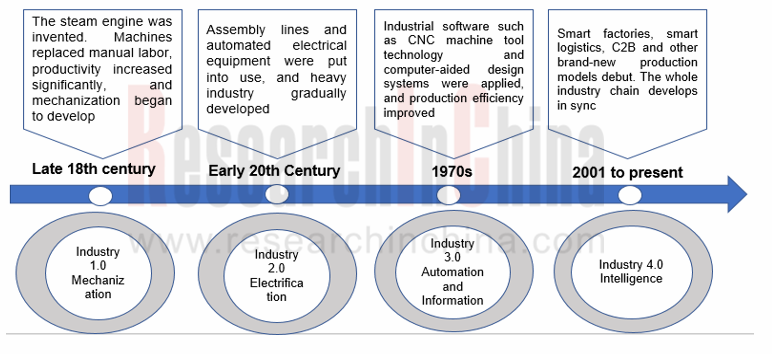
In essence, digitization actually maps and orderly manages the real world (such as cars, roads, car owners, etc.) in the virtual world. The real world is transformed into various information systems through data collection from automobile production, R&D, marketing, services and management. Via the integration of information and data, big data and artificial intelligence technology which optimizes the processing of the virtual world, the process and management of the real world are optimized as well.
During the “Industry 3.0” era (automation and information age, approximately from 1980 to 2010), production information systems, R&D information systems, sales information systems, user and service information systems, etc. were formed, but these information systems were basically isolated then. Due to the low frequency of information collection, a lot of information still lagged.
With the substantial improvement in chip computing power and storage capacity, the automotive industry has entered the era of Industry 4.0 (intelligence) which will connect information systems in all business links. At the same time, the frequency and precision of information collection will be greatly improved, and some fields may even see digital twin (that is, the virtual world by digital mapping is highly consistent with the real world).
Tesla achieves the highest degree of intelligence among all automakers, and has basically connected the information systems and data of all business links. Tesla not only conducts self-research on electrification, connectivity and intelligence of cars, but also tries its best to develop software systems in the entire life cycle of cars.
Software-driven is the source of Tesla’s subversion of the entire automotive industry. Its self-developed software system named Warp supports its direct sales business in the United States and adapts to growth in China and other markets around the world. Warp is a combination of e-commerce and back-end management software and completely customized to support Tesla's counter-approach to selling and servicing cars. The automaker uses its Warp-powered e-commerce website and its own showrooms, not dealerships, to sell cars. Warp also handles all the back office functions for Tesla such as order processing, supply chain management, manufacturing workflow management, financial accounting and lead management.
China's emerging automaker NIO adopts a sales model similar to Tesla’s. No matter online or offline, NIO prefers self-operation and self-establishment. It basically relies on online channels to sell products, while displays the brand and offers user experience services offline. NIO's experiential digital marketing is widely praised. In terms of experience marketing, NIO starts from eight aspects: content experience, social experience, lifestyle experience, car purchase experience, driving experience, service experience, energy supplement experience, and battery swap experience.
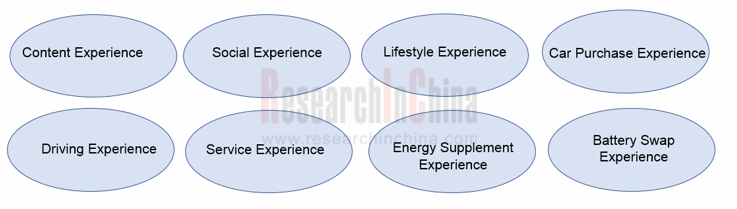
Take the social experience as an example: users can set up groups in the NIO App. In other words, once a user becomes a car owner, a dedicated car owner service group of 13 people will be formed. In the service group, there are sales partners, service specialists, power-on specialists, as well as various technical specialists and city general managers. When users have any problems in the process of using cars, they can inquire in the group, and someone will respond to and solve problems immediately.
The traditional automakers BMW and Mercedes-Benz have developed APPs which pay attention to functions and require registration. They only provide services for existing car owners, so they are unattractive to potential car owners. The limited traffic cannot support sales volume conversion.
As the emerging automakers represented by Tesla have been digitally operated from the beginning, they are sought after by consumers and recognized by the market. The emergence of new forces has posed tremendous pressure on traditional automakers who thus have formulated digital strategies one after another to boost digital transformation.
At present, automakers mainly deploy digital transformation in five aspects:
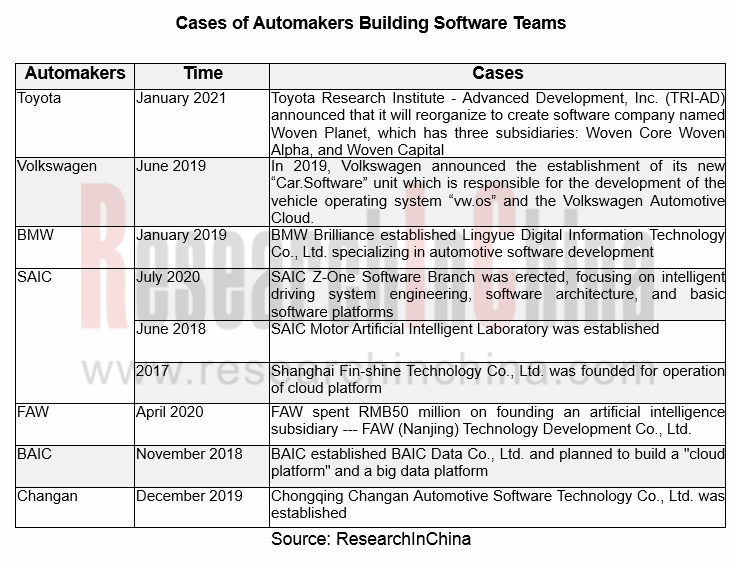
First, they establish software companies or R&D divisions as well as build software teams through self-construction or cooperation.
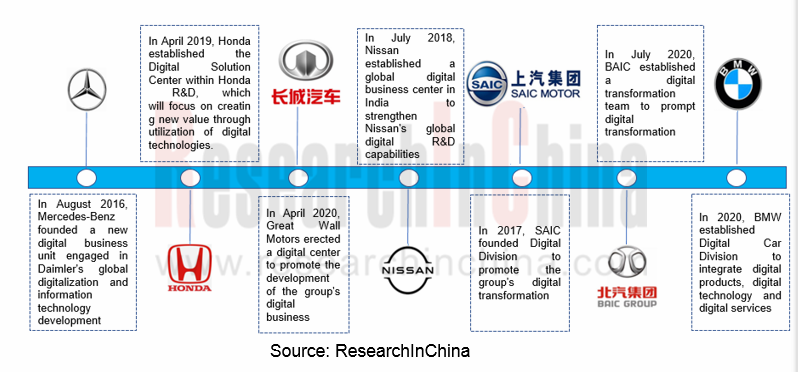
Second, automakers set up digital centers internally to coordinate the digital transformation of the entire groups and promote the implementation of overall digital strategy.
Third, automakers can reduce costs and improve competitiveness by allying with other automakers.
Fourth, automakers prompt digital transformation through cooperation with technology companies (such as Baidu, Alibaba, Tencent, Huawei, etc.).
Fifth, automakers create an online & offline user-centric digital marketing model.
GM’s 4S stores have evolved into a "7S modular dealer service system" consisting of New Car Sale, After-Sales Services, Spare Parts, Information Survey, Pre-owned Car Services, Sharing and Financial Support.
Xpeng's "2S+2S" marketing model disassembles "4S" into two parts: online (marketing and parts available on Tmall) and offline (after-sales services and information feedback). Through the dual-channel linkage of "the Tmall flagship store + offline stores", Xpeng connects both online and offline fields, which not only greatly reduces costs, but also brings consumers with new experience.
This report analyzes 21 OEMs’ strategies and specific measures for transformation. Conventional automakers like Toyota and Changan Automobile have made successes in digital transformation as well, in addition to emerging carmakers.
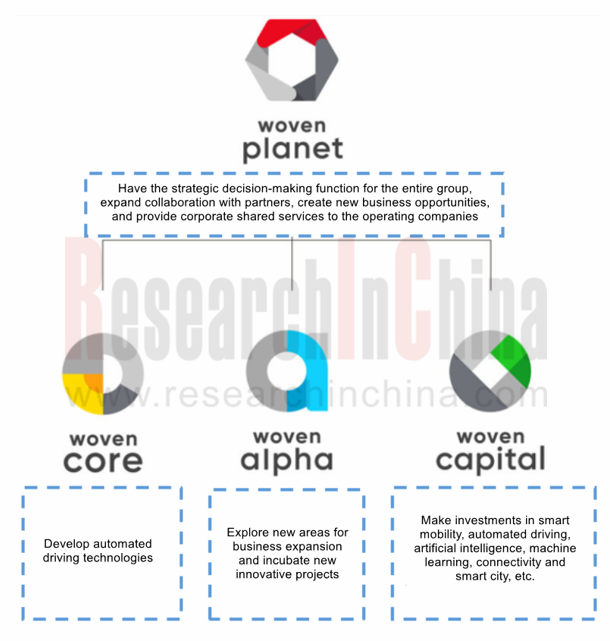
Toyota Digital Transformation focuses on five aspects: first, adjusting organizational structure, with high priority on restructuring of TRI-AD, Toyota’s advanced software company and segmenting its business into “R&D of Automated Driving Technologies”, “Incubation of Innovative Projects” and “Investment in Emerging Areas”; second, launching the Mobility Services Platform (MSPF) for an upgrade to the next-generation mobility services; third, building a cloud service platform for better business and operation models; fourth, creating Toyota New Global Architecture (TNGA) to reform R&D and production links; fifth, developing digital products, with deployments in autonomous driving, HD map, chip, HMI, etc.
Changan Automobile takes software as its corporate strategy, setting up a software center to enhance its digital transformation. For R&D and production, the automaker builds a R&D cloud platform for advancing construction of smart cities; for marketing, it creates an integrated marketing cloud platform and self-establishes an ecommerce platform; for product digitization, it makes deployments in areas from cloud platform and intelligence to telematics by way of independent construction and cooperation.
Despite great efforts on digital transformation, quite a few automakers still face some challenges, such as:
 Underpowered transformation, disputed transformation model, and some departments’ reluctance to transform;
Poor ability to attract customers online in digital marketing, and lower-than-expected return on offline high investment;
Under-investment in digital transformation, which blames for conventional businesses;
Lack of software teams and user operation experience.
Autonomous Driving Domain Controller and Central Computing Unit (CCU) Industry Report, 2026
Autonomous Driving Domain Controller (ADCU) Research: One-Chip CCU solutions are quickly available in vehicles
In China's passenger car market, autonomous driving systems involved in mass production ...
Automotive EMS and ECU Industry Research Report, 2026
Automotive EMS Research: The boundaries between EMS providers and Tier1 suppliers are becoming blurred, and the supply chain model is evolving from a linear chain to a networked structure
Mainstream ...
Automotive Microcontroller Unit (MCU) and Application Scenario Research Report, 2026
Automotive MCU Research: Increased demand for redundant security drives ASIL D-compliant MCU shipments to exceed 100 million units
In a vehicle EEA, MCUs are widely distributed in various functional ...
China Intelligent Cockpit Patent Analysis Report, 2026
Intelligent Cockpit Patent Research: Cockpit AI, In?vehicle Health, and Infotainment Are Upgrade to Scenario?based and Proactive Functions
From a patent perspective, this report explores the cutting?...
Research Report on Application of VLA Large Model in Automobiles and Robots, 2026
Research on Automotive and Robot VLA: Hybrid Architectures Become Mainstream, VLA Integrates with General World Models, and Reinforcement Learning Serves as Core Engine
Vision?Language?Action (VLA) m...
China Charging Infrastructure (Supercharging, Battery Swapping, V2G, etc.) and High-Performance Supercharging Battery Research Report, 2026
Charging and battery swapping research: as 5C+ supercharging vehicle models go into mass production, the pace of OEMs self-building supercharging networks quickens
800-1000V high-voltage platforms ar...
China Passenger Car Electronic Controlled Suspension Industry Report, 2026
Electronic Controlled Suspension Industry Research: As the First Year of Full Active Suspension Unfolds, Three Technical Routes Race Forward
1. Penetration Rate Surges Three Times, and Electronic Con...
Intelligent Driving SoC Research Report, 2026
Research on Intelligent Driving SoCs: Competition Focus Shifts to L3/L4 Embedded Hardware, and Computing Power of Flagship Vehicle Models Exceeds 1,000 TOPS
In terms of intelligent driving system in...
Automotive AI Large Model Technology Research Report, 2026
Automotive AI Large Model Research: Competition Shifts from "Who Has the Stronger Model" to "Who Boasts Higher Link Efficiency"
ResearchInChina released the Automotive AI Large Model Technology Resea...
Intelligent Vehicle Cockpit Domain Controller Research Report, 2026
Cockpit domain controller research: L3 AIDV intelligent cockpit domain controllers are entering a boom period
Driven by multiple factors such as the continuous evolution of the automotive central int...
Automotive Acoustic System (Audio, Multi-Channel) Industry Report, 2026
Automotive Acoustics Research: Multiple Channels, AI Tuning, and Self-Developed Algorithms Drive the Transformation of High-End Cockpit Sound Fields
I. Automotive Audio Hardware Solutions with 6–9 S...
Autonomous Driving Sensor Chip Research Report, 2026
Research on Autonomous Driving Sensor Chips: Deeply Perceiving the Physical World, Sensor Chips Are Playing A “Leading Role” in Intelligence
In 2026, the autonomous driving sensor chip industr...
Passenger Car Corner Module and Wheel‑Side Control System Research Report, 2026
Wheel-side control research: the “last mile” chassis innovation
Wheel-side control dismantles the traditional drive, braking, steering, and suspension control of the chassis from a "centralized" styl...
Embodied Artificial Intelligence (& Humanoid Robot) MCU Research Report, 2026
Research on Humanoid Robot MCUs: Evolution from General-Purpose Control to High-Value Dedicated Chip Solutions Integrated with Edge AI Functions
MCU (Microcontroller Unit) refers to a compact integra...
Intelligent Vehicle Zone Control Unit (ZCU) Research Report, 2026
ZCU Research: Cross-domain integrated ZCUs are becoming the edge computing nodes of the next-generation zonal architecture
Currently, the mainstream zonal architecture is mainly the quasi-central + z...
Automotive Cybersecurity and Data Security Research Report, 2026
Cybersecurity & Data Security Research: Intelligent Connected Vehicles Enter the Era of “Systematic Offense-Defense and AI-Defined Security”.
Centering on the panorama of intelligent connect...
Report on Breakthrough Strategies of OEMs and ADAS Tier 1 Suppliers for Overseas Layout of Intelligent Driving, 2026
Regulatory Breakthrough, Local System Establishment, OEMs Competing for NOA Layout: Overall Trends of China’s Intelligent Driving Overseas Layout in 2026
Research on overseas intelligent driving layo...
OEMs and Tier1s’ Intelligent Cockpit Platform (Hardware and Software) Innovation Strategy Research Report, 2026
Intelligent Cockpit Platform Research: multi-dimensional cockpit system architecture reconstruction for multi-agent collaboration and proactive intelligent services
The intelligent cockpit software s...