China Automotive Distribution and Aftermarket Industry Report, 2020-2026
Since 4S store model was introduced in China at the end of the 20th century, China’s authorized dealer system has made a shift from single stores to corporate operation and from extensive management to fine management. For the upstream raw materials, components suppliers provide an array of components to automakers; at the midstream end are automakers which take on design, R&D, manufacture and branding; dealers are downstream players responsible for selling new vehicles and offering aftermarket services. In the whole industry chain, automakers that manage dealers by authorization and rebate policy play a dominant role and have a big say.
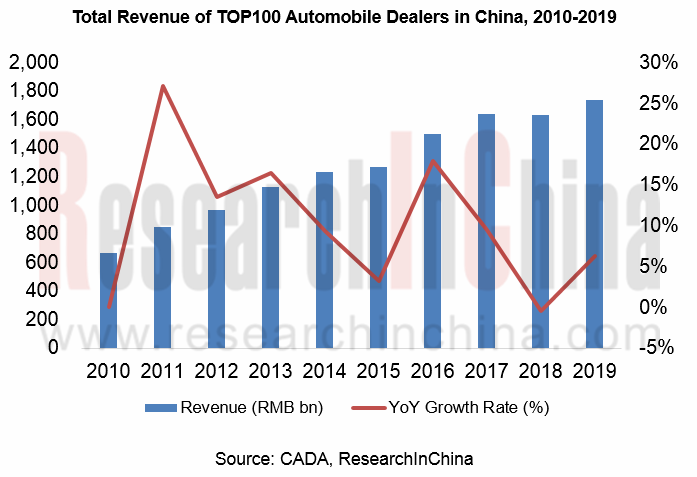
In 2019, China produced 25.72 million automobiles and sold 25.77 million units, down 7.5% and 8.2% on the previous year, up 3.3 and 5.4 percentage points, separately, according to the China Association of Automobile Manufacturers (CAAM). China’s automobile circulation industry faces unprecedented challenges as the automobile market is getting through an ever-colder winter. The automotive distribution industry however performs well as a whole. The data from the China Automobile Dealers Association (CADA) shows that in 2019, the top 100 dealers reported a combined output value of RMB1.74 trillion, up 6.3% compared with RMB1.63 trillion in 2018; their total asset investment was RMB802.4 billion, 5.7% less than in 2018 (RMB851.1 billion). In 2019, there were a total of 6,038 4S outlets in China, down 7.5% versus 2018 (6,529); total employment was 420,000 persons, a reduction of 10.6% from 470,000 in 2018.
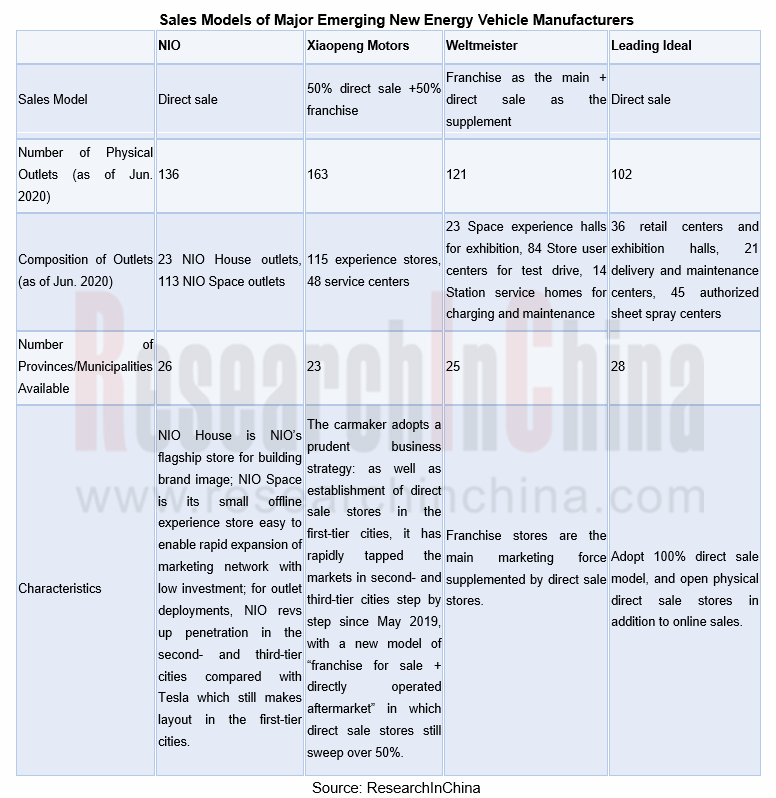
Emerging automakers adopt branding sales models and channels differing from the nationwide dealership model of conventional auto brands, changing from dealership model to direct operation of chain stores by auto brands or their cooperation with authorized dealers. The direct sale model offers totally different brand experience by providing full life cycle services for users, which serves as a solution to drawbacks of the common dealership model, such as non-transparent price and bad user service experience. Yet this model with some disadvantages like enormous investment and complicated operation process does not apply to all new energy vehicle manufacturers. 4S stores still need to shake up their service and profit structures even if they continue to employ the dealership model.
Automobile aftermarket refers to all the car-centric services needed by consumers in the period from post-sale to scrap. The growing aftermarket, especially maintenance and repair segment is accompanied by aging vehicles. That’s because the older the auto parts, the more frequent repairs they need and the more they cost. In current stage, the average vehicle in China is 5 years old, and those aged 4-10 seize over 58%. Vehicle aging, and increasing ownership are dual effective booster to prosperity of the aftermarket, making it a new industrial hotspot. The industry will usher in a boom period.
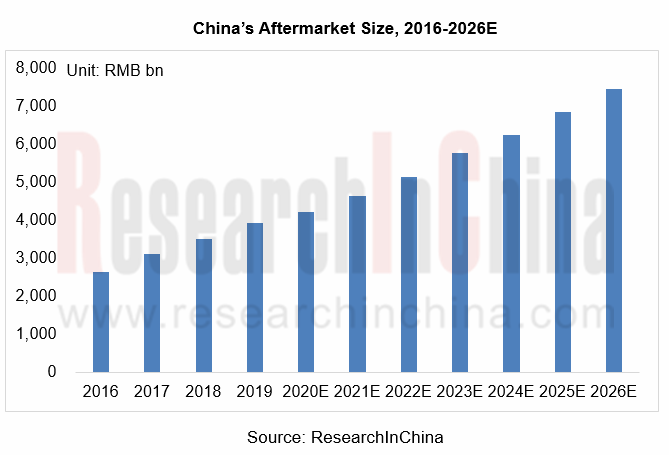
Automobile aftermarket involves maintenance and repair, auto finance, used car, rental, accessories, beauty and refit, recycling, and aftermarket alliance platform integration/car e-commerce, among which auto finance, maintenance & repair, and used car are the top three segments.
Used Cars
Factors such as household demand, profession, consumer preferences, etc. will prompt car owners to replace or resell their cars in the circulation market through used car dealers, used car e-commerce platforms and other channels. In recent years, the state and local governments will make more efforts to promote automobile consumption with favorable measures which will drive used car consumption and fuel Chinese used car market to grow with larger scale of transactions. In 2020, China saw approximately 14.34 million used cars transacted, with the estimated value of RMB888.8 billion. Although the annual transaction volume dropped by 3.9% in the entire 2020 due to the epidemic, the domestic used car transaction volume experienced consecutive growth from March to December. In the future, the used car market is expected to occupy more market share in the automotive aftermarket.
Repair and Maintenance
In the context of high ownership, aging of vehicles and changes in the maintenance concept, the auto repair and maintenance market continues to swell. The annual repair and maintenance cost increases year by year as vehicles become older, because the number of repairs and the expenses of each repair for old and worn auto parts jump each year. Learning from the experience of developed countries, China is about to see the demand for repair and maintenance hit the peak. In the past ten years, automobile sales volume has been impressive while the growth of new car sales volume has slowed down. In the future, the average vehicle age will continue to rise, which will boost the auto repair and maintenance industry into a golden age. The scale of China's auto repair and maintenance had reached approximately RMB1,332 billion as of 2019, and is expected to hit RMB2,458 billion by 2026, surpassing the auto finance market to rank first in the aftermarket. Amid the anti-monopoly, independent auto repairers are gradually eroding the market share of traditional 4S stores. With the help of the "Internet +" model, the independent repair model will develop more radically.
Auto Finance
Auto finance refers to a variety of financial products for companies, individuals, governments, automotive operators and other entities. It centers on automotive OEMs, stretching to the upstream and downstream of the industry, and eventually to end consumers. Typical auto finance products include dealer inventory financing, auto consumption loans, auto leasing and auto insurance. In recent years, the overall penetration rate of China's new car finance has ascended year by year, like 43% in 2019. According to the proportion of cars involved with financial products, the loan penetration rate is about 35% and the financial leasing penetration rate 8%, meaning loans still lead by a high margin. Compared with mature markets in Europe and America, China's auto finance market for new cars has enormous potentials. As terminal consumption upgrades and credit is widely accepted, auto finance will witness further growth. The car sales volume has fluctuated and the growth rate of the auto finance market has slowed down (about 20%) since 2017, but the momentum of auto finance is more robust than the trend of the car sales volume. In 2019, the overall scale of China's auto finance market reached approximately RMB1.58 trillion, of which licensed auto finance companies accounted for approximately 50%.
China Automotive Distribution and Aftermarket Industry Report, 2020-2026 sheds light on the followings:
 Introduction to the automotive distribution industry and aftermarket, including definition, classification, industrial chain, business models, etc.;
Global and Chinese automotive distribution market scale and forecast, including total automobile sales volume, dealer networks, dealers’ automobile sales volume, competitive landscape, new energy vehicle sales models, etc.;
Automotive aftermarket segments, including market size and forecast, competitive landscape, industry trends, etc. of auto finance, used cars, repair & maintenance, beauty, etc.;
Profile, business analysis, brand agency, business networks and marketing of major auto dealers in China.
Automotive EMS and ECU Industry Research Report, 2026
Automotive EMS Research: The boundaries between EMS providers and Tier1 suppliers are becoming blurred, and the supply chain model is evolving from a linear chain to a networked structure
Mainstream ...
Automotive Microcontroller Unit (MCU) and Application Scenario Research Report, 2026
Automotive MCU Research: Increased demand for redundant security drives ASIL D-compliant MCU shipments to exceed 100 million units
In a vehicle EEA, MCUs are widely distributed in various functional ...
China Intelligent Cockpit Patent Analysis Report, 2026
Intelligent Cockpit Patent Research: Cockpit AI, In?vehicle Health, and Infotainment Are Upgrade to Scenario?based and Proactive Functions
From a patent perspective, this report explores the cutting?...
Research Report on Application of VLA Large Model in Automobiles and Robots, 2026
Research on Automotive and Robot VLA: Hybrid Architectures Become Mainstream, VLA Integrates with General World Models, and Reinforcement Learning Serves as Core Engine
Vision?Language?Action (VLA) m...
China Charging Infrastructure (Supercharging, Battery Swapping, V2G, etc.) and High-Performance Supercharging Battery Research Report, 2026
Charging and battery swapping research: as 5C+ supercharging vehicle models go into mass production, the pace of OEMs self-building supercharging networks quickens
800-1000V high-voltage platforms ar...
China Passenger Car Electronic Controlled Suspension Industry Report, 2026
Electronic Controlled Suspension Industry Research: As the First Year of Full Active Suspension Unfolds, Three Technical Routes Race Forward
1. Penetration Rate Surges Three Times, and Electronic Con...
Intelligent Driving SoC Research Report, 2026
Research on Intelligent Driving SoCs: Competition Focus Shifts to L3/L4 Embedded Hardware, and Computing Power of Flagship Vehicle Models Exceeds 1,000 TOPS
In terms of intelligent driving system in...
Automotive AI Large Model Technology Research Report, 2026
Automotive AI Large Model Research: Competition Shifts from "Who Has the Stronger Model" to "Who Boasts Higher Link Efficiency"
ResearchInChina released the Automotive AI Large Model Technology Resea...
Intelligent Vehicle Cockpit Domain Controller Research Report, 2026
Cockpit domain controller research: L3 AIDV intelligent cockpit domain controllers are entering a boom period
Driven by multiple factors such as the continuous evolution of the automotive central int...
Automotive Acoustic System (Audio, Multi-Channel) Industry Report, 2026
Automotive Acoustics Research: Multiple Channels, AI Tuning, and Self-Developed Algorithms Drive the Transformation of High-End Cockpit Sound Fields
I. Automotive Audio Hardware Solutions with 6–9 S...
Autonomous Driving Sensor Chip Research Report, 2026
Research on Autonomous Driving Sensor Chips: Deeply Perceiving the Physical World, Sensor Chips Are Playing A “Leading Role” in Intelligence
In 2026, the autonomous driving sensor chip industr...
Passenger Car Corner Module and Wheel‑Side Control System Research Report, 2026
Wheel-side control research: the “last mile” chassis innovation
Wheel-side control dismantles the traditional drive, braking, steering, and suspension control of the chassis from a "centralized" styl...
Embodied Artificial Intelligence (& Humanoid Robot) MCU Research Report, 2026
Research on Humanoid Robot MCUs: Evolution from General-Purpose Control to High-Value Dedicated Chip Solutions Integrated with Edge AI Functions
MCU (Microcontroller Unit) refers to a compact integra...
Intelligent Vehicle Zone Control Unit (ZCU) Research Report, 2026
ZCU Research: Cross-domain integrated ZCUs are becoming the edge computing nodes of the next-generation zonal architecture
Currently, the mainstream zonal architecture is mainly the quasi-central + z...
Automotive Cybersecurity and Data Security Research Report, 2026
Cybersecurity & Data Security Research: Intelligent Connected Vehicles Enter the Era of “Systematic Offense-Defense and AI-Defined Security”.
Centering on the panorama of intelligent connect...
Report on Breakthrough Strategies of OEMs and ADAS Tier 1 Suppliers for Overseas Layout of Intelligent Driving, 2026
Regulatory Breakthrough, Local System Establishment, OEMs Competing for NOA Layout: Overall Trends of China’s Intelligent Driving Overseas Layout in 2026
Research on overseas intelligent driving layo...
OEMs and Tier1s’ Intelligent Cockpit Platform (Hardware and Software) Innovation Strategy Research Report, 2026
Intelligent Cockpit Platform Research: multi-dimensional cockpit system architecture reconstruction for multi-agent collaboration and proactive intelligent services
The intelligent cockpit software s...
Automotive AIOS Research Report, 2026
Automotive AIOS Research: Mass Production Solutions Are Implemented
Mass Production Solutions Are Implemented on A Small Scale.
In 2026, AIOS starts small-scale implementation, helping to improve v...