Research Report on Telematics Service Providers (TSP) and Their Products, 2021
Small and medium TSPs will fade away and TSP giants will come to the front
As “smart car as a service” grows, automakers focus more on introduction of technologies or platforms from big data and cloud computing to security, content platform and artificial intelligence, providing more intelligent, more diversified content and value-added services, while making an expansion in OEM market. As the gateway for vehicle traffic flow, telematics service providers (TSP) are catering to the industrial change by constantly extending services content and boundaries, across fields from initial remote service to phone mirroring and connectivity, then to connected IVI system, finally to integrated telematics system covering people, vehicle and life.
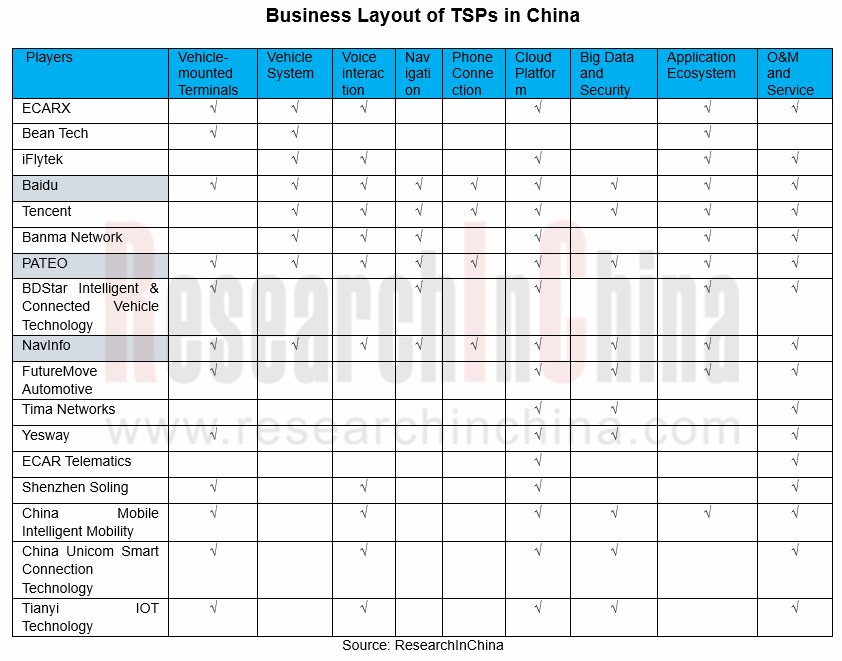
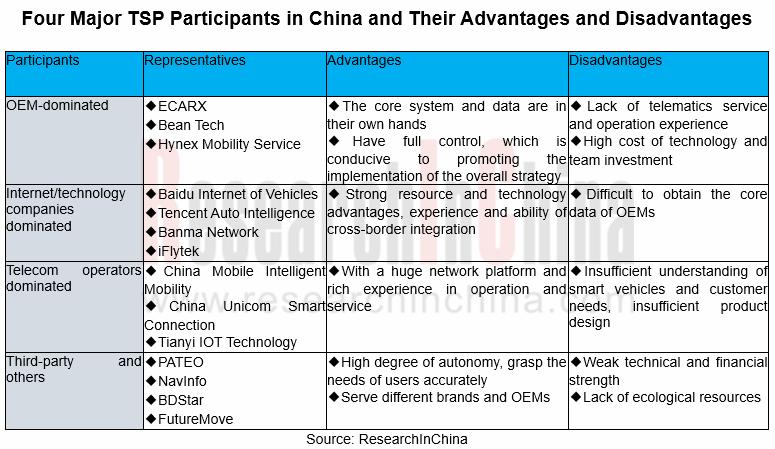
There are four typical types of TSPs: OEMs, telecom operators, internet/technology companies, and third-party platform providers. These players have built a mode of multi-party cooperation. For example, OEMs push for their partnerships with BATH, Pateo and more in their efforts to improve their ability to develop telematics and provide services, and work together with telecom operators to explore 5G + telematics application scenarios and application ecosystem. In the long run, the four major participants will integrate with each other across fields for win-win cooperation.
In future, China’s TSP industry will head in the following directions:
1. The closer connection of a vehicle with people, other vehicles, smart home appliances, living services and smart city comes with TSPs’ greater attempts to extend their services and open up their technology and ecosystem for a gradual coverage of all scenarios of mobile phone, car, home and city.
For example, based on extended BATH ecosystem (Baidu, Huawei, Tencent, Suning, Ping An, UnionPay, China Telecom, etc.) and third-party ecosystem, Pateo has made deployments in mobile phone, car, home and city scenarios, and will add “five new operations”, i.e., New Mobility, New Finance, New Retail, New Insurance and New Marketing. Now it has carried out its landing of new car retail strategy together with New Baojun and Sunning Car.
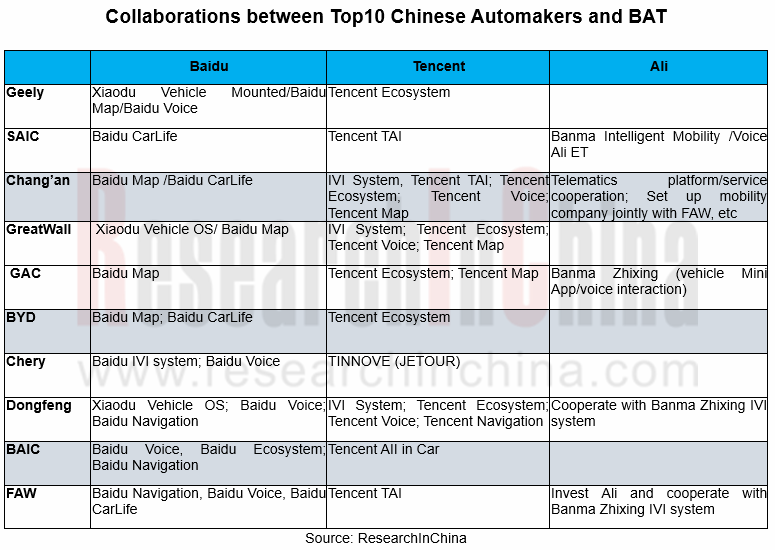
2. As cross-field integration becomes normal, players will achieve complementary advantages, resource sharing, and ecological integration to build a large ecosystem ultimately.
Examples include Baidu, Alibaba and Tencent (BAT) which are establishing closer partnerships with OEMs in more areas. Among them, in late 2020 Alibaba joined hands with SAIC again to set up IM Motors in charge of developing smart electric vehicles, following their establishment of Banma Network Technology (which finished strategic restructuring with AliOS in May 2020, aiming at improving automotive operating system and AI technology and upgrading the cloud-network-edge-terminal open system); based on their in-depth cooperation on intelligent connectivity, cloud technology and Baidu Ecosystem, Baidu and Geely announced they would co-found an intelligent vehicle company in January 2021, with Jidu Auto coming into being on March 2.
3. OEMs-lead TSPs to provide better IVI system-centric services.
Currently, OEMs have found common ground on intelligent connectivity and digital transformation acceleration. To hold core technology and data, Geely, Great Wall Motor and Honda China have founded their telematics company independently or together with others, with IVI system at the core of their multi-directional deployments:
ECARX: by the end of 2020, GKUI ECARX designed for Geely has been found in more than 40 models under Geely, Lynk & Co, Proton and served a total of over 2.3 million users.
On this basis, ECARX built in-depth cooperation with Baidu, with GKUI19-enabled Boyue PRO access to Baidu Map and Baidu Scenario for recommendation in 2020;
In November 2020, Baidu Map vehicle version became first available to Geely Preface upgrade edition.
In October 2020, ECARX raised RMB1.3 billion in a Series A funding round led by Baidu, which will be spent developing its automotive chip business.
In February 2021, ECARX joined hands with Visteon and Qualcomm to jointly provide intelligent cockpit solutions for the global market; in the same month, ECARX was invested USD200 million in its A+ funding round, which will be used for building an international R&D system and further expanding its global operation.
Bean Tech: Haval Fun-Life 2.0 system co-developed by Bean Tech and Haval integrates with Tencent TAI 3.0 features, and has been installed in several models like Haval Big Dog, Haval F7, Gen 3 H6, and WEY Tank 300. In future, Bean Tech will partner more closely with Haval and Tencent to promote its cloud services (supplied by Tencent Cloud Platform) in Great Wall Motor’s overseas markets and provide full-stack intelligent marketing closed loop services from user profiling and SCRM to advertising and user operation.
4. TSPs face intensified competition and a new reshuffle amid telematics industry change, with four or five giants expected to be born by 2025
Currently, most conventional TSPs have been acquired and integrated into other business by tycoons. A handful of TSPs can run independently. Even Baidu, Alibaba, Tencent and Huawei (BATH) are able to deploy just one of dozens of intelligent connected vehicle product lines each. As OEMs regain dominance in software development, TSPs will contend more fiercely and face a new reshuffle. It is predicted that by 2025, four or five bellwethers that have ability to develop full-stack telematics systems and link vehicles with V2X equipment facilities, earphones, watches, bracelets and various IOT (Internet of Things) device will come out. Small and medium TSPs will be edged out by TSP giants.
Autonomous Driving Domain Controller and Central Computing Unit (CCU) Industry Report, 2026
Autonomous Driving Domain Controller (ADCU) Research: One-Chip CCU solutions are quickly available in vehicles
In China's passenger car market, autonomous driving systems involved in mass production ...
Automotive EMS and ECU Industry Research Report, 2026
Automotive EMS Research: The boundaries between EMS providers and Tier1 suppliers are becoming blurred, and the supply chain model is evolving from a linear chain to a networked structure
Mainstream ...
Automotive Microcontroller Unit (MCU) and Application Scenario Research Report, 2026
Automotive MCU Research: Increased demand for redundant security drives ASIL D-compliant MCU shipments to exceed 100 million units
In a vehicle EEA, MCUs are widely distributed in various functional ...
China Intelligent Cockpit Patent Analysis Report, 2026
Intelligent Cockpit Patent Research: Cockpit AI, In?vehicle Health, and Infotainment Are Upgrade to Scenario?based and Proactive Functions
From a patent perspective, this report explores the cutting?...
Research Report on Application of VLA Large Model in Automobiles and Robots, 2026
Research on Automotive and Robot VLA: Hybrid Architectures Become Mainstream, VLA Integrates with General World Models, and Reinforcement Learning Serves as Core Engine
Vision?Language?Action (VLA) m...
China Charging Infrastructure (Supercharging, Battery Swapping, V2G, etc.) and High-Performance Supercharging Battery Research Report, 2026
Charging and battery swapping research: as 5C+ supercharging vehicle models go into mass production, the pace of OEMs self-building supercharging networks quickens
800-1000V high-voltage platforms ar...
China Passenger Car Electronic Controlled Suspension Industry Report, 2026
Electronic Controlled Suspension Industry Research: As the First Year of Full Active Suspension Unfolds, Three Technical Routes Race Forward
1. Penetration Rate Surges Three Times, and Electronic Con...
Intelligent Driving SoC Research Report, 2026
Research on Intelligent Driving SoCs: Competition Focus Shifts to L3/L4 Embedded Hardware, and Computing Power of Flagship Vehicle Models Exceeds 1,000 TOPS
In terms of intelligent driving system in...
Automotive AI Large Model Technology Research Report, 2026
Automotive AI Large Model Research: Competition Shifts from "Who Has the Stronger Model" to "Who Boasts Higher Link Efficiency"
ResearchInChina released the Automotive AI Large Model Technology Resea...
Intelligent Vehicle Cockpit Domain Controller Research Report, 2026
Cockpit domain controller research: L3 AIDV intelligent cockpit domain controllers are entering a boom period
Driven by multiple factors such as the continuous evolution of the automotive central int...
Automotive Acoustic System (Audio, Multi-Channel) Industry Report, 2026
Automotive Acoustics Research: Multiple Channels, AI Tuning, and Self-Developed Algorithms Drive the Transformation of High-End Cockpit Sound Fields
I. Automotive Audio Hardware Solutions with 6–9 S...
Autonomous Driving Sensor Chip Research Report, 2026
Research on Autonomous Driving Sensor Chips: Deeply Perceiving the Physical World, Sensor Chips Are Playing A “Leading Role” in Intelligence
In 2026, the autonomous driving sensor chip industr...
Passenger Car Corner Module and Wheel‑Side Control System Research Report, 2026
Wheel-side control research: the “last mile” chassis innovation
Wheel-side control dismantles the traditional drive, braking, steering, and suspension control of the chassis from a "centralized" styl...
Embodied Artificial Intelligence (& Humanoid Robot) MCU Research Report, 2026
Research on Humanoid Robot MCUs: Evolution from General-Purpose Control to High-Value Dedicated Chip Solutions Integrated with Edge AI Functions
MCU (Microcontroller Unit) refers to a compact integra...
Intelligent Vehicle Zone Control Unit (ZCU) Research Report, 2026
ZCU Research: Cross-domain integrated ZCUs are becoming the edge computing nodes of the next-generation zonal architecture
Currently, the mainstream zonal architecture is mainly the quasi-central + z...
Automotive Cybersecurity and Data Security Research Report, 2026
Cybersecurity & Data Security Research: Intelligent Connected Vehicles Enter the Era of “Systematic Offense-Defense and AI-Defined Security”.
Centering on the panorama of intelligent connect...
Report on Breakthrough Strategies of OEMs and ADAS Tier 1 Suppliers for Overseas Layout of Intelligent Driving, 2026
Regulatory Breakthrough, Local System Establishment, OEMs Competing for NOA Layout: Overall Trends of China’s Intelligent Driving Overseas Layout in 2026
Research on overseas intelligent driving layo...
OEMs and Tier1s’ Intelligent Cockpit Platform (Hardware and Software) Innovation Strategy Research Report, 2026
Intelligent Cockpit Platform Research: multi-dimensional cockpit system architecture reconstruction for multi-agent collaboration and proactive intelligent services
The intelligent cockpit software s...