Automotive wiring harness is often split into two types: main wiring harness and small wiring harness. As new energy vehicles emerge, automotive wiring harness is also divided into low-voltage and high-voltage types. Conventional fuel-powered vehicles use low-voltage harness while new energy vehicles employ the high-voltage harness.
The boom of new energy vehicles will fuel the demand for high-voltage wiring harness. On our estimate, the global new energy vehicle high-voltage wiring harness market was valued at RMB4.69 billion in 2020, 41.4% more than in the previous year, sharing roughly 3% of the entire automotive wiring harness market. In future, the new energy vehicles promoted by governments and automakers will see a rising sales share, which in turn will give a big boost to the high-voltage wiring harness market in the years to come.
Globally, there are four echelons of automotive wiring harness companies: the first-echelon players are Yazaki and Sumitomo Electric Industries; Aptiv, Leoni and Lear are typical second-echelon players; the third-echelon players are led by Draexlmaier, Kromberg & Schubert, Furukawa Electric, Yuratech, Kyungshin and Fujikura; players in the fourth echelon are a number of other small wiring harness firms.
In current stage, the global automotive wiring harness market is almost carved up by the first three echelons which have built stable supply relationships with automakers. Furthermore, international wiring harness manufacturers deploy the promising Chinese market by way of acquiring or establishing wholly-owned companies or joint ventures with local companies, hoping to support co-funded auto plants and homegrown automakers.
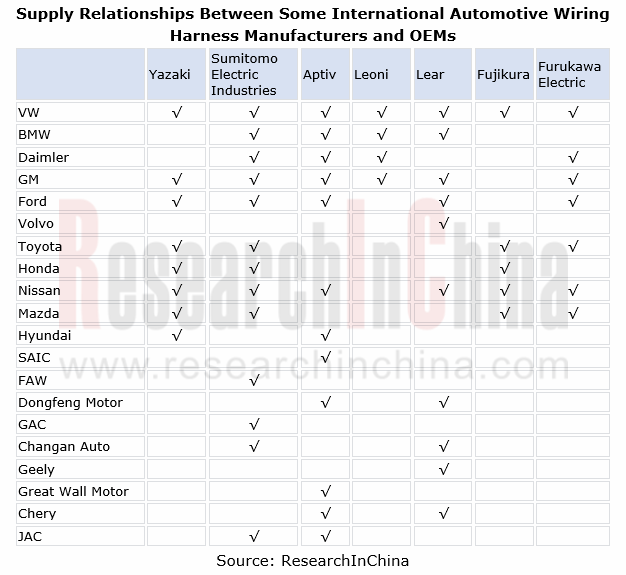
Local companies edge into the supply chains of international automakers.
In China, typical automotive wiring harness companies include Kunshan Huguang Auto Harness Co., Ltd., THB Group, Shenzhen Deren Electronics Co., Ltd., Shanghai Jinting Automobile Harness Co., Ltd. (Jiangsu Etern Co., Ltd.), Mind Electronic Appliances Co., Ltd., Luxshare Precision Industry Co., Ltd., Shenzhen Qiaoyun Electronics Co., Ltd., Jiangsu Huakai Wire Harness Co., Ltd. and Keboda Technology Co., Ltd.
As more homemade auto parts tend to be purchased, some domestic harness companies with years of technical expertise and synchronous development experience have gained far more strength and edged into the supply chains of world-renowned automakers by virtue of timely and effective services and reliable products. Examples include THB Group, Kunshan Huguang Auto Harness Co., Ltd., Shanghai Jinting Automobile Harness Co., Ltd., Shenzhen Deren Electronics Co., Ltd. and Keboda Technology Co., Ltd.
The more functions are added in vehicles, the more wiring harnesses are demanded, which directly causes a surge in length and weight of wiring harnesses and further much heavier automobiles, and makes it too much harder to deploy wires. Optimizing wiring harnesses from quality to wiring is a must for meeting the soaring demand. We argue that automotive wiring harness will head in the following directions:
Trend 1: lightweight
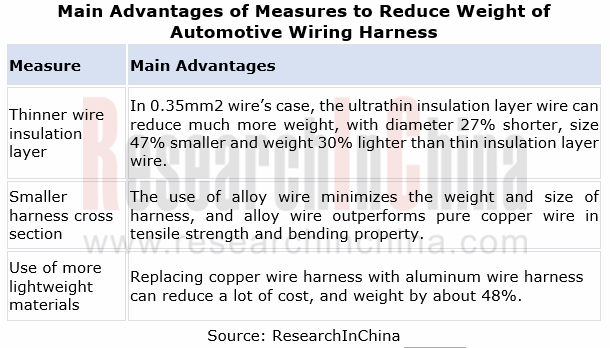
Automotive wiring harness is a key component that makes up around 5% of vehicle curb weight. As vehicles become lighter, lightweight automotive wiring harness already holds the trend. Currently, there are mainly three ways to reduce the weight of automotive wiring harness: thinner wire insulation layer; improved process for smaller harness cross section; use of more lightweight materials.
Trend 2: E/E architecture design optimization
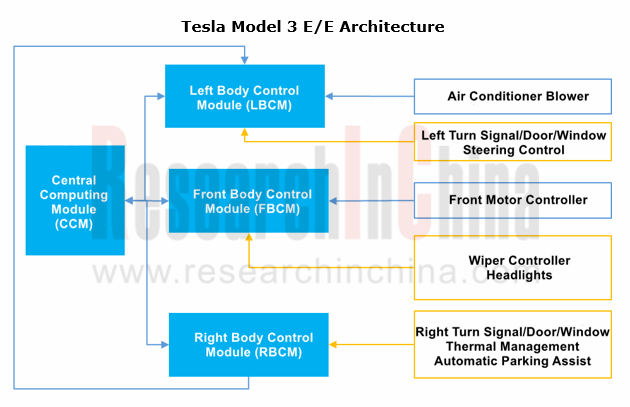
Lightweight automotive wiring harness can reduce weight, but fundamentally less use of harness will pay off more in optimizing harness. The adoption of new E/E architecture is a key to improving automotive wiring harness. A new architecture can lessen wires used for various vehicle functions through simplifying wiring design, also reduce weight to favor automated production and lower cost.
Take Tesla as an example. Its application of new E/E architecture leads to a sharp cut in harness length from 3km of Model S to 1.9km of Model 3. In addition, its patented technology released in 2019 upgrades the wiring layout where harness can be as short as 100m. Yet current Model Y falls short of the goal. In future, the mass adoption of flexible circuit boards to replace current wires may achieve the length cut goal.
Also, Aptiv announced its smart vehicle architecture (SVA) that allows for the integration of multiple ECUs into a small domain control unit. The architecture can thus save multiple microcontrollers, multiple power supply devices, and multiple housings and copper wiring harnesses but still maintain or even improve the vehicle computing power, which contributes to a 20% reduction in both harness weight, and the weight and size of computing-related hardware.
Trend 3: production process automation
Wiring harness is a typical labor-intensive industry where 95% harnesses are handmade products and productivity is low, because automotive wiring layout is complex. Labor cost therefore has been a critical constraint on capacity expansion and scale effect. At present, most automotive wiring harness manufacturers still rest on advanced equipment to automate just some production links. Intelligent manufacturing has not yet become widespread.
As automotive wiring harness tends to be integrated and production technology advances, intelligent manufacturing will have the potential to penetrate the whole process of automotive wiring harness from design, production, warehousing and logistics to management and service. Automotive wiring harness players such as Aptiv, Lear and Kunshan Huguang Auto Harness all are promoting the automated production process.
Trend 4: apply wireless communication to reduce the use of wiring harnesses
The application of wireless communication will reduce the use of wiring harnesses.
A patent Yazaki obtained in 2018 involves an extended system’s electronic device and ECU that are configured to send and receive signals with each other via wireless communication. This avoids the necessary addition of communication circuits to the extended system, simplifying wiring layout and lessening harnesses.
Vehicle-Road-Cloud Integration and C-V2X Industry Report, 2026
Vehicle-Road-Cloud and C-V2X Research: with the three-tier promotion system of "top-level planning + mandatory pilot + evaluation binding", the industry turning point is approachingThis report focuses...
China OEM Data Capability Analysis Report, 2026
OEM Data Capability Research: 24 OEMs × 9 Capability Domains, Who Takes the Lead?
An L4 autonomous driving R&D and test vehicle can generate approximately 10TB of raw data per single day — data v...
Autonomous Driving Domain Controller and Central Computing Unit (CCU) Industry Report, 2026
Autonomous Driving Domain Controller (ADCU) Research: One-Chip CCU solutions are quickly available in vehicles
In China's passenger car market, autonomous driving systems involved in mass production ...
Automotive EMS and ECU Industry Research Report, 2026
Automotive EMS Research: The boundaries between EMS providers and Tier1 suppliers are becoming blurred, and the supply chain model is evolving from a linear chain to a networked structure
Mainstream ...
Automotive Microcontroller Unit (MCU) and Application Scenario Research Report, 2026
Automotive MCU Research: Increased demand for redundant security drives ASIL D-compliant MCU shipments to exceed 100 million units
In a vehicle EEA, MCUs are widely distributed in various functional ...
China Intelligent Cockpit Patent Analysis Report, 2026
Intelligent Cockpit Patent Research: Cockpit AI, In?vehicle Health, and Infotainment Are Upgrade to Scenario?based and Proactive Functions
From a patent perspective, this report explores the cutting?...
Research Report on Application of VLA Large Model in Automobiles and Robots, 2026
Research on Automotive and Robot VLA: Hybrid Architectures Become Mainstream, VLA Integrates with General World Models, and Reinforcement Learning Serves as Core Engine
Vision?Language?Action (VLA) m...
China Charging Infrastructure (Supercharging, Battery Swapping, V2G, etc.) and High-Performance Supercharging Battery Research Report, 2026
Charging and battery swapping research: as 5C+ supercharging vehicle models go into mass production, the pace of OEMs self-building supercharging networks quickens
800-1000V high-voltage platforms ar...
China Passenger Car Electronic Controlled Suspension Industry Report, 2026
Electronic Controlled Suspension Industry Research: As the First Year of Full Active Suspension Unfolds, Three Technical Routes Race Forward
1. Penetration Rate Surges Three Times, and Electronic Con...
Intelligent Driving SoC Research Report, 2026
Research on Intelligent Driving SoCs: Competition Focus Shifts to L3/L4 Embedded Hardware, and Computing Power of Flagship Vehicle Models Exceeds 1,000 TOPS
In terms of intelligent driving system in...
Automotive AI Large Model Technology Research Report, 2026
Automotive AI Large Model Research: Competition Shifts from "Who Has the Stronger Model" to "Who Boasts Higher Link Efficiency"
ResearchInChina released the Automotive AI Large Model Technology Resea...
Intelligent Vehicle Cockpit Domain Controller Research Report, 2026
Cockpit domain controller research: L3 AIDV intelligent cockpit domain controllers are entering a boom period
Driven by multiple factors such as the continuous evolution of the automotive central int...
Automotive Acoustic System (Audio, Multi-Channel) Industry Report, 2026
Automotive Acoustics Research: Multiple Channels, AI Tuning, and Self-Developed Algorithms Drive the Transformation of High-End Cockpit Sound Fields
I. Automotive Audio Hardware Solutions with 6–9 S...
Autonomous Driving Sensor Chip Research Report, 2026
Research on Autonomous Driving Sensor Chips: Deeply Perceiving the Physical World, Sensor Chips Are Playing A “Leading Role” in Intelligence
In 2026, the autonomous driving sensor chip industr...
Passenger Car Corner Module and Wheel‑Side Control System Research Report, 2026
Wheel-side control research: the “last mile” chassis innovation
Wheel-side control dismantles the traditional drive, braking, steering, and suspension control of the chassis from a "centralized" styl...
Embodied Artificial Intelligence (& Humanoid Robot) MCU Research Report, 2026
Research on Humanoid Robot MCUs: Evolution from General-Purpose Control to High-Value Dedicated Chip Solutions Integrated with Edge AI Functions
MCU (Microcontroller Unit) refers to a compact integra...
Intelligent Vehicle Zone Control Unit (ZCU) Research Report, 2026
ZCU Research: Cross-domain integrated ZCUs are becoming the edge computing nodes of the next-generation zonal architecture
Currently, the mainstream zonal architecture is mainly the quasi-central + z...
Automotive Cybersecurity and Data Security Research Report, 2026
Cybersecurity & Data Security Research: Intelligent Connected Vehicles Enter the Era of “Systematic Offense-Defense and AI-Defined Security”.
Centering on the panorama of intelligent connect...