The surging global freight shipping rates will rev up the deployment of automated driving in ports.
The global freight shipping rates have enjoyed a marked increase since June 2020, for example, from USD1,358 per FEU on March 5, 2021 to USD4,115 per FEU on March 6, 2021. The frequent shipping crises in 2021 have forced many exporters to sign freight contracts for the next 12 months at high prices.
A combination of factors including soaring demand for goods boosted by global fiscal and monetary stimulus, saturated ports, and shortage of ship and dock workers and truck drivers trigger the increase in shipping costs. Port operators are keen on higher operation efficiency and solutions to labor shortage.
Globally, foreign countries made an early start on straddle carrier and AGV, having won a place in the market. Yet it is hard for them to accelerate port container turnover and lower operating cost in a short time, due to rising international shipping costs, too long time taken to deploy AGVs, and larger space needed for autonomous straddle carriers. While, autonomous container trucks cost less than other solutions, its rapid deployment only requires introduction of intelligent roadside facilities to existing smart terminals. It is predicted that large container ports worldwide will work to deploy autonomous container trucks from 2021 onwards.
As a key importer and exporter in the world, China is trying hard to promote autonomous driving that enables port logistics and enhance the construction of new-generation automated terminals and the mass adoption of autonomous container trucks. By 2025, some coastal container hub ports should preliminarily build intelligent systems that enable comprehensive perception, internet of everything, and port-truck cooperation; by 2035, container hub ports should complete the construction of intelligent systems, according to the Guideline to Accelerate the Building of World-class Ports issued by the Ministry of Transport of China. Faster progress in construction of “new infrastructure” in ports comes with the boom of 5G, CVIS and autonomous driving technologies.
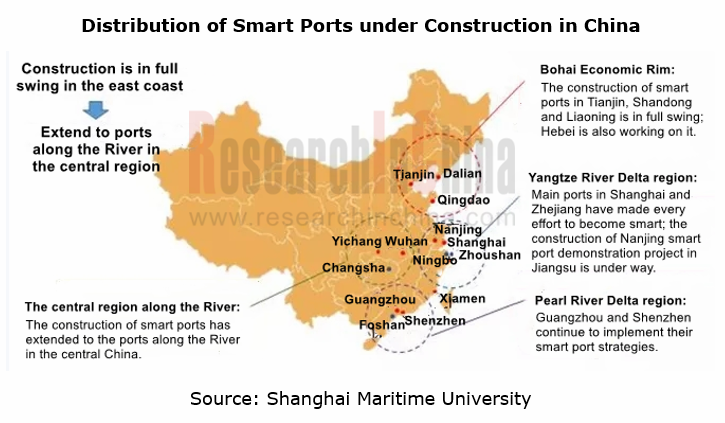
Autonomous logistics covers the whole process from port shipping hubs to trunk highways.
Port automated driving is a typical closed scenario of low speed operation and a representative scenario that is the first one to allow for commercial use of autonomous driving. In current stage, China boasts the ownership of more than 25,000 container trailers, but most port terminals still depend on manned container trucks, with the penetration of autonomous ones lower than 2%.
It is expected that in 2025, 6,000 to 7,000 L4 autonomous container trucks will come into service in Chinese ports, with their penetration over 20%; China’s port automated driving market will be worth more than RMB6 billion in 2025, holding roughly 30% of the global market.
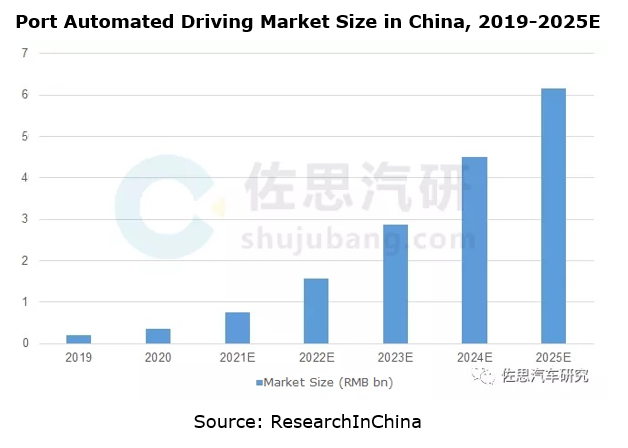
Despite not a big market, port automated driving creates a demonstration effect and many derivatives, such as autonomous logistics scenario covering the whole process from shipping to port and then to trunk highway and logistics hub.
At first, port autonomous container trucks take priority to acquire the rights of transporting containers from ships to container yards to distributing centers. On one estimate, China’s trunk logistics market valued at RMB5 trillion or so (approximately USD700 billion) attracts autonomous driving investors. In 2020, half the autonomous driving funding cases in China targeted start-ups making deployments in commercial vehicles. Among the 19 investees, 8 that deploy trunk logistics scenarios averagely raised more funds than those focusing on other segments.
On April 15, 2021, TuSimple listed its shares on Nasdaq, with the first-day closing price at USD40 a share sending its market capitalization to USD8.48 billion. TuSimple concentrates on L4 automated driving for such logistics scenarios as highways, ports and sites. In March 2021, TuSimple became qualified for intelligent connected vehicle demonstration application in Shanghai, which allows it to carry out load tests on designated test roads in the downtown, Lingang Logistics Park, East Sea Bridge and Yangshan Port within the Lin-gang Special Area of China (Shanghai) Pilot Free Trade Zone.
Port logistics has been a critical application scenario of autonomous vehicles. That is mainly because:
First, port automated driving can be deployed in the shortest time, pays off and offers a clear business model. It is expected the commercial use of port automated driving will be widespread in the next two or three years. Actual operation of automated driving that needs heavy investment and has a long payback period, allows for testing technologies in ports and also brings benefits, making the commercial operation a reality in a short term.
Second, it takes just one or two years to extend the commercial use of automated driving from ports to trunk logistics, because the two scenarios share hardware devices of commercial vehicles like chassis and use the common engineering approaches, and the large-scale commercial operations in ports will accumulate and iterate capabilities of algorithm, engineering, operation and commercialization rapidly, preparing for future extension to external container trucks and trunk logistics.
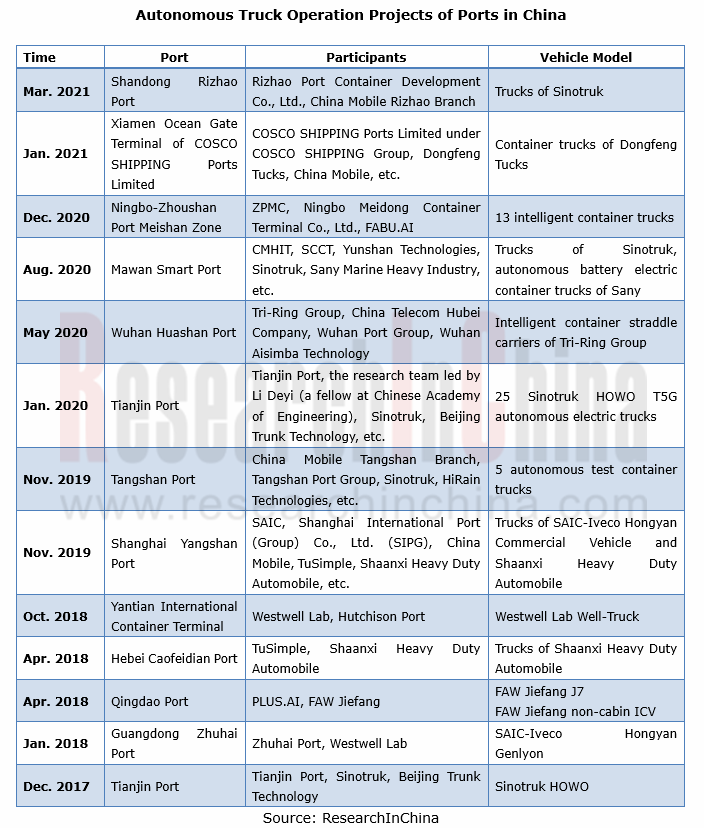
China already has 13 ports introducing autonomous container trucks.
Since 2018, China has speeded up construction of autonomous ports. Quite a few autonomous driving solution providers have phased in application to autonomous trucks for commercial trial use. At present, there are 13 ports applying autonomous container trucks, including Shanghai Yangshan Port, Tianjin Port, Mawan Port, Ningbo Zhoushan Port, Zhuhai Port and Xiamen Port, which forms a “north-central-south” coastal deployment pattern.
China: port automated driving is often found in the southeast coastal ports, especially in new or expanded coastal port projects like Shenzhen Mawan Smart Port, Shanghai Yangshan Port, Ningbo Zhoushan Port and Tianjin Port, while hardly seen in inland ports and river terminals due to more bulk cargos and less containers there.
Overseas: Chinese companies are making an aggressive expansion in overseas markets. In 2020, Shanghai Zhenhua Heavy Industries (ZPMC) and Westwell Lab began to operate Westwell Lab Q-Truck at Khalifa Port Container Terminal Phase II in Abu Dhabi, UAE; in April 2020, Westwell Lab’s 6 Q-Truck trucks went into operation in Laem Chabang, Thailand and completed 12-hour continuous loading and unloading operation.
In the scenario of horizontal transportation at port container terminals, autonomous driving solutions that enable single vehicles are not enough to meet the current actual needs of smart terminals. Fleet-level scheduling systems are thus needed to bridge the gap between the original production operation system and single vehicles to let the two systems work together smoothly for higher overall efficiency.
Development Trends of Port Automated Driving
5G-based network communication (5G Port Private Network+MEC+V2X): “port automated driving” requires low latency, large bandwidth, high reliability communication connections; communication systems for large special operation equipment for automated terminals need to afford efficient and reliable transmission of control, multi-channel video and other information. 5G V2X is a new engine for the construction of “smart ports”.
In September 2020, Beijing Trunk Technology Co., Ltd.’s autonomous container trucks packed 5G V2X technology, a solution to ultra-long truck queues in port logistics hubs. 5G V2X enables autonomous container trucks to perceive more widely for better interconnection with other production equipment and systems in port areas. Moreover, based on low-latency, high-bandwidth 5G networks, the cloud computing and remote monitoring services enable real-time system optimization, intelligent scheduling control and remote driving.
Electrified/hydrogen fuel-powered: transport vehicles in autonomous ports feature electric drive, quicker response, direct power supply to the autonomous driving system, and higher efficiency than fuel-powered vehicles. Electric vehicles for autonomous ports hold the trend. Among current autonomous container trucks operated in ports, 8 models, or 61.5% of the total are electric drive.
SAIC-Iveco Hongyan Commercial Vehicle Co., Ltd. has introduced intelligent hydrogen fuel cell heavy trucks, giving full support to construction of green ports and green transportation systems. In April 2020, Shenzhen Center Power Tech. Co., Ltd. made a strategic investment in Westwell Lab, aiming at co-developing port hydrogen-powered autonomous vehicles and building a port AI + hydrogen energy ecosystem in an age of 5G+AIoT.
Top-level design: through the lens of digitalization in the whole industry, port scenario lags behind others in such as digital concept and new technology application. Greater effort should be made on new digital technology development and top-level design, and data flow + business flow development plan on the basis of other technologies. Top-level design brings a shake-up to existing port information and intelligent construction resources.
In January, 2021, Beijing Trunk Technology Co., Ltd. and Huawei signed a cooperative agreement in Tianjin Port. With its 5G technology, Huawei provides “Car Cloud”-“Roadside”-“Car End” port intelligent driving solutions. In August 2020, Alibaba Cloud won the bidding of Shandong Port Group (China’s first smart port owning 4 port companies: Qingdao Port, Rizhao Port, Yantai Port and Bohai Bay Port) for top-level design schemes.
Platooning/CVIS: in the closed port environment with multiple scenarios, autonomous container trucks need to communicate with other container trucks, other types of vehicles, port equipment and containers. Fleet operation and CVIS is a trend for port automated driving.
In November 2020, the platooning of 13 autonomous container trucks independently developed and delivered by Beijing Trunk Technology Co., Ltd. was carried out in Ningbo Zhoushan Port. This is another delivered mass-production project of the company following the commercial order for 25 autonomous container trucks from Tianjin Port.
Intelligent Driving SoC Research Report, 2026
Research on Intelligent Driving SoCs: Competition Focus Shifts to L3/L4 Embedded Hardware, and Computing Power of Flagship Vehicle Models Exceeds 1,000 TOPS
In terms of intelligent driving system in...
Automotive AI Large Model Technology Research Report, 2026
Automotive AI Large Model Research: Competition Shifts from "Who Has the Stronger Model" to "Who Boasts Higher Link Efficiency"
ResearchInChina released the Automotive AI Large Model Technology Resea...
Intelligent Vehicle Cockpit Domain Controller Research Report, 2026
Cockpit domain controller research: L3 AIDV intelligent cockpit domain controllers are entering a boom period
Driven by multiple factors such as the continuous evolution of the automotive central int...
Automotive Acoustic System (Audio, Multi-Channel) Industry Report, 2026
Automotive Acoustics Research: Multiple Channels, AI Tuning, and Self-Developed Algorithms Drive the Transformation of High-End Cockpit Sound Fields
I. Automotive Audio Hardware Solutions with 6–9 S...
Autonomous Driving Sensor Chip Research Report, 2026
Research on Autonomous Driving Sensor Chips: Deeply Perceiving the Physical World, Sensor Chips Are Playing A “Leading Role” in Intelligence
In 2026, the autonomous driving sensor chip industr...
Passenger Car Corner Module and Wheel‑Side Control System Research Report, 2026
Wheel-side control research: the “last mile” chassis innovation
Wheel-side control dismantles the traditional drive, braking, steering, and suspension control of the chassis from a "centralized" styl...
Embodied Artificial Intelligence (& Humanoid Robot) MCU Research Report, 2026
Research on Humanoid Robot MCUs: Evolution from General-Purpose Control to High-Value Dedicated Chip Solutions Integrated with Edge AI Functions
MCU (Microcontroller Unit) refers to a compact integra...
Intelligent Vehicle Zone Control Unit (ZCU) Research Report, 2026
ZCU Research: Cross-domain integrated ZCUs are becoming the edge computing nodes of the next-generation zonal architecture
Currently, the mainstream zonal architecture is mainly the quasi-central + z...
Automotive Cybersecurity and Data Security Research Report, 2026
Cybersecurity & Data Security Research: Intelligent Connected Vehicles Enter the Era of “Systematic Offense-Defense and AI-Defined Security”.
Centering on the panorama of intelligent connect...
Report on Breakthrough Strategies of OEMs and ADAS Tier 1 Suppliers for Overseas Layout of Intelligent Driving, 2026
Regulatory Breakthrough, Local System Establishment, OEMs Competing for NOA Layout: Overall Trends of China’s Intelligent Driving Overseas Layout in 2026
Research on overseas intelligent driving layo...
OEMs and Tier1s’ Intelligent Cockpit Platform (Hardware and Software) Innovation Strategy Research Report, 2026
Intelligent Cockpit Platform Research: multi-dimensional cockpit system architecture reconstruction for multi-agent collaboration and proactive intelligent services
The intelligent cockpit software s...
Automotive AIOS Research Report, 2026
Automotive AIOS Research: Mass Production Solutions Are Implemented
Mass Production Solutions Are Implemented on A Small Scale.
In 2026, AIOS starts small-scale implementation, helping to improve v...
Automotive Telematics Service Provider (TSP) Research Report, 2026
TSP Research: Leading providers collectively turn to AI agents to provide all-scenario active services
Telematics Service Providers (TSPs) are the core hub of the telematics industry chain, connectin...
Automotive Smart Interior Research Report, 2026
Smart Interior Research: As Technologies like Interactive Starlight Headliner, Hidden Display and Surface Projection Are Launched, Automotive Interiors Become Ever More Intelligent
The Automotive Sma...
Research Report on AI Applications in Cockpits, 2026
AI Application in Cockpits: AI Services Become More Comprehensive, Convenient, and Refined.
In the first half of 2026, cockpit AI functions underwent initial upgrades across multiple dimensions, inc...
Software-Defined Vehicles in 2026: OEM Software Development and Supply Chain Deployment Strategy Research Report
Research on OEMs’ Software Strategies: R&D Focus, Development Strategies and Supplier Building Models of 30 OEMs
In this paper, we adopt a research framework covering 13 subsystems and 48 sub-di...
Passenger Car Chassis Domain Control and Chassis Cross-Domain Integration Research Report, 2026
Chassis Control Research: Mass Production of Full Chassis-by-Wire Solutions Starts
1. A Cluster of Full Chassis-by-Wire Solutions Make Their Debut, and EMB Enters Mass Production and Adoption for the...
Central Domain Control (Powertrain, Chassis, Body) and Motion Controller Research Report, 2026
Central Domain Control and Motion Control Research: XYZ Coordinated Control and Full X-by-Wire Actuation System
With the gradual penetration of L3+ autonomous driving, the chassis control system is ...