Automotive Vision Research: With the division of labor, Mobileye's share in China is expected to exceed 55%
With the development of smart cars, the industry has gradually reached a consensus on "software-defined cars" whose core lies in the separation of software and hardware as well as embedded hardware. From January to May of 2021, many new cars released in China, such as NIO ET7, SAIC R ES33, IM L7, Xpeng P5, ARCFOX αS Huawei HI, ZEEKR 001 and so on, were embedded with a large number of sensor hardware, especially cameras, to achieve ADAS functions above L2/L2+.
In the future, as new cars equipped with high-speed autonomous driving, urban autonomous driving, and memory parking increase in volume, the demand for perception around and inside cars will further rise. It is estimated that more than 11 cameras are generally required for L2+ and above, and over 15 vision-based cameras for L4\L5.
It is estimated that more than 16 million passenger cars in China will be installed with front view system in 2025
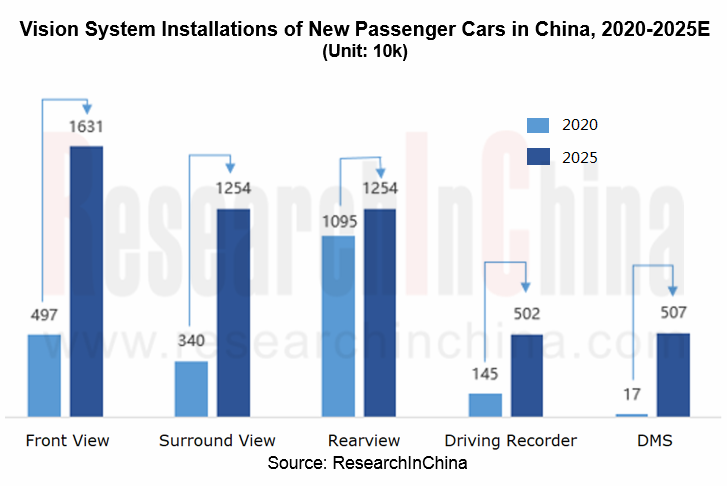
Front View: In 2020, 4.968 million new passenger cars in China were equipped with front view, up 62.1% year-on-year; the installation rate was 26.4%, a year-on-year increase of 10.9 percentage points. With the improvement in the computing power and increase of functions of front view system and the relative cost advantage, it is estimated that more than 16 million passenger cars in China will be installed with front view system in 2025 with the installation rate of 65%.
Currently, the front view monocular solution is the mainstream solution for Chinese passenger cars, and some companies are also exploring the application of front view cameras such as binocular cameras. In 2021, Huawei and DJI successively launched self-developed binocular cameras and solutions. Huawei's binocular cameras have been applied on ARCFOX Alpha S. DJI also plans to apply the binocular camera autonomous driving solution to Chinese models in 2021.
Surround View: In 2020, surround view system was available in 3.398 million cars in China, an increase of 44% over 2019; the installation rate was 18%, up 6 percentage points year-on-year. With surround view system's replacement of rearview and the addition of parking functions, surround view system installations will further jump. As surround view system is an alternative to rearview and the 360° surround view + ultrasonic solution becomes the mainstream solution for integrated parking, 360° surround view has entered a new development stage. It is estimated that the installation rate will rise to 50% in 2025.
Visual DMS: According to ResearchInChina, more than 10 new passenger car models, such as Changan Automobile, NIO, Xpeng, WEY, EXEED, Neta, Leapmotor, Geely, WM Motor, GAC Aion, etc., in China was equipped with DMS in 2020. In 2020, DMS was seen in 173,000 cars, with the installation rate of 0.9%. By 2025, the installation rate is expected to leap to be about 20%.
In April 2021, the Ministry of Industry and Information Technology issued Access Management Guide for Intelligent Connected Vehicle Manufacturers and Products (Trial), requiring intelligent connected vehicles to have HMI and driver monitoring functions, which released strong signals of mandatory DMS installation.
Driving Recorder: In 2020, 1.453 million cars in China had driving recorders, an increase of 7.6% compared to 2019. Meanwhile, the installation rate of driving recorders was 7.7%, up 0.9 percentage points from 2019.
Access Management Guide for Intelligent Connected Vehicle Manufacturers and Products (Trial), which requires intelligent connected vehicles to feature event data recording and autonomous driving data storage, will accelerate the assembly of driving recorders on new vehicles. The installation rate is expected to be 20% by 2025.
Mobileye enjoyed about 30+% share of China’s passenger car front view chip market in 2020, and it expects to seize over 55% in 2025
According to ResearchInChina, the main suppliers of passenger car front view system in China include Denso, Bosch, Aptiv, Kostal, Panasonic, Veoneer, Continental, Jingwei Hirain Technologies, etc. The top 10 suppliers in 2020 occupied more than 90% of the market share. In China, only Jingwei Hirain Technologies was shortlisted, with a market share of 3.6%.
The chip (algorithm) supply of front view system generally has two modes: the self-developed mode (from the core chip to system integration) and the division of labor mode (the core chip is supplied by a company (such as Mobileye) while the system is integrated by Tier1 suppliers.
For example, Jingwei Hirain Technologies mainly uses Mobileye's chips for its front view system to realize the functions of identifying vehicles in front, lane lines, and pedestrians. Major customers include SAIC MAXUS, FAW Hongqi, FAW Jiefang, FAW Besturn, Roewe, MG, Geely, JMC, JAC, Sinotruk, Shaanxi Heavy Duty Truck and other automakers.
In addition to Jingwei Hirain Technologies, Aptiv, ZF, Kostal, Wistron, Yihang AI, iMotion, etc. have also established long-term cooperative relationship with Mobileye. According to ResearchInChina, Mobileye enjoyed about more than 30% share of China’s passenger car front view chip market in 2020. At the same time, Mobileye continued to contact new OEMs and Tier 1 suppliers, such as Great Wall Motors, Dongfeng Motors, and Toyota. It launched a full-scale deployment plan with Volkswagen and Ford. It is expected that its market share will reach more than 55% by 2025.
Great Wall Motors: In 2019, Great Wall Motors said that L0-L2+ADAS based on Mobileye‘s technology will be integrated into a series of models in the next 3-5 years. In 2020, Big Dog, the third-generation H6, and Tank 300 were all equipped with the “monocular camera + Mobileye EyeQ4 chip vision” solution, which has realized the autonomous driving function of L2 and above.
Dongfeng Motor: ZF has launched its coASSIST L2+ semi-automated driving system on the 2020 Dongfeng Aeolus Yixuan which was launched late in 2020. ZF coASSIST is the cost-effective (the price is less than $1,000) L2+ solution that helps meet Euro NCAP performance requirements while delivering the most popular Level 2+ ADAS functions utilizing Mobileye, an Intel Company, EyeQ ? technology. In the next few years, it will be applied to Dongfeng Aerolus Yixuan MAX.
Toyota Motor: In May 2021, ZF and Mobileye were chosen by Toyota Motor to develop ADAS for use in multiple vehicle platforms starting in the next few years. Prior to this, Toyota mainly adopted Denso's solutions.
It can be seen that the division of labor mode is more recognized by OEMs. In addition to Mobileye, Horizon Robotics is also making efforts in the field of vision chips.
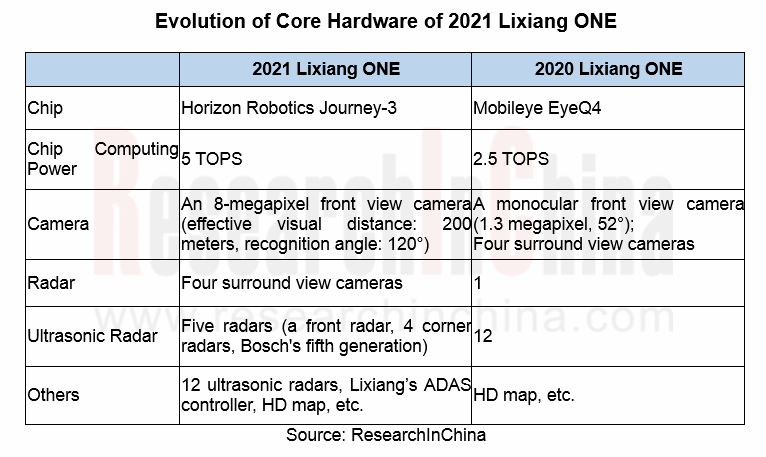
The 2021 Lixiang ONE, released in May 2021, is equipped with two Journey-3 processors developed by Horizon Robotics, an 8-megapixel front view camera (effective visual distance: 200 meters, recognition angle: 120°), four surround view cameras, five radars, 12 ultrasonic radars, Lixiang’s ADAS controller, and NOA navigation assistance driving capabilities.
Domestic suppliers consolidate the commercial vehicle market while working hard on the passenger car OEM market
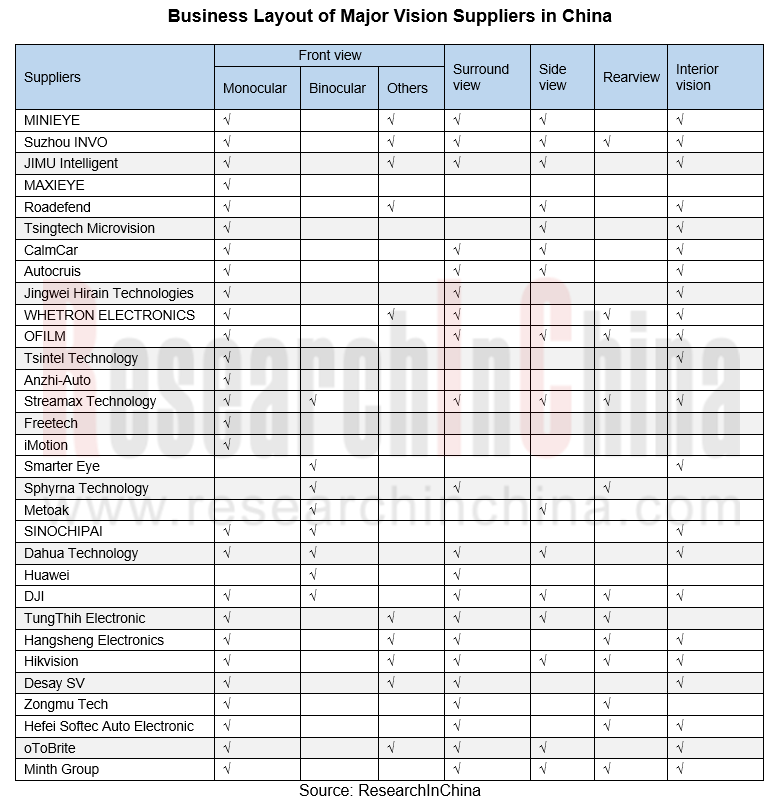
Since 2017, the commercial vehicle ADAS market has been booming thanks to the mandatory installation of early warning functions such as LDWS and AEBS. Leading companies such as Continental and ZF have launched ADAS and integrated solutions for commercial vehicles. China-based MAXIEYE, Jingwei Hirain Technologies, JIMU Intelligent MINIEYE, etc. have received orders from commercial vehicle OEMs, and realized the large-scale mass production of L1 assisted driving.
While consolidating the advantages in the commercial vehicle ADAS market, local suppliers represented by Suzhou INVO, MINIEYE, MAXIEYE, Freetech, iMotion, etc. have begun to make efforts in the L2 (or above) passenger vehicle ADAS market.
MINIEYE: MINIEYE has secured passenger vehicle projects of BYD and JAC. In March 2021, it was designated by a new energy OEM to conduct a L2+ mass production project. On the basis of Huawei’s MDC 210 platform, it adopts a multi-sensor fusion solution with AEB, ACC, LKA, HWP, TJP and other functions. In addition, it is co-developing L0-L3 autonomous driving perception solutions with Xilinx; it is cooperating with SMART on L3 (or above) ADAS.
MAXIEYE: In October 2020, MAXIEYE won the domestic L2+ production passenger car model project, providing products based on IFVS - intelligent forward visual perception system, which can realize LKA, LCK, AEB, ACC, TJA, ILC, ELK and other functions. In April 2021, in cooperation with HYCAN (formerly GAC NIO New Energy), MAXIEYE will gradually implement the L3 autonomous driving in high-speed scenarios and the L2+ driving assistance system in open urban roads.
Intelligent Driving SoC Research Report, 2026
Research on Intelligent Driving SoCs: Competition Focus Shifts to L3/L4 Embedded Hardware, and Computing Power of Flagship Vehicle Models Exceeds 1,000 TOPS
In terms of intelligent driving system in...
Automotive AI Large Model Technology Research Report, 2026
Automotive AI Large Model Research: Competition Shifts from "Who Has the Stronger Model" to "Who Boasts Higher Link Efficiency"
ResearchInChina released the Automotive AI Large Model Technology Resea...
Intelligent Vehicle Cockpit Domain Controller Research Report, 2026
Cockpit domain controller research: L3 AIDV intelligent cockpit domain controllers are entering a boom period
Driven by multiple factors such as the continuous evolution of the automotive central int...
Automotive Acoustic System (Audio, Multi-Channel) Industry Report, 2026
Automotive Acoustics Research: Multiple Channels, AI Tuning, and Self-Developed Algorithms Drive the Transformation of High-End Cockpit Sound Fields
I. Automotive Audio Hardware Solutions with 6–9 S...
Autonomous Driving Sensor Chip Research Report, 2026
Research on Autonomous Driving Sensor Chips: Deeply Perceiving the Physical World, Sensor Chips Are Playing A “Leading Role” in Intelligence
In 2026, the autonomous driving sensor chip industr...
Passenger Car Corner Module and Wheel‑Side Control System Research Report, 2026
Wheel-side control research: the “last mile” chassis innovation
Wheel-side control dismantles the traditional drive, braking, steering, and suspension control of the chassis from a "centralized" styl...
Embodied Artificial Intelligence (& Humanoid Robot) MCU Research Report, 2026
Research on Humanoid Robot MCUs: Evolution from General-Purpose Control to High-Value Dedicated Chip Solutions Integrated with Edge AI Functions
MCU (Microcontroller Unit) refers to a compact integra...
Intelligent Vehicle Zone Control Unit (ZCU) Research Report, 2026
ZCU Research: Cross-domain integrated ZCUs are becoming the edge computing nodes of the next-generation zonal architecture
Currently, the mainstream zonal architecture is mainly the quasi-central + z...
Automotive Cybersecurity and Data Security Research Report, 2026
Cybersecurity & Data Security Research: Intelligent Connected Vehicles Enter the Era of “Systematic Offense-Defense and AI-Defined Security”.
Centering on the panorama of intelligent connect...
Report on Breakthrough Strategies of OEMs and ADAS Tier 1 Suppliers for Overseas Layout of Intelligent Driving, 2026
Regulatory Breakthrough, Local System Establishment, OEMs Competing for NOA Layout: Overall Trends of China’s Intelligent Driving Overseas Layout in 2026
Research on overseas intelligent driving layo...
OEMs and Tier1s’ Intelligent Cockpit Platform (Hardware and Software) Innovation Strategy Research Report, 2026
Intelligent Cockpit Platform Research: multi-dimensional cockpit system architecture reconstruction for multi-agent collaboration and proactive intelligent services
The intelligent cockpit software s...
Automotive AIOS Research Report, 2026
Automotive AIOS Research: Mass Production Solutions Are Implemented
Mass Production Solutions Are Implemented on A Small Scale.
In 2026, AIOS starts small-scale implementation, helping to improve v...
Automotive Telematics Service Provider (TSP) Research Report, 2026
TSP Research: Leading providers collectively turn to AI agents to provide all-scenario active services
Telematics Service Providers (TSPs) are the core hub of the telematics industry chain, connectin...
Automotive Smart Interior Research Report, 2026
Smart Interior Research: As Technologies like Interactive Starlight Headliner, Hidden Display and Surface Projection Are Launched, Automotive Interiors Become Ever More Intelligent
The Automotive Sma...
Research Report on AI Applications in Cockpits, 2026
AI Application in Cockpits: AI Services Become More Comprehensive, Convenient, and Refined.
In the first half of 2026, cockpit AI functions underwent initial upgrades across multiple dimensions, inc...
Software-Defined Vehicles in 2026: OEM Software Development and Supply Chain Deployment Strategy Research Report
Research on OEMs’ Software Strategies: R&D Focus, Development Strategies and Supplier Building Models of 30 OEMs
In this paper, we adopt a research framework covering 13 subsystems and 48 sub-di...
Passenger Car Chassis Domain Control and Chassis Cross-Domain Integration Research Report, 2026
Chassis Control Research: Mass Production of Full Chassis-by-Wire Solutions Starts
1. A Cluster of Full Chassis-by-Wire Solutions Make Their Debut, and EMB Enters Mass Production and Adoption for the...
Central Domain Control (Powertrain, Chassis, Body) and Motion Controller Research Report, 2026
Central Domain Control and Motion Control Research: XYZ Coordinated Control and Full X-by-Wire Actuation System
With the gradual penetration of L3+ autonomous driving, the chassis control system is ...