China Automotive Ultrasonic Radar and OEM Parking Roadmap Research Report, 2021
China Automotive Ultrasonic Radar & OEM Parking Roadmap Research Report, 2021 combs through automotive ultrasonic radar market characteristics, suppliers, development trends and OEM’s automatic parking roadmaps. At present, the market presents the following features:
①Proportion of 12 ultrasonic radar solution continues to increase;
②Home-zone parking pilot (HPP) and automated valet parking (AVP) put forward higher requirements for sensor fusion;
③ Cockpit applications such as life detection and gesture control are expected to become new growth points of ultrasonic radar.
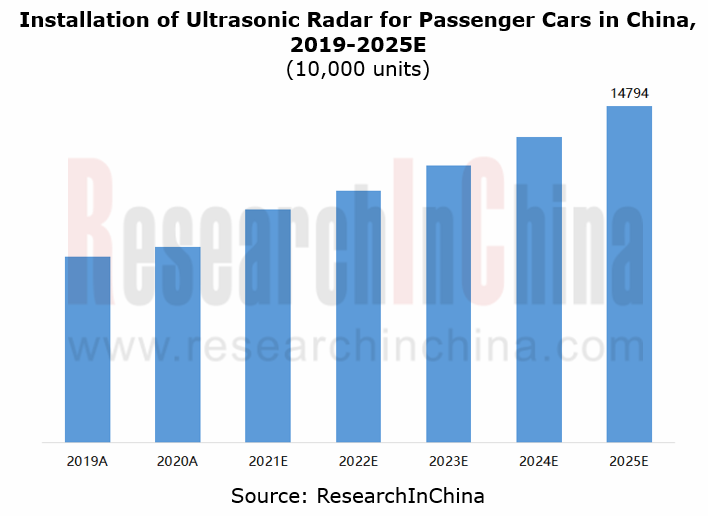
Installation of China’s automotive ultrasonic radars will hit 150 million units by 2025
Installation of China’s automotive ultrasonic radars attained 86.20 mln units (factory-installed market), up 5.2% yr-on-yr. The ultrasonic radars are mainly applied to reversing assist and parking assist. With the upgrading of parking functions and the improvement of installation rate, demand for ultrasonic radars is steadily increasing, further to nearly 150 million units by 2025.
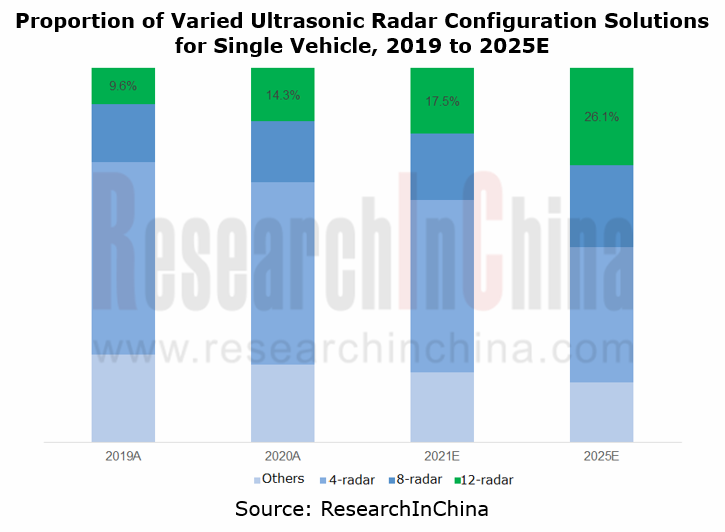
Proportion of 12 ultrasonic radar solution continues to increase
Viewed from ultrasonic radar configuration solution for single vehicle, 4 ultrasonic radar solution occupied most of the market share from 2019 to 2020, applied for realizing reversing assist. With the commercial promotion of automatic parking, the proportion of 12 ultrasonic radar solution is rapidly rising and is expected to become the mainstream of smart cars in the future.
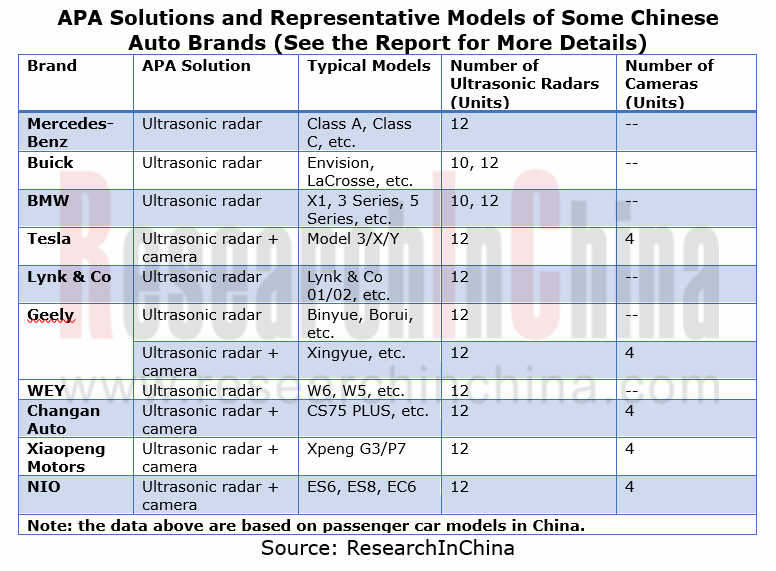
At present, APA solution launched by OEMs basically adopts 12 ultrasonic radars. Among them, BMW and Buick mainly adopt full ultrasonic radar solution. Partial OEMs (such as NIO, Xpeng, Changan and Geely) adopt the vision fusion solution of ultrasonic radar plus surround view camera to improve the success rate of parking in/out of the automatic parking system.
HPP and AVP put forward higher requirements for sensor fusion
Existing L2 and L2 + automatic parking fusion solutions mostly adopt ultrasonic + visual fusion. L3 HPP and L4 AVP will realize the fusion of more sensors, such as the introduction of front-view cameras, radar or LiDAR.
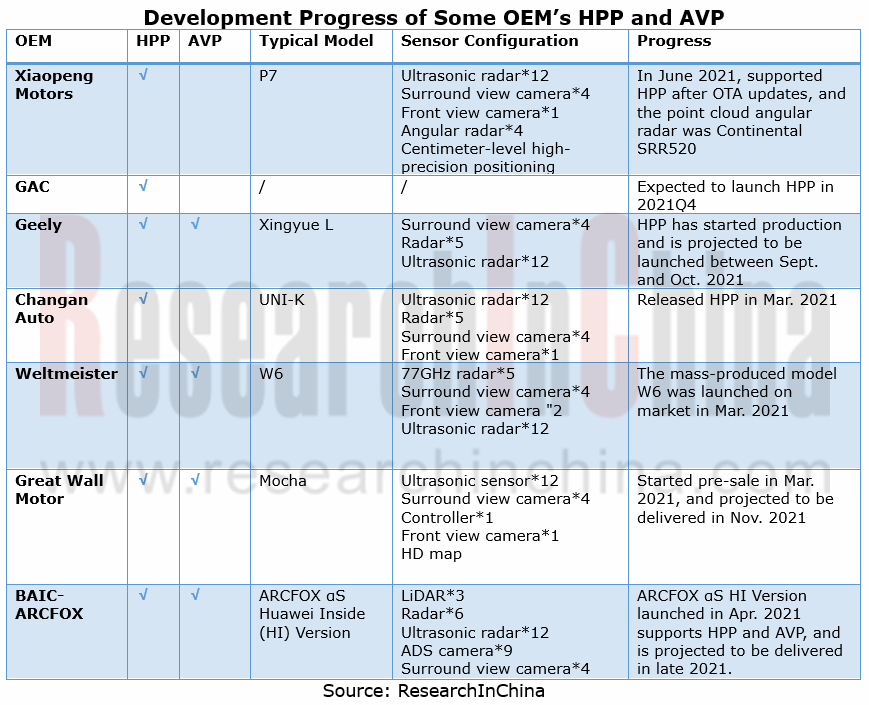
Viewed from HPP, mass production time of HPP is scheduled in 2021 to 2022. Generally, OEMs adopt the solution of adding more sensors (such as front-view camera, millimeter wave angle radar, and high-precision positioning) on the basis of APA sensors, which puts forward higher requirements for sensor fusion.
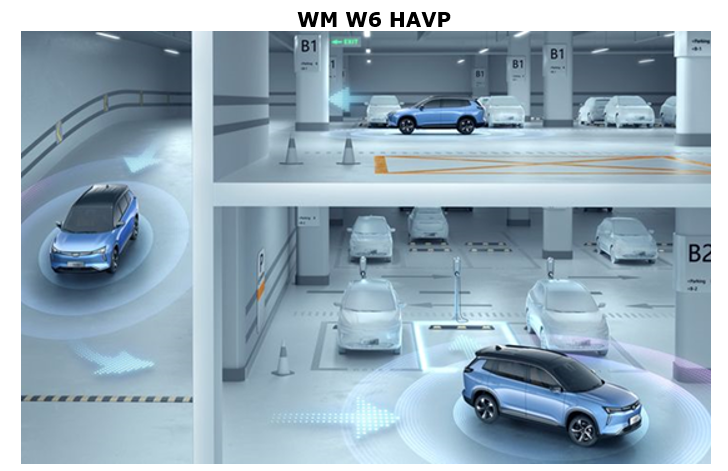
In April 2021, WM W6 was released to the market. It is equipped with HAVP (Home-AVP) for one-key autonomous driving, obstacle avoidance, intelligent search for parking spaces, and automatic parking in or out without human intervention. WM W6’s HAVP supports up to 100m distance and 5 routes learning.
WM W6’s HAVP integrates autonomous driving computing platform (Apollo ACU Wuren), with sensors integrating ultrasonic radars, surround view cameras, front-view angle radars and angle radars. Sensor configurations include 5 77GHz radars, 4 surround view cameras, 2 front-view cameras and 12 ultrasonic radars.
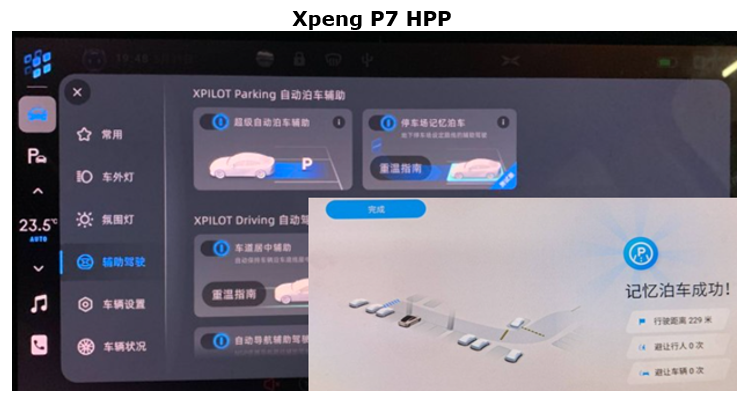
In June 2021, Xpeng Motor added HPP function in the OTA upgrade of Xpeng P7 (Xmart OS 2.6.0). The HPP does not rely on the renovation of parking lot end, with up to 1,000m of route learning, supporting up to 100 routes learning in the parking lots (learning one route for each parking lot).
Xpeng P7’s HPP integrates ultrasonic radars + surround view cameras + front-view camera + angle radars. Sensor configuration includes 12 ultrasonic radars, 4 surround view cameras, 1 front-view camera, 4 angle radars and centimeter-level high-precision positioning. Of which, its angle radars adopt SRR520 point cloud radars provided by Continental.
As of AVP, many OEMs actively deploy AVP at present. But most of AVP projects are under demo stage
Great Wall WEY Mocha, scheduled to be delivered in Nov.2021, adopt AVP solution of car-end intelligence. Its sensors integrate ultrasonic sensors, surround view cameras, front-view cameras and HD map. The AVP solution is mainly applied for parking scenarios in areas such as supermarkets.
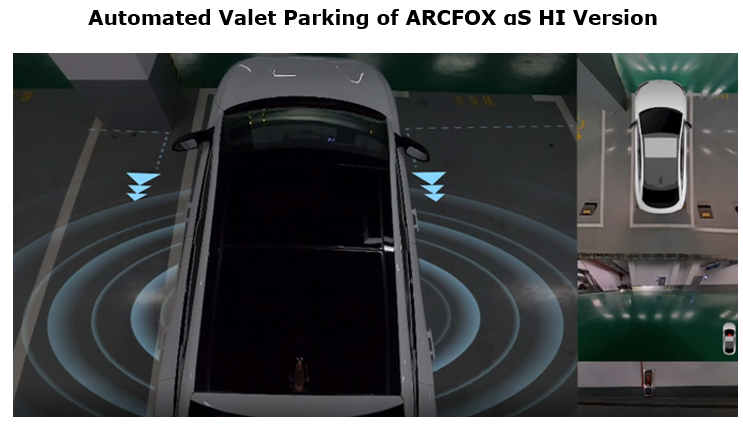
ARCFOX αS S Hi version, with mass production scheduled for the end of 2021, adopts AVP solution of car end intelligence. Its sensor configuration includes LiDAR, radar, ultrasonic radar, ADS camera and surround view camera.
Cockpit applications like life detection and gesture control are expected to be new drivers for the growth of ultrasonic radar
As intelligent cockpits advance, ultrasonic radar may become applicable to new functions such as life detection and gesture control.
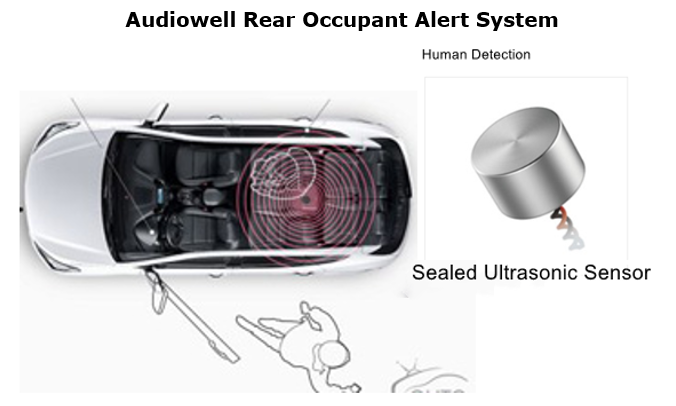
One example is Audiowell Rear Occupant Alert (ROA), a system that detects moving objects via ultrasonic radar. When confirming a moving object at the rear row, it sends a warning to the owner; when the rear occupants fall sleep, it detects slight movements caused by breathing through the Doppler Effect of ultrasonic waves.
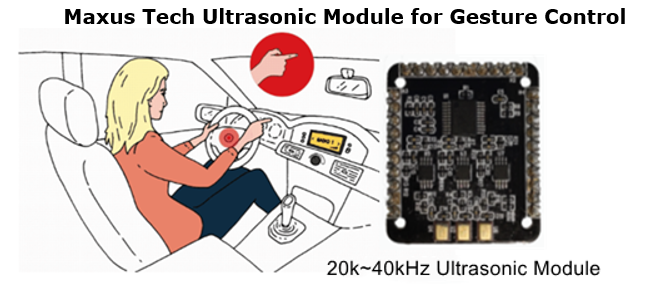
With ultrasonic signals as the carrier, Maxus Tech enables gesture control, a function applicable to scenarios such as smart home, smart wearable device and intelligent cockpit.
Autonomous Driving Domain Controller and Central Computing Unit (CCU) Industry Report, 2026
Autonomous Driving Domain Controller (ADCU) Research: One-Chip CCU solutions are quickly available in vehicles
In China's passenger car market, autonomous driving systems involved in mass production ...
Automotive EMS and ECU Industry Research Report, 2026
Automotive EMS Research: The boundaries between EMS providers and Tier1 suppliers are becoming blurred, and the supply chain model is evolving from a linear chain to a networked structure
Mainstream ...
Automotive Microcontroller Unit (MCU) and Application Scenario Research Report, 2026
Automotive MCU Research: Increased demand for redundant security drives ASIL D-compliant MCU shipments to exceed 100 million units
In a vehicle EEA, MCUs are widely distributed in various functional ...
China Intelligent Cockpit Patent Analysis Report, 2026
Intelligent Cockpit Patent Research: Cockpit AI, In?vehicle Health, and Infotainment Are Upgrade to Scenario?based and Proactive Functions
From a patent perspective, this report explores the cutting?...
Research Report on Application of VLA Large Model in Automobiles and Robots, 2026
Research on Automotive and Robot VLA: Hybrid Architectures Become Mainstream, VLA Integrates with General World Models, and Reinforcement Learning Serves as Core Engine
Vision?Language?Action (VLA) m...
China Charging Infrastructure (Supercharging, Battery Swapping, V2G, etc.) and High-Performance Supercharging Battery Research Report, 2026
Charging and battery swapping research: as 5C+ supercharging vehicle models go into mass production, the pace of OEMs self-building supercharging networks quickens
800-1000V high-voltage platforms ar...
China Passenger Car Electronic Controlled Suspension Industry Report, 2026
Electronic Controlled Suspension Industry Research: As the First Year of Full Active Suspension Unfolds, Three Technical Routes Race Forward
1. Penetration Rate Surges Three Times, and Electronic Con...
Intelligent Driving SoC Research Report, 2026
Research on Intelligent Driving SoCs: Competition Focus Shifts to L3/L4 Embedded Hardware, and Computing Power of Flagship Vehicle Models Exceeds 1,000 TOPS
In terms of intelligent driving system in...
Automotive AI Large Model Technology Research Report, 2026
Automotive AI Large Model Research: Competition Shifts from "Who Has the Stronger Model" to "Who Boasts Higher Link Efficiency"
ResearchInChina released the Automotive AI Large Model Technology Resea...
Intelligent Vehicle Cockpit Domain Controller Research Report, 2026
Cockpit domain controller research: L3 AIDV intelligent cockpit domain controllers are entering a boom period
Driven by multiple factors such as the continuous evolution of the automotive central int...
Automotive Acoustic System (Audio, Multi-Channel) Industry Report, 2026
Automotive Acoustics Research: Multiple Channels, AI Tuning, and Self-Developed Algorithms Drive the Transformation of High-End Cockpit Sound Fields
I. Automotive Audio Hardware Solutions with 6–9 S...
Autonomous Driving Sensor Chip Research Report, 2026
Research on Autonomous Driving Sensor Chips: Deeply Perceiving the Physical World, Sensor Chips Are Playing A “Leading Role” in Intelligence
In 2026, the autonomous driving sensor chip industr...
Passenger Car Corner Module and Wheel‑Side Control System Research Report, 2026
Wheel-side control research: the “last mile” chassis innovation
Wheel-side control dismantles the traditional drive, braking, steering, and suspension control of the chassis from a "centralized" styl...
Embodied Artificial Intelligence (& Humanoid Robot) MCU Research Report, 2026
Research on Humanoid Robot MCUs: Evolution from General-Purpose Control to High-Value Dedicated Chip Solutions Integrated with Edge AI Functions
MCU (Microcontroller Unit) refers to a compact integra...
Intelligent Vehicle Zone Control Unit (ZCU) Research Report, 2026
ZCU Research: Cross-domain integrated ZCUs are becoming the edge computing nodes of the next-generation zonal architecture
Currently, the mainstream zonal architecture is mainly the quasi-central + z...
Automotive Cybersecurity and Data Security Research Report, 2026
Cybersecurity & Data Security Research: Intelligent Connected Vehicles Enter the Era of “Systematic Offense-Defense and AI-Defined Security”.
Centering on the panorama of intelligent connect...
Report on Breakthrough Strategies of OEMs and ADAS Tier 1 Suppliers for Overseas Layout of Intelligent Driving, 2026
Regulatory Breakthrough, Local System Establishment, OEMs Competing for NOA Layout: Overall Trends of China’s Intelligent Driving Overseas Layout in 2026
Research on overseas intelligent driving layo...
OEMs and Tier1s’ Intelligent Cockpit Platform (Hardware and Software) Innovation Strategy Research Report, 2026
Intelligent Cockpit Platform Research: multi-dimensional cockpit system architecture reconstruction for multi-agent collaboration and proactive intelligent services
The intelligent cockpit software s...