Automotive T-Box Ranking and Comparison Analysis Report, 2021 conducts comparison of T-BOX parameters of 15 vendors, and the comparative items include:
size,
power consumption,
5G support,
4G support,
V2X support,
positioning support,
sensor support,
integrated antennas,
integrated central gateways,
network security and encryption,
vehicle connectivity,
whether OTA is supported,
remote control,
API interface support,
storage capacity,
authentication status,
mass production capacity,
number of designated customers,
mass production shipments,
etc.
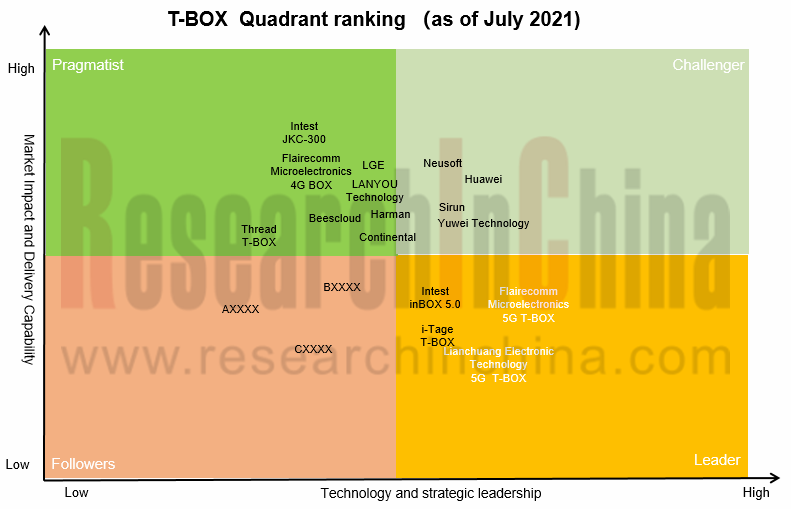
At the same time, ResearchInChina conducted interviews with experts who participated in the ranking research. Experts introduced some development trends of T-BOX, and this article extracts some of them.
T-BOX Software Development Trend
Q: What functions do you think will be expanded in T-BOX software, and what are the future trends?
A: T-BOX software must have TSN protocol functions in the future. TSN refers to a set of "sub-standards" formulated based on specific application requirements under the framework of IEEE802.1 standards. It aims to establish a "universal" time-sensitive mechanism for Ethernet protocols to ensure the time certainty of network data transmission. At the same time, data shaping is used to ensure that the delay reaches the microsecond level (generally no more than 250 microseconds per bridge), and to ensure that reliable communication can be enforced regardless of link failures, cable breaks and other errors. This option ensures that copies of critical traffic can be transmitted in a disjoint path in the network, leaving only any packets that reach the destination first, thus achieving seamless redundancy and achieving ultra-high reliability, which is especially important for unmanned driving.
The T-BOX function is currently based on data collection and forwarding, and will evolve into many functions such as data collection, editing, analysis, control, OTA, integration of multiple ECU information and analysis, etc.
T-BOX Hardware Integration Trend
Q: What do you think is the development direction of T-BOX product hardware integration?
A: In order to increase bandwidth and achieve low latency, T-BOX will add Ethernet interface in the future and gradually become standard, now generally 100M, a few 1G. T-BOX will be integrated with the gateway to assume the switch function. T-BOX can also consider integration with the domain controller.
3-4-way CAN will become the mainstream, and most of them are 1-2-way CAN at present.
The T-BOX products currently produced by Hopechart can also realize the function of online exhaust gas monitoring.
Bottleneck to be broken by T-BOX Vendors
Q: T-BOX is a necessary communication component of vehicles and carries a large number of computing tasks. What technical bottlenecks do you think T-BOX vendors may encounter in the future?
A: As T-Box will undertake more functions in the future, it needs to embed more applications. This not only needs to increase memory and processing power, but also increases the complexity of software system development (for example, SOA should be isolated between different applications), Software capabilities is a severe challenge to traditional T-BOX suppliers.
Autonomous Driving Domain Controller and Central Computing Unit (CCU) Industry Report, 2026
Autonomous Driving Domain Controller (ADCU) Research: One-Chip CCU solutions are quickly available in vehicles
In China's passenger car market, autonomous driving systems involved in mass production ...
Automotive EMS and ECU Industry Research Report, 2026
Automotive EMS Research: The boundaries between EMS providers and Tier1 suppliers are becoming blurred, and the supply chain model is evolving from a linear chain to a networked structure
Mainstream ...
Automotive Microcontroller Unit (MCU) and Application Scenario Research Report, 2026
Automotive MCU Research: Increased demand for redundant security drives ASIL D-compliant MCU shipments to exceed 100 million units
In a vehicle EEA, MCUs are widely distributed in various functional ...
China Intelligent Cockpit Patent Analysis Report, 2026
Intelligent Cockpit Patent Research: Cockpit AI, In?vehicle Health, and Infotainment Are Upgrade to Scenario?based and Proactive Functions
From a patent perspective, this report explores the cutting?...
Research Report on Application of VLA Large Model in Automobiles and Robots, 2026
Research on Automotive and Robot VLA: Hybrid Architectures Become Mainstream, VLA Integrates with General World Models, and Reinforcement Learning Serves as Core Engine
Vision?Language?Action (VLA) m...
China Charging Infrastructure (Supercharging, Battery Swapping, V2G, etc.) and High-Performance Supercharging Battery Research Report, 2026
Charging and battery swapping research: as 5C+ supercharging vehicle models go into mass production, the pace of OEMs self-building supercharging networks quickens
800-1000V high-voltage platforms ar...
China Passenger Car Electronic Controlled Suspension Industry Report, 2026
Electronic Controlled Suspension Industry Research: As the First Year of Full Active Suspension Unfolds, Three Technical Routes Race Forward
1. Penetration Rate Surges Three Times, and Electronic Con...
Intelligent Driving SoC Research Report, 2026
Research on Intelligent Driving SoCs: Competition Focus Shifts to L3/L4 Embedded Hardware, and Computing Power of Flagship Vehicle Models Exceeds 1,000 TOPS
In terms of intelligent driving system in...
Automotive AI Large Model Technology Research Report, 2026
Automotive AI Large Model Research: Competition Shifts from "Who Has the Stronger Model" to "Who Boasts Higher Link Efficiency"
ResearchInChina released the Automotive AI Large Model Technology Resea...
Intelligent Vehicle Cockpit Domain Controller Research Report, 2026
Cockpit domain controller research: L3 AIDV intelligent cockpit domain controllers are entering a boom period
Driven by multiple factors such as the continuous evolution of the automotive central int...
Automotive Acoustic System (Audio, Multi-Channel) Industry Report, 2026
Automotive Acoustics Research: Multiple Channels, AI Tuning, and Self-Developed Algorithms Drive the Transformation of High-End Cockpit Sound Fields
I. Automotive Audio Hardware Solutions with 6–9 S...
Autonomous Driving Sensor Chip Research Report, 2026
Research on Autonomous Driving Sensor Chips: Deeply Perceiving the Physical World, Sensor Chips Are Playing A “Leading Role” in Intelligence
In 2026, the autonomous driving sensor chip industr...
Passenger Car Corner Module and Wheel‑Side Control System Research Report, 2026
Wheel-side control research: the “last mile” chassis innovation
Wheel-side control dismantles the traditional drive, braking, steering, and suspension control of the chassis from a "centralized" styl...
Embodied Artificial Intelligence (& Humanoid Robot) MCU Research Report, 2026
Research on Humanoid Robot MCUs: Evolution from General-Purpose Control to High-Value Dedicated Chip Solutions Integrated with Edge AI Functions
MCU (Microcontroller Unit) refers to a compact integra...
Intelligent Vehicle Zone Control Unit (ZCU) Research Report, 2026
ZCU Research: Cross-domain integrated ZCUs are becoming the edge computing nodes of the next-generation zonal architecture
Currently, the mainstream zonal architecture is mainly the quasi-central + z...
Automotive Cybersecurity and Data Security Research Report, 2026
Cybersecurity & Data Security Research: Intelligent Connected Vehicles Enter the Era of “Systematic Offense-Defense and AI-Defined Security”.
Centering on the panorama of intelligent connect...
Report on Breakthrough Strategies of OEMs and ADAS Tier 1 Suppliers for Overseas Layout of Intelligent Driving, 2026
Regulatory Breakthrough, Local System Establishment, OEMs Competing for NOA Layout: Overall Trends of China’s Intelligent Driving Overseas Layout in 2026
Research on overseas intelligent driving layo...
OEMs and Tier1s’ Intelligent Cockpit Platform (Hardware and Software) Innovation Strategy Research Report, 2026
Intelligent Cockpit Platform Research: multi-dimensional cockpit system architecture reconstruction for multi-agent collaboration and proactive intelligent services
The intelligent cockpit software s...