In 2021H1, the sales of vehicle models with console multi and dual display surged by 61% and 155% on a like-on-like basis, respectively
Our Automotive Cockpit Multi and Dual Display Trend Report, 2021 combs through the passenger car models with console multi and dual displays during 2020-2021H1, and discusses the relationship between chip, display and system.
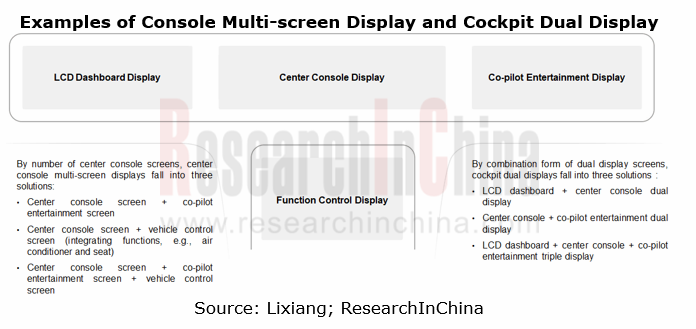
“Console multi-screen display”, a functional description of center console, refers to center console display with two or more screens, for example, center console screen + co-pilot entertainment screen, function control screen, etc.
“Cockpit dual display”, a functional description of cockpit, refers to the abreast layout of in-vehicle displays, that is, integrated design or approximate design, for example, integrated display solutions like “LCD dashboard screen + console screen dual display” and “LCD dashboard screen + console screen display + co-pilot entertainment screen triple display”.
1. The pace of launching models with multi and dual displays quickens.
In 2021H1, a total of 136 auto brands were scrambling for the Chinese passenger car market. In the fairly fierce competition, Chinese and foreign brands kept updating their products from within.
On the face of it, users can directly see how in-vehicle screens are deployed and how many they are. In a connotative view, cockpit software systems implement new hardware and software architectures via high-performance computing chips, thus providing better user experience in actual use. Quite a few automakers make in-depth improvements based on intelligent cockpits, and accelerate the roll-out of models that pack integrated displays, multi-screen displays, and one-chip, multi-screen, dual-system solutions.
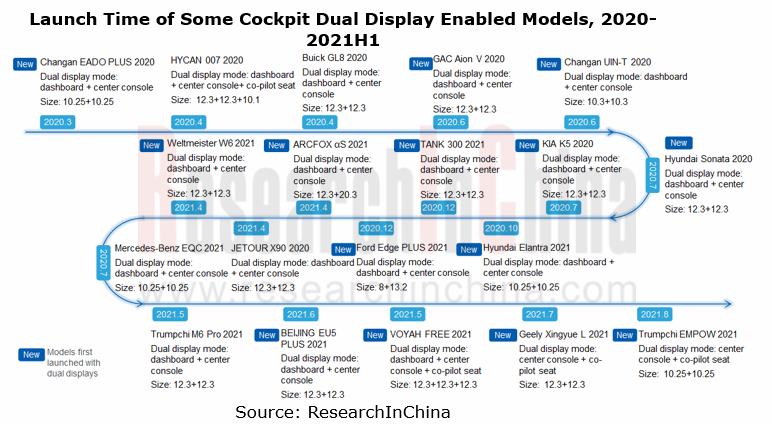
In the case of cockpit dual display, several auto brands including Chinese, German, American and Korean ones have launched their mass-produced models that carry dual/triple displays on market during 2020-2021H1.
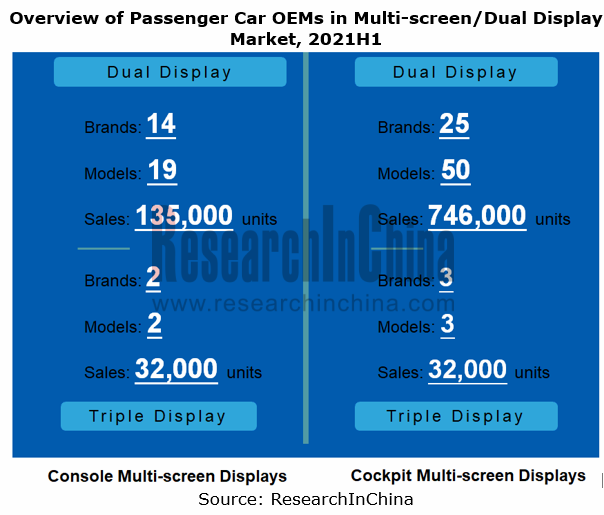
In 2021H1, the sales of models with console multi and dual displays surged by 61% and 155% on a like-on-like basis, respectively.
In spite of the downturn in overall passenger car sales in China, models with multi and dual displays bucked the trend and showed an aggressive growth in 2021H1. The sales of models with console multi-screen displays and cockpit dual displays shot up by 61% and 155% from the prior-year period, separately.
The booming sales of such models indicate how determined automakers are in cockpit disruption, and are also an evidence of their high acceptance in market. The positive effects given by automakers and the market have created an active and effective closed loop, which will make the sales of models with multi-screen and dual displays sustain rapid growth.
Chinese brands hold a more positive, more open attitude towards cockpit dual displays.
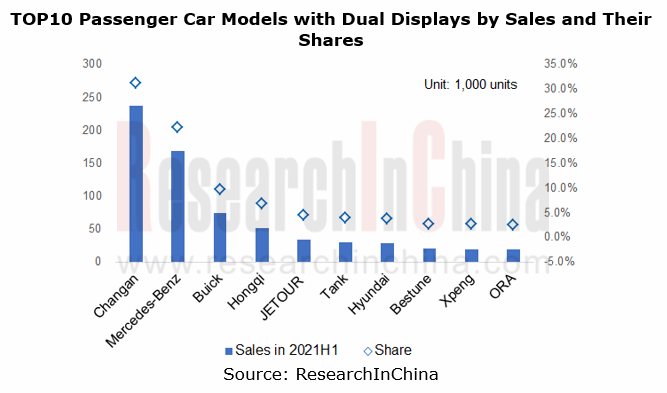
Still take cockpit dual display as an example. Homegrown brands in China have become the main drivers of cockpit dual display solutions in the first half of 2021, with a market share of 62.3%, among which Changan Auto is the most typical player followed by Hongqi and Jetour. In the joint venture brands, Hyundai, Ford and SOL have introduced several dual display-enabled models during 2020-2021H1.
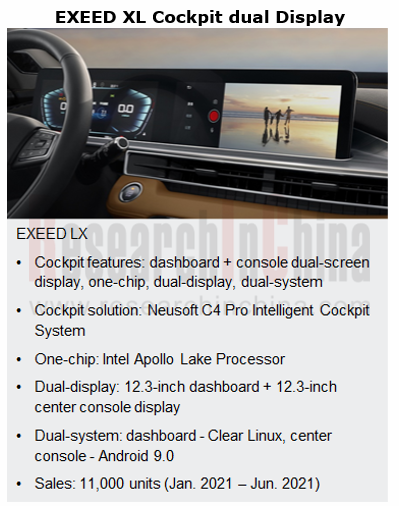
Chery is one of the earliest homegrown brands deploying dual displays and using one-chip, dual-display, dual-system solutions.
In October 2019, EXEED, a high-end brand under Chery introduced EXEED LX, its second model equipped with i-Connect@Lion 3.0 and 12.3-inch dashboard + 12.3-inch console dual-screen display. Differing from the previous versions, i-Connect@Lion 3.0 co-developed by Neusoft, Baidu and Intel enables a one-chip, dual-display, dual-system solution via ACRN hypervisor that runs on the Intel Apollo Lake processor.
This solution has become available to the full range of EXEED models, making the auto brand one of the few thorough implementers of dual displays and one-chip, dual-display, dual-system solutions in the auto industry.
2. Chip vendors and Tier1 cockpit solution suppliers are strong advocates of one-chip, multi-display, multi-system solutions.
Simple technology upgrade is not enough to make cockpits intelligent in a substantial way. High performance chips such as Qualcomm, Renesas and Intel bring in a possibility for multiple operating systems to run on one chip, and also support several screens including LCD dashboard screen, center console screen and co-pilot entertainment screen.
Take Qualcomm SA8155 as an example: as the world’s first mass-produced 7nm automotive digital cockpit chip, the octa-core chip supports 4 2K screens or 3 4K screens, with the computing forces of CPU and GPU up to 80K DMIPS and 1142G FLOPS, respectively. Qualcomm SA8155 has provided one-chip, multi-display solution enablers for mass-produced models like AION LX, WEY Mocha and Xingyue L.
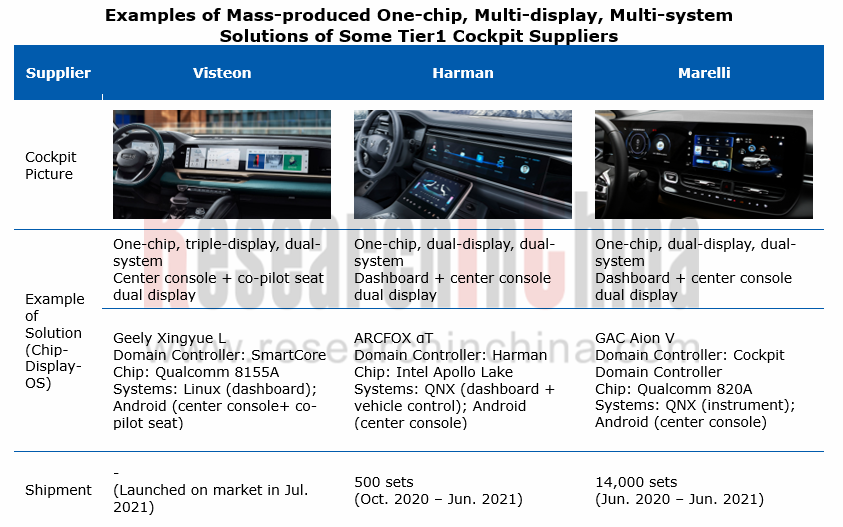
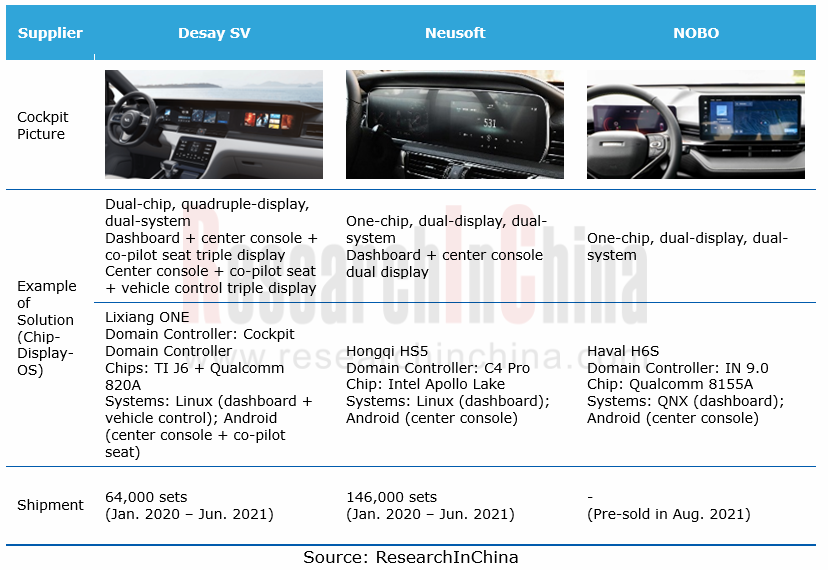
Automotive E/E architecture is shifting to a domain centralized one, which allows Tier1 cockpit suppliers to integrate different operating systems into the cockpit domain controller through hardware isolation or hypervisor technology, so as to realize the one-chip multi-system function on a single hardware platform for higher computational efficiency and lower cost.
One example is SmartCore, Visteon's latest cockpit domain controller which enables HMI seamless connection in multiple display domains such as digital cluster, infotainment and rear seat infotainment. On the strength of its powerful computing force, the Hypervisor-based SmartCore architecture running on two systems allows SmartCore solution to simultaneously drive digital cluster system, infotainment system, and body control system. SmartCore domain controller has provided one-chip, dual-system solution support for mass-produced models like Mercedes-Benz A-Class, AION LX and Xingyue L.
Globally, Tier1 cockpit suppliers both inside and outside China are racing to launch one-chip, multi-display, multi-system cockpit solutions based on high performance chip and cockpit domain controller.
3. Challenges and Trends
Multi-screen and dual displays provide substantially better occupant experience in multiple aspects: in usability, both displays improve the interaction efficiency between people and vehicles to some extent and make it cheaper for users to obtain vehicle information and functions; in scalability, both of them expand the information load capacity of a cockpit and add more driving information and entertainment content.
Meanwhile, the upgrade of current cockpit industry chain technologies including chip, operating system, cockpit domain controller and display will leave more scope for OEMs to conceive and implement multi-screen and dual displays, helping to reshape cockpits technologically.
As concerns whether it is necessary to introduce multi-screen/dual display or one-chip, multi-display, multi-system solution into a car or not, automakers need to take into account a combination of factors such as product orientation, user needs, R&D costs and competitive pattern. As for cockpit interior structure, it is not the use or re-layout of displays that poses technical and cost challenges to OEMs, but how to improve user experience with multi-screen/dual displays of limited number and size, that are introduced into a cockpit based on redesigned software and hardware architecture, in an age of intelligent cockpits. This is really worth OEMs thinking about.
Research Report on Application of VLA Large Model in Automobiles and Robots, 2026
Research on Automotive and Robot VLA: Hybrid Architectures Become Mainstream, VLA Integrates with General World Models, and Reinforcement Learning Serves as Core Engine
Vision?Language?Action (VLA) m...
China Charging Infrastructure (Supercharging, Battery Swapping, V2G, etc.) and High-Performance Supercharging Battery Research Report, 2026
Charging and battery swapping research: as 5C+ supercharging vehicle models go into mass production, the pace of OEMs self-building supercharging networks quickens
800-1000V high-voltage platforms ar...
China Passenger Car Electronic Controlled Suspension Industry Report, 2026
Electronic Controlled Suspension Industry Research: As the First Year of Full Active Suspension Unfolds, Three Technical Routes Race Forward
1. Penetration Rate Surges Three Times, and Electronic Con...
Intelligent Driving SoC Research Report, 2026
Research on Intelligent Driving SoCs: Competition Focus Shifts to L3/L4 Embedded Hardware, and Computing Power of Flagship Vehicle Models Exceeds 1,000 TOPS
In terms of intelligent driving system in...
Automotive AI Large Model Technology Research Report, 2026
Automotive AI Large Model Research: Competition Shifts from "Who Has the Stronger Model" to "Who Boasts Higher Link Efficiency"
ResearchInChina released the Automotive AI Large Model Technology Resea...
Intelligent Vehicle Cockpit Domain Controller Research Report, 2026
Cockpit domain controller research: L3 AIDV intelligent cockpit domain controllers are entering a boom period
Driven by multiple factors such as the continuous evolution of the automotive central int...
Automotive Acoustic System (Audio, Multi-Channel) Industry Report, 2026
Automotive Acoustics Research: Multiple Channels, AI Tuning, and Self-Developed Algorithms Drive the Transformation of High-End Cockpit Sound Fields
I. Automotive Audio Hardware Solutions with 6–9 S...
Autonomous Driving Sensor Chip Research Report, 2026
Research on Autonomous Driving Sensor Chips: Deeply Perceiving the Physical World, Sensor Chips Are Playing A “Leading Role” in Intelligence
In 2026, the autonomous driving sensor chip industr...
Passenger Car Corner Module and Wheel‑Side Control System Research Report, 2026
Wheel-side control research: the “last mile” chassis innovation
Wheel-side control dismantles the traditional drive, braking, steering, and suspension control of the chassis from a "centralized" styl...
Embodied Artificial Intelligence (& Humanoid Robot) MCU Research Report, 2026
Research on Humanoid Robot MCUs: Evolution from General-Purpose Control to High-Value Dedicated Chip Solutions Integrated with Edge AI Functions
MCU (Microcontroller Unit) refers to a compact integra...
Intelligent Vehicle Zone Control Unit (ZCU) Research Report, 2026
ZCU Research: Cross-domain integrated ZCUs are becoming the edge computing nodes of the next-generation zonal architecture
Currently, the mainstream zonal architecture is mainly the quasi-central + z...
Automotive Cybersecurity and Data Security Research Report, 2026
Cybersecurity & Data Security Research: Intelligent Connected Vehicles Enter the Era of “Systematic Offense-Defense and AI-Defined Security”.
Centering on the panorama of intelligent connect...
Report on Breakthrough Strategies of OEMs and ADAS Tier 1 Suppliers for Overseas Layout of Intelligent Driving, 2026
Regulatory Breakthrough, Local System Establishment, OEMs Competing for NOA Layout: Overall Trends of China’s Intelligent Driving Overseas Layout in 2026
Research on overseas intelligent driving layo...
OEMs and Tier1s’ Intelligent Cockpit Platform (Hardware and Software) Innovation Strategy Research Report, 2026
Intelligent Cockpit Platform Research: multi-dimensional cockpit system architecture reconstruction for multi-agent collaboration and proactive intelligent services
The intelligent cockpit software s...
Automotive AIOS Research Report, 2026
Automotive AIOS Research: Mass Production Solutions Are Implemented
Mass Production Solutions Are Implemented on A Small Scale.
In 2026, AIOS starts small-scale implementation, helping to improve v...
Automotive Telematics Service Provider (TSP) Research Report, 2026
TSP Research: Leading providers collectively turn to AI agents to provide all-scenario active services
Telematics Service Providers (TSPs) are the core hub of the telematics industry chain, connectin...
Automotive Smart Interior Research Report, 2026
Smart Interior Research: As Technologies like Interactive Starlight Headliner, Hidden Display and Surface Projection Are Launched, Automotive Interiors Become Ever More Intelligent
The Automotive Sma...
Research Report on AI Applications in Cockpits, 2026
AI Application in Cockpits: AI Services Become More Comprehensive, Convenient, and Refined.
In the first half of 2026, cockpit AI functions underwent initial upgrades across multiple dimensions, inc...