Autosar research: How Chinese providers seize the opportunity in the wave of software-defined vehicles.
As vehicle software becomes more complicated and single vehicle software value rises, AUTOSAR empowers the automotive industry chain to evolve to software-defined vehicles rapidly, in the megatrend of software-defined vehicles. As an open system architecture and also a standard, AUTOSAR enables standardization, reusability and interoperability of software, and helps OEMs and Tier1s cut more costs.
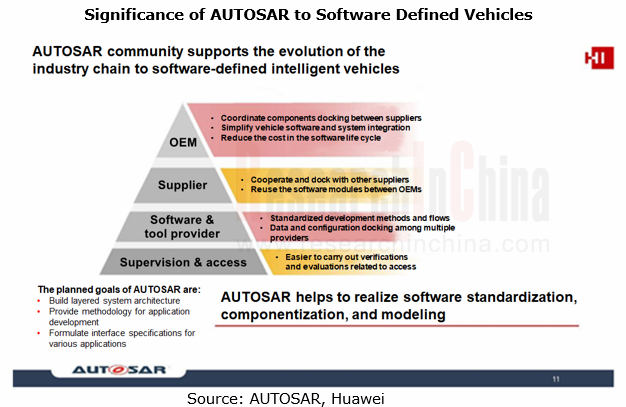
AUTOSAR has released Classic and Adaptive platform specifications. AUTOSAR Classic corresponds to the security control architecture which adopts layered design and enables decoupling of basic software layer and application layer. As E/E architectures evolve and more domain controllers are used, the central computing platform becomes a development trend, and just AUTOSAR Classic is not enough to meet the market needs. So AUTOSAR Adaptive comes into being and becomes an indispensable element to the new-generation E/E architectures.
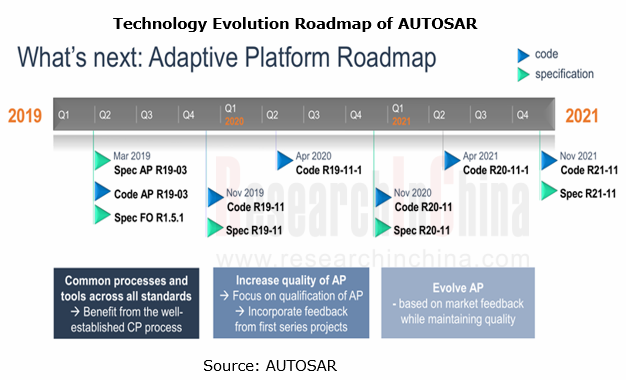
The future version of AUTOSAR Adaptive has planned 23 new features, including better interaction between AUTOSAR Classic and AUTOSAR Adaptive, and upgrade of Security and Safety. According to the roadmap, AUTOSAR will offer a new software architecture version every year.
According to the official definition, AUTOSAR Adaptive supports all future vehicle APPs, e.g., IVI, V2X, multi-sensor fusion and ADAS. AUTOSAR is a standard option of next-generation automotive basic software architectures, for many automakers, components suppliers, and software providers among others.
China’s vehicle basic software industry started late. The early basic software providers were foreign players. To expedite China’s vehicle basic software and create its own intellectual property system and harmonious ecosystem, Neusoft Reach and China Association of Automobile Manufactures (CAAM) jointly planed and initiated the Automotive Software Ecosystem Member Organization of China (AUTOSEMO) under the guidance of the Ministry of Industry and Information Technology of China, aiming to share and practice innovations and build open standardized software architectures, interface specifications and application frameworks together with other over 20 member units. The AUTOSEMO is dedicated to developing China’s proprietary vehicle basic software industry ecosystem and facilitate the transformation of the country’s automotive industry into an intelligent one.
The AUTOSEMO was founded in Shanghai on July 22, 2020, with 20 founder members: FAW, SAIC, GAC, NIO, Geely, Great Wall Motor, Changan Auto, Beiqi Foton, Dongfeng Motor, FAW Jiefang, Xpeng Motors, Neusoft Reach, HiRain Technologies, Shanghai Nasn Automotive Electronics, Horizon Robotics, Suzhou Zhito Technology, Wanxiang Qianchao, Shenzhen VMAX Power, Shanghai Re-Fire Technology, and China Automotive Innovation. Neusoft Reach acted as the first rotating chairman.
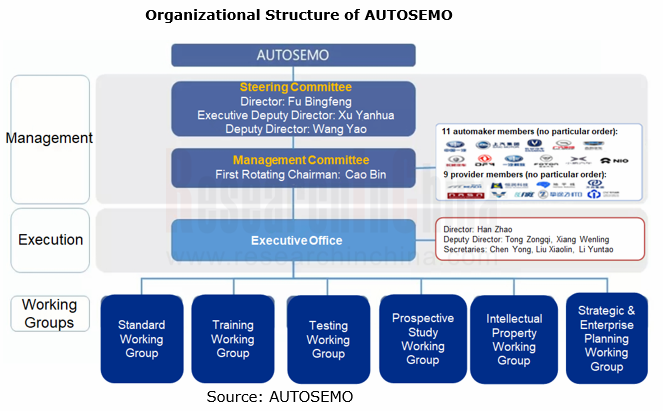
The missions of the AUTOSEMO are: to formulate local companies-led proprietary basic software architecture standards and interface specifications for future intelligent connected vehicles (ICV) to share knowledge and results and build an industrial ecosystem; to create a vehicle software ecosystem communication platform for the industry with the concept of independence, development and innovation.
In November 2020, the AUTOSEMO introduced the China Automotive Basic Software Development White Paper 1.0, which analyzes all opportunities and challenges in the development of China's automotive basic software, sorts out the status quo of China's automotive basic software industry, and puts forward the hot issues in the industry.
In June 2021, the AUTOSEMO publicized the Vehicle SOA Software Architecture Specification 1.0, the first theoretical system of SOA software architecture for the automotive industry.
In September 2021, the AUTOSEMO released China Automotive Basic Software Development White Paper 2.0 and Vehicle SOA Software Architecture Specification 1.1 at the World Intelligent Connected Vehicles (ICV) Conference, two upgraded versions which elaborate background and architecture of SOA standards, overall framework of AUTOSEMO Service Framework (ASF), promotion plan of ASF group standards working group, and development of AUTOSEMO standards.
Foreign providers work to explore the application of AUTOSAR in ICV.
Through the lens of market pattern, overseas providers such as EB (Continental), ETAS (Bosch) and VECTOR have played a dominant role in AUTOSAR Classic standard-compliant development tool chain and basic software; typical Chinese players are Neusoft Reach, Huawei and iSoft Infrastructure Software. Foreign companies with a long foothold in AUTOSAR are endeavoring to explore the application of AUTOSAR Adaptive in ICV fields (ADAS, intelligent cockpit, OTA, etc.). Examples include EB, the first one to probe AUTOSAR Adaptive Platform (AUTOSAR AP), having partnered with Volkswagen on use of its SOA platform in ID.3 (4) and gaining a leading edge.
? EB keeps extending its AUTOSAR tool chain and adding product features.
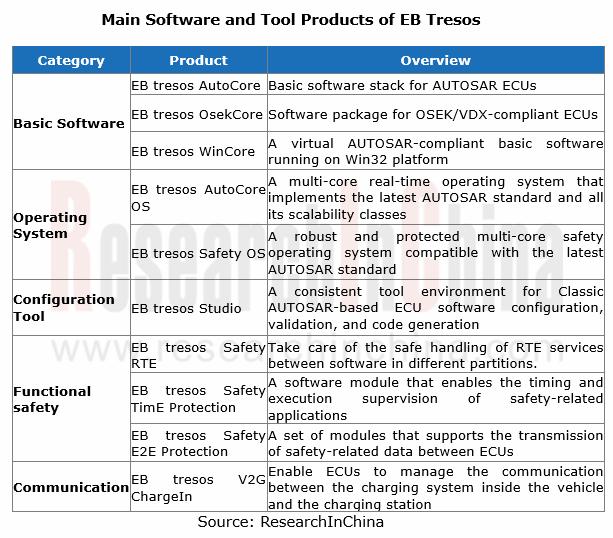
As an established AUTOSAR provider, EB boasts a full range of product lines, including AUTOSAR Adaptive products like EB Corbos Linux, EB corbos Hypervisor, EB corbos Studio, EB corbos Adaptive Core and EB xelor, and the AUTOSAR Classic software tool EB tresos.
In late 2020, EB launched EB xelor, an all-in-one software platform for creating next-generation automotive electronics architectures based on high-performance computers (HPCs). It can reduce OEMs’ HPC engineering efforts by up to 30%.
In June 2021, EB added EB tresos V2G ChargeIn, a new, in-vehicle, AUTOSAR-compatible software module that—in combination with an ISO 15118-compliant communication stack—enables ECUs to manage the communication between the charging system inside the vehicle and the charging station. In addition, through a partnership with SEVENSTAX, EB tresos AutoCore now integrates the fully ISO 15118-compliant SEVENSTAX application stack, supporting the latest V2G communication features.
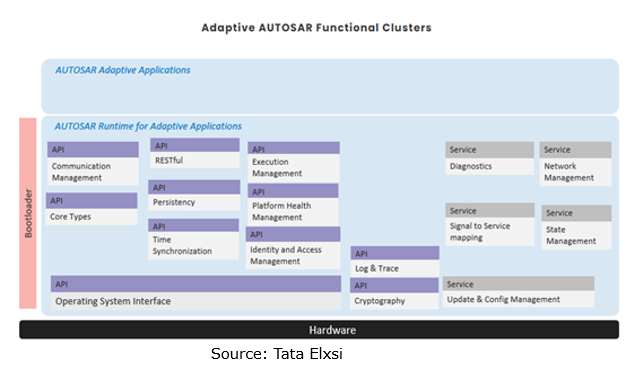
? Tata Elxsi unveiled a new intelligent cockpit application.
In November 2021, Tata Elxsi and Green Hills Software announced their collaboration on a Driver Monitoring System (DMS) platform that combines advanced DMS software (V.O.E.O.S.Y.S, Vehicle Operator Environment Observation System) and AUTOSAR Adaptive from Tata Elxsi integrated with the safe and secure INTEGRITY? real-time operating system (RTOS) from Green Hills Software optimized to run on the latest families of automotive-grade microprocessors.
The integrated AUTOSAR Adaptive-based DMS delivers intelligent determination of a driver’s readiness and state of attentiveness and runs on the safe, secure INTEGRITY-based high-performance platform.
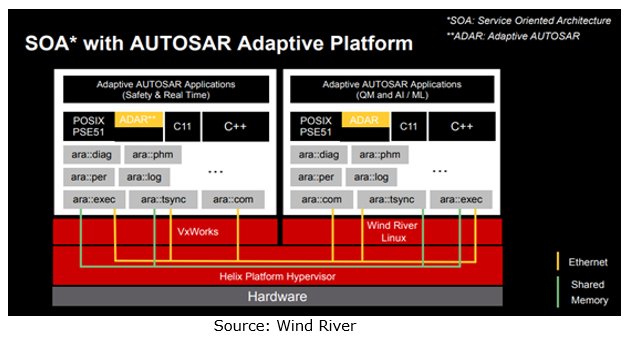
? Wind River makes great efforts on autonomous driving application.
In April 2021, Wind River collaborated with Vector to deliver service-oriented architecture (SOA) capabilities for the development of advanced driver assistance systems (ADAS) and autonomous driving based on the AUTOSAR Adaptive standard. The joint solution comprises Vector’s AUTOSAR Adaptive technologies and the new Wind River Studio, which includes the VxWorks? real-time operating system (RTOS).
In October 2021, Wind River announced that TüV SüD endorsed an ISO 26262 ASIL-D certification program for its AUTOSAR Adaptive software platform which provides a foundation for a next-generation ADAS and autonomous driving systems.
Chinese providers try hard to deploy and develop independently.
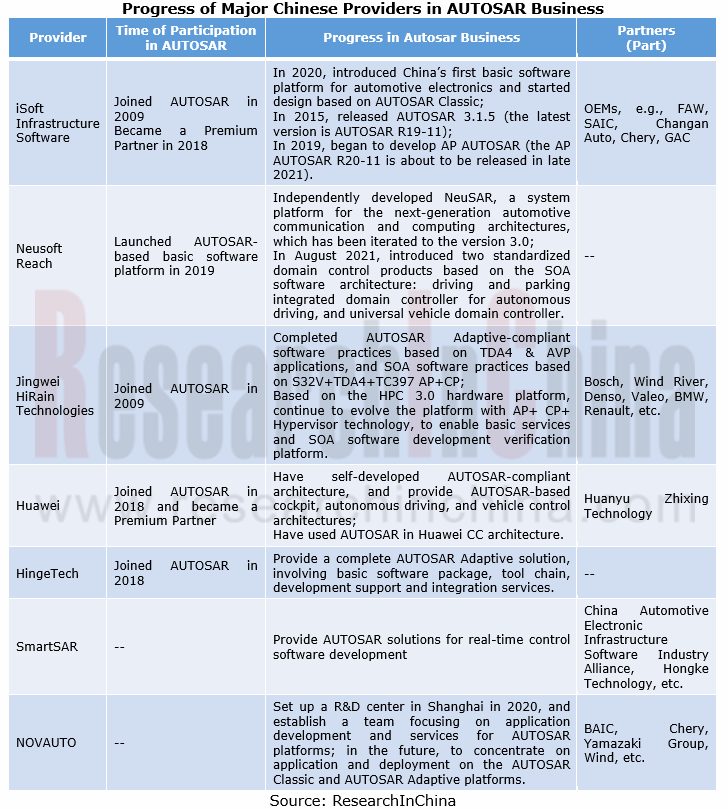
In China, local companies are trying hard to self-develop AUTOSAR Classic. Both Chinese and foreign companies are still in their infancy in AUTOSAR Adaptive development. Chinese providers exert great efforts on it amid an unclear competitive pattern.
? iSoft Infrastructure Software
In November 2021, iSoft Infrastructure Software and SemiDrive built strategic cooperation on automotive chips, operating systems, and basic software. They have launched a complete AUTOSAR Classic solution based on SemiDrive G9X smart gateway chip.
With MCAL from SemiDrive, and AUTOSAR OS, RTE and BSW provided by iSoft Infrastructure Software, the solution is a totally proprietary software and hardware AUTOSAR solution that meets functional safety requirements. The software and hardware integrated digital base of the solution not only helps customers shorten the evaluation cycle and save development costs but brings the computing capability of SemiDrive chips into a better play, making it easier to develop software.
iSoft Infrastructure Software’s Configuration Tool at the underlying layer MCAL of the solution seamlessly connects ORIENTAIS AUTOSAR products and components. Based on ORIENTAIS AUTOSAR, it enables complete gateway basic functions: AUTOSAR OS, CAN communication, LIN communication, CAN network management, NVM protocol stack, system management, CSM, Wathchdog, etc.
SemiDrive previously used EB tresos Studio based on AUTOSAR Classic to develop automotive chip underlying software on the AUTOSAR standard-compliant microcontroller abstraction layer (MCAL) development platform. The selection of iSoft’s basic software is the evidence that the technical strength of Chinese providers is gaining recognition.
? Neusoft Reach
In November 2020, Neusoft Reach upgraded NeuSAR, its self-developed AUTOSAR-compliant system platform for next-generation automotive communication and computing architectures, to the version 3.0. With years of iteration and development, NeuSAR has been used widely and deployed in such application scenarios as traditional ECU, domain controller, central computing unit and vehicle cloud integration, providing AUTOSAR standard-compliant products and services like aCore, cCore, middleware, and tool chain, for autonomous driving, intelligent connection, vehicle domain, EV power domain and other fields.
In August 2021, Neusoft Reach rolled out two standardized domain control products: driving and parking integrated domain controller for autonomous driving, and universal vehicle domain controller. At the software layer, the two products are SOA-based software architectures with preset standardized basic software and middleware for autonomous driving, and standard configuration of Neusoft Reach’s self-developed AUTOSAR-compliant basic software products—NeuSAR and related development tools, based on which developers can develop upper layer applications and iterate functions rapidly.
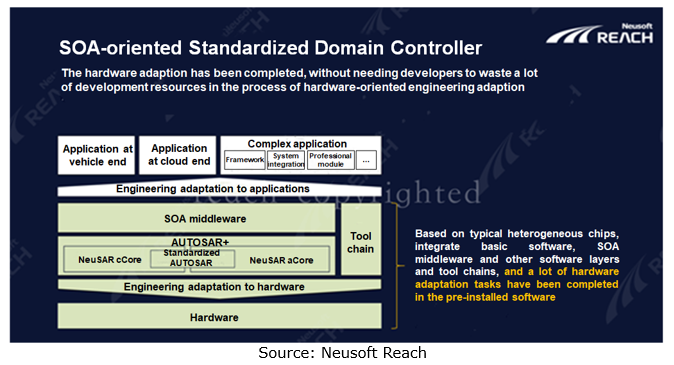
In the fast disruption in the intelligent vehicle industry, basic software providers need to partner closely with automakers to satisfy the changing needs of the upper-layer applications for the underlying software. Neusoft Reach hopes to be a participant in framework construction and a provider of key components and services (e.g., standard AUTOSAR components and middleware on AUTOSAR basic software) in the development of the industry, and help automakers build their own iterable software systems by catering to their application development needs, so as to speed up the evolution of the automotive industry to an intelligent one.
? Huawei
Huawei’s self-developed AUTOSAR-based architectures are autonomous and controllable, delivering high matching rate, high integration and high degree of freedom. Based on its deep understanding of AUTOSAR, Huawei introduced its self-developed VOS architecture that supports the evolution from the international AUTOSAR specifications to Chinese vehicle specifications.
Based on AUTOSAR AP architecture, Huawei is working to make its vehicle products deploy and upgrade applications just as a smartphone. Moreover, it is easier for different Tier-1 suppliers to integrate and upgrade on a single multi-core controller. They are also allowed to independently develop power domain, chassis domain, body domain and entertainment domain and eventually realize more efficient integration.
The AUTOSAR Basic Software Platform Report, 2021 highlights the following:
 AUTOSAR (basic concept, classification, industry standards, competitive pattern, etc.);
The role of AUTOSAR in the evolution of EE architectures, the impact of AUTOSAR on vehicle networks, the development roadmap of AUTOSAR Adaptive, etc.;
AUTOSAR application (OTA, ADAS, intelligent cockpit, vehicle control, SOA, etc.);
Foreign and Chinese AUTOSAR companies (product lines, new business orientations, etc.).
Automotive Microcontroller Unit (MCU) and Application Scenario Research Report, 2026
Automotive MCU Research: Increased demand for redundant security drives ASIL D-compliant MCU shipments to exceed 100 million units
In a vehicle EEA, MCUs are widely distributed in various functional ...
China Intelligent Cockpit Patent Analysis Report, 2026
Intelligent Cockpit Patent Research: Cockpit AI, In?vehicle Health, and Infotainment Are Upgrade to Scenario?based and Proactive Functions
From a patent perspective, this report explores the cutting?...
Research Report on Application of VLA Large Model in Automobiles and Robots, 2026
Research on Automotive and Robot VLA: Hybrid Architectures Become Mainstream, VLA Integrates with General World Models, and Reinforcement Learning Serves as Core Engine
Vision?Language?Action (VLA) m...
China Charging Infrastructure (Supercharging, Battery Swapping, V2G, etc.) and High-Performance Supercharging Battery Research Report, 2026
Charging and battery swapping research: as 5C+ supercharging vehicle models go into mass production, the pace of OEMs self-building supercharging networks quickens
800-1000V high-voltage platforms ar...
China Passenger Car Electronic Controlled Suspension Industry Report, 2026
Electronic Controlled Suspension Industry Research: As the First Year of Full Active Suspension Unfolds, Three Technical Routes Race Forward
1. Penetration Rate Surges Three Times, and Electronic Con...
Intelligent Driving SoC Research Report, 2026
Research on Intelligent Driving SoCs: Competition Focus Shifts to L3/L4 Embedded Hardware, and Computing Power of Flagship Vehicle Models Exceeds 1,000 TOPS
In terms of intelligent driving system in...
Automotive AI Large Model Technology Research Report, 2026
Automotive AI Large Model Research: Competition Shifts from "Who Has the Stronger Model" to "Who Boasts Higher Link Efficiency"
ResearchInChina released the Automotive AI Large Model Technology Resea...
Intelligent Vehicle Cockpit Domain Controller Research Report, 2026
Cockpit domain controller research: L3 AIDV intelligent cockpit domain controllers are entering a boom period
Driven by multiple factors such as the continuous evolution of the automotive central int...
Automotive Acoustic System (Audio, Multi-Channel) Industry Report, 2026
Automotive Acoustics Research: Multiple Channels, AI Tuning, and Self-Developed Algorithms Drive the Transformation of High-End Cockpit Sound Fields
I. Automotive Audio Hardware Solutions with 6–9 S...
Autonomous Driving Sensor Chip Research Report, 2026
Research on Autonomous Driving Sensor Chips: Deeply Perceiving the Physical World, Sensor Chips Are Playing A “Leading Role” in Intelligence
In 2026, the autonomous driving sensor chip industr...
Passenger Car Corner Module and Wheel‑Side Control System Research Report, 2026
Wheel-side control research: the “last mile” chassis innovation
Wheel-side control dismantles the traditional drive, braking, steering, and suspension control of the chassis from a "centralized" styl...
Embodied Artificial Intelligence (& Humanoid Robot) MCU Research Report, 2026
Research on Humanoid Robot MCUs: Evolution from General-Purpose Control to High-Value Dedicated Chip Solutions Integrated with Edge AI Functions
MCU (Microcontroller Unit) refers to a compact integra...
Intelligent Vehicle Zone Control Unit (ZCU) Research Report, 2026
ZCU Research: Cross-domain integrated ZCUs are becoming the edge computing nodes of the next-generation zonal architecture
Currently, the mainstream zonal architecture is mainly the quasi-central + z...
Automotive Cybersecurity and Data Security Research Report, 2026
Cybersecurity & Data Security Research: Intelligent Connected Vehicles Enter the Era of “Systematic Offense-Defense and AI-Defined Security”.
Centering on the panorama of intelligent connect...
Report on Breakthrough Strategies of OEMs and ADAS Tier 1 Suppliers for Overseas Layout of Intelligent Driving, 2026
Regulatory Breakthrough, Local System Establishment, OEMs Competing for NOA Layout: Overall Trends of China’s Intelligent Driving Overseas Layout in 2026
Research on overseas intelligent driving layo...
OEMs and Tier1s’ Intelligent Cockpit Platform (Hardware and Software) Innovation Strategy Research Report, 2026
Intelligent Cockpit Platform Research: multi-dimensional cockpit system architecture reconstruction for multi-agent collaboration and proactive intelligent services
The intelligent cockpit software s...
Automotive AIOS Research Report, 2026
Automotive AIOS Research: Mass Production Solutions Are Implemented
Mass Production Solutions Are Implemented on A Small Scale.
In 2026, AIOS starts small-scale implementation, helping to improve v...
Automotive Telematics Service Provider (TSP) Research Report, 2026
TSP Research: Leading providers collectively turn to AI agents to provide all-scenario active services
Telematics Service Providers (TSPs) are the core hub of the telematics industry chain, connectin...