Research on 800V high voltage platform: the mass production will commence in 2022
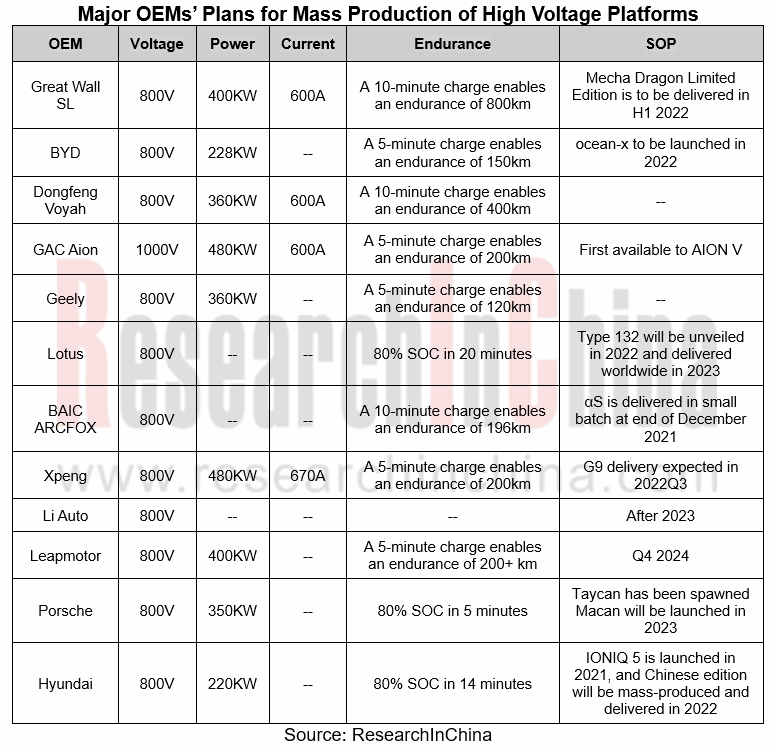
800V high voltage platform-based models are a key deployment of OEMs.
It is hard for a 400V platform to enable >200KW fast charge under current E/E architectures, while the upgrade to the 800V platform allows much smaller fast charging current at 200KW, making it more likely to achieve >350KW fast charge.
In the case of the same charging power, under the 800V fast charging architecture the high voltage wiring harness boasts smaller diameter and costs less, and the battery dissipates less heat, which makes thermal management easier and optimizes the overall cost of the battery.
Already, most OEMs have made aggressive inroads into the 800V high voltage platform since it serves as an efficient solution to the replenishment anxiety.
In 2021, BYD, Geely, Great Wall Motor, Xpeng Motors and Leapmotor among others have announced their 800V high voltage technology deployment plans; Li Auto, NIO and the likes are preparing for related technologies as well. Through the lens of start of production, major OEMs will roll out their new vehicles based on 800V solution beyond 2022.
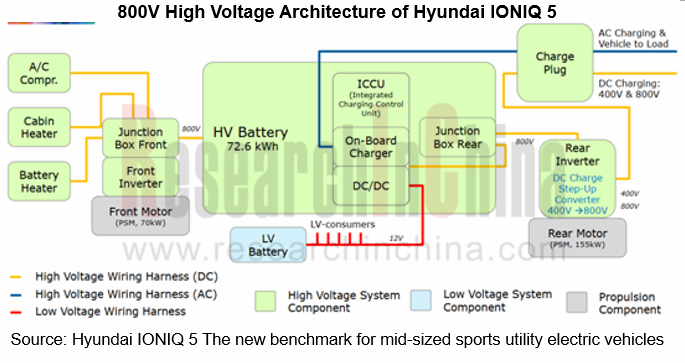
Hyundai: at the Auto Shanghai 2021, Hyundai introduced IONIQ5, the first IONIQ BEV model developed on the E-GMP. The Chinese edition will be spawned in 2022. IONIQ5 highlights the following:
- It takes just 18 minutes to rise state of charge (SOC) from 10% to 80%;
- 800V high voltage architecture
- The rear wheel drive integrates a HV booster that converts 400V to 800V.
From the 800V architecture diagram of IONIQ 5, it can be seen that almost all high voltage devices have been upgraded to 800V; the front wheel drive is a 75kW three-in-one drive, while the rear one is a 155kW five-in-one drive, with a 400V to 800V converter designed for wider scenarios of fast charge.
Great Wall: in November 2021, Great Wall SL unveiled Mecha Dragon, its first model that packs proprietary Dayu battery delivering capacity of 115kWh and CLTC range of 802km. Besides, Mecha Dragon uses 800V charging technology, enabling a 401km endurance by a 10-minute charge and 545km by a 15-minute charge, with peak current up to 600A.
Great Wall also endeavors to deploy 800V high voltage components, such as 800V dual-motor vector control module, 800V SiC controller, and 800V~1000V 250A ultrahigh voltage wiring harness systems.
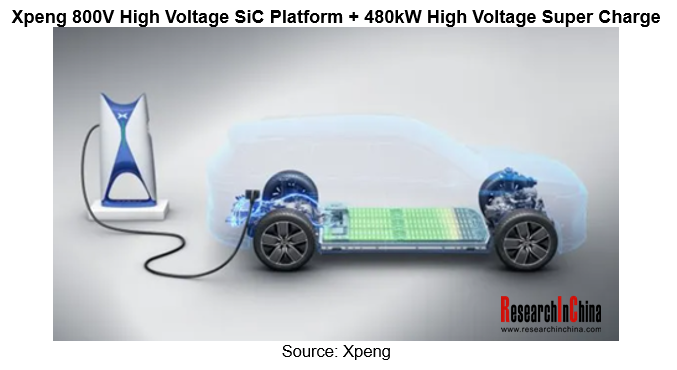
Xpeng: in November 2021, Xpeng released Xpeng G9, a production vehicle based on the 800V high voltage SiC platform. The new car can travel more than 200km by a 5-minute super charge. Its maximum charging current also exceeds 600A, electric drive efficiency is as high as 95%, and overall system efficiency is close to 90%.
All components on Xpeng G9 are 800V ones, meaning they support the high voltage of 800V. In addition, Xpeng G9 reduces the resistance of each high voltage linkage, and also offers safety protection in special circumstances. The maximum charging current of over 600A enables super charge in a real sense.
Leapmotor: in July 2021, Leapmotor announced its Future Strategy 2.0, specifying a clear-cut plan for 800V high voltage technology. The carmaker is scheduled to mass-produce the 800V ultrahigh voltage electrical platform in the fourth quarter of 2024, which allows 400KW ultrafast charge and brings a 200km endurance by a 5-minute charge. Moreover, Leapmotor also projects mass-production of a high-performance high-power silicon carbide (SiC) controller in late 2023 to replace the current IGBTs. This product in support of 800V fast charge can lift the power of motors to 300KW, with a 4% rise in efficiency.
OEMs step up efforts to deploy the self-operated ultrafast charging networks for their high voltage platform-based models.
Vehicles equipped with 800V high voltage platforms charge on existing common charging piles that allow just lower-than-expected charging speed and fall short of ultrafast charging in real terms. The onboard 800V high voltage platform therefore cannot exert itself fully without super charging piles. It grows a trend for 800V vehicle high voltage platform and super charging pile to be combined.
At present, models based on 800V platforms is in readiness for production, and the deployment of super charging piles is also progressing steadily. As well as cooperating with operators to deploy charging networks, OEMs also work to build their own. The high voltage technology is an important development trend regardless of self-built or cooperative charging networks.
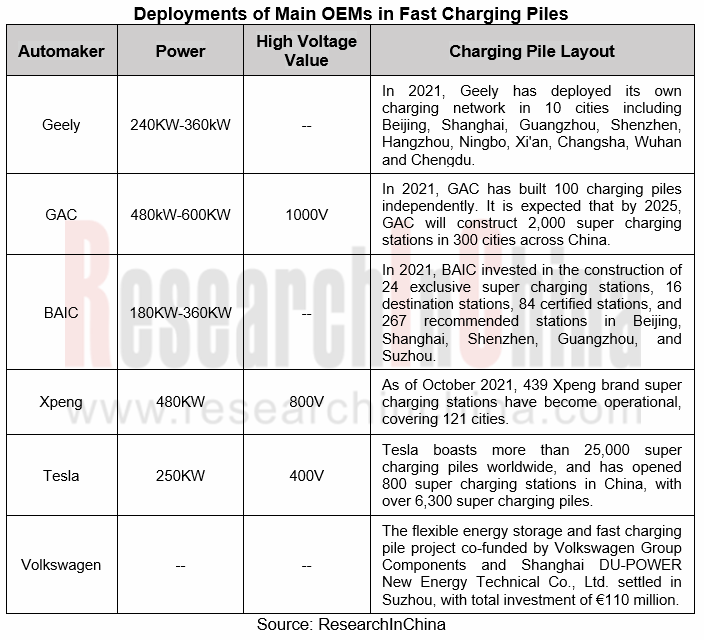
GAC: in August 2021, GAC AION launched an A480 super charging pile, which is compatible with 800V high voltage platform-based models. This pile enables 6C high-rate charge, that is, 0% to 80% charge in 8 minutes, and 30% to 80% charge in 5 minutes.
GAC AION has built its first super charging station at Guangzhou Donghong International Plaza and has brought it into operation, with a plan to build 2,000 super charging stations in 300 cities by 2025.
Xpeng: Xpeng’s super energy replenishment system is implemented at vehicle, charging pile and station simultaneously. At the vehicle end, the production models with 800V high voltage SiC platforms will be deployed. As concerns the charging pile, the 480kW high voltage supercharging piles will be first built. In the charging station, the self-developed energy storage and charging technologies will be applied, with energy storage at a time meeting the needs of 30 vehicles for uninterrupted high power super charge. As of October 2021, there have been 439 Xpeng brand supercharging stations in 121 cities.
Automotive SiC ushers in a boom, and suppliers expedite their layout.
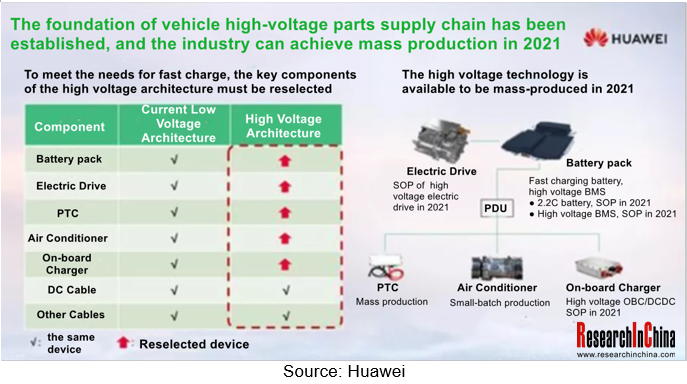
On the 800V high voltage platform, the withstand voltage of system components also needs to be leveled up to 800V, so do the corresponding components and materials. And under the high voltage architecture, battery pack, electric drive, PTC, air conditioner, on-board charger, etc. all require being re-selected as well.
As for the vehicle, high voltage technologies such as electric drive, fast charging battery, PTC, and DCDC have been production-ready. In fast charging battery’s case, in April 2021, Honeycomb Energy Technology under Great Wall Motor launched an all-new fast charging battery and corresponding battery cells. The 1st-Gen 2.2C fast-charging battery features cell capacity of 158Ah and energy density of 250Wh/kg, and enables 20%-80% SOC in 16 minutes. It is to be mass-produced in the fourth quarter of 2021. The 2nd-Gen 4C fast-charging battery boasts typical charging capacity of 165Ah and energy density of >260Wh/kg, and enables 20%-80% SOC in 10 minutes. Its mass production is arranged in Q2 2023.
SiC features good voltage withstand, high stability, better frequency than silicon-based IGBTs, and small size, in the process of upgrading 800V high voltage platform components. It has drawn widespread attention in the industry.
In new energy vehicles, SiC is largely used in vehicle power supplies and motor controllers. Though still priced high in a relative sense and the inevitable higher cost by massive adoption in a single vehicle, the use of SiC devices can deliver a longer mileage range and slash the battery cost. The cost of a single vehicle is actually lower after offsetting the cost rise caused by SiC devices.
In the long run, the price of SiC devices will edge down. In China, silicon-based IGBTs are monopolized by foreign vendors, while in the SiC field Chinese suppliers like Huawei, Shinry Technologies and Zhuhai Enpower Electric have made successful deployments. Chinese players may outrun and replace their foreign peers in the race. The cost of SiC devices will drop further if localized.
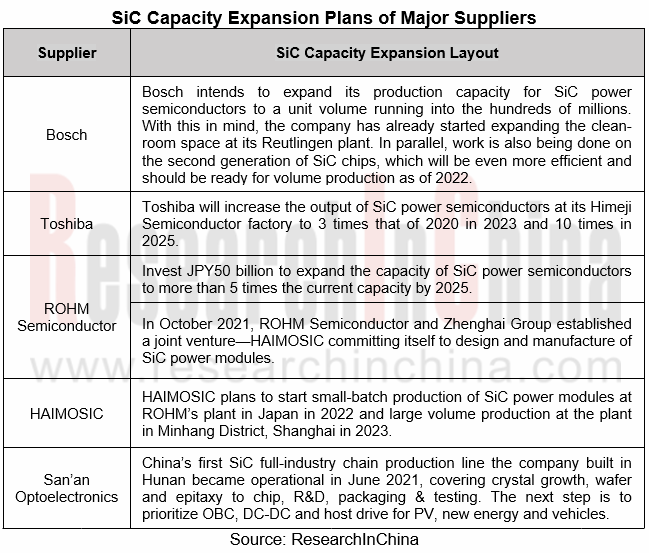
The mass production of 800V high voltage platforms breathes new life into the development of SiC. Influential suppliers compete to expand SiC production capacity to satisfy the growing demand.
The 800V High Voltage Platform Research Report, 2022 highlights the following:
 Introduction to 800V high voltage platform and its advantages, vehicle high voltage platform standards, charging pile high voltage platform standards, high voltage platform market size and competitive landscape, etc.;
800V high voltage platform's impacts on the upstream industry chain (battery, electric drive, thermal management, etc.), electrical architecture design of the 800V high voltage platform, status quo of the downstream new energy vehicle sector, etc.;
Development stages of 800V high voltage platform, its availability on vehicles, and its use in charging piles, etc.;
Merits of SiC applied in 800V high voltage platform, its application at the vehicle end, its application in charging piles, status quo of SiC industry, etc.;
Deployments of OEMs and suppliers in 800V high voltage technology.
Automotive Microcontroller Unit (MCU) and Application Scenario Research Report, 2026
Automotive MCU Research: Increased demand for redundant security drives ASIL D-compliant MCU shipments to exceed 100 million units
In a vehicle EEA, MCUs are widely distributed in various functional ...
China Intelligent Cockpit Patent Analysis Report, 2026
Intelligent Cockpit Patent Research: Cockpit AI, In?vehicle Health, and Infotainment Are Upgrade to Scenario?based and Proactive Functions
From a patent perspective, this report explores the cutting?...
Research Report on Application of VLA Large Model in Automobiles and Robots, 2026
Research on Automotive and Robot VLA: Hybrid Architectures Become Mainstream, VLA Integrates with General World Models, and Reinforcement Learning Serves as Core Engine
Vision?Language?Action (VLA) m...
China Charging Infrastructure (Supercharging, Battery Swapping, V2G, etc.) and High-Performance Supercharging Battery Research Report, 2026
Charging and battery swapping research: as 5C+ supercharging vehicle models go into mass production, the pace of OEMs self-building supercharging networks quickens
800-1000V high-voltage platforms ar...
China Passenger Car Electronic Controlled Suspension Industry Report, 2026
Electronic Controlled Suspension Industry Research: As the First Year of Full Active Suspension Unfolds, Three Technical Routes Race Forward
1. Penetration Rate Surges Three Times, and Electronic Con...
Intelligent Driving SoC Research Report, 2026
Research on Intelligent Driving SoCs: Competition Focus Shifts to L3/L4 Embedded Hardware, and Computing Power of Flagship Vehicle Models Exceeds 1,000 TOPS
In terms of intelligent driving system in...
Automotive AI Large Model Technology Research Report, 2026
Automotive AI Large Model Research: Competition Shifts from "Who Has the Stronger Model" to "Who Boasts Higher Link Efficiency"
ResearchInChina released the Automotive AI Large Model Technology Resea...
Intelligent Vehicle Cockpit Domain Controller Research Report, 2026
Cockpit domain controller research: L3 AIDV intelligent cockpit domain controllers are entering a boom period
Driven by multiple factors such as the continuous evolution of the automotive central int...
Automotive Acoustic System (Audio, Multi-Channel) Industry Report, 2026
Automotive Acoustics Research: Multiple Channels, AI Tuning, and Self-Developed Algorithms Drive the Transformation of High-End Cockpit Sound Fields
I. Automotive Audio Hardware Solutions with 6–9 S...
Autonomous Driving Sensor Chip Research Report, 2026
Research on Autonomous Driving Sensor Chips: Deeply Perceiving the Physical World, Sensor Chips Are Playing A “Leading Role” in Intelligence
In 2026, the autonomous driving sensor chip industr...
Passenger Car Corner Module and Wheel‑Side Control System Research Report, 2026
Wheel-side control research: the “last mile” chassis innovation
Wheel-side control dismantles the traditional drive, braking, steering, and suspension control of the chassis from a "centralized" styl...
Embodied Artificial Intelligence (& Humanoid Robot) MCU Research Report, 2026
Research on Humanoid Robot MCUs: Evolution from General-Purpose Control to High-Value Dedicated Chip Solutions Integrated with Edge AI Functions
MCU (Microcontroller Unit) refers to a compact integra...
Intelligent Vehicle Zone Control Unit (ZCU) Research Report, 2026
ZCU Research: Cross-domain integrated ZCUs are becoming the edge computing nodes of the next-generation zonal architecture
Currently, the mainstream zonal architecture is mainly the quasi-central + z...
Automotive Cybersecurity and Data Security Research Report, 2026
Cybersecurity & Data Security Research: Intelligent Connected Vehicles Enter the Era of “Systematic Offense-Defense and AI-Defined Security”.
Centering on the panorama of intelligent connect...
Report on Breakthrough Strategies of OEMs and ADAS Tier 1 Suppliers for Overseas Layout of Intelligent Driving, 2026
Regulatory Breakthrough, Local System Establishment, OEMs Competing for NOA Layout: Overall Trends of China’s Intelligent Driving Overseas Layout in 2026
Research on overseas intelligent driving layo...
OEMs and Tier1s’ Intelligent Cockpit Platform (Hardware and Software) Innovation Strategy Research Report, 2026
Intelligent Cockpit Platform Research: multi-dimensional cockpit system architecture reconstruction for multi-agent collaboration and proactive intelligent services
The intelligent cockpit software s...
Automotive AIOS Research Report, 2026
Automotive AIOS Research: Mass Production Solutions Are Implemented
Mass Production Solutions Are Implemented on A Small Scale.
In 2026, AIOS starts small-scale implementation, helping to improve v...
Automotive Telematics Service Provider (TSP) Research Report, 2026
TSP Research: Leading providers collectively turn to AI agents to provide all-scenario active services
Telematics Service Providers (TSPs) are the core hub of the telematics industry chain, connectin...