Research on emerging carmaking strategies: no new cars in 2021, 3 new cars in 2022, can NIO make its renaissance?
The delivery of ET7 is imminent, and the sluggish sales situation is expected to fade out in 2022
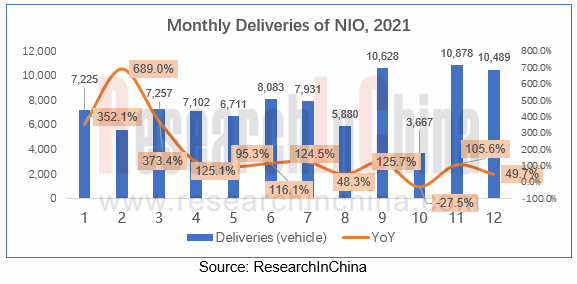
In 2021, NIO sold 90,805 cars, a year-on-year surge of 108%. However, its ranking among emerging automakers by sales volume dropped from the first in 2020 to the third. This is mainly affected by three factors.
First, the delivery plunged in October 2021 due to the reorganization and upgrade of the production line as well as the preparation for the launch of new products.
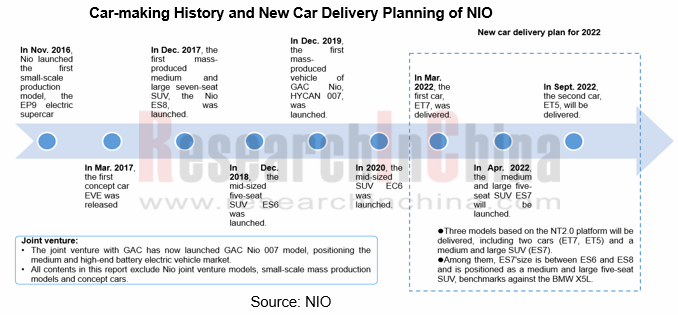
Second, the upcoming ET7, ET5 and ES7 will all be delivered in 2022, which led to a gap throughout 2021 when the existing models ES6 and EC6 were squeezed by new stronger rivals such as Model Y and BMW iX3.
Third, new cars were mainly sold in first-tier cities. In 2021, NIO saw the highest sales volume in the economically developed coastal provinces and cities, especially Shanghai, Beijing and Hangzhou contributed the overwhelming 33%.
In 2022, NIO will deliver three new models one after another, and its sluggish sales status is expected to fade out. ET7 delivered on March 28th is the first model based on the NT2.0 platform. It is equipped with NIO Autonomous Driving (NAD). Compared with NIO Pilot, it adds emergency active Parking Assist (EAS), emergency lane keeping (ELK), Advanced Driver Monitoring System (ADMS), Power Station Parking Assist (PSAP), autonomous driving functions on some urban roads, etc.
ET7 is equipped with four NVIDIA DRIVE Orin chips with a computing power of 1016TOPS. Two Orin SoCs are used as master chips to realize NAD full-stack computing. The third Orin SoC acts as a redundant backup; if any main chip fails, NAD can ensure safety. The fourth Orin SoC implements local training, and can personalize training as per user habits to speed up NAD evolution.
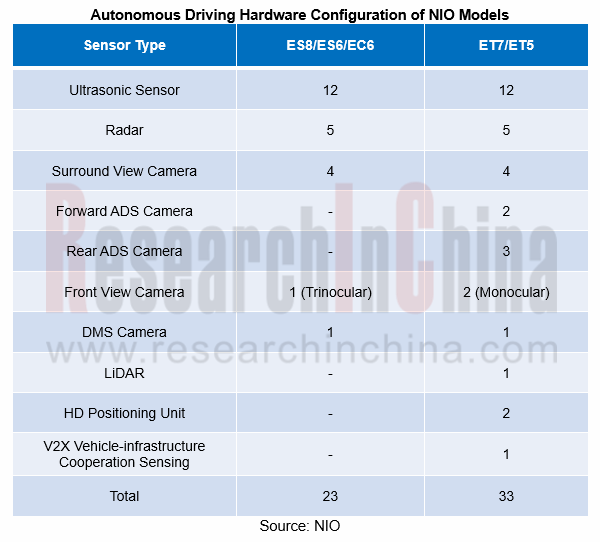
In terms of hardware configuration, ET7 is equipped with radar, ultrasonic radar, 1,550nm LiDAR and CVIS perception controls in preparation for software upgrades for higher-level autonomous driving in the future. It is worth mentioning that the solid-state LiDAR provided by Innovusion has a horizontal viewing angle of 120°, a maximum detection distance of 500 meters, and a maximum resolution of 0.06°x0.06°. In addition, the watchtower-like layout reduces the blind spots of the sensor.
Relying on Internet operation, community marketing has become a role model in the industry
Most traditional automakers take delivering orders as the ultimate goal, and they terminate marketing campaigns as soon as deals are completed. NIO regards the purchase of products by users as the beginning of its marketing, and makes experience and marketing penetrate into the entire life cycle of products.
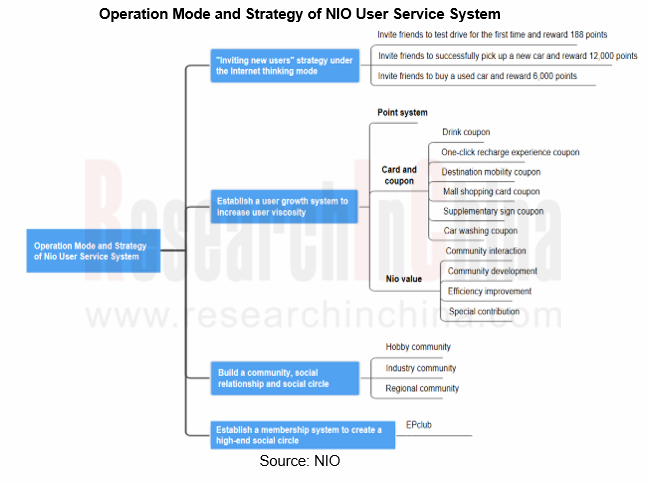
In NIO's ripple model, core car owners are in the kernel, accounting for about 10% of the total car owners. Core car owners play an exemplary role to attract followers closer to them, and continuously expand their influence. Similarly, this model is also vividly reflected in the operation of APP community. For community operation, NIO has established a set of user service system, with the following operation methods and strategies:
1. Recruitment strategy: the Internet operation method is adopted, with reward points for old users who invite new users successfully. The points earned by users can be exchanged for gifts at NIO Life (NIO’s mall), or for coffee coupons, event tickets and some other rewards at NIO House (NIO’s offline user center).
2. User growth system: three evaluation criteria - points, coupons and NIO Value.
Points: exchange for gifts and other benefits.
Cards and coupons: including drink coupons, one-click recharge coupons, destination mobility coupons, etc.
NIO Value: It is an accumulated value that records each user's activities in NIO community and his/her contribution to the community. Its unit is N.
3. A community was established to create a social circle for ordinary users: The community of NIO APP makes it easier for users to find like-minded people according to hobbies, regions and industries.
4. A membership system was erected to forge a high-end social circle.
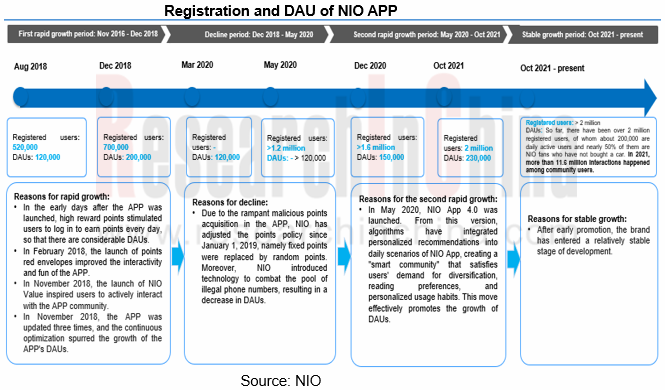
The update frequency of NIO APP is very high. From its launch in November 2016 to February 2022, NIO APP experienced four versions - 1.0, 2.0, 3.0, and 4.0, with a total of 44 updates and an update every two months averagely. The functions of the APP are continuously optimized and adjusted, so that users can always feel refreshed.
Under such operational measures, NIO APP has become the cornerstone for establishing deep connections with users. So far, there have been over 2 million registered users, of whom about 200,000 are daily active users and nearly 50% of them are NIO fans who have not bought a car. In 2021, more than 11.6 million interactions happened among community users, and each EPclub member recommend 25 NIO cars for sale averagely, equivalent to RMB10 million as per the unit selling price of RMB400,000.
NIO lays out the operation ecology of the Internet of Vehicles in advance by manufacturing mobile phones
In terms of intelligent connectivity, NIO's smart cockpit is equipped with the NOMI in-vehicle artificial intelligence system, so that NIO car owners can communicate with other people and vehicles through NOMI. NIO also continuously upgrades and optimizes the functions of NOMI via OTA. For example, NIO has improved the recognition capability and wake-up rate (especially the response to children's wake-up) of NOMI in the Aspen 3.0 unveiled in September 2021; at the same time, it has ramped up NOMI’s control over cars, such as memory of seat positions, adjustment of ambient light brightness, switching of sound field modes and other car control commands. In the Aspen 3.1 launched in January 2022, wake-up words + continuous instructions are added, without calling NOMI before giving a command. NIO plans to optimize the understanding, hearing, and understanding of NOMI in the future.
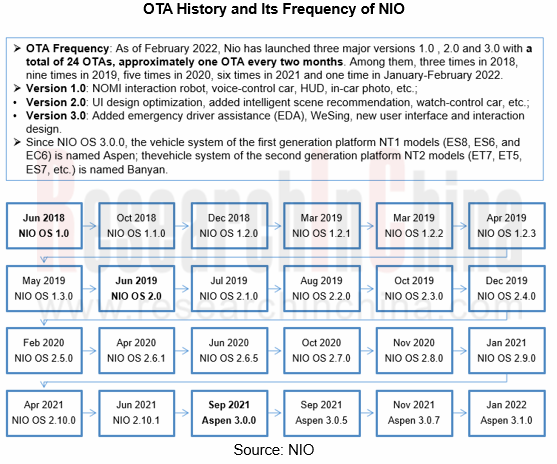
Besides, NIO has maintained a high frequency of OTA updates for the Internet of Vehicles. As of February 2022, NIO had launched three major versions, 1.0, 2.0, and 3.0, with a total of 24 OTA updates and about once every two months. Specifically, three updates occurred in 2018, nine in 2019, five in 2020, six in 2021, and one in January-February 2022.
Features of OTA updates for the Internet of Vehicles:
? All models support OTA updates.
?A major system upgrade is carried out almost every year, such as NIO OS 2.0 (Jun 2019), Aspen 3.0 (Sep 2021).
?As of February 2022, there had been 351 OTA updates, 56.1% of which were reflected in IVI, ADAS and autonomous driving.
In its future planning, NIO expects to form a closed “people-vehicles-mobile phones” loop through interconnection between mobile phones and IVI, realize data sharing, and provide users with more intelligent interactive life experience. It is reported that NIO is preparing for dabbling in the mobile phone industry. Yin Shuijun, the former president of Meitu, has joined NIO and leads the mobile phone business.
Research Report on Application of VLA Large Model in Automobiles and Robots, 2026
Research on Automotive and Robot VLA: Hybrid Architectures Become Mainstream, VLA Integrates with General World Models, and Reinforcement Learning Serves as Core Engine
Vision?Language?Action (VLA) m...
China Charging Infrastructure (Supercharging, Battery Swapping, V2G, etc.) and High-Performance Supercharging Battery Research Report, 2026
Charging and battery swapping research: as 5C+ supercharging vehicle models go into mass production, the pace of OEMs self-building supercharging networks quickens
800-1000V high-voltage platforms ar...
China Passenger Car Electronic Controlled Suspension Industry Report, 2026
Electronic Controlled Suspension Industry Research: As the First Year of Full Active Suspension Unfolds, Three Technical Routes Race Forward
1. Penetration Rate Surges Three Times, and Electronic Con...
Intelligent Driving SoC Research Report, 2026
Research on Intelligent Driving SoCs: Competition Focus Shifts to L3/L4 Embedded Hardware, and Computing Power of Flagship Vehicle Models Exceeds 1,000 TOPS
In terms of intelligent driving system in...
Automotive AI Large Model Technology Research Report, 2026
Automotive AI Large Model Research: Competition Shifts from "Who Has the Stronger Model" to "Who Boasts Higher Link Efficiency"
ResearchInChina released the Automotive AI Large Model Technology Resea...
Intelligent Vehicle Cockpit Domain Controller Research Report, 2026
Cockpit domain controller research: L3 AIDV intelligent cockpit domain controllers are entering a boom period
Driven by multiple factors such as the continuous evolution of the automotive central int...
Automotive Acoustic System (Audio, Multi-Channel) Industry Report, 2026
Automotive Acoustics Research: Multiple Channels, AI Tuning, and Self-Developed Algorithms Drive the Transformation of High-End Cockpit Sound Fields
I. Automotive Audio Hardware Solutions with 6–9 S...
Autonomous Driving Sensor Chip Research Report, 2026
Research on Autonomous Driving Sensor Chips: Deeply Perceiving the Physical World, Sensor Chips Are Playing A “Leading Role” in Intelligence
In 2026, the autonomous driving sensor chip industr...
Passenger Car Corner Module and Wheel‑Side Control System Research Report, 2026
Wheel-side control research: the “last mile” chassis innovation
Wheel-side control dismantles the traditional drive, braking, steering, and suspension control of the chassis from a "centralized" styl...
Embodied Artificial Intelligence (& Humanoid Robot) MCU Research Report, 2026
Research on Humanoid Robot MCUs: Evolution from General-Purpose Control to High-Value Dedicated Chip Solutions Integrated with Edge AI Functions
MCU (Microcontroller Unit) refers to a compact integra...
Intelligent Vehicle Zone Control Unit (ZCU) Research Report, 2026
ZCU Research: Cross-domain integrated ZCUs are becoming the edge computing nodes of the next-generation zonal architecture
Currently, the mainstream zonal architecture is mainly the quasi-central + z...
Automotive Cybersecurity and Data Security Research Report, 2026
Cybersecurity & Data Security Research: Intelligent Connected Vehicles Enter the Era of “Systematic Offense-Defense and AI-Defined Security”.
Centering on the panorama of intelligent connect...
Report on Breakthrough Strategies of OEMs and ADAS Tier 1 Suppliers for Overseas Layout of Intelligent Driving, 2026
Regulatory Breakthrough, Local System Establishment, OEMs Competing for NOA Layout: Overall Trends of China’s Intelligent Driving Overseas Layout in 2026
Research on overseas intelligent driving layo...
OEMs and Tier1s’ Intelligent Cockpit Platform (Hardware and Software) Innovation Strategy Research Report, 2026
Intelligent Cockpit Platform Research: multi-dimensional cockpit system architecture reconstruction for multi-agent collaboration and proactive intelligent services
The intelligent cockpit software s...
Automotive AIOS Research Report, 2026
Automotive AIOS Research: Mass Production Solutions Are Implemented
Mass Production Solutions Are Implemented on A Small Scale.
In 2026, AIOS starts small-scale implementation, helping to improve v...
Automotive Telematics Service Provider (TSP) Research Report, 2026
TSP Research: Leading providers collectively turn to AI agents to provide all-scenario active services
Telematics Service Providers (TSPs) are the core hub of the telematics industry chain, connectin...
Automotive Smart Interior Research Report, 2026
Smart Interior Research: As Technologies like Interactive Starlight Headliner, Hidden Display and Surface Projection Are Launched, Automotive Interiors Become Ever More Intelligent
The Automotive Sma...
Research Report on AI Applications in Cockpits, 2026
AI Application in Cockpits: AI Services Become More Comprehensive, Convenient, and Refined.
In the first half of 2026, cockpit AI functions underwent initial upgrades across multiple dimensions, inc...