China Automotive Distribution and Aftermarket Industry Report, 2022-2027
Since the introduction of 4S store model into China at the end of 20th century, China's authorized dealer system has gradually developed from a single-store-based mode to a group-based mode, and from extensive management to refined management. In the automotive industry chain, the upstream parts manufacturers provide all kinds of parts and components to the midstream automakers who are responsible for design, R&D, manufacturing and brand building, while the downstream dealers sell new cars and provide after-sales services for consumers. In the entire industry chain, automakers occupy a dominant position, and they have a strong voice in managing dealers through authorization and rebate measures.
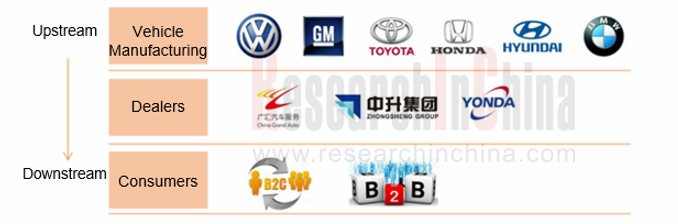
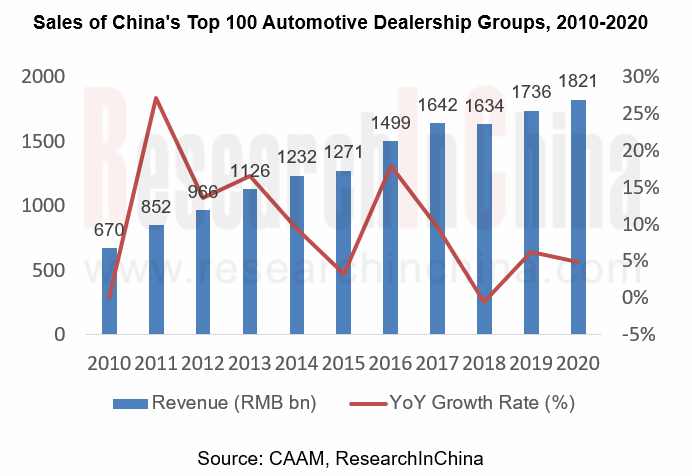
According to data from China Association of Automobile Manufacturers (CAAM), 26.082 million and 26.275 million automobiles were produced and sold respectively in 2021, up 3.4% and 83.8% year-on-year correspondingly. This is the first growth since 2019. The COVID-19 pandemic has brought unprecedented challenges to China's automotive dealership industry which still performs well. According to the data of CAAM, the total revenue and output value of the top 100 automotive dealership groups in 2020 jumped 4.9% year-on-year to RMB1.82 trillion. In 2020, the number of authorized 4S dealers nationwide experienced negative growth for the first time in history. The number of 4S stores in the network dropped to 28,000. A total of 3,920 4S stores withdrew throughout the year, namely over 10 4S stores exited every day averagely.
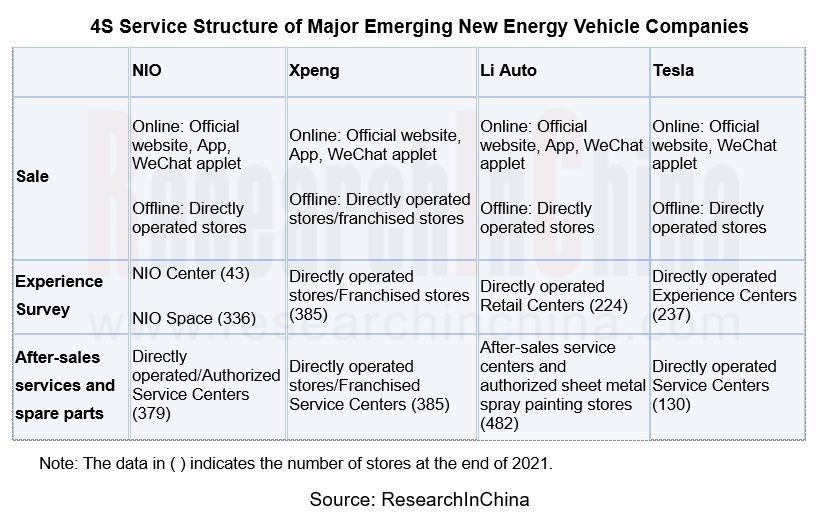
Different from the national dealership model of conventional auto brands, the current sales models and channels of emerging automakers have evolved from the dealership model to the direct operation of chain stores by brand automakers or the cooperative operation with authorized agents. The direct sales model offers users refreshing brand experience through services covering the entire life cycle of products, and avoids many drawbacks (like opaque prices and poor services) of the conventional dealership model. However, it also triggers multiple problems such as huge capital and complex operation, which are not applicable to all new energy vehicle manufacturers. But even if the dealership model is still adopted, the service structure and profit structure of 4S stores will be significantly altered.
The automotive aftermarket refers to all the services needed by consumers around the use of automobiles after they are sold until being scrapped.
The automotive aftermarket, especially the maintenance market, expands year by year with the increase of automobile age, because the older the automobile, the more worn the accessories, the more repairs per year, and the higher the repair cost. At present, the average age of automobiles in China has reached 6 years. The growth in both automobile age and automobile ownership has driven the booming development of automotive aftermarket which has gradually become a new industrial focus, meaning the industry has seen lucrative opportunities.
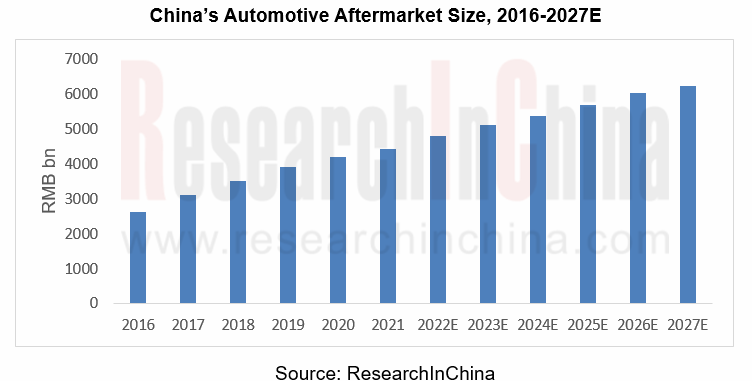
The automotive aftermarket mainly includes auto repair and maintenance, auto finance, used cars, car leasing, auto supplies, beauty and modification, car recycling, aftermarket alliance platform integration/automotive e-commerce, etc. Among them, auto finance, auto maintenance and used cars are the top three segments of the automotive aftermarket:
Used Cars
Factors such as consumption upgrade, occupational needs, and consumer preference will allow car owners to swap their existing cars through channels such as used car dealers and used car e-commerce platforms. In recent years, the state and local governments have increased their efforts to promote automobile consumption, and taken favorable measures to drive the consumption of used cars. China's used car market has maintained growth with a wider transaction scale. In 2020, approximately 17.59 million used cars were transacted in China, a spike of 22.6% over the previous year. In the future, the used car market is expected to raise its market share in the automotive aftermarket.
Maintenance
Under the background of high automobile ownership, high automobile age and maintenance concept change, the auto repair and maintenance market size continues to swell. The annual automobile maintenance cost escalates year by year with the increase of automobile age, because the older the automobile, the more worn the accessories, the more repairs per year, and the higher the repair cost. According to the experience of developed countries, China is about to see the maintenance demand hit the peak. In the past ten years, the sales volume of automobiles has been considerable, but the growth rate of new car sales volume has slowed down. In the future, the average automobile age will continue to rise, which will prompt the automotive maintenance industry into a golden age. China's auto maintenance market size had reached about RMB1,533 billion as of 2021, and it is expected to exceed RMB2 trillion by 2027. In the context of anti-monopoly, independent auto repairers are gradually encroaching on the market share of traditional 4S stores; with the help of the "Internet +" model, the independent repair model will further burgeon.
Auto Finance
Pivoting on OEMs, auto finance is the combination of various financial products derived from upstream and downstream of the industry to end consumers. It targets companies, individuals, governments, auto operators and other entities. Typical auto finance products include dealer inventory financing, auto loans, auto leasing, and auto insurance. In recent years, the overall penetration rate of China's new car finance has ticked up year by year. However, compared with mature markets in Europe and the United States, China's new car finance market still lags behind. With consumption upgrade and higher credit acceptance, auto finance will further grow. In 2021, the assets of 25 auto finance companies ascended 15% year-on-year to RMB1.12 trillion.
China Automotive Distribution and Aftermarket Industry Report, 2022-2027 highlights the following:
 Definition, classification, industry chain, business models, etc. of the automotive dealership industry and aftermarket;
Market size and forecast of Global and Chinese automobile and dealership industry, including automobile sales volume, dealer network, automobile sales volume by dealers, competition pattern, sales models of the new energy vehicle industry, etc.;
Market size, forecast, competition pattern, trends, etc. of automotive aftermarket segments including auto finance, used cars, maintenance and beauty, etc.;
Profile, business, agency brands, operating network and marketing of major auto dealers in China.
Vehicle-Road-Cloud Integration and C-V2X Industry Report, 2026
Vehicle-Road-Cloud and C-V2X Research: with the three-tier promotion system of "top-level planning + mandatory pilot + evaluation binding", the industry turning point is approachingThis report focuses...
China OEM Data Capability Analysis Report, 2026
OEM Data Capability Research: 24 OEMs × 9 Capability Domains, Who Takes the Lead?
An L4 autonomous driving R&D and test vehicle can generate approximately 10TB of raw data per single day — data v...
Autonomous Driving Domain Controller and Central Computing Unit (CCU) Industry Report, 2026
Autonomous Driving Domain Controller (ADCU) Research: One-Chip CCU solutions are quickly available in vehicles
In China's passenger car market, autonomous driving systems involved in mass production ...
Automotive EMS and ECU Industry Research Report, 2026
Automotive EMS Research: The boundaries between EMS providers and Tier1 suppliers are becoming blurred, and the supply chain model is evolving from a linear chain to a networked structure
Mainstream ...
Automotive Microcontroller Unit (MCU) and Application Scenario Research Report, 2026
Automotive MCU Research: Increased demand for redundant security drives ASIL D-compliant MCU shipments to exceed 100 million units
In a vehicle EEA, MCUs are widely distributed in various functional ...
China Intelligent Cockpit Patent Analysis Report, 2026
Intelligent Cockpit Patent Research: Cockpit AI, In?vehicle Health, and Infotainment Are Upgrade to Scenario?based and Proactive Functions
From a patent perspective, this report explores the cutting?...
Research Report on Application of VLA Large Model in Automobiles and Robots, 2026
Research on Automotive and Robot VLA: Hybrid Architectures Become Mainstream, VLA Integrates with General World Models, and Reinforcement Learning Serves as Core Engine
Vision?Language?Action (VLA) m...
China Charging Infrastructure (Supercharging, Battery Swapping, V2G, etc.) and High-Performance Supercharging Battery Research Report, 2026
Charging and battery swapping research: as 5C+ supercharging vehicle models go into mass production, the pace of OEMs self-building supercharging networks quickens
800-1000V high-voltage platforms ar...
China Passenger Car Electronic Controlled Suspension Industry Report, 2026
Electronic Controlled Suspension Industry Research: As the First Year of Full Active Suspension Unfolds, Three Technical Routes Race Forward
1. Penetration Rate Surges Three Times, and Electronic Con...
Intelligent Driving SoC Research Report, 2026
Research on Intelligent Driving SoCs: Competition Focus Shifts to L3/L4 Embedded Hardware, and Computing Power of Flagship Vehicle Models Exceeds 1,000 TOPS
In terms of intelligent driving system in...
Automotive AI Large Model Technology Research Report, 2026
Automotive AI Large Model Research: Competition Shifts from "Who Has the Stronger Model" to "Who Boasts Higher Link Efficiency"
ResearchInChina released the Automotive AI Large Model Technology Resea...
Intelligent Vehicle Cockpit Domain Controller Research Report, 2026
Cockpit domain controller research: L3 AIDV intelligent cockpit domain controllers are entering a boom period
Driven by multiple factors such as the continuous evolution of the automotive central int...
Automotive Acoustic System (Audio, Multi-Channel) Industry Report, 2026
Automotive Acoustics Research: Multiple Channels, AI Tuning, and Self-Developed Algorithms Drive the Transformation of High-End Cockpit Sound Fields
I. Automotive Audio Hardware Solutions with 6–9 S...
Autonomous Driving Sensor Chip Research Report, 2026
Research on Autonomous Driving Sensor Chips: Deeply Perceiving the Physical World, Sensor Chips Are Playing A “Leading Role” in Intelligence
In 2026, the autonomous driving sensor chip industr...
Passenger Car Corner Module and Wheel‑Side Control System Research Report, 2026
Wheel-side control research: the “last mile” chassis innovation
Wheel-side control dismantles the traditional drive, braking, steering, and suspension control of the chassis from a "centralized" styl...
Embodied Artificial Intelligence (& Humanoid Robot) MCU Research Report, 2026
Research on Humanoid Robot MCUs: Evolution from General-Purpose Control to High-Value Dedicated Chip Solutions Integrated with Edge AI Functions
MCU (Microcontroller Unit) refers to a compact integra...
Intelligent Vehicle Zone Control Unit (ZCU) Research Report, 2026
ZCU Research: Cross-domain integrated ZCUs are becoming the edge computing nodes of the next-generation zonal architecture
Currently, the mainstream zonal architecture is mainly the quasi-central + z...
Automotive Cybersecurity and Data Security Research Report, 2026
Cybersecurity & Data Security Research: Intelligent Connected Vehicles Enter the Era of “Systematic Offense-Defense and AI-Defined Security”.
Centering on the panorama of intelligent connect...