Passenger car T-BOX research: T-Box OEM installation rate will reach 83.5% in China in 2025
ResearchInChina has published Global and China Passenger Car T-Box Market Report 2022 to summarize and analyze the T-Box installations and installation rates to passenger cars in China and the world, T-Box suppliers, T-Box development trends, and the App remote control function configuration of new models launched by OEMs.
Passenger car T-Box is developing towards:
1. T-Box OEM installation rate will reach 83.5% in China in 2025;
2. 5G C-V2X T-Box seizes more and more market shares;
3. Automotive Ethernet is expected to replace CAN bus and FlexRay to become the main connection way of T-Box;
4. The remote vehicle control by mobile Apps becomes ever smarter (AVP, etc.).
T-Box OEM installation rate will register 83.5% in China in 2025
T-Box is mainly used for the communication between vehicle and Internet of Vehicles (IoV) service platform and acts as the core hardware of OEM telematics.
In 2021, 12.94 million passenger cars were installed with T-Box by OEMs in China, a year-on-year increase of 31%; the installation rate hit 60%, up about 10 percentage points from last year. By 2025, over 20 million passenger cars will be equipped with T-Box, and the installation rate will climb to 83.5%, and. T-Box and telematics are growing indispensable to passenger cars.
In 2021, 6.301 million passenger cars of Chinese automakers carried T-Box, a year-on-year spike of 59.9%; 6.634 million passenger cars of joint venture carmakers did so, up 12.9% on a yearly basis. Chinese OEMs make much faster progress in Internet of Vehicles than JV brands.
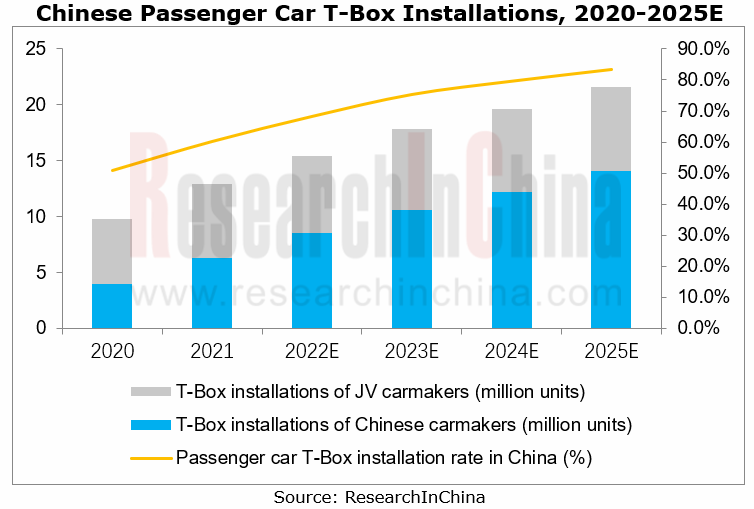
T-Box installations to passenger cars will keep an uptrend, so will the installation rate, and passenger car Internet of Vehicles will be further popularized, which are contributed by the consumers’ robust demand for intelligent connected vehicles (ICVs), the surge in new energy vehicle (NEV) sales, OEMs’ needs for FOTA as well as regulatory requirements and other factors.
Top 10 OEMs command 64% market shares
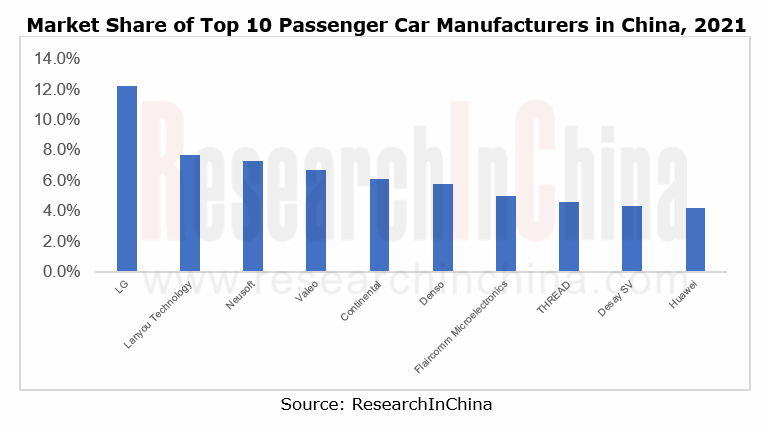
Viewed from the market structure, the top 10 T-Box suppliers in China held 64% market shares together in 2021, with LG, Lanyou Technology and Neusoft at the top. Among them, Lanyou Technology, established in 2002 with DFS Industrial Group holding its 80% stake, mainly supplies T-Box products to Nissan and Dongfeng Motor. Lanyou’s T-Box was installed to one million cars in 2021. Also in 2021, Neusoft served 940,000 vehicles, mainly from Geely and Great Wall Motor. Thanks to Great Wall's high sales, Neusoft witnessed fast-growing T-Box installations in 2021.
5G C-V2X T-Box will see the rising market shares
In 2020, the Ministry of Industry and Information Technology of China (MIIT) granted two 5G T-Box models Network Access License. In 2021, 19 5G T-Box models secured Network Access License, making for 9.3% which jumped 8 percentage points year-on-year. From January to March of 2022, seven 5G T-Box models obtained Network Access License. The number is expected to rise throughout 2022. At present, 4G T-Box still prevails, but it will be gradually replaced by 5G T-Box in the long run.
T-Box vendors are vigorously developing T-Box products that integrate 5G, C-V2X, high-precision positioning and other functional modules to create differentiated advantages. As of March 2022, a total of 25 5G T-Box models had gained Network Access License, including one from Samsung Harman, one from Lear, six from Neusoft, three from Datang Gohigh, two from DIAS, two from Huawei, two from JOYNEXT, two from China Mobile IoT, one from HiRain Technologies, one from Lanyou Technology, one from YF Tech, one from China TSP, one from TAGE, and one from Chelutong Technology (Chengdu) Co., Ltd.
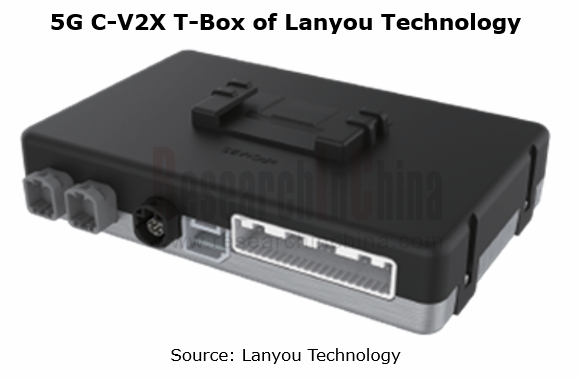
Lanyou Technology mass-produced its 5G C-V2X T-Box in August 2021. Based on 5G, it provides high bandwidth, integrates 5G, C-V2X and centimeter-level positioning, supports 5G only and 5G+V2X dual mode, and enables at least 25 C-V2X application scenarios. Lanyou in harness with Huawei, Qualcomm, MTK, UNISOC and other platforms now boasts 5G T-Box customers such as Dongfeng Voyah, Aeolus, Nissan, and Venucia.
Neusoft’s 5G C-V2X T-Box bolsters 16 application scenarios based on three mainstream platforms and V2X national standards, as well as supports 5G NSA/SA communication, L1+L5 GNSS global positioning, Gigabit Ethernet technology, C-V2X communication, CANFD communication, LIN communication, Bluetooth 5.0+ communication, WiFi 6 communication, RKE, TPMS communication and ETC, etc. In 2021, Neusoft's 5G (V2X) BOX were massively available onto New Great Wall Haval H6, ZEEKR 001 and other models.
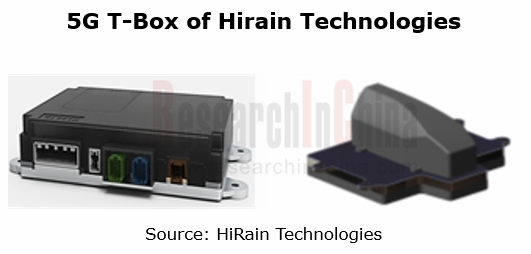
HiRain Technologies leverages the AP+NAD+MCU architecture for its 5G T-Box, provides multi-platform support (like Qualcomm, MTK), and presents various forms such as stand-alone type, smart antenna type, and multiple communication module integration. Functional interfaces cover 5G SA/NSA, C-V2X, CAN/CANFD, Gigabit Ethernet, dual-band GNSS, WiFi6, Bluetooth 5.2, USB, etc., and can also integrate TPMS, ETC, swap control, Bluetooth key (scalable UWB) and the like. For intelligent driving, centimeter-level positioning, parking lot/vehicle AVP, 10 Gigabit Ethernet high-speed channels and other services are available. Mass production for Dongfeng Voyah and other models has been achieved.
Some companies are also developing T-Box products that support 5G C-V2X. For example, the 5G T-Box being developed by Flaircomm Microelectronics will be compatible with mainstream 5G SOC solutions at home and abroad, and support SA/NSA networking technology, 5G V2X technology, centimeter-level positioning, Gigabit Automotive Ethernet and CAN FD bus technology.
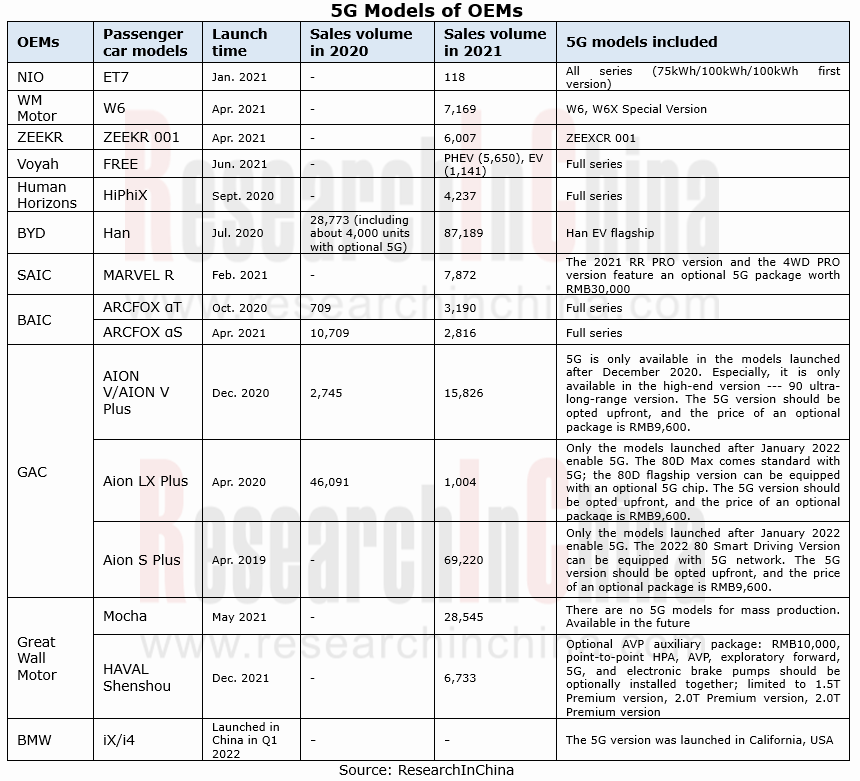
Meanwhile, OEMs have begun to mount 5G C-V2X technology on more and more new models. For instance, SAIC Marvel R is equipped with 5G V2X i-BOX, a fusion of 5G, V2X and high-precision positioning; GAC Aion V, outfitted with Huawei MH5000 5G Module, features a 100M transmission channel and enables intelligent driving with C-V2X.
Automotive Ethernet is expected to replace CAN bus and FlexRay to become the main connection method of T-Box
New automotive functions (such as automated parking system, lane departure detection system, blind spot detection and advanced infotainment system) pose higher requirements on new data bus transmission.
With the release of the new Ethernet protocol in 2021, automotive Ethernet is expected to substitute for CAN bus and FlexRay and be the main connection method of T-Box by virtue of its low cost, low power consumption, low electromagnetic radiation, and strong scalability, thus speeding up updates and calibrations of firmware and software remarkably while reducing downtime caused by vehicle system updates. BMW and GM have confirmed that they will replace the CAN bus with 10BASE-T1S in their next-generation cars.
To date, the T-Box products of leading Chinese players (Lanyou Technology, Neusoft, Flaircomm Microelectronics, HiRain Technologies, etc.) have integrated Gigabit Ethernet to efficiently handle a universe of data from intelligent connected vehicle in the future.
The remote vehicle control by mobile Apps grows ever smarter (like AVP)
Automotive T-BOX is mainly used to communicate with background systems and mobile Apps so as to display and control vehicle information on the mobile Apps.
With the addition of technologies such as cloud computing and HD maps, the remote vehicle control functions on mobile Apps are constantly evolving. For example, AVP allows the driver to remotely control parking via mobile Apps in above-ground or basement public parking lots at a certain distance from their cars. WM W6 and GAC Aion V Plus have offered such a feature.
Vehicle-Road-Cloud Integration and C-V2X Industry Report, 2026
Vehicle-Road-Cloud and C-V2X Research: with the three-tier promotion system of "top-level planning + mandatory pilot + evaluation binding", the industry turning point is approachingThis report focuses...
China OEM Data Capability Analysis Report, 2026
OEM Data Capability Research: 24 OEMs × 9 Capability Domains, Who Takes the Lead?
An L4 autonomous driving R&D and test vehicle can generate approximately 10TB of raw data per single day — data v...
Autonomous Driving Domain Controller and Central Computing Unit (CCU) Industry Report, 2026
Autonomous Driving Domain Controller (ADCU) Research: One-Chip CCU solutions are quickly available in vehicles
In China's passenger car market, autonomous driving systems involved in mass production ...
Automotive EMS and ECU Industry Research Report, 2026
Automotive EMS Research: The boundaries between EMS providers and Tier1 suppliers are becoming blurred, and the supply chain model is evolving from a linear chain to a networked structure
Mainstream ...
Automotive Microcontroller Unit (MCU) and Application Scenario Research Report, 2026
Automotive MCU Research: Increased demand for redundant security drives ASIL D-compliant MCU shipments to exceed 100 million units
In a vehicle EEA, MCUs are widely distributed in various functional ...
China Intelligent Cockpit Patent Analysis Report, 2026
Intelligent Cockpit Patent Research: Cockpit AI, In?vehicle Health, and Infotainment Are Upgrade to Scenario?based and Proactive Functions
From a patent perspective, this report explores the cutting?...
Research Report on Application of VLA Large Model in Automobiles and Robots, 2026
Research on Automotive and Robot VLA: Hybrid Architectures Become Mainstream, VLA Integrates with General World Models, and Reinforcement Learning Serves as Core Engine
Vision?Language?Action (VLA) m...
China Charging Infrastructure (Supercharging, Battery Swapping, V2G, etc.) and High-Performance Supercharging Battery Research Report, 2026
Charging and battery swapping research: as 5C+ supercharging vehicle models go into mass production, the pace of OEMs self-building supercharging networks quickens
800-1000V high-voltage platforms ar...
China Passenger Car Electronic Controlled Suspension Industry Report, 2026
Electronic Controlled Suspension Industry Research: As the First Year of Full Active Suspension Unfolds, Three Technical Routes Race Forward
1. Penetration Rate Surges Three Times, and Electronic Con...
Intelligent Driving SoC Research Report, 2026
Research on Intelligent Driving SoCs: Competition Focus Shifts to L3/L4 Embedded Hardware, and Computing Power of Flagship Vehicle Models Exceeds 1,000 TOPS
In terms of intelligent driving system in...
Automotive AI Large Model Technology Research Report, 2026
Automotive AI Large Model Research: Competition Shifts from "Who Has the Stronger Model" to "Who Boasts Higher Link Efficiency"
ResearchInChina released the Automotive AI Large Model Technology Resea...
Intelligent Vehicle Cockpit Domain Controller Research Report, 2026
Cockpit domain controller research: L3 AIDV intelligent cockpit domain controllers are entering a boom period
Driven by multiple factors such as the continuous evolution of the automotive central int...
Automotive Acoustic System (Audio, Multi-Channel) Industry Report, 2026
Automotive Acoustics Research: Multiple Channels, AI Tuning, and Self-Developed Algorithms Drive the Transformation of High-End Cockpit Sound Fields
I. Automotive Audio Hardware Solutions with 6–9 S...
Autonomous Driving Sensor Chip Research Report, 2026
Research on Autonomous Driving Sensor Chips: Deeply Perceiving the Physical World, Sensor Chips Are Playing A “Leading Role” in Intelligence
In 2026, the autonomous driving sensor chip industr...
Passenger Car Corner Module and Wheel‑Side Control System Research Report, 2026
Wheel-side control research: the “last mile” chassis innovation
Wheel-side control dismantles the traditional drive, braking, steering, and suspension control of the chassis from a "centralized" styl...
Embodied Artificial Intelligence (& Humanoid Robot) MCU Research Report, 2026
Research on Humanoid Robot MCUs: Evolution from General-Purpose Control to High-Value Dedicated Chip Solutions Integrated with Edge AI Functions
MCU (Microcontroller Unit) refers to a compact integra...
Intelligent Vehicle Zone Control Unit (ZCU) Research Report, 2026
ZCU Research: Cross-domain integrated ZCUs are becoming the edge computing nodes of the next-generation zonal architecture
Currently, the mainstream zonal architecture is mainly the quasi-central + z...
Automotive Cybersecurity and Data Security Research Report, 2026
Cybersecurity & Data Security Research: Intelligent Connected Vehicles Enter the Era of “Systematic Offense-Defense and AI-Defined Security”.
Centering on the panorama of intelligent connect...