DENSO CASE (Connectivity, Automation, Sharing and Electrification) Layout Research Report, 2022
DENSO CASE Research: The semiconductor business will help it go "from Toyota to the world”
ResearchInChina has released DENSO CASE (Connectivity, Automation, Sharing and Electrification) Layout Research Report, 2022 to sort out and study the layout of Japan-based DENSO Group in the fields of automation, connectivity, electrification and other fields, summarize its development dynamics in 2021-2022 and predict its future business focus.
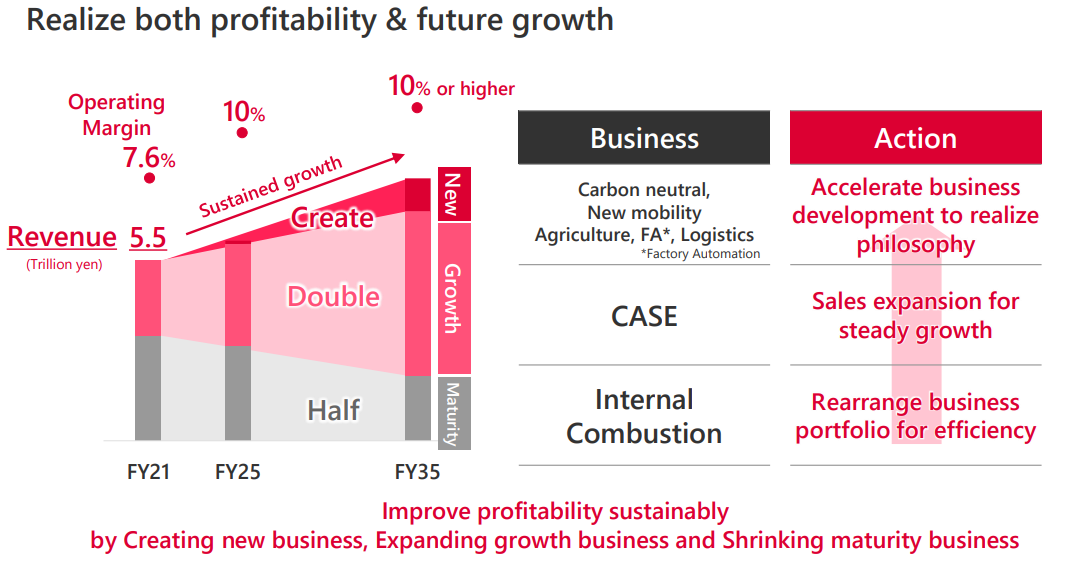
1. DENSO's future growth will mainly hinge on CASE
With the transformation and development of CASE, DENSO has built relatively sound technical capabilities in the fields of automation, connectivity, and electrification, and its future growth will mainly hinge on CASE.
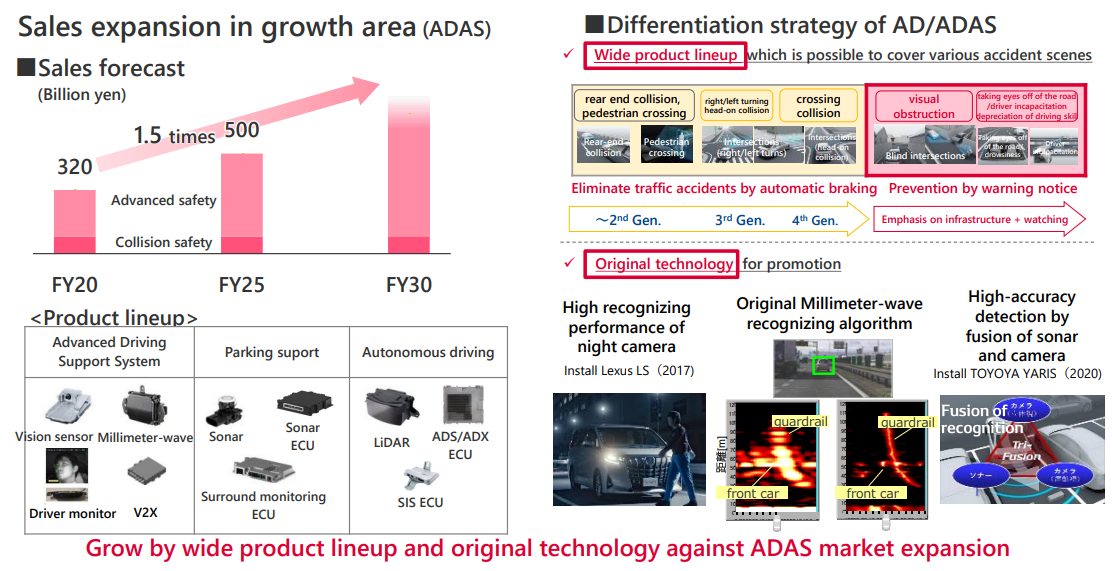
In the field of automation, DENSO has formed ADAS (L2-L4), surround-view systems, AVP, autonomous platooning, autonomous taxis, a series of active safety systems, AD systems and ADAS through the provision of cameras (front-view monocular/binocular, surround-view), radar (forward, corner), LiDAR, ultrasonic radar, integrated control software for autonomous driving and other products. In addition, it provides users with integrated software and hardware solutions.
At this stage, DENSO mainly applies the autonomous braking function to the front, rear, left and right directions, and to avoid traffic accidents in scenarios such as crossing intersections. In the future, DENSO will strengthen the development of early warning functions with the help of V2X and other infrastructure.
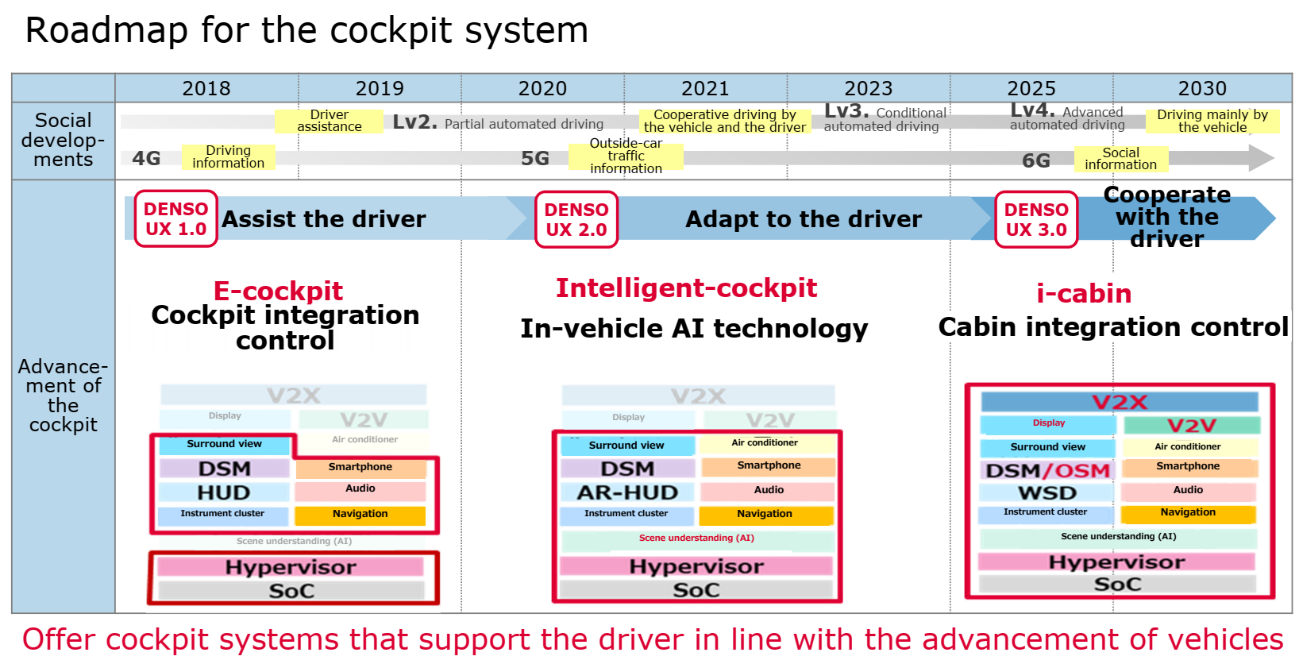
In the field of connectivity, DENSO’s products cover automotive communication, IVI systems, digital keys, OTA solutions, cyber security solutions, cockpit domain control platforms, clusters & center consoles, HUD, DMS, etc. Among them, automotive V2X communication equipment features wireless communication, vehicle positioning and status judgment, and it enables safe driving assistance through wireless vehicle-to-vehicle and road-vehicle communication. It has been installed in Toyota Prius, Crown, Lexus RX, Lexus LS and other models. DENSO plans to integrate V2X, V2V, display systems, DMS/OMS and other functions into the bottom layer of cockpit to offer a more intelligent cockpit solution by 2025.
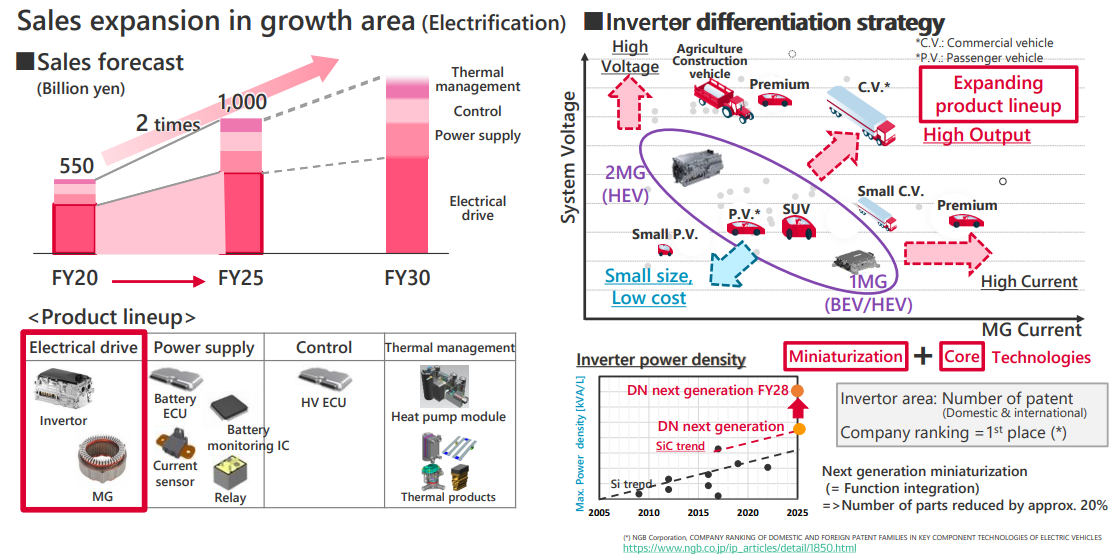
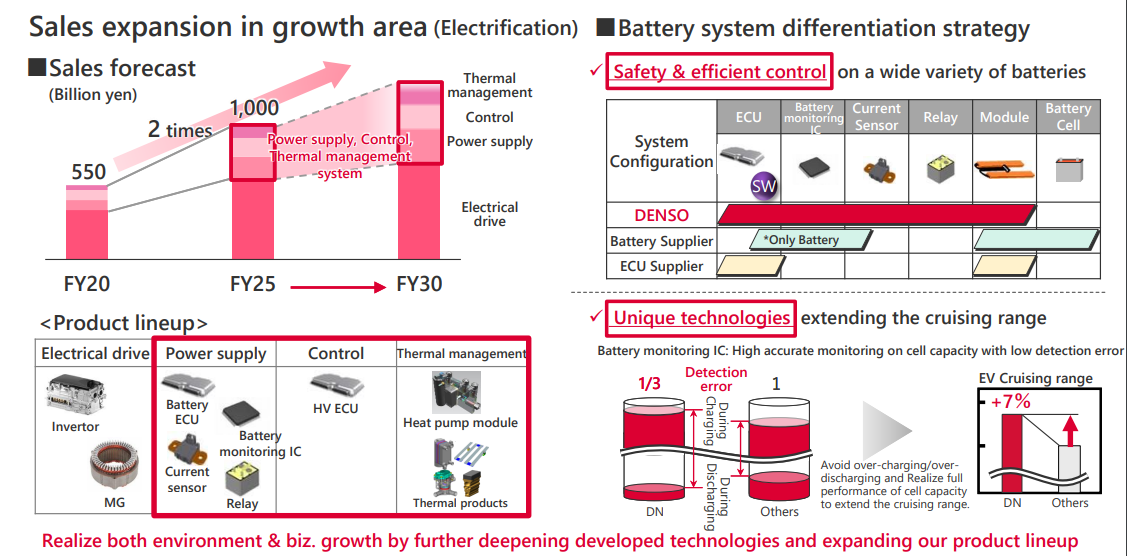
In the field of electrification, DENSO focuses on the development of core products across electrified powertrain platforms (PHEV, HEV, BEV, FCEV): battery packs, motors, inverters, and energy management systems.
According to the plan, DENSO will center on the development of inverter and stator winding technologies before 2025, extend to power modules, control modules and thermal management systems from 2026 to 2030, and further enhance its supply chain.
2. Toyota contributes over 50% to DENSO's revenue
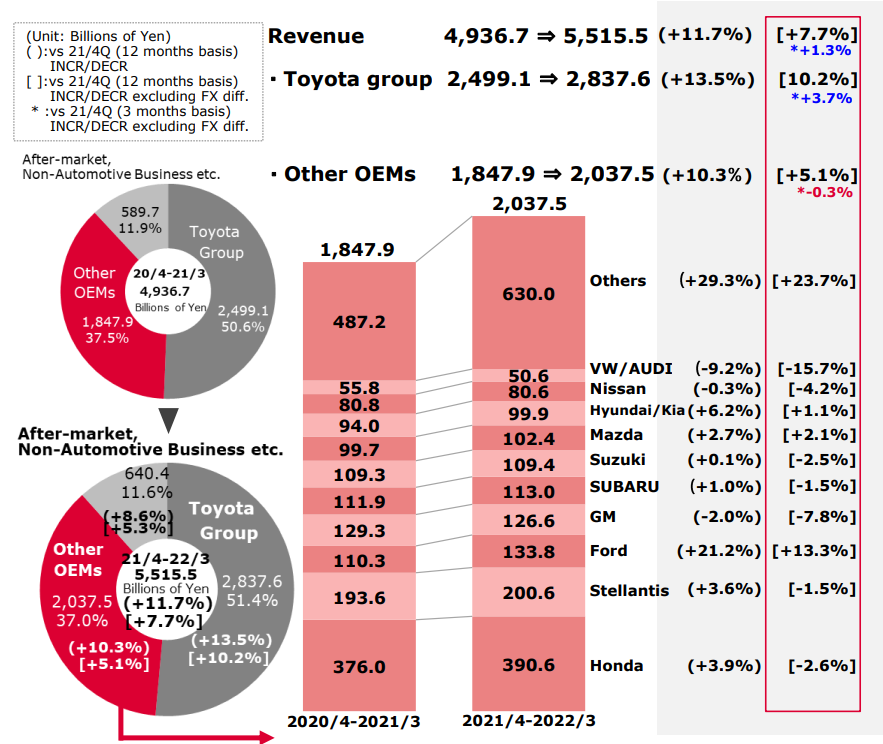
After DENSO was separated from Toyota in 1949, the two have maintained an amicable and cooperative relationship. In FY2022, Toyota contributed 51.4% to DENSO's revenue, an increase of 0.8 percentage point from the previous fiscal year; the order intake worth JPY2,837.6 billion, up 13.5% year-on-year.
DENSO's CASE products are mainly tested and mass-produced through Toyota. For instance:
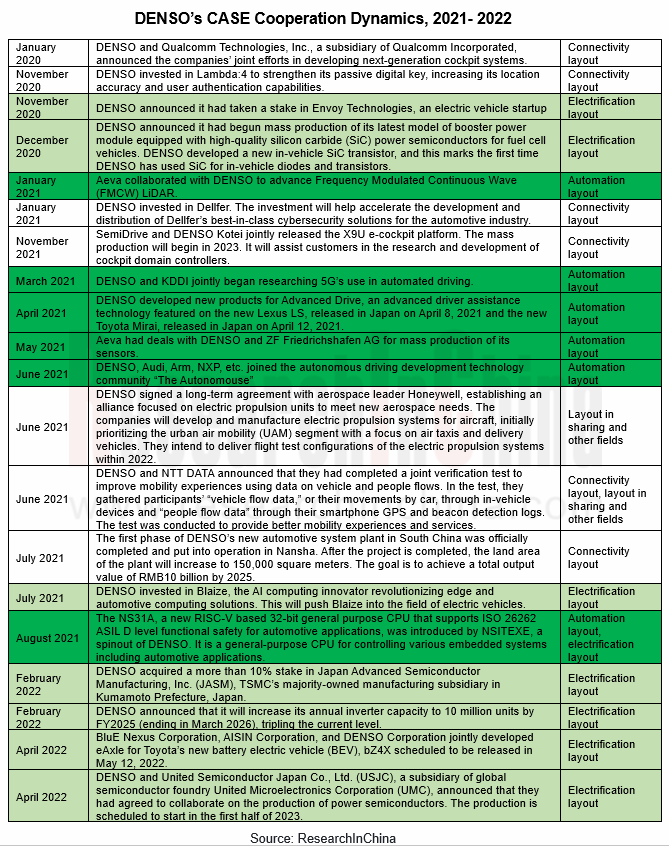
 In April 2021, DENSO announced it had developed products for Advanced Drive, an advanced driver assistance technology featured on the new Lexus LS and the new Toyota Mirai. DENSO’s newly developed products used in Advanced Drive include LiDAR, a binocular vision system, an Spatial Information Service Electronic Control Unit (SIS ECU), an Advanced Drive System Electronic Control Unit (ADS ECU) and Advanced Drive Extension Electronic Control Unit (ADX ECU).
In May 2022, BluE Nexus Corporation, AISIN Corporation, and DENSO Corporation announced that they had jointly developed eAxle for Toyota’s new battery electric vehicle (BEV), bZ4X.
In addition, DENSO's forward-looking layout and innovative products in CASE almost reflect Toyota's presence. They are deeply bound and closely tied up in CASE transformation.
3. The semiconductor business will help DENSO go "from Toyota to the world”
In 2022, DENSO's layout concentrates on the semiconductor field.
In February 2022, DENSO acquired a more than 10% stake in Japan Advanced Semiconductor Manufacturing, Inc. (JASM), TSMC’s majority-owned manufacturing subsidiary in Kumamoto Prefecture, Japan. With this equity investment, DENSO became JASM’s third largest shareholder. TSMC will build a new chip factory in Kumamoto Prefecture, Japan through JASM to produce cutting-edge logic semiconductors for image sensors and MCUs, with mass production scheduled to begin by the end of 2024. The acquisition will enable DENSO to stably purchase cutting-edge semiconductors with circuit line widths of around 10-20 nanometers in Japan.
In February, DENSO announced that it will increase its annual inverter capacity to 10 million units by FY2025 (ending in March 2026), tripling the current level. In order to achieve this goal, DENSO will expand or build new factories in Japan, the United States, China, Europe, Southeast Asia, India and other countries and regions. In addition to supplying products to Toyota, it will contact European and American OEMs.
In April 2022, DENSO and United Semiconductor Japan Co., Ltd. (USJC), a subsidiary of global semiconductor foundry United Microelectronics Corporation (UMC), announced that they had agreed to collaborate on the production of IGBTs at USJC's 300mm fab. The production is scheduled to start in the first half of 2023.
"DENSO is considering spinning off its JPY420 billion chip business”, CTO Yoshifumi Kato said in an interview in June 2022.
With the development of mobility technologies such as autonomous driving and electrification, the importance of semiconductors in the automotive industry is becoming more and more prominent. Recently, DENSO's semiconductor layout mainly pivots on digital chips with high computing power, which will be mainly used in AD systems/ADAS. In order to obtain more semiconductor-related resources, DENSO has successively formed close capital bonds with Renesas, Infineon, TSMC, and UMC.
At present, DENSO keeps an eye to meet the internal chip demand and support Toyota. If DENSO splits its semiconductor business in the future, the relationship with Toyota is expected to be loosened, facilitating its global expansion. After all, DENSO has become the world's fifth-largest supplier of automotive chips by sales volume, and digital semiconductors to mass-produced in 2023-2024 will be a blessing.
Vehicle-Road-Cloud Integration and C-V2X Industry Report, 2026
Vehicle-Road-Cloud and C-V2X Research: with the three-tier promotion system of "top-level planning + mandatory pilot + evaluation binding", the industry turning point is approachingThis report focuses...
China OEM Data Capability Analysis Report, 2026
OEM Data Capability Research: 24 OEMs × 9 Capability Domains, Who Takes the Lead?
An L4 autonomous driving R&D and test vehicle can generate approximately 10TB of raw data per single day — data v...
Autonomous Driving Domain Controller and Central Computing Unit (CCU) Industry Report, 2026
Autonomous Driving Domain Controller (ADCU) Research: One-Chip CCU solutions are quickly available in vehicles
In China's passenger car market, autonomous driving systems involved in mass production ...
Automotive EMS and ECU Industry Research Report, 2026
Automotive EMS Research: The boundaries between EMS providers and Tier1 suppliers are becoming blurred, and the supply chain model is evolving from a linear chain to a networked structure
Mainstream ...
Automotive Microcontroller Unit (MCU) and Application Scenario Research Report, 2026
Automotive MCU Research: Increased demand for redundant security drives ASIL D-compliant MCU shipments to exceed 100 million units
In a vehicle EEA, MCUs are widely distributed in various functional ...
China Intelligent Cockpit Patent Analysis Report, 2026
Intelligent Cockpit Patent Research: Cockpit AI, In?vehicle Health, and Infotainment Are Upgrade to Scenario?based and Proactive Functions
From a patent perspective, this report explores the cutting?...
Research Report on Application of VLA Large Model in Automobiles and Robots, 2026
Research on Automotive and Robot VLA: Hybrid Architectures Become Mainstream, VLA Integrates with General World Models, and Reinforcement Learning Serves as Core Engine
Vision?Language?Action (VLA) m...
China Charging Infrastructure (Supercharging, Battery Swapping, V2G, etc.) and High-Performance Supercharging Battery Research Report, 2026
Charging and battery swapping research: as 5C+ supercharging vehicle models go into mass production, the pace of OEMs self-building supercharging networks quickens
800-1000V high-voltage platforms ar...
China Passenger Car Electronic Controlled Suspension Industry Report, 2026
Electronic Controlled Suspension Industry Research: As the First Year of Full Active Suspension Unfolds, Three Technical Routes Race Forward
1. Penetration Rate Surges Three Times, and Electronic Con...
Intelligent Driving SoC Research Report, 2026
Research on Intelligent Driving SoCs: Competition Focus Shifts to L3/L4 Embedded Hardware, and Computing Power of Flagship Vehicle Models Exceeds 1,000 TOPS
In terms of intelligent driving system in...
Automotive AI Large Model Technology Research Report, 2026
Automotive AI Large Model Research: Competition Shifts from "Who Has the Stronger Model" to "Who Boasts Higher Link Efficiency"
ResearchInChina released the Automotive AI Large Model Technology Resea...
Intelligent Vehicle Cockpit Domain Controller Research Report, 2026
Cockpit domain controller research: L3 AIDV intelligent cockpit domain controllers are entering a boom period
Driven by multiple factors such as the continuous evolution of the automotive central int...
Automotive Acoustic System (Audio, Multi-Channel) Industry Report, 2026
Automotive Acoustics Research: Multiple Channels, AI Tuning, and Self-Developed Algorithms Drive the Transformation of High-End Cockpit Sound Fields
I. Automotive Audio Hardware Solutions with 6–9 S...
Autonomous Driving Sensor Chip Research Report, 2026
Research on Autonomous Driving Sensor Chips: Deeply Perceiving the Physical World, Sensor Chips Are Playing A “Leading Role” in Intelligence
In 2026, the autonomous driving sensor chip industr...
Passenger Car Corner Module and Wheel‑Side Control System Research Report, 2026
Wheel-side control research: the “last mile” chassis innovation
Wheel-side control dismantles the traditional drive, braking, steering, and suspension control of the chassis from a "centralized" styl...
Embodied Artificial Intelligence (& Humanoid Robot) MCU Research Report, 2026
Research on Humanoid Robot MCUs: Evolution from General-Purpose Control to High-Value Dedicated Chip Solutions Integrated with Edge AI Functions
MCU (Microcontroller Unit) refers to a compact integra...
Intelligent Vehicle Zone Control Unit (ZCU) Research Report, 2026
ZCU Research: Cross-domain integrated ZCUs are becoming the edge computing nodes of the next-generation zonal architecture
Currently, the mainstream zonal architecture is mainly the quasi-central + z...
Automotive Cybersecurity and Data Security Research Report, 2026
Cybersecurity & Data Security Research: Intelligent Connected Vehicles Enter the Era of “Systematic Offense-Defense and AI-Defined Security”.
Centering on the panorama of intelligent connect...