Overseas ADAS Tier1 Suppliers Research: The gap between suppliers has widened in terms of revenue growth, and many of them plan to launch L4 products by 2025
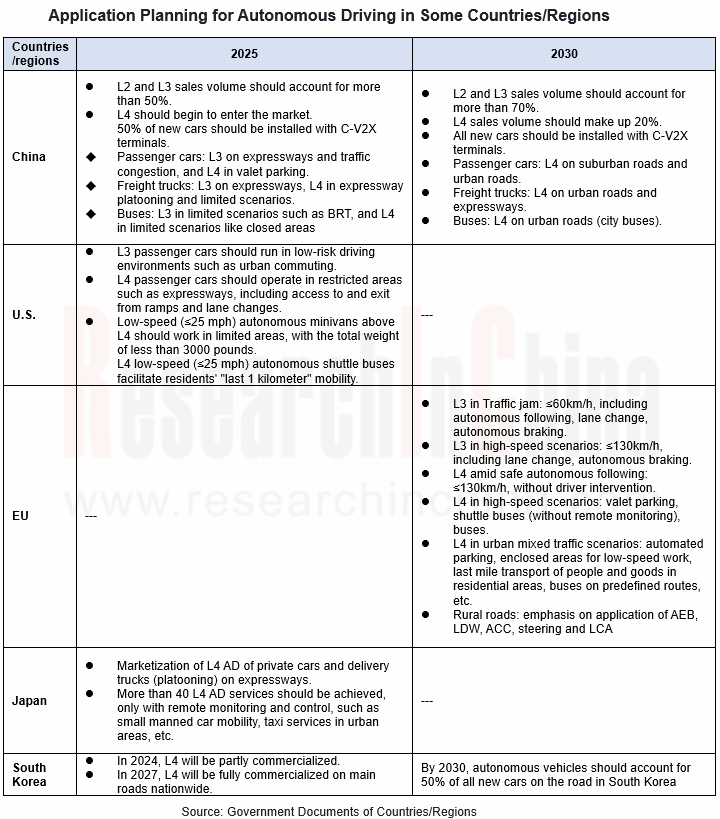
Countries allow L3/L4 vehicles on the road to a limited extent
Germany enacted Autonomous Driving Act in July 2021. Through its new legislation, Germany has become the first country in the world to allow L4 autonomous vehicles onto public roads without requiring a human backup safety driver behind the wheel. Application scenarios include: shuttle buses, short-distance public transport in urban areas, logistics between distribution centers, demand-oriented off-peak passenger transport in rural areas, first/last mile passenger or cargo transport, automated parking of dual-mode vehicles.
Japan's government planned to amend traffic laws to allow L4 autonomous vehicles to drive on some roads and ask lawmakers to approve the change as early as March 2022. Under the revised law, a license system will be introduced for operators of transport services using autonomous vehicles with L4 autonomy. Operators will be required to assign a chief monitor who can supervise the operation by riding a car or through remote control and can command multiple vehicles simultaneously. Japan aims to achieve L4 by 2025, which would allow private cars and delivery trucks (platooning) to operate on expressways, as market-oriented application.
In March 2022, the U.S. Department of Transportation’s National Highway Traffic Safety Administration (NHTSA) issued the "Occupant Protection Regulations for Automated Vehicles", stating that fully autonomous cars no longer need to be equipped with traditional manual control devices such as steering wheels, brakes or accelerator pedals. The United States plans to realize the market-oriented application of L3 passenger cars in low-risk driving environments such as urban commuting, and L4 passenger cars on expressways (like going on/off ramps, autonomous lane change) by 2025.
In July 2022, Shenzhen, China issued "Regulations on Administration of Intelligent Connected Vehicles in Shenzhen Special Economic Zone", allowing L3 autonomous vehicles to be tested and demonstrated on open roads in administrative areas with relatively sound CVIS infrastructure.
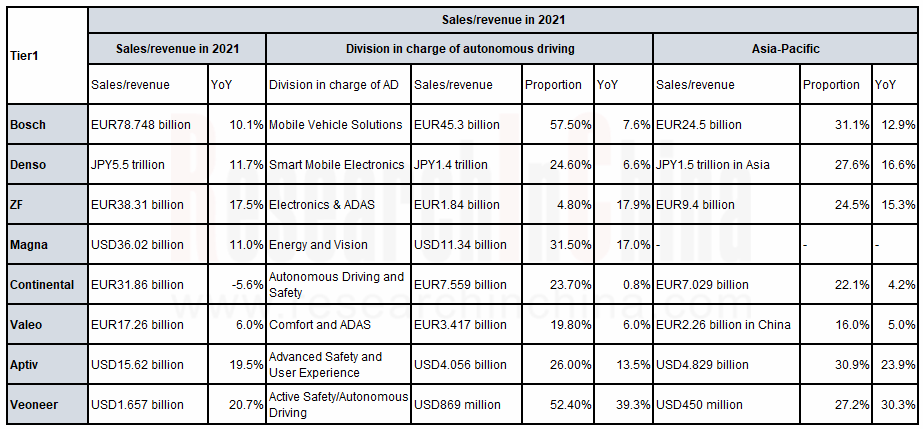
The ADAS business of major Tier 1 suppliers maintains rapid growth and they vigorously deploy L3/L4 products
In 2021, a number of Tier 1 suppliers saw the sales related to autonomous driving swell by more than 10% year-on-year. For example, ZF’s Electronics & ADAS Division earned sales of EUR1.84 billion, a year-on-year increase of 17.9%; the sales of Magna's Power & Vision Division jumped 17.0% year-on-year to USD11.34 billion; Veoneer secured sales of USD869 million from active safety, a year-on-year spike of 39.3%.
Source: financial reports of above companies
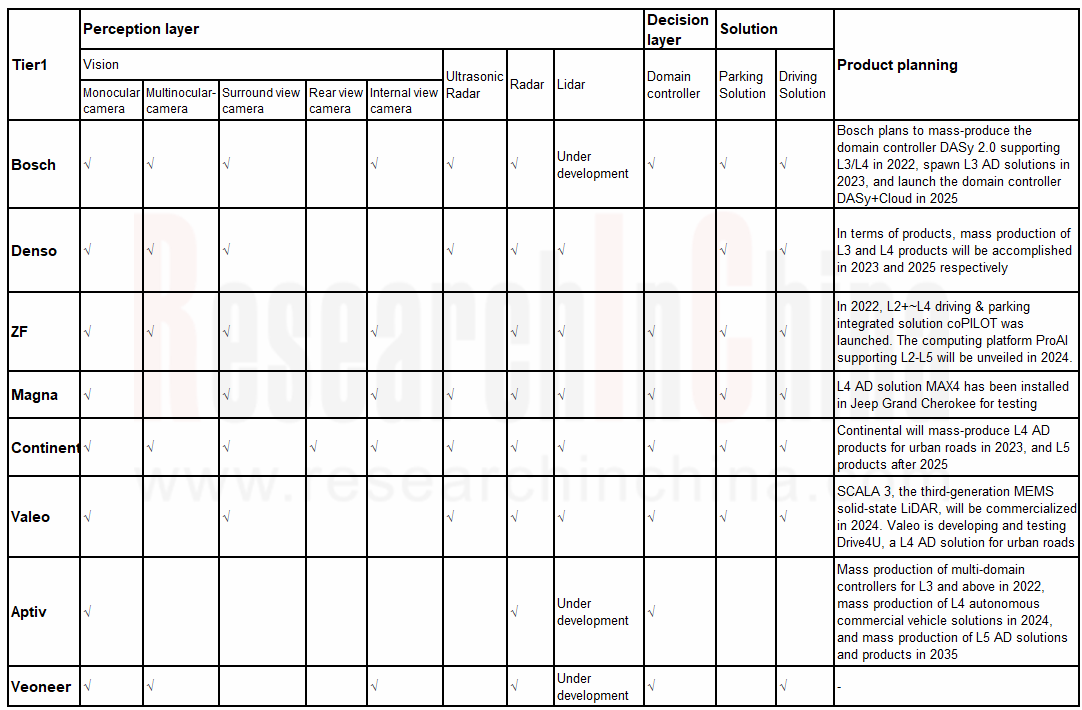
Bosch plans to mass-produce the domain controller DASy 2.0 supporting L3/L4 in 2022, spawn L3 driving solutions in 2023, and launch the domain controller DASy+Cloud in 2025.
Denso aims to achieve sales of JPY500 billion in ADAS field in 2025. In terms of products, mass production of L3 and L4 products will be accomplished in 2023 and 2025 respectively.
In 2021, Continental recorded EUR 7.559 billion in the revenue of its autonomous driving and safety business, accounting for 23.7% and edging up 0.8% year-on-year which was lower than that of its competitors. Continental will mass-produce L4 autonomous driving products for urban roads in 2023, and L5 products after 2025.
In 2021, Valeo Comfort & Driving Assistance Systems Business Group garnered EUR3.417 billion in revenue with a year-on-year spike of 6%, of which autonomous driving contributed EUR1.9 billion or 56%. The ADAS sales will reach EUR4 billion in 2025, with CAGR of 20.5%. Valeo says SCALA 3, the third-generation MEMS solid-state LiDAR released by Valeo in November 2021, which will be commercialized in 2024, offers 12 times better resolution, three times longer range and a viewing angle that is 2.5 times wider than the second-generation. SCALA 3 supports L3 autonomous driving below 130km/h.
Source: ResearchInChina
1 Global Traffic Regulations and Development Planning for Autonomous Driving
1.1 Global Traffic Regulations on Autonomous Driving
1.1.1 UNECE Automated Lane Keeping System (ALKS) Regulation
1.1.2 Autonomous Driving Development Planning in Some Countries/Regions Worldwide
1.2 China’s Traffic Regulations on Autonomous Driving
1.2.1 China's Management Specifications for Road Tests and Demonstrative Application of Intelligent Connected Vehicles (Trial)
1.2.2 Access Conditions of Open Road Tests in China
1.2.3 China's Autonomous Driving Development Planning
1.2.4 China's Intelligent Connected Vehicle Technology Roadmap: Phased Development Goals and Milestones of Passenger Cars
1.3 EU’s Traffic Regulations on Autonomous Driving
1.3.1 Autonomous Driving Act in Germany
1.3.2 Autonomous Driving Development Planning of EU & Europe
1.3.3 EU’s Autonomous Driving Roadmap and Outlook in 2040
1.4 Traffic Regulations on Autonomous Driving and Planning of the U.S. by State
1.5 Japan’s Traffic Regulations on Autonomous Driving
1.5.1 Japan's Action Plan for Realizing and Popularizing Autonomous Driving 4.0 - Classification of Driving Environments for Autonomous Vehicles
1.5.2 Japan's Autonomous Driving Development Planning
1.5.3 Japan's "RoAD to the L4 Project" - Four Themes
1.6 South Korea’s Traffic Regulations on Autonomous Driving and Planning
1.7 Singapore’s Traffic Regulations on Autonomous Driving
2 Summary and Comparison of Overseas Major Autonomous Driving Tier 1 Suppliers
2.1 Overview of Overseas Major Autonomous Driving Tier 1 Suppliers
2.2 Sales/Revenue of Overseas Major Autonomous Driving Tier 1 Suppliers, 2021
2.3 Products and Customers of Overseas Major Autonomous Driving Tier 1 Suppliers
2.4 Lidar and Customers of Overseas Major Autonomous Driving Tier 1 Suppliers
2.5 Domain Controllers and Customers of Overseas Major Autonomous Driving Tier 1 Suppliers
2.6 Solutions and Customers of Overseas Major Autonomous Driving Tier 1 Suppliers
3 Overseas Major Autonomous Driving Tier 1 Suppliers
3.1 Continental
3.1.1 Profile
3.1.2 Revenue
3.1.3 Management Structure
3.1.4 Autonomous Driving Product Layout
3.1.5 Autonomous Driving Product Lineup
3.1.6 Autonomous Driving Product - Camera
3.1.7 Autonomous Driving Product - Driver Monitoring
3.1.8 Autonomous Driving Product - Cockpit Monitoring
3.1.9 Autonomous Driving Product - Radar
3.1.10 Autonomous Driving Product - LiDAR
3.1.11 Autonomous Driving Product - Domain Controller
3.1.12 Autonomous Driving Product - Ultrasonic Radar
3.1.13 Autonomous Driving Product - Automated Parking Solution
3.1.14 Autonomous Driving Product - Autonomous Driving Solution
3.1.15 Autonomous Driving Product - Autonomous Driving Solution for Passenger Transport
3.1.16 Autonomous Driving Product - 5G& V2X
3.1.17 Autonomous Driving Planning
3.1.18 Autonomous Driving Partners
3.1.19 Market Layout of Main Autonomous Driving Products
3.1.20 Summary
3.2 Bosch
3.2.1 Profile
3.2.2 Sales
3.2.3 Distribution of Human Resources
3.2.4 Presence in China
3.2.5 Intelligent Driving and Control Division
3.2.6 Main Business
3.2.7 Autonomous Driving Product Layout
3.2.8 Autonomous Driving Product Lineup
3.2.9 Autonomous Driving Product - Third-generation Front View Camera
3.2.10 Autonomous Driving Product - Surround View Camera
3.2.11 Autonomous Driving Product - In-vehicle Monitoring System
3.2.12 Autonomous Driving Product - Radar
3.2.13 Autonomous Driving Product - LiDAR Layout
3.2.14 Autonomous Driving Product - Domain Controller
3.2.15 Autonomous Driving Product - Sixth-generation Ultrasonic Radar
3.2.16 Autonomous Driving Product - Automated Parking Solution
3.2.17 Autonomous Driving Product - Autonomous Driving Solution
3.2.18 Autonomous Driving Product - Middleware
3.2.19 Autonomous Driving Product - Redundant Positioning Solution
3.2.20 Autonomous Driving Partners
3.3 Magna
3.3.1 Profile
3.3.2 ADAS Lineup
3.3.3 Autonomous Driving Product - Camera
3.3.4 Autonomous Driving Product - Driver Monitoring & Lidar
3.3.5 Autonomous Driving Product - Radar
3.3.6 Autonomous Driving Product - Domain Controller
3.3.7 Autonomous Driving Product - Ultrasonic Radar
3.3.8 Autonomous Driving Product - Automated Parking Solution
3.3.9 Autonomous Driving Product - Autonomous Driving Solution
3.3.10 Autonomous Driving & Intelligent Connectivity Planning
3.3.11 Summary
3.4 ZF
3.4.1 Profile
3.4.2 Operation
3.4.3 Corporate Structure
3.4.4 Autonomous Driving Product Layout
3.4.5 Autonomous Driving Product Lineup
3.4.6 Autonomous Driving Product - Camera
3.4.7 Autonomous Driving Product - Driver Monitoring System
3.4.8 Autonomous Driving Product - Radar
3.4.9 Autonomous Driving Product - LiDAR & Sound Sensor
3.4.10 Autonomous Driving Product - Domain Controller
3.4.11 Autonomous Driving Product - Domain Controller and Middleware
3.4.12 Autonomous Driving Product - Autonomous Driving & Parking Solution
3.4.13 Autonomous Driving Product - Automated Valet Parking System
3.4.14 Development Trends & Layout
3.4.15 Summary
3.5 Valeo
3.5.1 Profile
3.5.2 Sales
3.5.3 Automotive Product Layout
3.5.4 R&D Bases in China
3.5.5 Autonomous Driving Product Layout
3.5.6 Autonomous Driving Product Lineup
3.5.7 Autonomous Driving Product - Front View Monocular Camera
3.5.8 Autonomous Driving Product - Surround View Camera
3.5.9 Autonomous Driving Product - Radar
3.5.10 Autonomous Driving Product - LiDAR
3.5.11 Autonomous Driving Product - Domain Controller
3.5.12 Autonomous Driving Product - Ultrasonic Radar
3.5.13 Autonomous Driving Product - Parking Solution
3.5.14 Autonomous Driving Product - Autonomous Driving Solution for Expressways
3.5.15 Autonomous Driving Product - eDeliver4U
3.5.16 Autonomous Driving Products - Move Predict.ai
3.5.17 Autonomous Driving Product - 360° Autonomous Emergency Braking System
3.5.18 Autonomous Driving Partners
3.5.19 Dynamics in Autonomous Driving
3.6 Denso
3.6.1 Profile
3.6.2 Operation
3.6.3 Major Customers
3.6.4 Smart Mobile Electronics Division
3.6.5 Autonomous Driving Capability and R&D Layout
3.6.6 Autonomous Driving Product Lineup
3.6.7 Autonomous Driving Product - Development History of Sensor
3.6.8 Autonomous Driving Product - Camera
3.6.9 Autonomous Driving Product - Radar
3.6.10 Autonomous Driving Product - LiDAR
3.6.11 Autonomous Driving Product - Ultrasonic Radar
3.6.12 Autonomous Driving Product - Automated Parking Solution
3.6.13 Autonomous Driving Product - Autonomous Driving Solution
3.6.14 Autonomous Driving Product - 5G V2X
3.6.15 Tests and Dynamics of Autonomous Driving
3.6.16 Development Roadmap of Autonomous Driving
3.7 Hyundai Mobis
3.7.1 Profile
3.7.2 Operation
3.7.3 Autonomous Driving Product Lineup
3.7.4 Autonomous Driving Product - Camera
3.7.5 Autonomous Driving Product - Driver Monitoring
3.7.6 Autonomous Driving Product - Radar
3.7.7 Autonomous Driving Product - LiDAR & Ultrasonic Radar
3.7.8 Autonomous Driving Product - Automated Valet Parking (AVP)
3.7.9 Autonomous Driving Product - Mobis Parking System (MPS) and Smart Cruise Control (SCC)
3.7.10 Autonomous Driving Product - Autonomous Concept Vehicle
3.7.11 Autonomous Driving Development Planning
3.7.12 Summary
3.8 Veoneer
3.8.1 Profile
3.8.2 Revenue
3.8.3 key Managers
3.8.4 Corporate Development Roadmap
3.8.5 Autonomous Driving Product Layout
3.8.6 Autonomous Driving Product Lineup
3.8.7 Autonomous Driving Product - Camera
3.8.8 Autonomous Driving Product - Driver Monitoring
3.8.9 Autonomous Driving Product - Radar
3.8.10 Autonomous Driving Product - LiDAR
3.8.11 Autonomous Driving Product - Domain Controller
3.8.12 Autonomous Driving Product - Positioning System
3.8.13 Autonomous Driving Product - V2X
3.8.14 Autonomous Driving Product - Autonomous Driving Solution
3.8.15 Development History and Planning of Autonomous Driving Solution
3.8.16 Key Partners
3.8.17 Release of ADAS Technology in 2021
3.8.18 ADAS Availability in 2021
3.8.19 Distribution of ADAS Customers in 2021
3.8.20 Summary
3.9 Aptiv
3.9.1 Profile
3.9.2 Sales by Region
3.9.3 Global Presence
3.9.4 Autonomous Driving Product Layout
3.9.5 Autonomous Driving Product Lineup
3.9.6 Autonomous Driving Product - Front View Camera
3.9.7 Autonomous Driving Product - Radar
3.9.8 Autonomous Driving Product - Radar and Monocular Camera Integrated System
3.9.9 Autonomous Driving Product - LiDAR Investment and Layout
3.9.10 Autonomous Driving Product - Domain Controller
3.9.11 Autonomous Driving Product - Satellite-based Sensing and Computing System
3.9.12 Autonomous Driving Product - ADAS Platform
3.9.13 Autonomous Driving Partners
3.9.14 Dynamics in the Field of Autonomous Driving
3.10 Visteon
3.10 Profile
3.10.1 ADAS Lineup
3.10.2 Autonomous Driving Product - Driver Monitoring
3.10.3 Autonomous Driving Product - Domain Controller
3.10.4 Summary
Automotive Microcontroller Unit (MCU) and Application Scenario Research Report, 2026
Automotive MCU Research: Increased demand for redundant security drives ASIL D-compliant MCU shipments to exceed 100 million units
In a vehicle EEA, MCUs are widely distributed in various functional ...
China Intelligent Cockpit Patent Analysis Report, 2026
Intelligent Cockpit Patent Research: Cockpit AI, In?vehicle Health, and Infotainment Are Upgrade to Scenario?based and Proactive Functions
From a patent perspective, this report explores the cutting?...
Research Report on Application of VLA Large Model in Automobiles and Robots, 2026
Research on Automotive and Robot VLA: Hybrid Architectures Become Mainstream, VLA Integrates with General World Models, and Reinforcement Learning Serves as Core Engine
Vision?Language?Action (VLA) m...
China Charging Infrastructure (Supercharging, Battery Swapping, V2G, etc.) and High-Performance Supercharging Battery Research Report, 2026
Charging and battery swapping research: as 5C+ supercharging vehicle models go into mass production, the pace of OEMs self-building supercharging networks quickens
800-1000V high-voltage platforms ar...
China Passenger Car Electronic Controlled Suspension Industry Report, 2026
Electronic Controlled Suspension Industry Research: As the First Year of Full Active Suspension Unfolds, Three Technical Routes Race Forward
1. Penetration Rate Surges Three Times, and Electronic Con...
Intelligent Driving SoC Research Report, 2026
Research on Intelligent Driving SoCs: Competition Focus Shifts to L3/L4 Embedded Hardware, and Computing Power of Flagship Vehicle Models Exceeds 1,000 TOPS
In terms of intelligent driving system in...
Automotive AI Large Model Technology Research Report, 2026
Automotive AI Large Model Research: Competition Shifts from "Who Has the Stronger Model" to "Who Boasts Higher Link Efficiency"
ResearchInChina released the Automotive AI Large Model Technology Resea...
Intelligent Vehicle Cockpit Domain Controller Research Report, 2026
Cockpit domain controller research: L3 AIDV intelligent cockpit domain controllers are entering a boom period
Driven by multiple factors such as the continuous evolution of the automotive central int...
Automotive Acoustic System (Audio, Multi-Channel) Industry Report, 2026
Automotive Acoustics Research: Multiple Channels, AI Tuning, and Self-Developed Algorithms Drive the Transformation of High-End Cockpit Sound Fields
I. Automotive Audio Hardware Solutions with 6–9 S...
Autonomous Driving Sensor Chip Research Report, 2026
Research on Autonomous Driving Sensor Chips: Deeply Perceiving the Physical World, Sensor Chips Are Playing A “Leading Role” in Intelligence
In 2026, the autonomous driving sensor chip industr...
Passenger Car Corner Module and Wheel‑Side Control System Research Report, 2026
Wheel-side control research: the “last mile” chassis innovation
Wheel-side control dismantles the traditional drive, braking, steering, and suspension control of the chassis from a "centralized" styl...
Embodied Artificial Intelligence (& Humanoid Robot) MCU Research Report, 2026
Research on Humanoid Robot MCUs: Evolution from General-Purpose Control to High-Value Dedicated Chip Solutions Integrated with Edge AI Functions
MCU (Microcontroller Unit) refers to a compact integra...
Intelligent Vehicle Zone Control Unit (ZCU) Research Report, 2026
ZCU Research: Cross-domain integrated ZCUs are becoming the edge computing nodes of the next-generation zonal architecture
Currently, the mainstream zonal architecture is mainly the quasi-central + z...
Automotive Cybersecurity and Data Security Research Report, 2026
Cybersecurity & Data Security Research: Intelligent Connected Vehicles Enter the Era of “Systematic Offense-Defense and AI-Defined Security”.
Centering on the panorama of intelligent connect...
Report on Breakthrough Strategies of OEMs and ADAS Tier 1 Suppliers for Overseas Layout of Intelligent Driving, 2026
Regulatory Breakthrough, Local System Establishment, OEMs Competing for NOA Layout: Overall Trends of China’s Intelligent Driving Overseas Layout in 2026
Research on overseas intelligent driving layo...
OEMs and Tier1s’ Intelligent Cockpit Platform (Hardware and Software) Innovation Strategy Research Report, 2026
Intelligent Cockpit Platform Research: multi-dimensional cockpit system architecture reconstruction for multi-agent collaboration and proactive intelligent services
The intelligent cockpit software s...
Automotive AIOS Research Report, 2026
Automotive AIOS Research: Mass Production Solutions Are Implemented
Mass Production Solutions Are Implemented on A Small Scale.
In 2026, AIOS starts small-scale implementation, helping to improve v...
Automotive Telematics Service Provider (TSP) Research Report, 2026
TSP Research: Leading providers collectively turn to AI agents to provide all-scenario active services
Telematics Service Providers (TSPs) are the core hub of the telematics industry chain, connectin...