Hybrid Research: China Hybrid EV penetration rate will hit 22% within five years
With the development of automobile energy-saving and new energy technologies and the promotion of low-carbon emission reduction policies worldwide, fuel economy and low-carbon emissions have been in the spotlight of automobile development, and hybrid electric vehicles have become R&D focus of current automobile industry.
The commercialization of hybrid vehicles has been developing for more than 20 years, with four major markets in the world: Europe, the United States, Japan, and China, which differ in technology, strategy and marketplace. Different automakers are also diversifying their hybrid system architectures. At present, hybrid technologies vary with technology platforms.
Hybrid vehicles are accelerating the pace of replacing fuel vehicles in China
According to statistics, 6.495 million new energy passenger cars (EVs+PHEVs) were sold globally in 2021, up 107.9% year-on-year with the market share hitting a record as high as 9%; wherein, the sales volume of battery-electric passenger cars (EVs) swelled by 110% year-on-year to 4.6 million units, and the sales volume of plug-in hybrid electric passenger cars (PHEVs) increased by 103% year-on-year to approximately 1.9 million units. In 2021, the global sales volume of energy-efficient HEVs jumped by more than 20% year-on-year to approximately 3.5 million units.
Catalyzed by a series of policies such as emission regulations, Measures for the Parallel Management of Corporate Average Fuel Consumption (CAFC) and New Energy Vehicle (NEV) Credits of Passenger Car Companies, Energy-saving and New Energy Vehicle Technology Roadmap 2.0, energy-saving and new energy vehicles are burgeoning. Low fuel consumption and Measures for the Parallel Management of Corporate Average Fuel Consumption (CAFC) and New Energy Vehicle (NEV) Credits of Passenger Car Companies have prompted automakers to accelerate the transformation toward electrification and speed up the deployment of 48V, HEV, REEV, PHEV and other hybrid roadmaps.
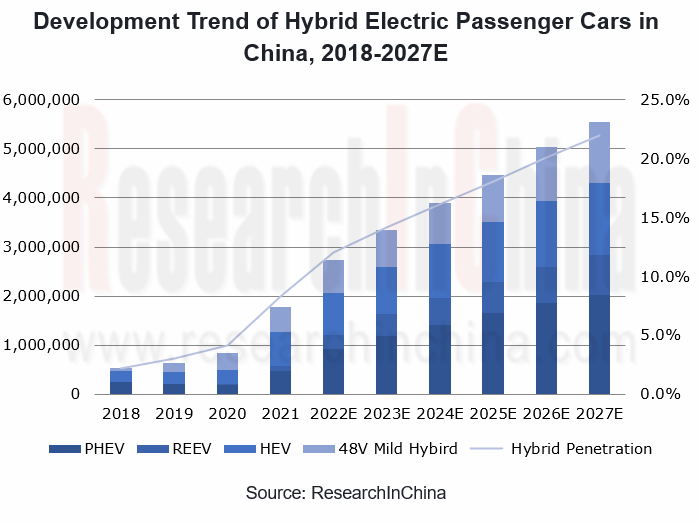
In 2021, the sales volume of hybrid passenger cars in China reached 1.778 million units, including 470,000 PHEVs, 105,000 REEVs, 689,000 HEVs, and 513,000 48V mild hybrids. With the development of hybrid systems of Chinese independent brands, PHEVs will outsell HEVs and 48V mild hybrids by 2022. REEVs have performed well since the launch, and will still grow at a relatively high growth rate from 2022 to 2027.
The penetration rate of hybrid electric passenger cars in China will fetched 8.3% in 2021, and it is expected to hit 22% by 2027 with sales over 5.5 million units.
After several years of development, Chinese independent brand automakers have made significant progress in hybrid vehicle technology, even surpassed Japanese companies such as Toyota and Honda in some aspects of performance. Their models cover weak hybrids, mild hybrids/medium hybrids, strong hybrids and so on:
Micro Hybrid - Start / Stop (12V): The currently available start / stop 12V passenger car models mainly come from European and American brands, while Chinese independent brands account for 19% of the total models;
Mild/Medium Hybrid (48V): Although Chinese independent brand automakers have deployed 48V mild hybrid system technology, they offer few models, and almost only FAW-Hongqi, Geely and Great Wall have sold cars equipped with the technology.
PHEV: BYD DM, DM-i, Great Wall L.E.M.O.N DHT, Geely Thor Hybrid Hi·X, Changan Blue Whale iDD and other hybrid systems have been mass-produced. BYD DM and DM-i have been installed on many of its models; DHT, has been applied to Mocha, Latte, Macchiato and other models of Great Wall; Changan Blue Whale iDD has been applied to UNI-K, UNI-V models;
REEV: The REEVs currently for sale mainly include Seres SF5, AITO M5, Li ONE and Voyah FREE. In June 2022, Li Auto released a full-size SUV - Li L9, and AITO unveiled a medium and large range-extended SUV - AITO M7. Both were so appealing that they received over 20,000 orders upon launch.
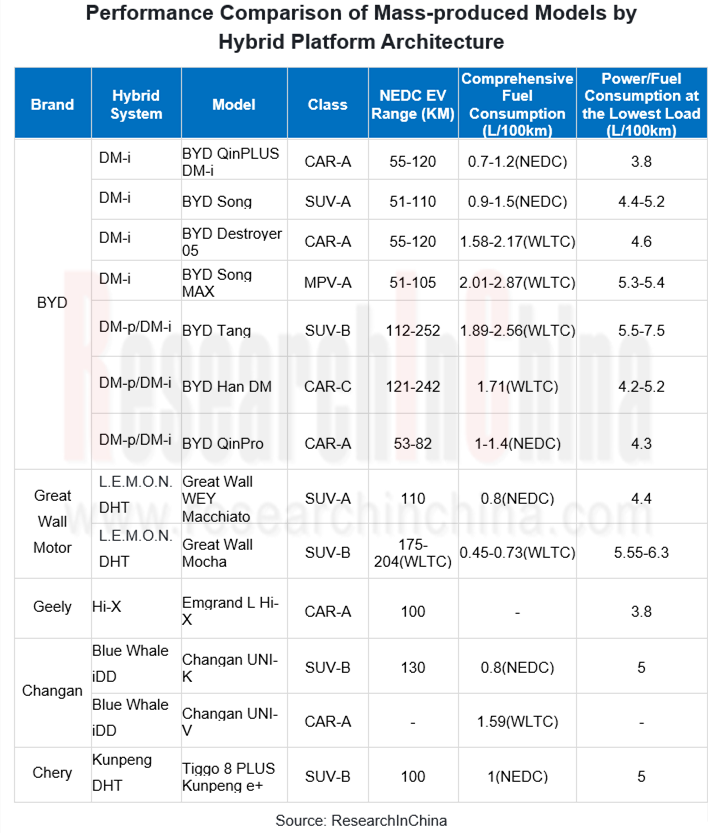
OEMs have mass-produced a new generation of DHE + DHT + integrated electric drive hybrid architecture
From the perspective of technical route selection:
 48V hybrid technology maintains steady growth by continuously improving motor efficiency and electrification level. At this stage, it is mainly driven by foreign OEMs;
HEV technology-based models pay more attention to development of energy saving, cost reduction, system simplification, etc.;
PHEV technology is developing towards low energy consumption and high cost performance, and China has explored an independent development of PHEV technology path;
REEV technology is complementary to other hybrid technologies due to its simple structure. High battery life and driving experience are welcomed by consumers. Driven by star models such as Li, AITO, and Voyah, it will grow rapidly in the next few years.
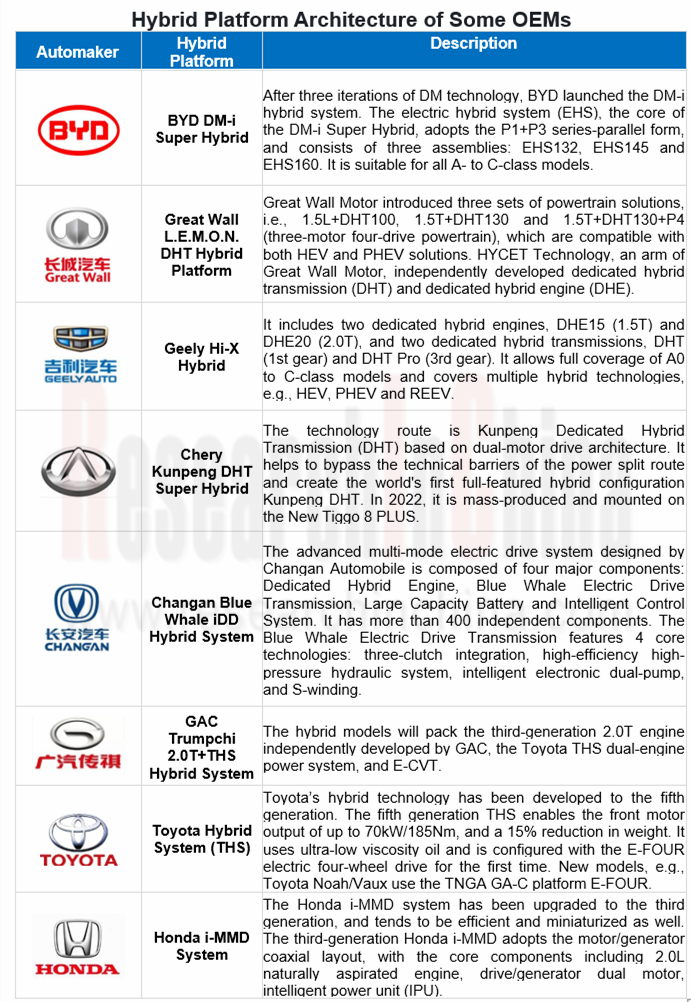
From the perspective of hybrid technology platform layout of OEMs, domestic OEMs have independently developed DHE (hybrid special engine) + DHT (hybrid special transmission assembly), and the platform supports multiple hybrid architectures such as HEV, PHEV, and REEV at the same time:
Automotive Microcontroller Unit (MCU) and Application Scenario Research Report, 2026
Automotive MCU Research: Increased demand for redundant security drives ASIL D-compliant MCU shipments to exceed 100 million units
In a vehicle EEA, MCUs are widely distributed in various functional ...
China Intelligent Cockpit Patent Analysis Report, 2026
Intelligent Cockpit Patent Research: Cockpit AI, In?vehicle Health, and Infotainment Are Upgrade to Scenario?based and Proactive Functions
From a patent perspective, this report explores the cutting?...
Research Report on Application of VLA Large Model in Automobiles and Robots, 2026
Research on Automotive and Robot VLA: Hybrid Architectures Become Mainstream, VLA Integrates with General World Models, and Reinforcement Learning Serves as Core Engine
Vision?Language?Action (VLA) m...
China Charging Infrastructure (Supercharging, Battery Swapping, V2G, etc.) and High-Performance Supercharging Battery Research Report, 2026
Charging and battery swapping research: as 5C+ supercharging vehicle models go into mass production, the pace of OEMs self-building supercharging networks quickens
800-1000V high-voltage platforms ar...
China Passenger Car Electronic Controlled Suspension Industry Report, 2026
Electronic Controlled Suspension Industry Research: As the First Year of Full Active Suspension Unfolds, Three Technical Routes Race Forward
1. Penetration Rate Surges Three Times, and Electronic Con...
Intelligent Driving SoC Research Report, 2026
Research on Intelligent Driving SoCs: Competition Focus Shifts to L3/L4 Embedded Hardware, and Computing Power of Flagship Vehicle Models Exceeds 1,000 TOPS
In terms of intelligent driving system in...
Automotive AI Large Model Technology Research Report, 2026
Automotive AI Large Model Research: Competition Shifts from "Who Has the Stronger Model" to "Who Boasts Higher Link Efficiency"
ResearchInChina released the Automotive AI Large Model Technology Resea...
Intelligent Vehicle Cockpit Domain Controller Research Report, 2026
Cockpit domain controller research: L3 AIDV intelligent cockpit domain controllers are entering a boom period
Driven by multiple factors such as the continuous evolution of the automotive central int...
Automotive Acoustic System (Audio, Multi-Channel) Industry Report, 2026
Automotive Acoustics Research: Multiple Channels, AI Tuning, and Self-Developed Algorithms Drive the Transformation of High-End Cockpit Sound Fields
I. Automotive Audio Hardware Solutions with 6–9 S...
Autonomous Driving Sensor Chip Research Report, 2026
Research on Autonomous Driving Sensor Chips: Deeply Perceiving the Physical World, Sensor Chips Are Playing A “Leading Role” in Intelligence
In 2026, the autonomous driving sensor chip industr...
Passenger Car Corner Module and Wheel‑Side Control System Research Report, 2026
Wheel-side control research: the “last mile” chassis innovation
Wheel-side control dismantles the traditional drive, braking, steering, and suspension control of the chassis from a "centralized" styl...
Embodied Artificial Intelligence (& Humanoid Robot) MCU Research Report, 2026
Research on Humanoid Robot MCUs: Evolution from General-Purpose Control to High-Value Dedicated Chip Solutions Integrated with Edge AI Functions
MCU (Microcontroller Unit) refers to a compact integra...
Intelligent Vehicle Zone Control Unit (ZCU) Research Report, 2026
ZCU Research: Cross-domain integrated ZCUs are becoming the edge computing nodes of the next-generation zonal architecture
Currently, the mainstream zonal architecture is mainly the quasi-central + z...
Automotive Cybersecurity and Data Security Research Report, 2026
Cybersecurity & Data Security Research: Intelligent Connected Vehicles Enter the Era of “Systematic Offense-Defense and AI-Defined Security”.
Centering on the panorama of intelligent connect...
Report on Breakthrough Strategies of OEMs and ADAS Tier 1 Suppliers for Overseas Layout of Intelligent Driving, 2026
Regulatory Breakthrough, Local System Establishment, OEMs Competing for NOA Layout: Overall Trends of China’s Intelligent Driving Overseas Layout in 2026
Research on overseas intelligent driving layo...
OEMs and Tier1s’ Intelligent Cockpit Platform (Hardware and Software) Innovation Strategy Research Report, 2026
Intelligent Cockpit Platform Research: multi-dimensional cockpit system architecture reconstruction for multi-agent collaboration and proactive intelligent services
The intelligent cockpit software s...
Automotive AIOS Research Report, 2026
Automotive AIOS Research: Mass Production Solutions Are Implemented
Mass Production Solutions Are Implemented on A Small Scale.
In 2026, AIOS starts small-scale implementation, helping to improve v...
Automotive Telematics Service Provider (TSP) Research Report, 2026
TSP Research: Leading providers collectively turn to AI agents to provide all-scenario active services
Telematics Service Providers (TSPs) are the core hub of the telematics industry chain, connectin...