LiDAR Research: Perception Algorithms Become the Layout Focus of Foreign Vendors
Amid a variety of technology routes in parallel, rotating mirror and flash solutions are adopted most widely during OEM mass production.
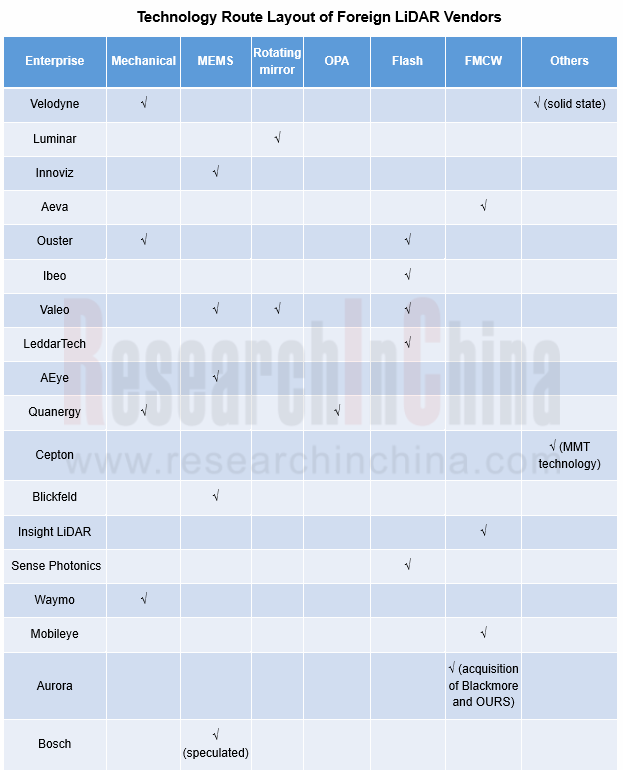
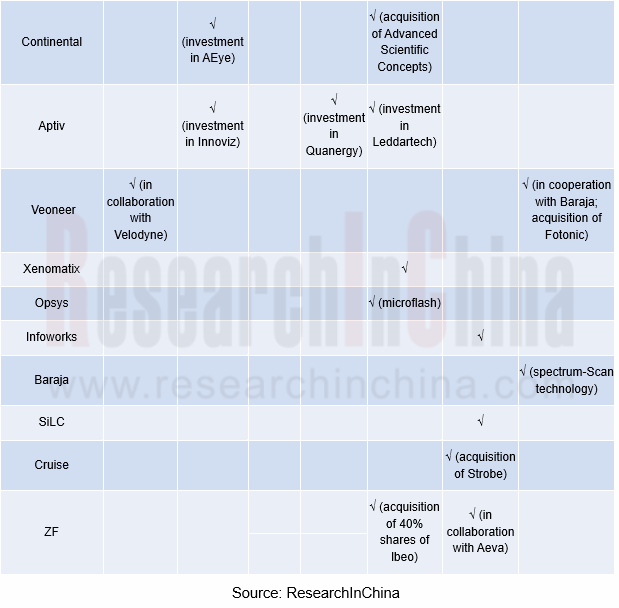
LiDAR technology routes include mechanical, MEMS, rotating mirror/prism, OPA, flash, etc. On the whole, LiDAR evolves from mechanical type to solid-state type, with multiple technology routes existing in parallel (for example, Velodyne has developed mechanical and solid-state solutions simultaneously since Velarray debuted at the 2017 Frankfurt Auto Show). Flash is the most popular solution in the layout of foreign vendors, followed by FMCW and MEMS.
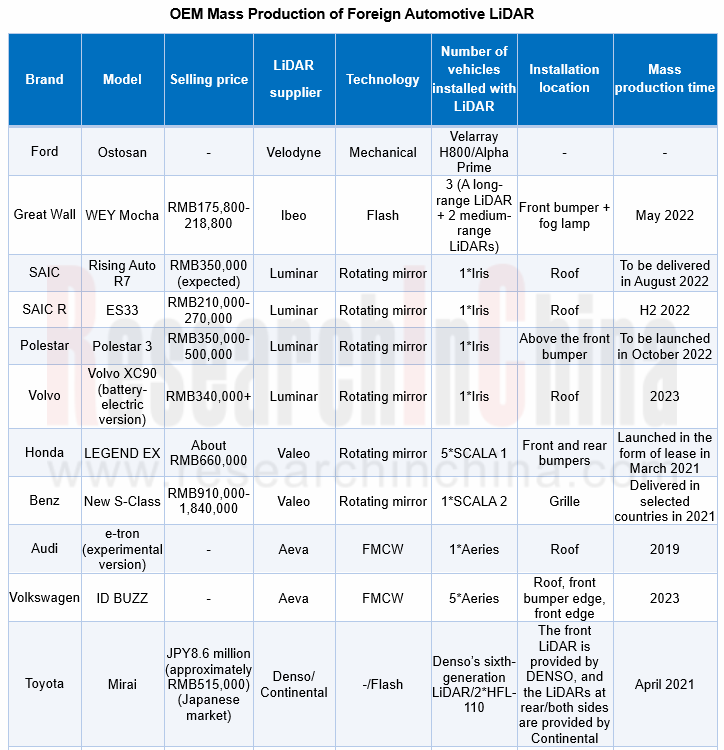
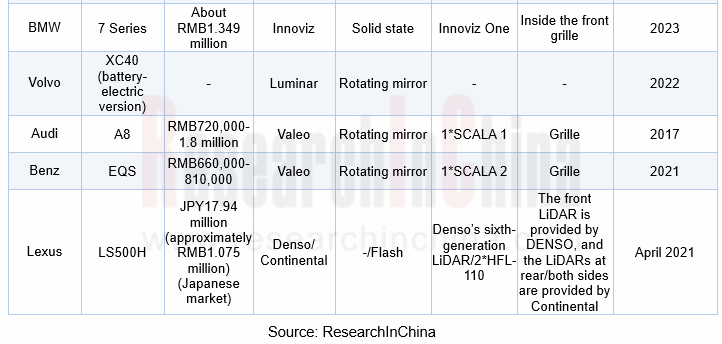
As per OEM mass production, rotating mirror and flash solutions are adopted most widely. Valeo is a typical vendor leveraging the rotating mirror solution, and it produces LiDAR at the Wemding factory in Bavaria, Germany. As of 2021, its Scala LiDAR shipments had exceeded 160,000 units, with a single unit costing less than $1,000. Ibeo is known for its flash LiDAR. The ibeoNEXT LiDAR system produced by ZF features the detection range of more than 250 meters, the horizontal angular resolution of 0.04°, and the vertical angular resolution of 0.07°. It can recognize guardrails, road signs, cars, bicycles and pedestrians, along with their respective positions and movement directions. It has been installed on Great Wall WEY Mocha.
Perception algorithms become the layout focus of foreign vendors
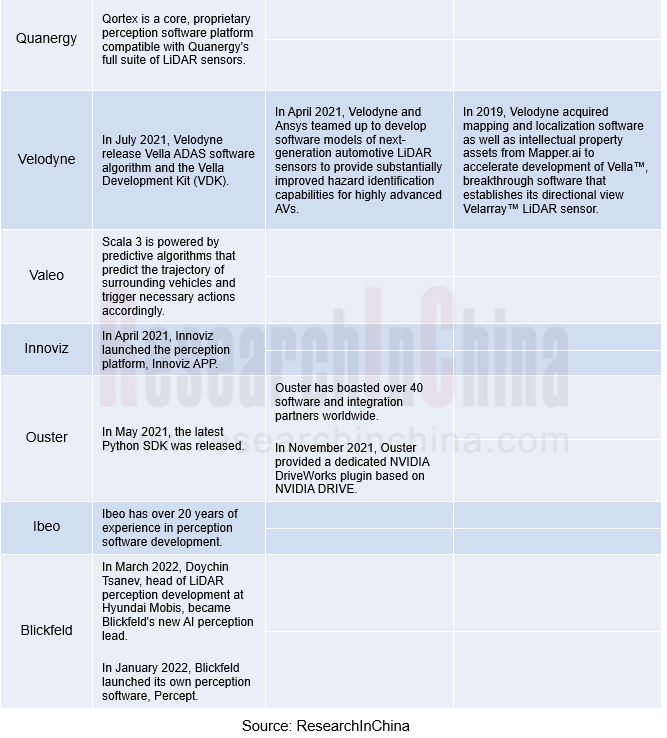
The quality of perception algorithm determines perception accuracy and distance. Therefore, LiDAR vendors not only upgrade their own hardware, but also develop perception software, so as to form the closed loop of perception fusion and system-level supply. Foreign LiDAR vendors mainly leverage self-research, acquisition and cooperation with software companies to deploy perception algorithms.
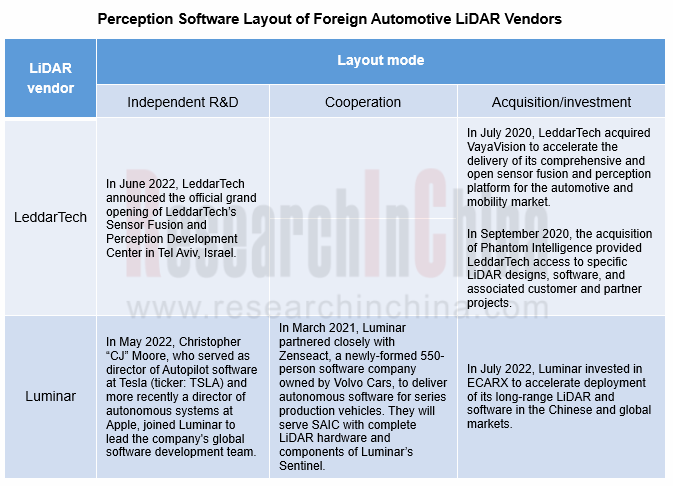
LeddarTech mainly makes its layout through acquisitions. LeddarTech acquired sensor fusion and perception software companies VayaVision and Phantom Intelligence in 2020. LeddarTech’s open platform based on its full-waveform digital signal processing technology combined with VayaVision’s raw data sensor fusion and perception software stack will deliver the most accurate environmental model, enabling the volume deployment of ADAS and AD applications. In September 2020, the acquisition of Phantom Intelligence provided LeddarTech access to specific LiDAR designs, software, and associated customer and partner projects.
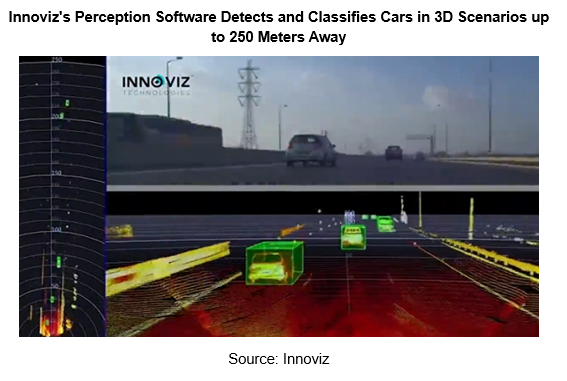
Innoviz mainly develops its own perception algorithm. In April 2021, Innoviz launched embedded automotive perception platform "Innoviz APP". Innoviz APP can accurately detect and classify objects in any 3D driving scenario up to 250 meters away, including cars, trucks, motorcycles, pedestrians, and more. It also executes perception algorithms in real time, detecting and classifying pixels as collision relevant or non-collision relevant. At the same time, it can also be integrated on chips as an embedded software IP. Innoviz's software leverages the massive data from LiDAR and proprietary AI algorithms to provide excellent scenario awareness as well as an automatically upgradable ASIL B(D) solution.
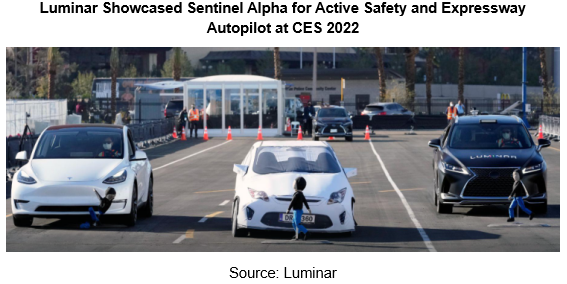
Luminar makes its layout through cooperation, investment and independent R&D. In March 2021, Luminar cooperated with Volvo’s self-driving software subsidiary Zenseact to create a “holistic autonomous vehicle stack” made for production vehicles. The stack is called Sentinel, which will integrate Zenseact’s OnePilot autonomous driving software solution alongside Luminar’s Iris LiDAR, perception software, and other components as a foundation. The system is designed to handle highway autonomy and a number of safety measures to proactively avoid collisions with evasive maneuvers, reducing accident rates by up to seven times. Luminar completed development of the alpha version of Sentinel in 2021 and plans to accomplish the beta version in 2022. In addition, Luminar will serve SAIC’s production vehicles with complete LiDAR hardware and components of Luminar’s Sentinel.
Chip-based LiDAR development is vital for mass production and cost reduction
Inside LiDAR, there are hundreds of discrete devices with high costs in materials and optical assembly, which pose a major obstacle to mass production. Chip-based LiDAR can integrate hundreds of discrete devices into one chip, effectively reducing the product size and costs while facilitating mass production.
For example, all of Ouster's digital LiDAR sensors share the same core architecture. The architecture consists of two chips and a patented micro-optical system, replacing hundreds of discrete components inside traditional analog LiDAR, improving reliability and reducing price (the ES2 debuts with an expected price of $600 for series production -- and Ouster’s digital LiDAR technology provides a clear roadmap that will allow future models to break the $100 price barrier).
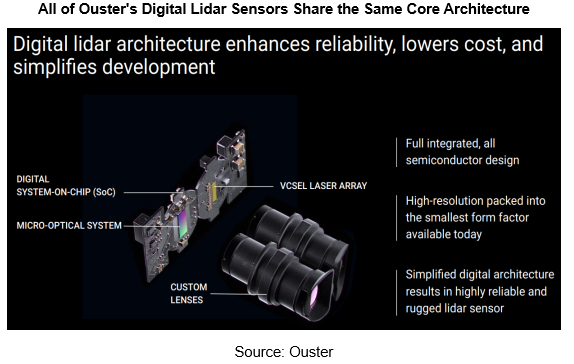
As shown above, in Ouster's LiDAR core architecture, a vertical cavity surface emitting laser (“VCSEL”) array integrates all lasers on a single chip. The custom SoC integrates single photon avalanche diode (“SPAD”) detectors and a proprietary digital signal processing system to handle all commands and control logic of LiDAR. The patented micro-optical system guides light through LiDAR to improve the detector efficiency exponentially.
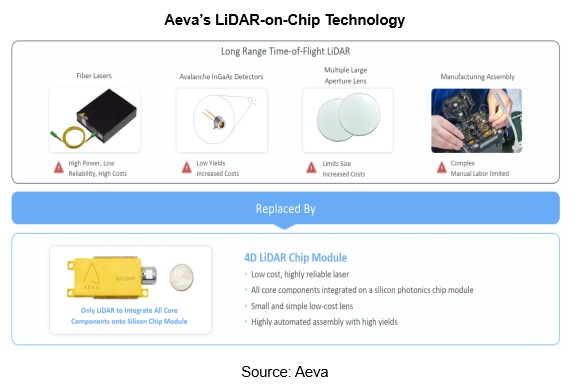
Aeva is also working on a chip-based layout. In February 2022, Aeva unveiled Aeries? II, a 4D LiDAR? sensor leveraging Aeva’s unique Frequency Modulated Continuous Wave (FMCW) technology and the world’s first LiDAR-on-chip module design which places all key components including transmitters, receivers and optics onto a silicon photonics chip in a compact module. The compact design is 75% smaller than the previous generation. Mass production is expected in 2023.
Automotive Microcontroller Unit (MCU) and Application Scenario Research Report, 2026
Automotive MCU Research: Increased demand for redundant security drives ASIL D-compliant MCU shipments to exceed 100 million units
In a vehicle EEA, MCUs are widely distributed in various functional ...
China Intelligent Cockpit Patent Analysis Report, 2026
Intelligent Cockpit Patent Research: Cockpit AI, In?vehicle Health, and Infotainment Are Upgrade to Scenario?based and Proactive Functions
From a patent perspective, this report explores the cutting?...
Research Report on Application of VLA Large Model in Automobiles and Robots, 2026
Research on Automotive and Robot VLA: Hybrid Architectures Become Mainstream, VLA Integrates with General World Models, and Reinforcement Learning Serves as Core Engine
Vision?Language?Action (VLA) m...
China Charging Infrastructure (Supercharging, Battery Swapping, V2G, etc.) and High-Performance Supercharging Battery Research Report, 2026
Charging and battery swapping research: as 5C+ supercharging vehicle models go into mass production, the pace of OEMs self-building supercharging networks quickens
800-1000V high-voltage platforms ar...
China Passenger Car Electronic Controlled Suspension Industry Report, 2026
Electronic Controlled Suspension Industry Research: As the First Year of Full Active Suspension Unfolds, Three Technical Routes Race Forward
1. Penetration Rate Surges Three Times, and Electronic Con...
Intelligent Driving SoC Research Report, 2026
Research on Intelligent Driving SoCs: Competition Focus Shifts to L3/L4 Embedded Hardware, and Computing Power of Flagship Vehicle Models Exceeds 1,000 TOPS
In terms of intelligent driving system in...
Automotive AI Large Model Technology Research Report, 2026
Automotive AI Large Model Research: Competition Shifts from "Who Has the Stronger Model" to "Who Boasts Higher Link Efficiency"
ResearchInChina released the Automotive AI Large Model Technology Resea...
Intelligent Vehicle Cockpit Domain Controller Research Report, 2026
Cockpit domain controller research: L3 AIDV intelligent cockpit domain controllers are entering a boom period
Driven by multiple factors such as the continuous evolution of the automotive central int...
Automotive Acoustic System (Audio, Multi-Channel) Industry Report, 2026
Automotive Acoustics Research: Multiple Channels, AI Tuning, and Self-Developed Algorithms Drive the Transformation of High-End Cockpit Sound Fields
I. Automotive Audio Hardware Solutions with 6–9 S...
Autonomous Driving Sensor Chip Research Report, 2026
Research on Autonomous Driving Sensor Chips: Deeply Perceiving the Physical World, Sensor Chips Are Playing A “Leading Role” in Intelligence
In 2026, the autonomous driving sensor chip industr...
Passenger Car Corner Module and Wheel‑Side Control System Research Report, 2026
Wheel-side control research: the “last mile” chassis innovation
Wheel-side control dismantles the traditional drive, braking, steering, and suspension control of the chassis from a "centralized" styl...
Embodied Artificial Intelligence (& Humanoid Robot) MCU Research Report, 2026
Research on Humanoid Robot MCUs: Evolution from General-Purpose Control to High-Value Dedicated Chip Solutions Integrated with Edge AI Functions
MCU (Microcontroller Unit) refers to a compact integra...
Intelligent Vehicle Zone Control Unit (ZCU) Research Report, 2026
ZCU Research: Cross-domain integrated ZCUs are becoming the edge computing nodes of the next-generation zonal architecture
Currently, the mainstream zonal architecture is mainly the quasi-central + z...
Automotive Cybersecurity and Data Security Research Report, 2026
Cybersecurity & Data Security Research: Intelligent Connected Vehicles Enter the Era of “Systematic Offense-Defense and AI-Defined Security”.
Centering on the panorama of intelligent connect...
Report on Breakthrough Strategies of OEMs and ADAS Tier 1 Suppliers for Overseas Layout of Intelligent Driving, 2026
Regulatory Breakthrough, Local System Establishment, OEMs Competing for NOA Layout: Overall Trends of China’s Intelligent Driving Overseas Layout in 2026
Research on overseas intelligent driving layo...
OEMs and Tier1s’ Intelligent Cockpit Platform (Hardware and Software) Innovation Strategy Research Report, 2026
Intelligent Cockpit Platform Research: multi-dimensional cockpit system architecture reconstruction for multi-agent collaboration and proactive intelligent services
The intelligent cockpit software s...
Automotive AIOS Research Report, 2026
Automotive AIOS Research: Mass Production Solutions Are Implemented
Mass Production Solutions Are Implemented on A Small Scale.
In 2026, AIOS starts small-scale implementation, helping to improve v...
Automotive Telematics Service Provider (TSP) Research Report, 2026
TSP Research: Leading providers collectively turn to AI agents to provide all-scenario active services
Telematics Service Providers (TSPs) are the core hub of the telematics industry chain, connectin...