LiDAR research: Chinese passenger cars will carry over 80,000 LiDAR sensors in 2022
1. The mass production of LiDAR is accelerating, and the installations are expected to exceed 80,000 units in 2022
Since 2021, LiDAR industry has entered the stage of commercialization. Local OEMs have taken the lead in mass-producing a number of models, including Xpeng P5, Aion LX PLUS, NIO ET7, and Li L9.
According to the statistics from ResearchInChina, Chinese new passenger cars were equipped with 24,700 LiDAR sensors in the first half of 2022, of which 18,400 units or 74.4% was seen in Xpeng P5.
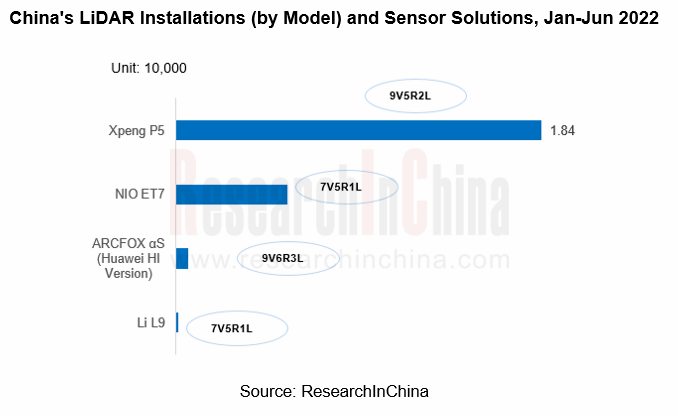
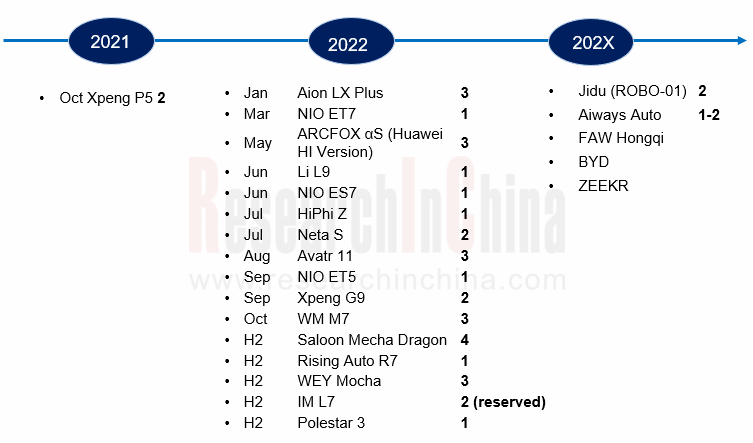
In the second half of 2022, there will be more than 10 new models featuring LiDAR to be delivered in China, including Xpeng G9 and WM M7, which will spur LiDAR installations to exceed 80,000 units in the full year.
2. The "rotating mirror + MEMS" technical solution is the first choice for mass production
At present, production models mainly adopt "rotating mirror + MEMS" technical solution, such as HESAI AT128, RoboSense M1, Huawei 96-channel LiDAR, Innovusion Falcon, etc...
RoboSense launched it semi-solid-state LiDAR - M1 in June 2021. Based on 2D MEMS smart chip scanning technology, it has “GAZE” function with intelligent zoom and detection distance of 150m for 10% reflectivity targets. So far, it has been designated by 40+ models. In 2022, it served GAC Aion LX Plus, IM L7, WM M7, Xpeng G9, Lotus, etc.
Huawei's 96-channel hybrid solid-state LiDAR adopts a rotating mirror solution, with a field of view of 120?x25? and a maximum detection distance of 150 meters. It has been mass-produced for ARCFOX αS (Huawei HI version), Neta S, and Avatr 11, and will be applied to other models such as Saloon Mecha Dragon which will boast 4 units located at the front, rear, and both sides of the front.
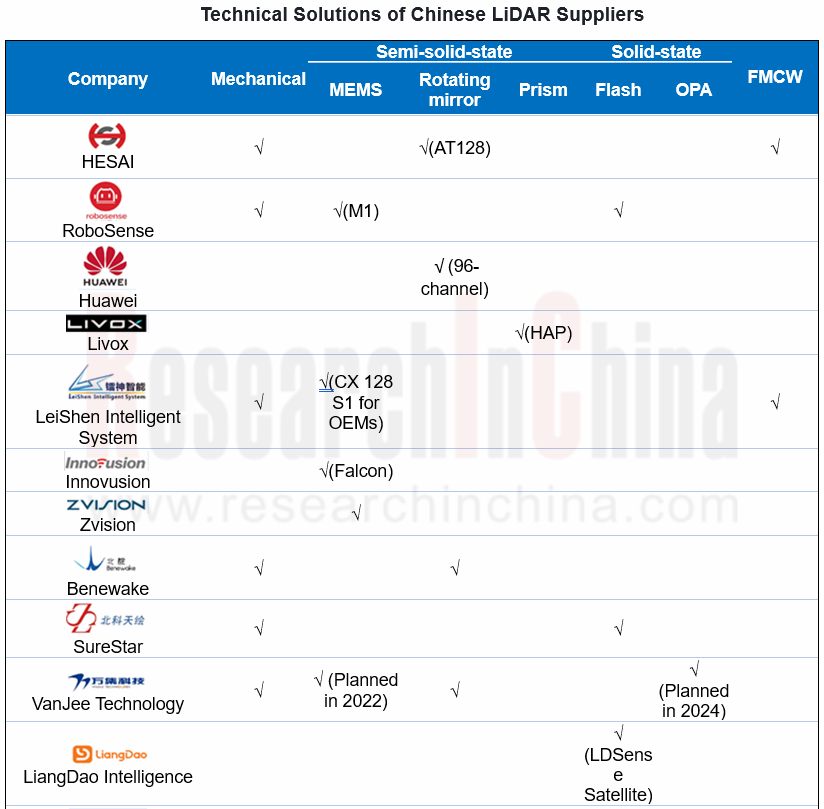
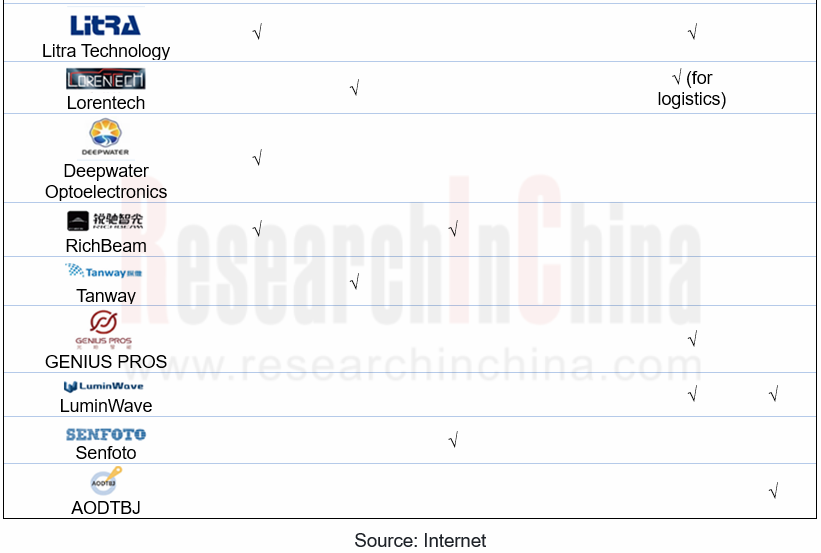
In the short term, the "rotating mirror + MEMS" solution is still the mainstream for local LiDAR installations on vehicles. In the long run, solid-state solutions (flash, OPA) and FMCW LiDAR will be play main roles.
Especially, the flash solution has achieved a breakthrough. In May 2022, LiangDao Intelligence released its first self-developed flash lateral LiDAR - LD Satellite for Chinese market, with a chip-based design and a vertical field of view of 75°-90°. It will be mass-produced in the second half of 2023. In the future, LiangDao Intelligence will combine LD Satellite with its experience in perception development and verification testing to provide LiDAR software and hardware integrated solutions for Chinese market.
A number of enterprises have deployed OPA technology, such as VanJee Technology, Litra Technology, GENIUS PROS, LuminWave, etc. Among them, VanJee Technology plans to release silicon-based OPA LiDAR with a range of 30 meters in August 2022, and automotive silicon-based OPA LiDAR in June 2024.
In addition, Chinese companies such as LeiShen Intelligent System and HESAI are developing FMCW technology. In July 2022, Aeva announced that the first Aeries? II 4D LiDAR had been produced and shipped to customers as the world's first FMCW LiDAR delivered. This will inspire breakthroughs in FMCW technology in China.
3. Mass production and delivery capabilities should be improved comprehensively
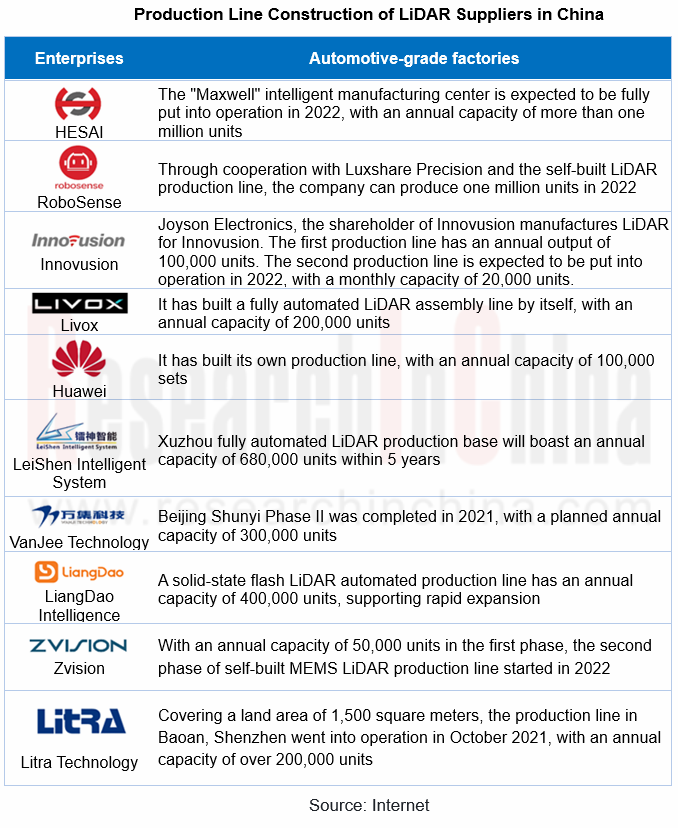
Thanks to the definite LiDAR technology route, many Chinese suppliers have improved capacity swiftly through foundries, cooperation and self-built factories.
The "Maxwell" intelligent manufacturing center invested by HESAI with nearly US$200 million is expected to be fully put into operation in 2022, with an annual capacity of more than one million units. Innovusion cooperates with Joyson Electronics. The first automotive-grade LiDAR production line has an annual output of 100,000 units. The second production line located in Xiangcheng District, Suzhou is expected to be put into operation in 2022, with a monthly capacity of 20,000 units.
In addition to large-scale production, suppliers are reducing LiDAR cost and accelerating mass production and applications through hardware integration and chipization. For instance, HESAI AT128 is a long-range semi-solid-state LiDAR based on a VCSEL array (the second-generation chip is provided by Lumentum). The VCSEL array embedded in the chip replaces the traditional discrete light source to significantly slash the manufacturing cost of LiDAR.
The solid-state LiDAR of LiangDao Intelligence leverages the flash technology upgrade solution - VCSEL electric drive scanning and SPAD partition receiving technology to dramatically amplify the detection distance of flash LiDAR. Plus the design of optical lens, it offers a wide field of view.
In general, Chinese LiDAR suppliers mainly focus on cost reduction in laser transceiver module (about 60% of cost). For a long time, the technology of electronic components such as lasers and detectors has been monopolized by foreign companies. However, in recent years, some Chinese enterprises have gradually broken through technical barriers, launched automotive-grade products, and secure orders from automakers.
Vertilite’s VCSEL has been certified by AEC-Q102 and IATF 16949, and won the bid for a major LiDAR customer's OEM mass production project. In March 2022, the company received investment from Huawei, Xiaomi, BYD, DJI, etc.; in August, HESAI and RoboSense became its shareholders.
Fortsense began to develop LiDAR SPAD chips in 2019, successfully taped out in 2021, and received a custom order from a leading automaker in early 2022.
Vehicle-Road-Cloud Integration and C-V2X Industry Report, 2026
Vehicle-Road-Cloud and C-V2X Research: with the three-tier promotion system of "top-level planning + mandatory pilot + evaluation binding", the industry turning point is approachingThis report focuses...
China OEM Data Capability Analysis Report, 2026
OEM Data Capability Research: 24 OEMs × 9 Capability Domains, Who Takes the Lead?
An L4 autonomous driving R&D and test vehicle can generate approximately 10TB of raw data per single day — data v...
Autonomous Driving Domain Controller and Central Computing Unit (CCU) Industry Report, 2026
Autonomous Driving Domain Controller (ADCU) Research: One-Chip CCU solutions are quickly available in vehicles
In China's passenger car market, autonomous driving systems involved in mass production ...
Automotive EMS and ECU Industry Research Report, 2026
Automotive EMS Research: The boundaries between EMS providers and Tier1 suppliers are becoming blurred, and the supply chain model is evolving from a linear chain to a networked structure
Mainstream ...
Automotive Microcontroller Unit (MCU) and Application Scenario Research Report, 2026
Automotive MCU Research: Increased demand for redundant security drives ASIL D-compliant MCU shipments to exceed 100 million units
In a vehicle EEA, MCUs are widely distributed in various functional ...
China Intelligent Cockpit Patent Analysis Report, 2026
Intelligent Cockpit Patent Research: Cockpit AI, In?vehicle Health, and Infotainment Are Upgrade to Scenario?based and Proactive Functions
From a patent perspective, this report explores the cutting?...
Research Report on Application of VLA Large Model in Automobiles and Robots, 2026
Research on Automotive and Robot VLA: Hybrid Architectures Become Mainstream, VLA Integrates with General World Models, and Reinforcement Learning Serves as Core Engine
Vision?Language?Action (VLA) m...
China Charging Infrastructure (Supercharging, Battery Swapping, V2G, etc.) and High-Performance Supercharging Battery Research Report, 2026
Charging and battery swapping research: as 5C+ supercharging vehicle models go into mass production, the pace of OEMs self-building supercharging networks quickens
800-1000V high-voltage platforms ar...
China Passenger Car Electronic Controlled Suspension Industry Report, 2026
Electronic Controlled Suspension Industry Research: As the First Year of Full Active Suspension Unfolds, Three Technical Routes Race Forward
1. Penetration Rate Surges Three Times, and Electronic Con...
Intelligent Driving SoC Research Report, 2026
Research on Intelligent Driving SoCs: Competition Focus Shifts to L3/L4 Embedded Hardware, and Computing Power of Flagship Vehicle Models Exceeds 1,000 TOPS
In terms of intelligent driving system in...
Automotive AI Large Model Technology Research Report, 2026
Automotive AI Large Model Research: Competition Shifts from "Who Has the Stronger Model" to "Who Boasts Higher Link Efficiency"
ResearchInChina released the Automotive AI Large Model Technology Resea...
Intelligent Vehicle Cockpit Domain Controller Research Report, 2026
Cockpit domain controller research: L3 AIDV intelligent cockpit domain controllers are entering a boom period
Driven by multiple factors such as the continuous evolution of the automotive central int...
Automotive Acoustic System (Audio, Multi-Channel) Industry Report, 2026
Automotive Acoustics Research: Multiple Channels, AI Tuning, and Self-Developed Algorithms Drive the Transformation of High-End Cockpit Sound Fields
I. Automotive Audio Hardware Solutions with 6–9 S...
Autonomous Driving Sensor Chip Research Report, 2026
Research on Autonomous Driving Sensor Chips: Deeply Perceiving the Physical World, Sensor Chips Are Playing A “Leading Role” in Intelligence
In 2026, the autonomous driving sensor chip industr...
Passenger Car Corner Module and Wheel‑Side Control System Research Report, 2026
Wheel-side control research: the “last mile” chassis innovation
Wheel-side control dismantles the traditional drive, braking, steering, and suspension control of the chassis from a "centralized" styl...
Embodied Artificial Intelligence (& Humanoid Robot) MCU Research Report, 2026
Research on Humanoid Robot MCUs: Evolution from General-Purpose Control to High-Value Dedicated Chip Solutions Integrated with Edge AI Functions
MCU (Microcontroller Unit) refers to a compact integra...
Intelligent Vehicle Zone Control Unit (ZCU) Research Report, 2026
ZCU Research: Cross-domain integrated ZCUs are becoming the edge computing nodes of the next-generation zonal architecture
Currently, the mainstream zonal architecture is mainly the quasi-central + z...
Automotive Cybersecurity and Data Security Research Report, 2026
Cybersecurity & Data Security Research: Intelligent Connected Vehicles Enter the Era of “Systematic Offense-Defense and AI-Defined Security”.
Centering on the panorama of intelligent connect...