Smart Surface Research: As an important medium for multimodal interaction, smart surfaces lead the trend of smart cockpits.
Smart surfaces represent the development trend of automotive interiors and exteriors.
Smart surfaces represent the development trend of automotive interiors and exteriors, as an important part of smart cockpits and a crucial medium of multi-modal interaction. On center consoles, steering wheels, doors, windows and other automotive interior parts, smart surfaces upgrade traditional interactive media such as buttons or knobs in traditional automotive interiors to touch interactive media made of surface materials such as plastic or fabric.
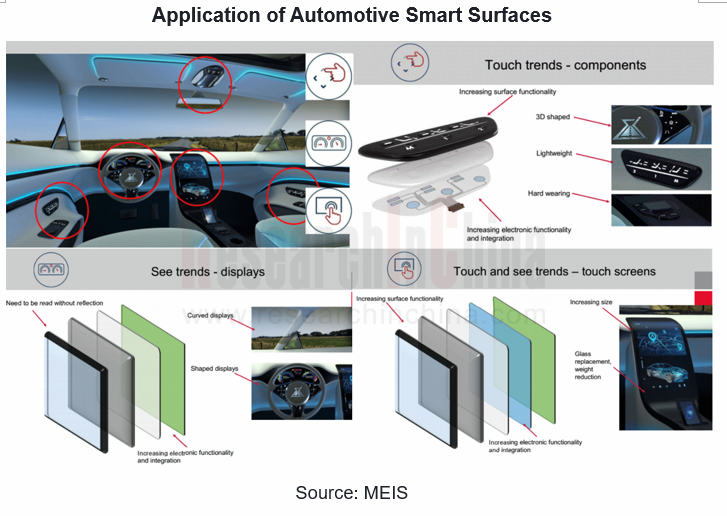
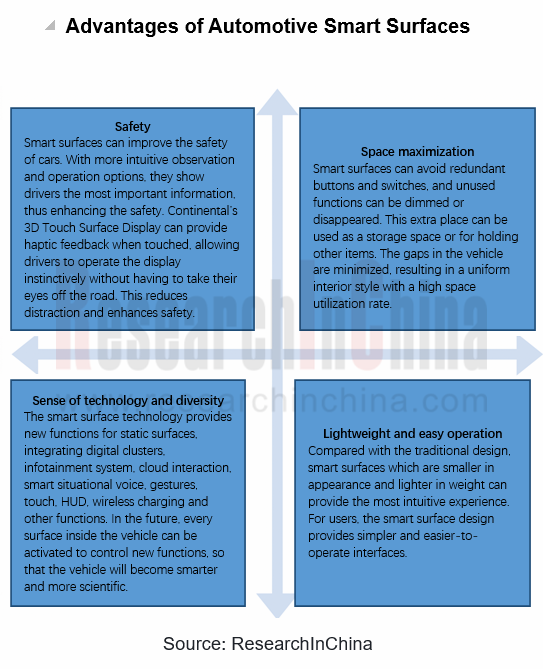
Compared with traditional automotive interiors, smart surfaces feature lightweight, intelligence and functionality.
Lightweight: The weight is reduced by 60%-80%, the thickness is cut by 90%, the PCBA area drops by 25%, and the number of parts is slashed by 95%.
Intelligence: The integration of intelligent components such as electronic switches, lighting, and sensors provides a medium for multimodal interactions.
Functionality: With more design freedom and higher functional integration, smart surfaces can provide more functions for drivers and passengers in a more convenient way.
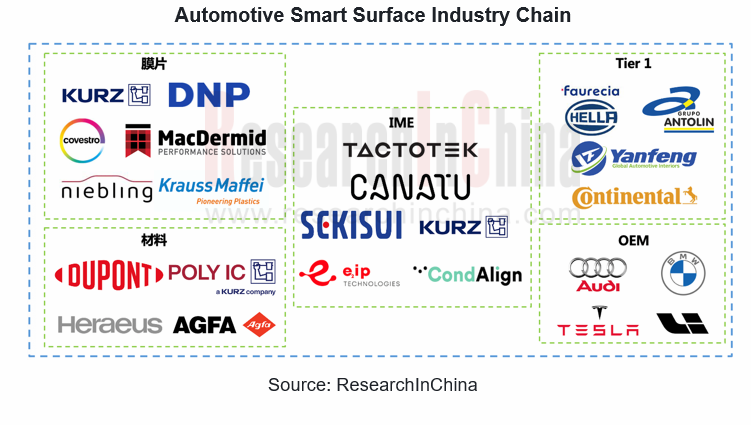
Professional IME enterprises and Tier1 interior enterprises jointly promote the development of automotive smart surfaces.
In-Mold Electronics is the main smart surface technology at present, featuring excellent bending and tensile properties, supporting 3D molding, requiring no new molds and enabling more free modeling design. Moreover, environmentally friendly and economical printed conductive ink solutions can meet the growing demand for model facelifts.
At present, there are not many companies that focus on automotive IME technology. Most companies take into account consumer electronics or industrial electronic components, such as Tactotek, Canatu, Sekisui, Kurz, e2ip, etc. At the same time, most automotive interior Tier1 companies are paying more and more attention to the application and development of smart surface components.
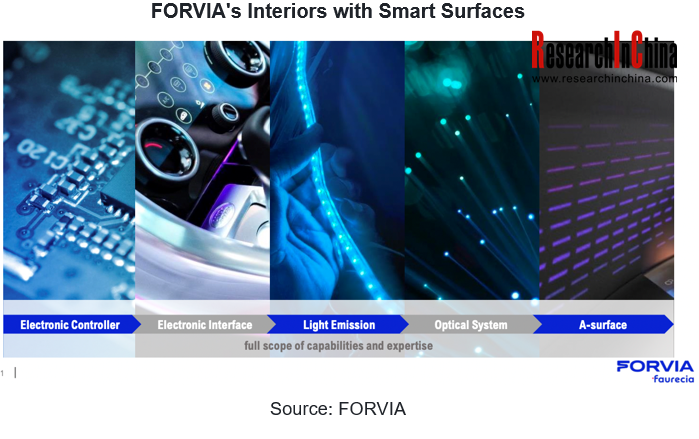
Faurecia envisions the cockpit of the future as a multifunctional, connected and intelligent space. The smart surface developed by Faurecia draws on the Group's experience in many professional fields: cockpit architecture, system integration, kinematics and mechatronics. In 2021, Faurecia and Immersion announced a multi-year license agreement, providing Faurecia with access to Immersion's patented technology as well as haptic technology solutions for automotive touch screens and control systems. In 2022, Faurecia completed the acquisition of Hella, and named the newly combined Group “FORVIA”. Smart surface products will also integrate more smart lighting functions.
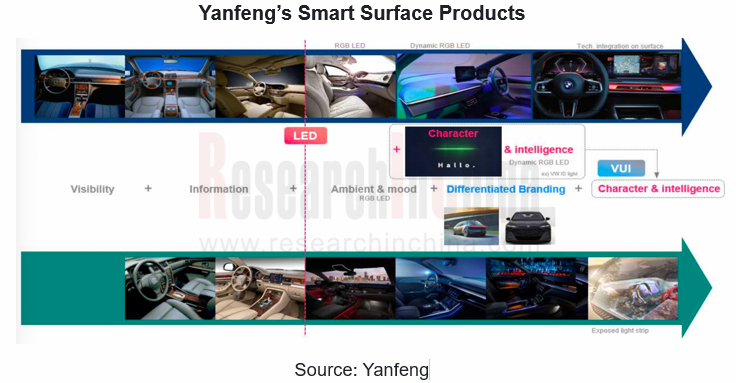
The smart interior surface being developed by Yanfeng Automotive Interiors (YFAI) combines automotive interior aesthetics with HMI technology, and seamlessly integrates control, information display, lighting and heating onto the same surface. In February, 2020, Yanfeng demonstrated its latest smart surface technology through a "smart surface model” which includes seven HMIs and is seamlessly integrated on various interior surfaces. In March, 2022, Yanfeng and SemsoTec signed a Memorandum of Understanding (MOU) for collaboration in display and sensor technologies, components and products for automotive application. The cooperation between the two parties aims to accelerate the seamless integration of HMI onto all interior surfaces of future cars, thereby offering unique in-car user experience.
Smart surfaces provide more possibilities for the smart cockpit strategies of OEMs
More and more OEMs apply smart surfaces to smart cockpits of both luxury cars and entry-level cars. Touch center consoles, touch door control modules and touch window control modules are very common, and even touch modules appear on steering wheels.
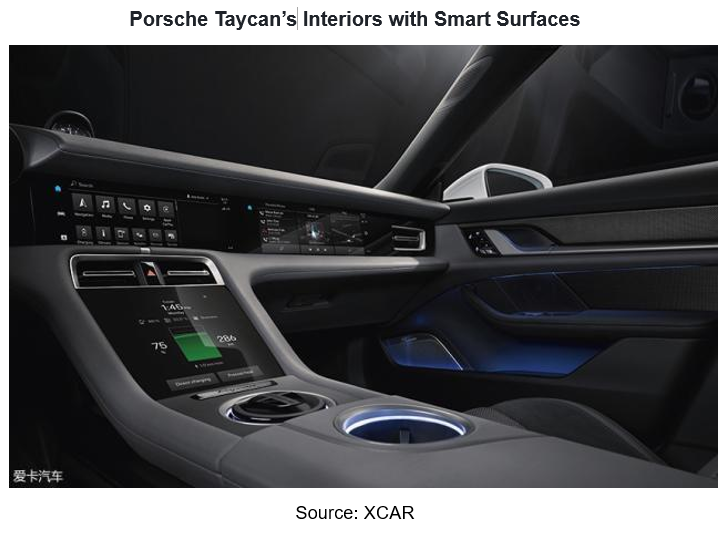
In Porsche's new interactive interface design, the 8.4-inch inclined screen at the lower part of the center console mainly displays the power, charging status, air conditioning control, writing pad, etc., with tactile feedback and error-proof operation functions.
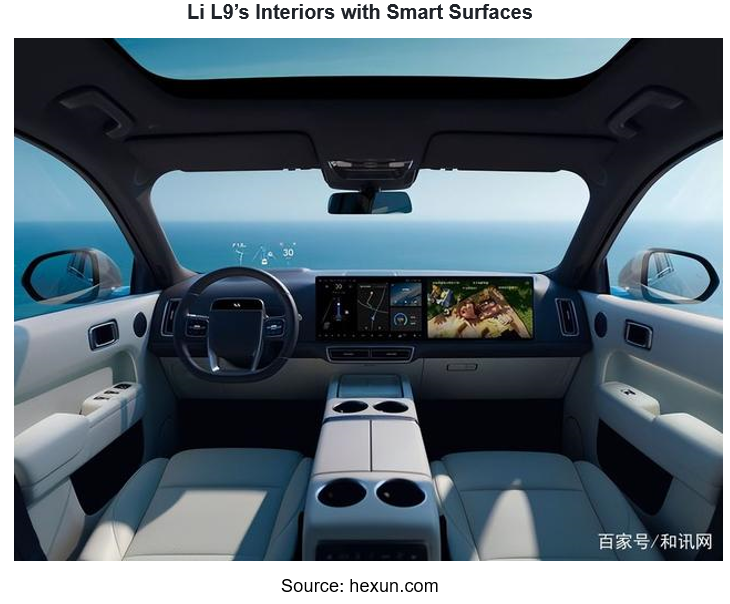
Li L9 cancels the cluster in front of the driver, and instead adds a small TouchBar above the steering wheel. The combination of 5-screen touch control, 6 microphones, 3D ToF sensors, and the multi-modal 3D interactive technology developed by Li Auto based on deep learning exalts the audio-visual and entertainment experience of the smart car to a new level.
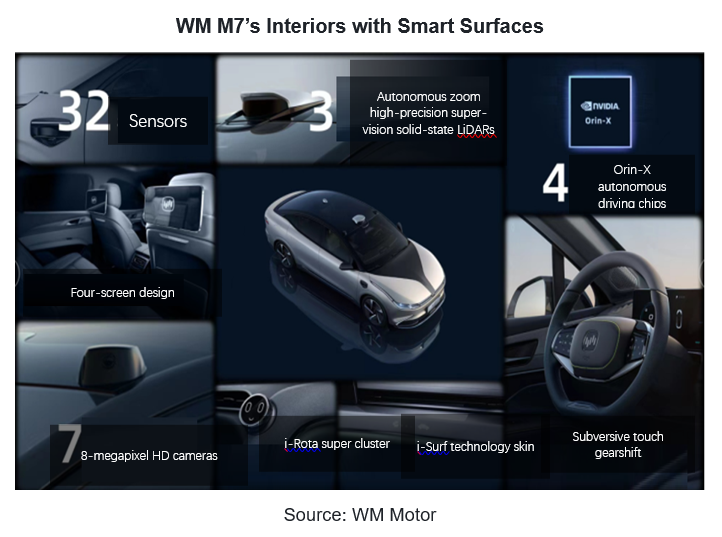
In order to embody a sense of science and technology and a simple design style, WM M7 not only removes all physical buttons, but also creates a touch gearshift mode integrated into the steering wheel. WM's "i-Surf Technology Skin" adopts superfine blended knitting technology, so that the texture feels like wool blend. At the same time, it features transparency. Combined with a flexible screen, it supports custom text or pictures.
Vehicle-Road-Cloud Integration and C-V2X Industry Report, 2026
Vehicle-Road-Cloud and C-V2X Research: with the three-tier promotion system of "top-level planning + mandatory pilot + evaluation binding", the industry turning point is approachingThis report focuses...
China OEM Data Capability Analysis Report, 2026
OEM Data Capability Research: 24 OEMs × 9 Capability Domains, Who Takes the Lead?
An L4 autonomous driving R&D and test vehicle can generate approximately 10TB of raw data per single day — data v...
Autonomous Driving Domain Controller and Central Computing Unit (CCU) Industry Report, 2026
Autonomous Driving Domain Controller (ADCU) Research: One-Chip CCU solutions are quickly available in vehicles
In China's passenger car market, autonomous driving systems involved in mass production ...
Automotive EMS and ECU Industry Research Report, 2026
Automotive EMS Research: The boundaries between EMS providers and Tier1 suppliers are becoming blurred, and the supply chain model is evolving from a linear chain to a networked structure
Mainstream ...
Automotive Microcontroller Unit (MCU) and Application Scenario Research Report, 2026
Automotive MCU Research: Increased demand for redundant security drives ASIL D-compliant MCU shipments to exceed 100 million units
In a vehicle EEA, MCUs are widely distributed in various functional ...
China Intelligent Cockpit Patent Analysis Report, 2026
Intelligent Cockpit Patent Research: Cockpit AI, In?vehicle Health, and Infotainment Are Upgrade to Scenario?based and Proactive Functions
From a patent perspective, this report explores the cutting?...
Research Report on Application of VLA Large Model in Automobiles and Robots, 2026
Research on Automotive and Robot VLA: Hybrid Architectures Become Mainstream, VLA Integrates with General World Models, and Reinforcement Learning Serves as Core Engine
Vision?Language?Action (VLA) m...
China Charging Infrastructure (Supercharging, Battery Swapping, V2G, etc.) and High-Performance Supercharging Battery Research Report, 2026
Charging and battery swapping research: as 5C+ supercharging vehicle models go into mass production, the pace of OEMs self-building supercharging networks quickens
800-1000V high-voltage platforms ar...
China Passenger Car Electronic Controlled Suspension Industry Report, 2026
Electronic Controlled Suspension Industry Research: As the First Year of Full Active Suspension Unfolds, Three Technical Routes Race Forward
1. Penetration Rate Surges Three Times, and Electronic Con...
Intelligent Driving SoC Research Report, 2026
Research on Intelligent Driving SoCs: Competition Focus Shifts to L3/L4 Embedded Hardware, and Computing Power of Flagship Vehicle Models Exceeds 1,000 TOPS
In terms of intelligent driving system in...
Automotive AI Large Model Technology Research Report, 2026
Automotive AI Large Model Research: Competition Shifts from "Who Has the Stronger Model" to "Who Boasts Higher Link Efficiency"
ResearchInChina released the Automotive AI Large Model Technology Resea...
Intelligent Vehicle Cockpit Domain Controller Research Report, 2026
Cockpit domain controller research: L3 AIDV intelligent cockpit domain controllers are entering a boom period
Driven by multiple factors such as the continuous evolution of the automotive central int...
Automotive Acoustic System (Audio, Multi-Channel) Industry Report, 2026
Automotive Acoustics Research: Multiple Channels, AI Tuning, and Self-Developed Algorithms Drive the Transformation of High-End Cockpit Sound Fields
I. Automotive Audio Hardware Solutions with 6–9 S...
Autonomous Driving Sensor Chip Research Report, 2026
Research on Autonomous Driving Sensor Chips: Deeply Perceiving the Physical World, Sensor Chips Are Playing A “Leading Role” in Intelligence
In 2026, the autonomous driving sensor chip industr...
Passenger Car Corner Module and Wheel‑Side Control System Research Report, 2026
Wheel-side control research: the “last mile” chassis innovation
Wheel-side control dismantles the traditional drive, braking, steering, and suspension control of the chassis from a "centralized" styl...
Embodied Artificial Intelligence (& Humanoid Robot) MCU Research Report, 2026
Research on Humanoid Robot MCUs: Evolution from General-Purpose Control to High-Value Dedicated Chip Solutions Integrated with Edge AI Functions
MCU (Microcontroller Unit) refers to a compact integra...
Intelligent Vehicle Zone Control Unit (ZCU) Research Report, 2026
ZCU Research: Cross-domain integrated ZCUs are becoming the edge computing nodes of the next-generation zonal architecture
Currently, the mainstream zonal architecture is mainly the quasi-central + z...
Automotive Cybersecurity and Data Security Research Report, 2026
Cybersecurity & Data Security Research: Intelligent Connected Vehicles Enter the Era of “Systematic Offense-Defense and AI-Defined Security”.
Centering on the panorama of intelligent connect...