China Charging / Battery Swapping Infrastructure Market Research Report, 2022
Research of charging / battery swapping: More than 20 OEMs layout charging business, new charging station construction accelerated
From January to September 2022, the sales volume of new energy vehicles in China was 4.567 million, with a market share of 23.5%, Thus ownership of new energy vehicles in China has exceeded 10 million units. In terms of charging infrastructure, according to statistics of Charging Alliance, as of September 2022, the ownership of charging infrastructure in China was 4.488 million sets, with a year-on-year increase of 101.9%; Based on this calculation, the overall car-to-pile ratio is close to 2.2:1, which has basically reached the national expected development goals.
In January 2022, National Development and Reform Commission and other 10 departments jointly issued "Fourteenth Five Year Plan" for Public Service, which specifies that by 2025, China will form a charging infrastructure system to meet the needs of more than 20 million electric vehicles. According to the 14th Five Year Development Plan of the State Council, by 2025, the car-to-pile ratio will increase to 2:1, which is equivalent to two cars equipped with one charging pile.
Market and technology trend of charging/ battery swapping infrastructure
In 2022, China's charging/battery swapping infrastructure industry ushers in further development and expansion, and the market pattern of 7-11kW AC charging piles is basically stable; The leading enterprise in 80-240kW DC charging pile market has begun to take shape. At the same time, new charging technologies/stations are developing rapidly, including high-voltage fast charging, battery swapping, orderly charging, PV-storage-charging integration, hydrogen-PV-storage-charging integration, mobile charging robot, etc.
Trend 1: High-voltage fast charging
In terms of charging power, there are two main solutions to improve fast charging power: high-voltage fast charging and high-current fast charging. Judging from the current development, high-voltage fast charging is popular, mainly because high-current fast charging has a huge challenge to thermal management system, and there is a ceiling for single vehicle charging power, which cannot reach 480KW charging efficiency.
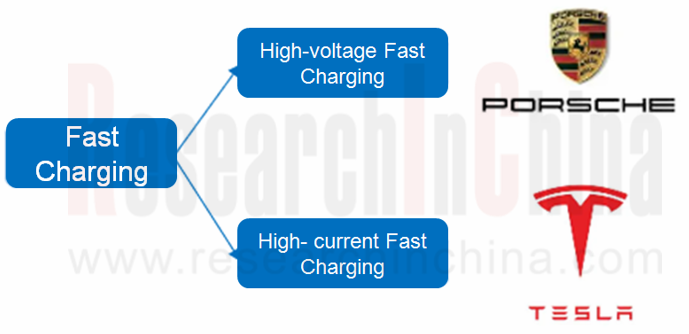
At present, high-voltage fast charging has become the most popular choice in the industry. In 2019, Porsche Taycan launched the first 800V high-voltage electrical architecture in the world, equipped with an 800V DC fast charging system and supporting 350kW high-power fast charging; In 2022, XPeng Motor launched its G9 model based on 800V SiC platform in mass production, while Geely and Mercedes Benz launched the SEA architecture and MMA architecture supporting 800V.
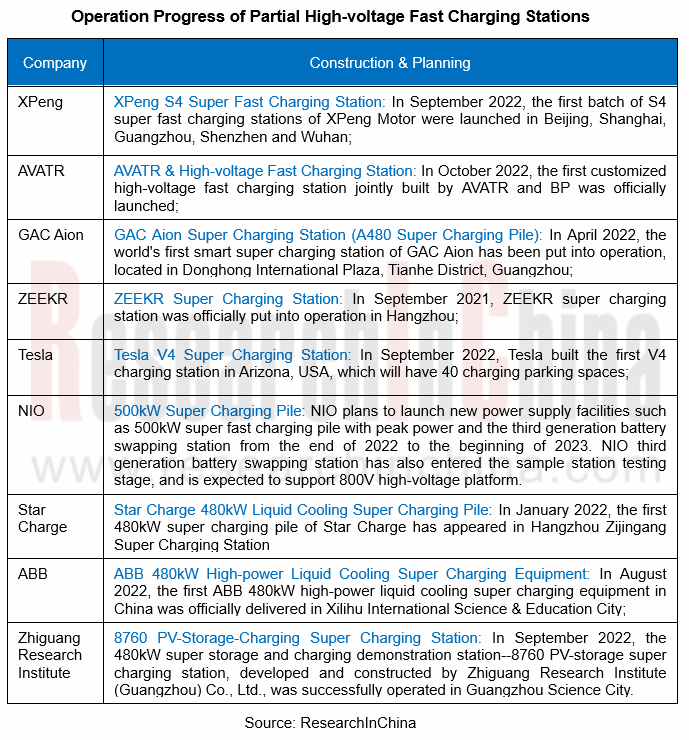
At the same time, OEMs, charging operators and energy enterprises have laid out high-voltage fast charging stations successively. GAC Aion, XPeng, AVATR, ZEEKR, NIO and Tesla all have layout plans for high-voltage fast charging stations. The maximum current of a single XPeng S4 ultrafast charging pile is 670A, and the peak charging power is 400kW; GAC Aion super-charging station (A480 super-charging pile) has a peak power of 1000V, a current of 600A and a liquid cooled charging system; In 2020, the State Grid began to invite bids for 480KW high-voltage fast charging piles, presenting a trend of continuous growth.
Trend 2: Battery swapping
The battery swapping mode is a fast power supplement mode for new energy vehicles. The battery is stored and charged through a centralized battery swapping station, and then the battery swapping service is provided for the car owners to achieve the same speed of battery supplement and refueling. According to the statistics of Charging Alliance, as of September 2022, China has 1762 battery swapping stations (excluding heavy truck battery swapping). In terms of provinces and cities, the top ten charging stations are Beijing, Guangdong, Zhejiang, Jiangsu, Shanghai, Shandong, Sichuan, Hebei, Hubei and Jilin, and top three provinces account for 39.9% of the total.
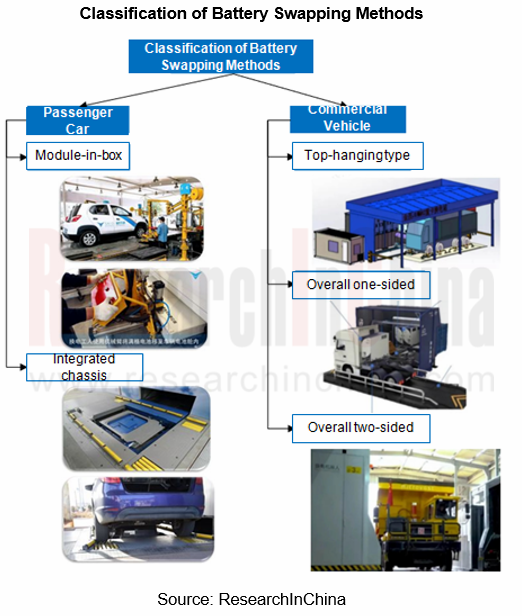
According to the different battery installation position, size and endurance mileage, the battery swapping methods are divided into passenger car and commercial vehicle, in which passenger car battery swapping is divided into module-in-box and integrated chassis; the commercial vehicle battery swapping can be divided into top-hanging type, overall one-sided type and overall two-sided type.
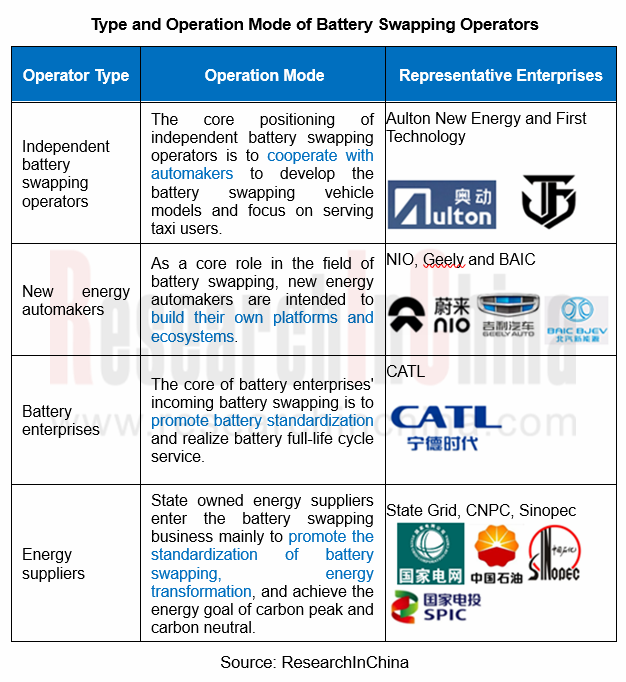
In the passenger car market, the main battery swapping operators in China at present include NIO, Aulton New Energy, Blue Park Smart Energy, First Technology, etc., of which NIO and Aulton New Energy are far ahead in the number of covered battery swapping stations.
The promotion and application of battery swapping mode need not only technical support of enterprises, but also cooperation of national standards, battery standards, vehicle manufacturers and energy enterprises. The "national team" in the field of battery swapping was established in 2022. On September 22, 2022, Shanghai Jieneng Intelligent Power New Energy Technology Co., Ltd. jointly invested by Sinopec, CNPC, SAIC, CATL and Shanghai International Automobile City Group was officially established, The registered capital is RMB 4 billion, and the business scope covers power battery leasing, energy supplement technology R&D and promotion, battery operation management, big data services, etc.
With establishment of "National Team" for battery swapping, 2022 will become the first year of China's battery swapping mode development. In the future, improvement of standardization of battery swapping vehicle model, BaaS mode and cascade utilization of batteries will become three major development trends of battery swapping technology.
Trend 3: PV-storage-charging integrated smart energy station
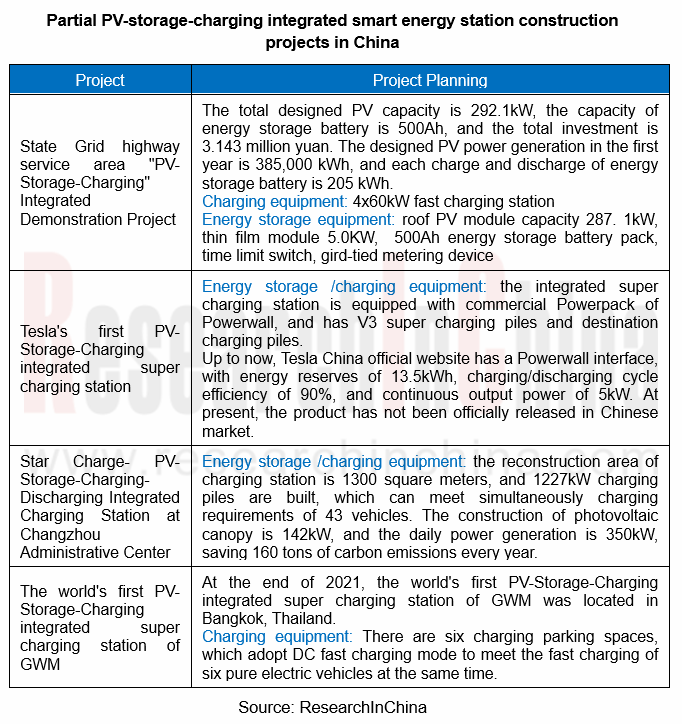
PV-storage-charging integrated smart energy station takes the electric vehicle charging station as carrier, based on the design concept of energy Internet, integrates photovoltaic, energy storage and other distributed energy systems, realizes the coordinated operation of energy, gird, load and storage, and on this basis, carries out practical demonstration of multiple commercial operation modes of electric vehicle charging and discharging facilities.
At present, the PV-storage-charging integrated station market has accommodated vehicle companies, battery companies, charging operators, energy companies and others, mainly through cooperative construction and operation of various enterprises, and most of them are demonstration stations and new energy practice stations.
China has small proportion of PV-storage-charging integrated stations, and the large-scale promotion is late, mainly because the construction of PV-storage-charging integrated stations needs large investment, and many enterprises are still waiting for the policy trend; as well as low technology maturity. With the launch of super-charged vehicles by OEMs, the cost efficiency improvement of energy storage batteries and the support of national policies, 2025 will be the first year of PV-storage-charging industry development.
OEMs' high-voltage fast charging/battery swapping technology architecture and trend
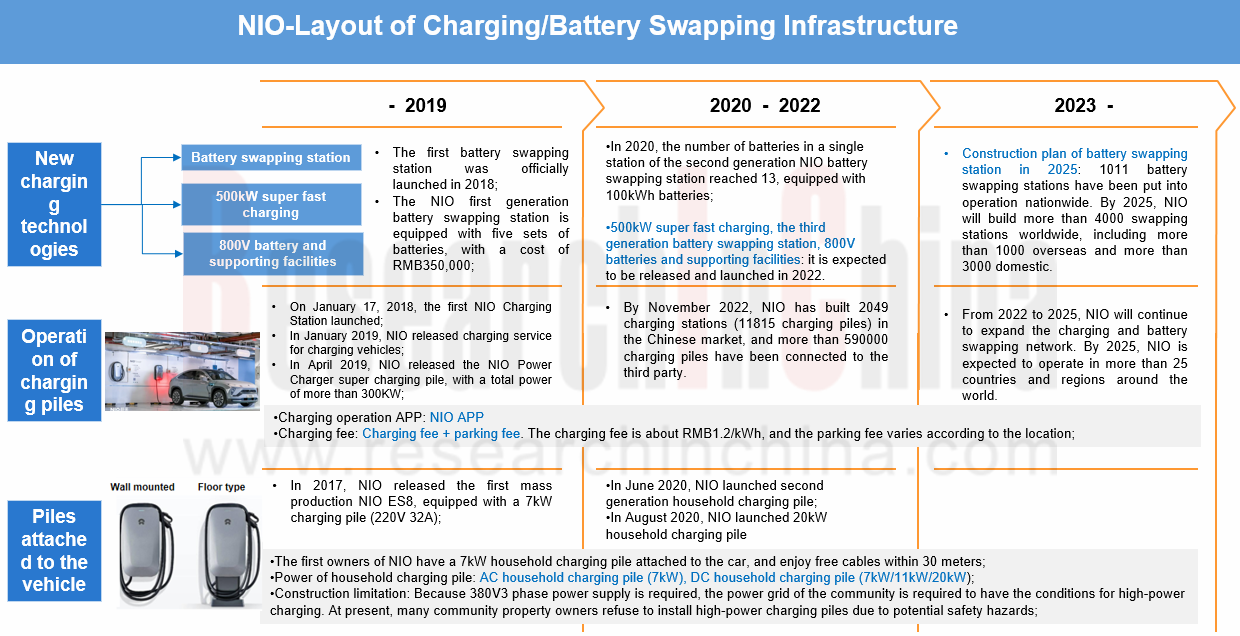
Taking NIO as an example, NIO has already layout in battery swapping station and ultrafast charging: the second generation of NIO battery swapping station has been put into use, introducing the BaaS mode. NIO also leads the establishment of Wuhan Weineng Battery Assets Co., Ltd. which is responsible for battery management and operation. According to the plan, the third generation battery swapping station and 500kW ultrafast charging station will be released at the end of 2022.
NIO automotive super-charge network: 500kW ultrafast charging is expected to achieve a peak current of 650A, and adopts liquid-cooling gun line design. In addition, NIO also announced 800V high-voltage platform battery pack and supporting battery swapping system, and which will be open to the whole industry in the future.
NIO battery swapping station: the second generation of NIO battery swapping station is the first in the world to realize autonomous parking in mass production. It is a software-defined and end-cloud combined intelligent battery swapping system. A total of 239 sensors and 4 cloud systems are arranged in the second generation battery swapping station to work together, comprehensively deepening the application of visual recognition technology. With the help of science and technology, users can start self-service battery swapping with one button in the car without getting off.
Vehicle-Road-Cloud Integration and C-V2X Industry Report, 2026
Vehicle-Road-Cloud and C-V2X Research: with the three-tier promotion system of "top-level planning + mandatory pilot + evaluation binding", the industry turning point is approachingThis report focuses...
China OEM Data Capability Analysis Report, 2026
OEM Data Capability Research: 24 OEMs × 9 Capability Domains, Who Takes the Lead?
An L4 autonomous driving R&D and test vehicle can generate approximately 10TB of raw data per single day — data v...
Autonomous Driving Domain Controller and Central Computing Unit (CCU) Industry Report, 2026
Autonomous Driving Domain Controller (ADCU) Research: One-Chip CCU solutions are quickly available in vehicles
In China's passenger car market, autonomous driving systems involved in mass production ...
Automotive EMS and ECU Industry Research Report, 2026
Automotive EMS Research: The boundaries between EMS providers and Tier1 suppliers are becoming blurred, and the supply chain model is evolving from a linear chain to a networked structure
Mainstream ...
Automotive Microcontroller Unit (MCU) and Application Scenario Research Report, 2026
Automotive MCU Research: Increased demand for redundant security drives ASIL D-compliant MCU shipments to exceed 100 million units
In a vehicle EEA, MCUs are widely distributed in various functional ...
China Intelligent Cockpit Patent Analysis Report, 2026
Intelligent Cockpit Patent Research: Cockpit AI, In?vehicle Health, and Infotainment Are Upgrade to Scenario?based and Proactive Functions
From a patent perspective, this report explores the cutting?...
Research Report on Application of VLA Large Model in Automobiles and Robots, 2026
Research on Automotive and Robot VLA: Hybrid Architectures Become Mainstream, VLA Integrates with General World Models, and Reinforcement Learning Serves as Core Engine
Vision?Language?Action (VLA) m...
China Charging Infrastructure (Supercharging, Battery Swapping, V2G, etc.) and High-Performance Supercharging Battery Research Report, 2026
Charging and battery swapping research: as 5C+ supercharging vehicle models go into mass production, the pace of OEMs self-building supercharging networks quickens
800-1000V high-voltage platforms ar...
China Passenger Car Electronic Controlled Suspension Industry Report, 2026
Electronic Controlled Suspension Industry Research: As the First Year of Full Active Suspension Unfolds, Three Technical Routes Race Forward
1. Penetration Rate Surges Three Times, and Electronic Con...
Intelligent Driving SoC Research Report, 2026
Research on Intelligent Driving SoCs: Competition Focus Shifts to L3/L4 Embedded Hardware, and Computing Power of Flagship Vehicle Models Exceeds 1,000 TOPS
In terms of intelligent driving system in...
Automotive AI Large Model Technology Research Report, 2026
Automotive AI Large Model Research: Competition Shifts from "Who Has the Stronger Model" to "Who Boasts Higher Link Efficiency"
ResearchInChina released the Automotive AI Large Model Technology Resea...
Intelligent Vehicle Cockpit Domain Controller Research Report, 2026
Cockpit domain controller research: L3 AIDV intelligent cockpit domain controllers are entering a boom period
Driven by multiple factors such as the continuous evolution of the automotive central int...
Automotive Acoustic System (Audio, Multi-Channel) Industry Report, 2026
Automotive Acoustics Research: Multiple Channels, AI Tuning, and Self-Developed Algorithms Drive the Transformation of High-End Cockpit Sound Fields
I. Automotive Audio Hardware Solutions with 6–9 S...
Autonomous Driving Sensor Chip Research Report, 2026
Research on Autonomous Driving Sensor Chips: Deeply Perceiving the Physical World, Sensor Chips Are Playing A “Leading Role” in Intelligence
In 2026, the autonomous driving sensor chip industr...
Passenger Car Corner Module and Wheel‑Side Control System Research Report, 2026
Wheel-side control research: the “last mile” chassis innovation
Wheel-side control dismantles the traditional drive, braking, steering, and suspension control of the chassis from a "centralized" styl...
Embodied Artificial Intelligence (& Humanoid Robot) MCU Research Report, 2026
Research on Humanoid Robot MCUs: Evolution from General-Purpose Control to High-Value Dedicated Chip Solutions Integrated with Edge AI Functions
MCU (Microcontroller Unit) refers to a compact integra...
Intelligent Vehicle Zone Control Unit (ZCU) Research Report, 2026
ZCU Research: Cross-domain integrated ZCUs are becoming the edge computing nodes of the next-generation zonal architecture
Currently, the mainstream zonal architecture is mainly the quasi-central + z...
Automotive Cybersecurity and Data Security Research Report, 2026
Cybersecurity & Data Security Research: Intelligent Connected Vehicles Enter the Era of “Systematic Offense-Defense and AI-Defined Security”.
Centering on the panorama of intelligent connect...