Automotive radar research: installations surged by 49.5% year on year in 2021, and by 35.4% in the first nine months of 2022.
1. The installations of automotive radars sustain growth, and are expected to reach more than 24 million units in 2025
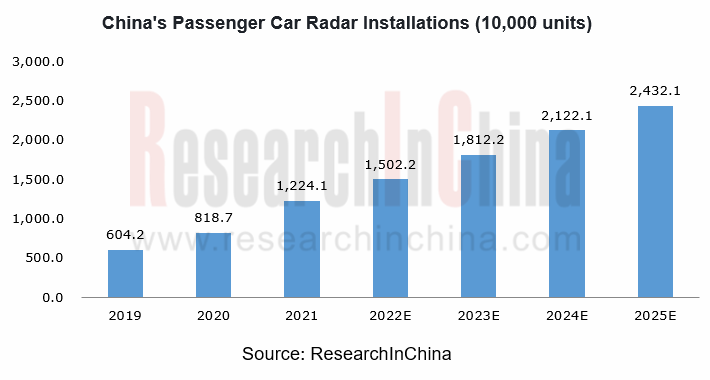
In 2021, the installations of radars in new passenger cars in China reached 12.241 million units, jumping by 49.5% from 8.187 million units in 2020; from January to September 2022, the installations achieved 11.391 million units, a 35.4% surge compared with 8.414 million units in the same period of 2021. As L2.5 and L2.9 autonomous driving come into real commercial use, the automotive radar market will still gain momentum, with more radars per vehicle. It is estimated that the installations will be over 24 million units in 2025.
2. In 2022, the proportion of multi-radar solutions in vehicle models on offer increases, of which 3R and 5R solutions grow fastest.
In terms of vehicle hardware solutions, from January to September 2022, there were 678 new passenger car models launched on market in China, of which 22.1% packed 1R solutions, up 3.1 percentage points from the prior-year period; 4% carried 2R solutions, up 0.3 percentage points; 18.7% were equipped with 3R solutions, up 5 percentage points; 8.7% were installed with 5R solutions, up 5.2 percentage points.
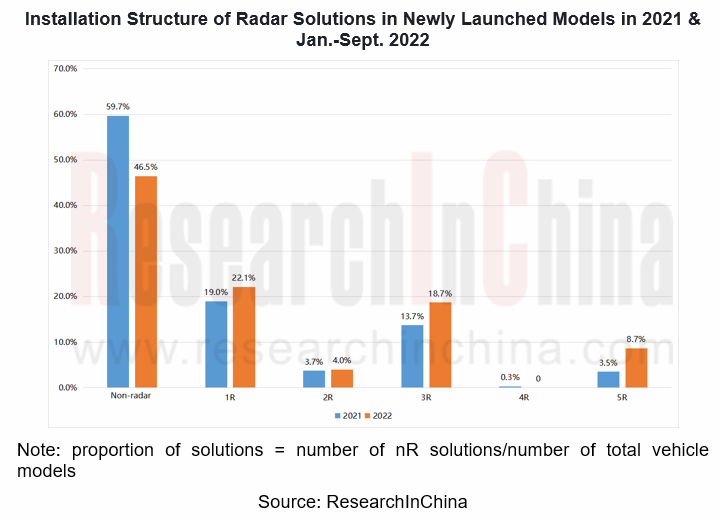
Wherein, 3R and 5R solutions sustained the fastest growth, mainly because:
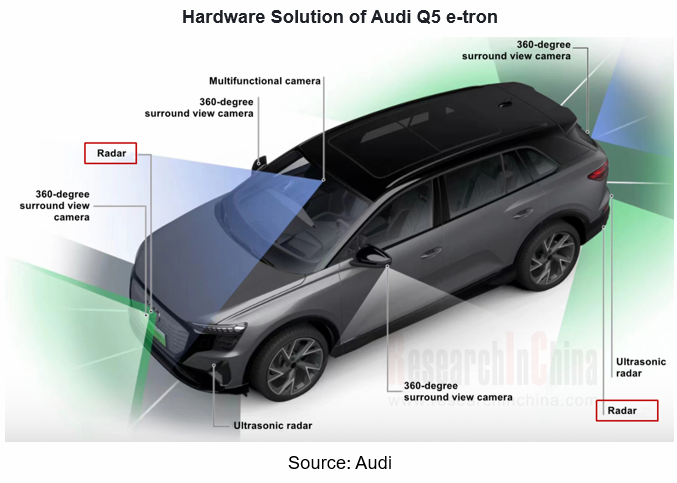
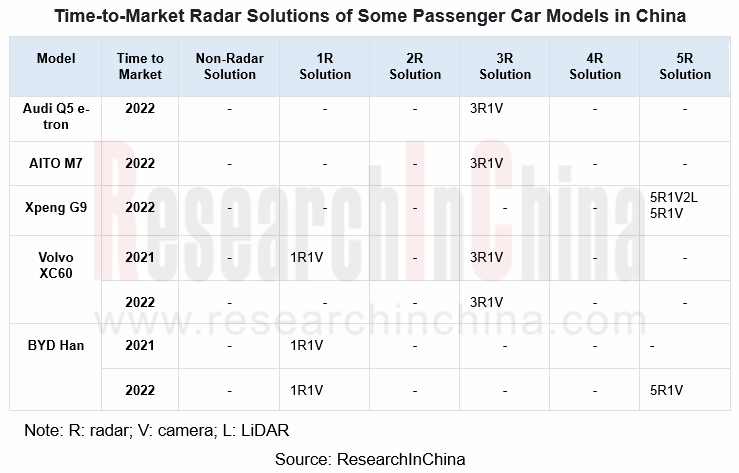
(1) Many of the new models launched in 2022 pack 3R and 5R solutions. Examples include Audi Q5 e-tron equipped with a 3R1V solution, and Xpeng G9 offering two 5R solutions (5R1V2L/5R1V).
(2) The 2022 new models of some cars carry upgraded solutions. For example, the 2022 models of Volvo XC60 pack a 3R1V solution as a standard configuration, while the 2021 models feature a standard configuration of 1R1V and 3R1V is a high configuration; the 2022 models of BYD Han add the high configuration of a 5R1V solution and are equipped with the standard 1R1V solution, also a standard configuration for the 2021 models.
3. The new-generation forward radars deliver a detection range up to 300 meters.
From suppliers, it can be seen that in the first nine months of 2022, foreign forward radar companies still played a dominant role, with installations sweeping over 96% of the total. Suppliers were led by Bosch, Denso, and Continental.
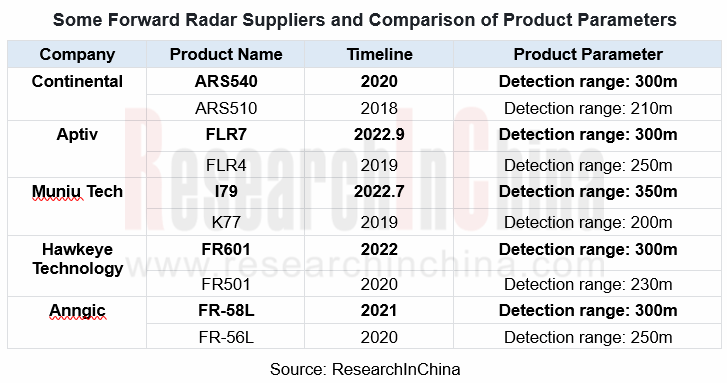
As radar technology keeps iterating, the parameters are also being improved. The latest generation of forward radars launched by suppliers during 2020-2022 offers a common maximum detection range of 300m, about 50-100m longer than the previous generation.
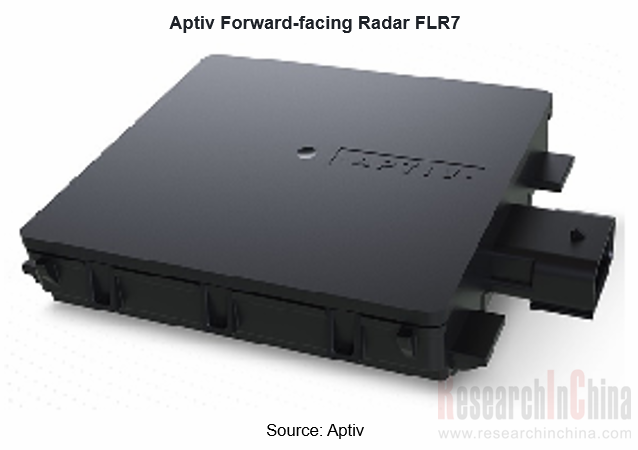
For example, FLR7, a forward-facing radar launched by Aptiv in 2022, features 4D imaging and a detection range of 300m (50m longer than the previous generation product). As Aptiv's seventh-generation radar (Gen7), it incorporates air-waveguide antenna technology based on proprietary intellectual property and a unique design.
Hawkeye Technology, established in 2015 and headquartered in Nanjing, specializes in research and application of 76~81GHz automotive radars for passenger cars and transportation. FR601 Hawkeye Technology introduced in 2022 delivers a detection range of 300m (70m longer than the previous generation product), HFOV of 100° and VFOV of 20°, and detects as many as 1,024 targets.
4. 77GHz is the current mainstream of corner radars, and 79GHz is the future trend.
79GHz corner radar well outperforms 77GHz and 24GHz radars. 77GHz radar with limited bandwidth below 1GHz (76-77GHz) fails to enable high resolution. 79GHz corner radar with bandwidth of 4GHz (77-81GHz) is a better option in the case of high resolution required. Compared with 24GHz radar, 79GHz radar allows for design of more transceiver arrays in the same size to form a larger transmit aperture and narrower beams, thus offering higher angular resolution.
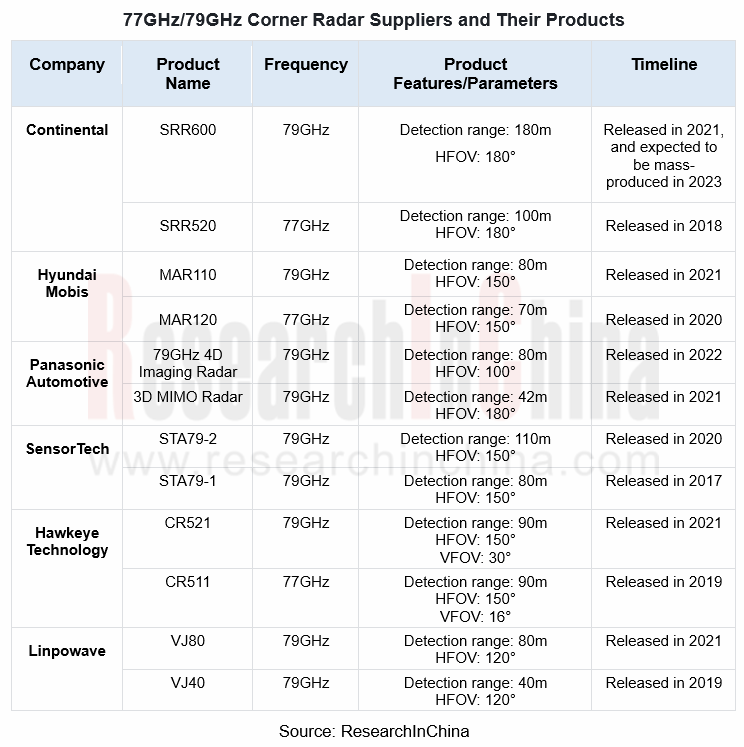
At present, among the foreign suppliers of corner radar products, Continental and Hyundai Mobis have turned to 79GHz from 77GHz. Continental unveiled 79GHz corner radar SRR600 in 2021, with a detection range of 180m (80m longer than the previous-generation product), and HFOV of 180°; Hyundai Mobis released 79GHz corner radar MAR110 in 2021, with a detection range of 80m (10m longer than the previous generation product), and HFOV of 150°.
Panasonic Automotive launched a 4D 79GHz corner radar in 2022, with a detection range of 80m and HFOV of 100°. In 2021, it announced a 3D MIMO 79GHz corner radar with a detection range of 42m and HFOV of 180°.
Among Chinese suppliers, Hawkeye Technology has turned to 79GHz corner radar products from 77GHz. In 2021, it introduced CR521, a 79GHz corner radar with a detection range of 90m, HFOV of 150°, and VFOV of 30°.
Wuhu SensorTech and Linpowave have launched their second-generation 79GHz corner radars. Wherein, SensorTech released the second-generation 79GHz corner radar STA79-2 in 2020, with a detection range of 110m and HFOV of 150°; in 2021, it introduced STA79-1, the first-generation 79GHz corner radar with a detection range of 80m and HFOV of 150°.
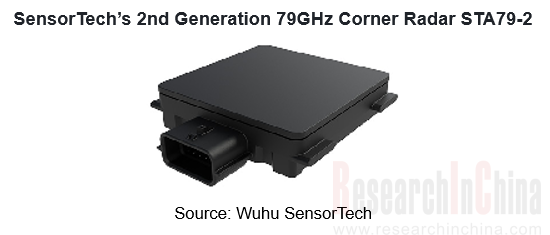
Linpowave released the second-generation 79GHz corner radar VJ80 in 2021, with a detection range of 80m and HFOV of 120°; in 2019, it announced VJ40, the first-generation 79GHz corner radar with a detection range of 40m and HFOV of 120°.
5. Chinese suppliers work to deploy 4D radars, having announced the first-generation products.
In addition to the distance, azimuth, and speed that can be detected by conventional 3D radars, 4D radars can also detect height. Moreover, 4D radars feature a high angular resolution and the ability to classify static obstacles. There are three key 4D radar technology routes: multi-receiver and multi-transmitter chip, synthetic aperture imaging + antenna design, and metamaterials.
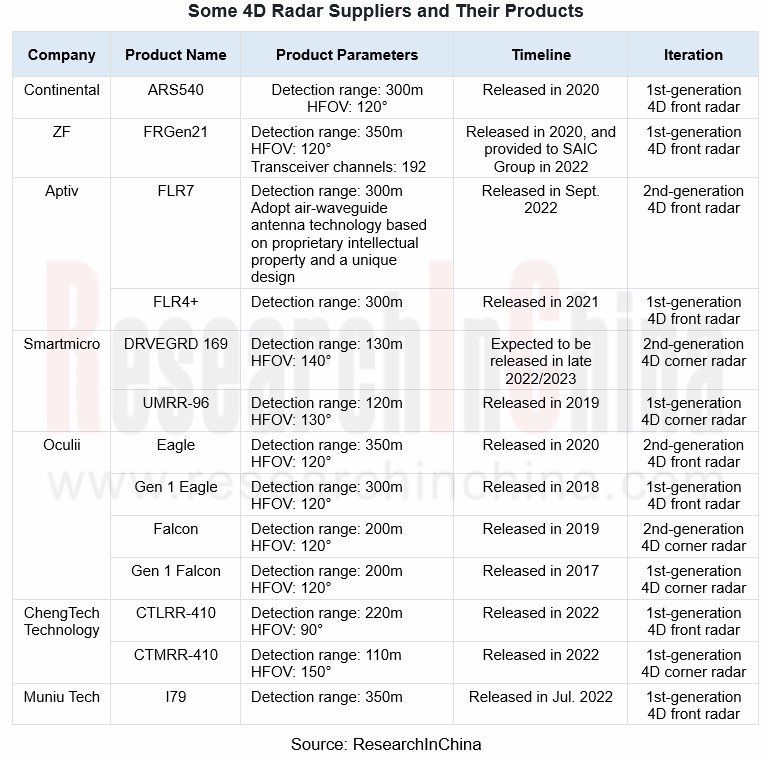
Among current foreign suppliers, Aptiv and Smartmicro have released second-generation 4D radars. Aptiv has introduced the second-generation 4D forward-facing radar FLR7 in 2022, with a detection range of 300m; in 2021, it announced FLR4+, its first-generation 4D forward-facing radar that delivers a detection range of 300m.
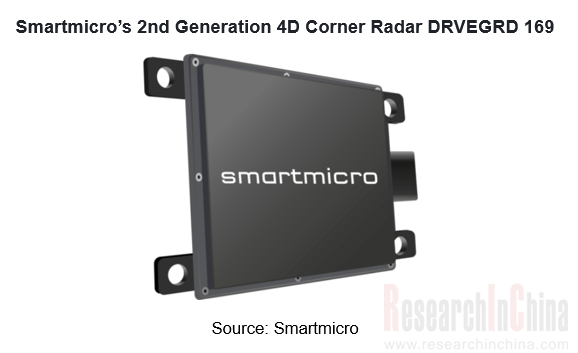
Smartmicro, a radar technology company established in 1997 and headquartered in Germany, mainly provides traffic radars and Automotive Radars. The company is expected to announce its second-generation 4D corner radar with a detection range of 130m and HFOV of 140°, in late 2022 or 2023. Its first-generation 4D corner radar UMRR-96 was introduced in 2019, with a detection range of 120m and HFOV of 130°.
Chinese suppliers follow suit. In 2022, ChengTech Technology launched 4D front radar CTLRR-410, with a detection range of 220m and HFOV of 90°, and the 4D corner radar CTMRR-410, with a detection range of 110m and HFOV of 150°. Muniu Tech released 4D front radar I79 in July 2022, which is its third-generation front radar, and also its first-generation 4D front radar, with a detection range of 350m.
Autonomous Driving Domain Controller and Central Computing Unit (CCU) Industry Report, 2026
Autonomous Driving Domain Controller (ADCU) Research: One-Chip CCU solutions are quickly available in vehicles
In China's passenger car market, autonomous driving systems involved in mass production ...
Automotive EMS and ECU Industry Research Report, 2026
Automotive EMS Research: The boundaries between EMS providers and Tier1 suppliers are becoming blurred, and the supply chain model is evolving from a linear chain to a networked structure
Mainstream ...
Automotive Microcontroller Unit (MCU) and Application Scenario Research Report, 2026
Automotive MCU Research: Increased demand for redundant security drives ASIL D-compliant MCU shipments to exceed 100 million units
In a vehicle EEA, MCUs are widely distributed in various functional ...
China Intelligent Cockpit Patent Analysis Report, 2026
Intelligent Cockpit Patent Research: Cockpit AI, In?vehicle Health, and Infotainment Are Upgrade to Scenario?based and Proactive Functions
From a patent perspective, this report explores the cutting?...
Research Report on Application of VLA Large Model in Automobiles and Robots, 2026
Research on Automotive and Robot VLA: Hybrid Architectures Become Mainstream, VLA Integrates with General World Models, and Reinforcement Learning Serves as Core Engine
Vision?Language?Action (VLA) m...
China Charging Infrastructure (Supercharging, Battery Swapping, V2G, etc.) and High-Performance Supercharging Battery Research Report, 2026
Charging and battery swapping research: as 5C+ supercharging vehicle models go into mass production, the pace of OEMs self-building supercharging networks quickens
800-1000V high-voltage platforms ar...
China Passenger Car Electronic Controlled Suspension Industry Report, 2026
Electronic Controlled Suspension Industry Research: As the First Year of Full Active Suspension Unfolds, Three Technical Routes Race Forward
1. Penetration Rate Surges Three Times, and Electronic Con...
Intelligent Driving SoC Research Report, 2026
Research on Intelligent Driving SoCs: Competition Focus Shifts to L3/L4 Embedded Hardware, and Computing Power of Flagship Vehicle Models Exceeds 1,000 TOPS
In terms of intelligent driving system in...
Automotive AI Large Model Technology Research Report, 2026
Automotive AI Large Model Research: Competition Shifts from "Who Has the Stronger Model" to "Who Boasts Higher Link Efficiency"
ResearchInChina released the Automotive AI Large Model Technology Resea...
Intelligent Vehicle Cockpit Domain Controller Research Report, 2026
Cockpit domain controller research: L3 AIDV intelligent cockpit domain controllers are entering a boom period
Driven by multiple factors such as the continuous evolution of the automotive central int...
Automotive Acoustic System (Audio, Multi-Channel) Industry Report, 2026
Automotive Acoustics Research: Multiple Channels, AI Tuning, and Self-Developed Algorithms Drive the Transformation of High-End Cockpit Sound Fields
I. Automotive Audio Hardware Solutions with 6–9 S...
Autonomous Driving Sensor Chip Research Report, 2026
Research on Autonomous Driving Sensor Chips: Deeply Perceiving the Physical World, Sensor Chips Are Playing A “Leading Role” in Intelligence
In 2026, the autonomous driving sensor chip industr...
Passenger Car Corner Module and Wheel‑Side Control System Research Report, 2026
Wheel-side control research: the “last mile” chassis innovation
Wheel-side control dismantles the traditional drive, braking, steering, and suspension control of the chassis from a "centralized" styl...
Embodied Artificial Intelligence (& Humanoid Robot) MCU Research Report, 2026
Research on Humanoid Robot MCUs: Evolution from General-Purpose Control to High-Value Dedicated Chip Solutions Integrated with Edge AI Functions
MCU (Microcontroller Unit) refers to a compact integra...
Intelligent Vehicle Zone Control Unit (ZCU) Research Report, 2026
ZCU Research: Cross-domain integrated ZCUs are becoming the edge computing nodes of the next-generation zonal architecture
Currently, the mainstream zonal architecture is mainly the quasi-central + z...
Automotive Cybersecurity and Data Security Research Report, 2026
Cybersecurity & Data Security Research: Intelligent Connected Vehicles Enter the Era of “Systematic Offense-Defense and AI-Defined Security”.
Centering on the panorama of intelligent connect...
Report on Breakthrough Strategies of OEMs and ADAS Tier 1 Suppliers for Overseas Layout of Intelligent Driving, 2026
Regulatory Breakthrough, Local System Establishment, OEMs Competing for NOA Layout: Overall Trends of China’s Intelligent Driving Overseas Layout in 2026
Research on overseas intelligent driving layo...
OEMs and Tier1s’ Intelligent Cockpit Platform (Hardware and Software) Innovation Strategy Research Report, 2026
Intelligent Cockpit Platform Research: multi-dimensional cockpit system architecture reconstruction for multi-agent collaboration and proactive intelligent services
The intelligent cockpit software s...