Global and China Automotive Cluster and Center Console Industry Report, 2022
Automotive Display Research: Penetration Rate of OLED, Mini LED and Other Innovative Display Technology Increased Rapidly
With the penetration of new energy and intelligent driving vehicles, the trend of large-screen and multi-screen displays in vehicles is becoming more and more obvious. In addition to the central control and instrument screens, new products such as HUD, passenger display, rear entertainment display, electronic rearview mirrors and transparent A-pillars have also been added in the cabin, and the installation volume of automotive display screens has ushered in rapid growth.
OLED, Mini LED, Micro-LED is the evolution direction of automotive display technology
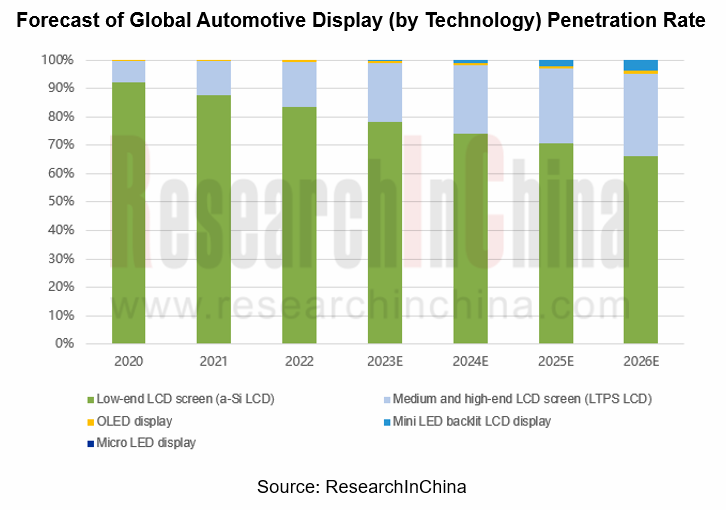
At present, the market penetration rate of the mainstream technology a-Si LCD in the automotive display market continues to decline. On the one hand, OEMs deploy LTPS-LCD in high-end models, and on the other hand, they step up the deployment of innovative technologies such as OLED, Mini-LED, and Micro-LED for mass production and installation.
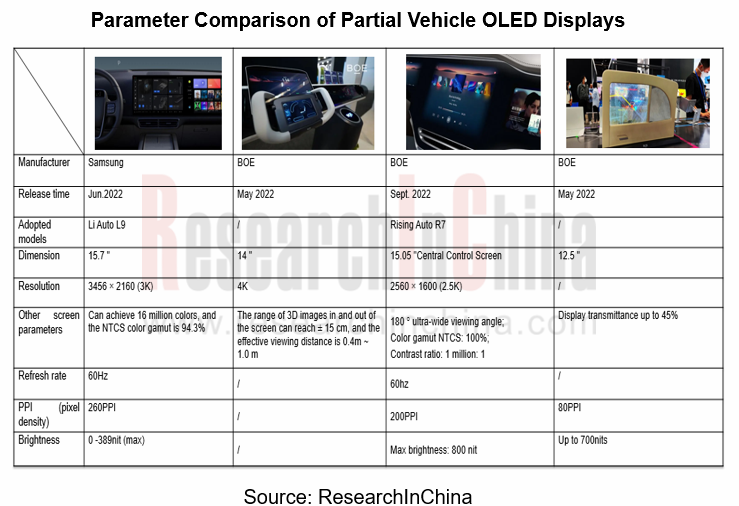
Compared with LCD, although OLED priors in strong ductility, wide color gamut, high brightness, pure color, and mature technology, the penetration rate in the automotive display market is still less than 1%. Due to the influence of OLED luminescence characteristics, in addition to cost issues, there are technical difficulties such as yield, burn-in and service life, which hinder the rapid development of OLED screens in the vehicle field.
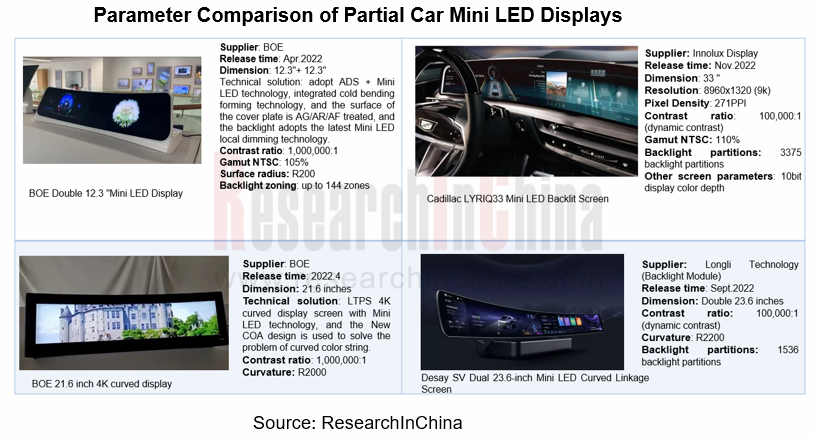
Generally, in the automotive display market, Mini LEDs use direct-type backlights, which combine the advantages of OLED and LCD, such as long service life and do not have the burn-in problem. Compared with OLED, Mini LED backlights have higher yield, lower cost, and obvious advantages in mass production. In terms of display performance, Mini LED's overall brightness, contrast, power consumption, and curved display are better than traditional side-entry backlight displays. Mini LED backlight displays have higher cost-effective advantages, so they are widely recognized by OEMs, and the willingness of OEMs to use Mini LED backlight displays is becoming stronger and stronger.
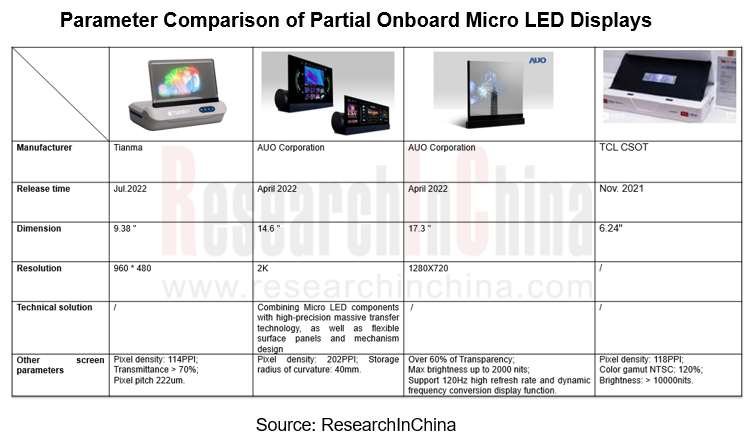
Micro LED integrates the advantages of LCD and OLED, with high image quality, low energy consumption and long life. However, its manufacturing process is difficult, the production cost is high, and the technology is not yet mature. Although it appeared at the exhibition at high frequency, it is far from meeting the mass production requirements. Therefore, it can only be used as a reserve technology for Automotive Display in the short term, and it still needs to be developed and broken through.
AR-HUD leads a new mode of in-cabin display interaction
The core of the development of intelligent cockpit is how to realize natural and reasonable human-vehicle interaction. After the intelligent car enters the stage of human-machine co-driving, AR-HUD will become a bridge for the interaction between people and vehicles.
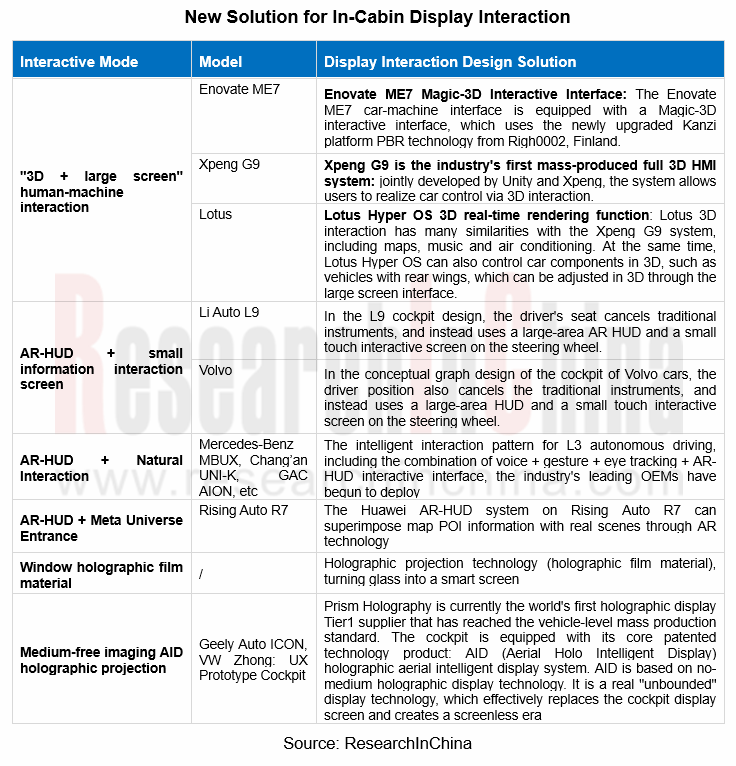
The Rising Auto R7, launched in Sept. 2022, adopts an in-cabin display that combines a triple screen and AR-HUD. The triple screen is integrated by a 10.25-inch Mini LED full LCD instrument, a 15.05-inch AMOLED flexible center control screen and a 12.3-inch Mini LED co-pilot entertainment screen, which can realize multi-screen linkage. For example, the co-pilot entertainment screen mainly provides entertainment applications for the co-pilot user, but during the trip, the co-pilot user can also set the navigation on the co-pilot screen to avoid the driver's distraction. After the navigation setting is successful, the display screen in the middle will automatically display the corresponding map navigation, and the AR-HUD will also absorb the navigation information to make road instructions at the same time.
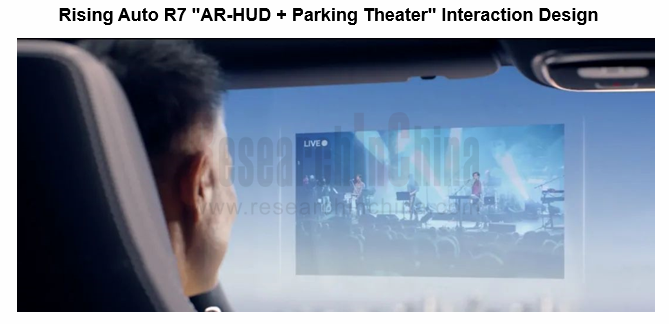
The AR-HUD of Rising Auto R7 provides immersive experience of giant-screen cinema when parked and charging. Through the video application software in the automotive Infotainment, the AR projection screen can project the video content into the AR-HUD for viewing. At present, this equivalent 70-inch large frame size currently only supports the main driver. A user needs to park the car in viewing mode, and adjusts the seat height at the same time.
New supply model for OEM + panel (module) manufacturers
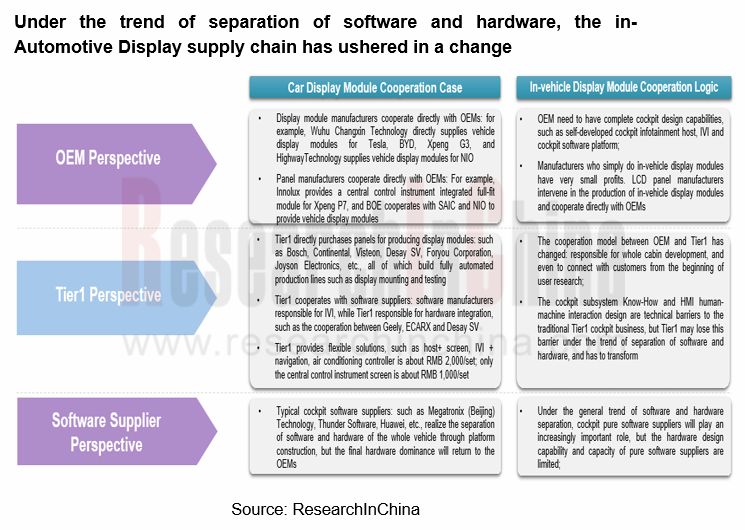
With the improvement of the software capabilities of the OEMs, the trend of separation of software and hardware is becoming more and more obvious. OEMs has begun to develop its own cockpit main engine, IVI and software platform. The business model of in-vehicle panel and module supply will change, and gradually form a new supply model of "OEM + panel (module) manufacturer". Therefore, Tier1 offering the traditional cockpit display will face challenges.
Panel (module) manufacturers will gradually play the role of on-board display module Tier1. Typical manufacturers include Tianma, BOE Varitronix, Truly International, Innolux Display, etc. Panel manufacturers can directly provide OEMs with integrated packaging module products. In addition to traditional central control instruments, panel (module) manufacturers and OEMs will further cooperate to explore transparent window display, very narrow frame on-board display, flexible OLED, 3D curved display technology, AR-HUD, OLED tail lights, etc.
For example, AUO Corporation and Innolux Display directly provide full mini LED backlight display modules to American OEMs; Samsung Display works closely with Audi to develop OLED products; Tesla leads the procurement of key display components and designates display module manufacturers for packaging. In the next step, panel suppliers will strengthen their partnerships with automakers and provide next-generation display technologies.
Autonomous Driving Domain Controller and Central Computing Unit (CCU) Industry Report, 2026
Autonomous Driving Domain Controller (ADCU) Research: One-Chip CCU solutions are quickly available in vehicles
In China's passenger car market, autonomous driving systems involved in mass production ...
Automotive EMS and ECU Industry Research Report, 2026
Automotive EMS Research: The boundaries between EMS providers and Tier1 suppliers are becoming blurred, and the supply chain model is evolving from a linear chain to a networked structure
Mainstream ...
Automotive Microcontroller Unit (MCU) and Application Scenario Research Report, 2026
Automotive MCU Research: Increased demand for redundant security drives ASIL D-compliant MCU shipments to exceed 100 million units
In a vehicle EEA, MCUs are widely distributed in various functional ...
China Intelligent Cockpit Patent Analysis Report, 2026
Intelligent Cockpit Patent Research: Cockpit AI, In?vehicle Health, and Infotainment Are Upgrade to Scenario?based and Proactive Functions
From a patent perspective, this report explores the cutting?...
Research Report on Application of VLA Large Model in Automobiles and Robots, 2026
Research on Automotive and Robot VLA: Hybrid Architectures Become Mainstream, VLA Integrates with General World Models, and Reinforcement Learning Serves as Core Engine
Vision?Language?Action (VLA) m...
China Charging Infrastructure (Supercharging, Battery Swapping, V2G, etc.) and High-Performance Supercharging Battery Research Report, 2026
Charging and battery swapping research: as 5C+ supercharging vehicle models go into mass production, the pace of OEMs self-building supercharging networks quickens
800-1000V high-voltage platforms ar...
China Passenger Car Electronic Controlled Suspension Industry Report, 2026
Electronic Controlled Suspension Industry Research: As the First Year of Full Active Suspension Unfolds, Three Technical Routes Race Forward
1. Penetration Rate Surges Three Times, and Electronic Con...
Intelligent Driving SoC Research Report, 2026
Research on Intelligent Driving SoCs: Competition Focus Shifts to L3/L4 Embedded Hardware, and Computing Power of Flagship Vehicle Models Exceeds 1,000 TOPS
In terms of intelligent driving system in...
Automotive AI Large Model Technology Research Report, 2026
Automotive AI Large Model Research: Competition Shifts from "Who Has the Stronger Model" to "Who Boasts Higher Link Efficiency"
ResearchInChina released the Automotive AI Large Model Technology Resea...
Intelligent Vehicle Cockpit Domain Controller Research Report, 2026
Cockpit domain controller research: L3 AIDV intelligent cockpit domain controllers are entering a boom period
Driven by multiple factors such as the continuous evolution of the automotive central int...
Automotive Acoustic System (Audio, Multi-Channel) Industry Report, 2026
Automotive Acoustics Research: Multiple Channels, AI Tuning, and Self-Developed Algorithms Drive the Transformation of High-End Cockpit Sound Fields
I. Automotive Audio Hardware Solutions with 6–9 S...
Autonomous Driving Sensor Chip Research Report, 2026
Research on Autonomous Driving Sensor Chips: Deeply Perceiving the Physical World, Sensor Chips Are Playing A “Leading Role” in Intelligence
In 2026, the autonomous driving sensor chip industr...
Passenger Car Corner Module and Wheel‑Side Control System Research Report, 2026
Wheel-side control research: the “last mile” chassis innovation
Wheel-side control dismantles the traditional drive, braking, steering, and suspension control of the chassis from a "centralized" styl...
Embodied Artificial Intelligence (& Humanoid Robot) MCU Research Report, 2026
Research on Humanoid Robot MCUs: Evolution from General-Purpose Control to High-Value Dedicated Chip Solutions Integrated with Edge AI Functions
MCU (Microcontroller Unit) refers to a compact integra...
Intelligent Vehicle Zone Control Unit (ZCU) Research Report, 2026
ZCU Research: Cross-domain integrated ZCUs are becoming the edge computing nodes of the next-generation zonal architecture
Currently, the mainstream zonal architecture is mainly the quasi-central + z...
Automotive Cybersecurity and Data Security Research Report, 2026
Cybersecurity & Data Security Research: Intelligent Connected Vehicles Enter the Era of “Systematic Offense-Defense and AI-Defined Security”.
Centering on the panorama of intelligent connect...
Report on Breakthrough Strategies of OEMs and ADAS Tier 1 Suppliers for Overseas Layout of Intelligent Driving, 2026
Regulatory Breakthrough, Local System Establishment, OEMs Competing for NOA Layout: Overall Trends of China’s Intelligent Driving Overseas Layout in 2026
Research on overseas intelligent driving layo...
OEMs and Tier1s’ Intelligent Cockpit Platform (Hardware and Software) Innovation Strategy Research Report, 2026
Intelligent Cockpit Platform Research: multi-dimensional cockpit system architecture reconstruction for multi-agent collaboration and proactive intelligent services
The intelligent cockpit software s...