AUTOSAR research: CP + AP integration, ecosystem construction, and localization will be the key directions.
AUTOSAR standard technology keeps upgrading, and the willingness to build open cooperation gets ever stronger.
The trend for the boom in intelligent vehicle basic software brings new development opportunities to AUTOSAR. In recent years, new AUTOSAR standards have been continuously introduced to adapt to the fast-growing automotive standard software market.
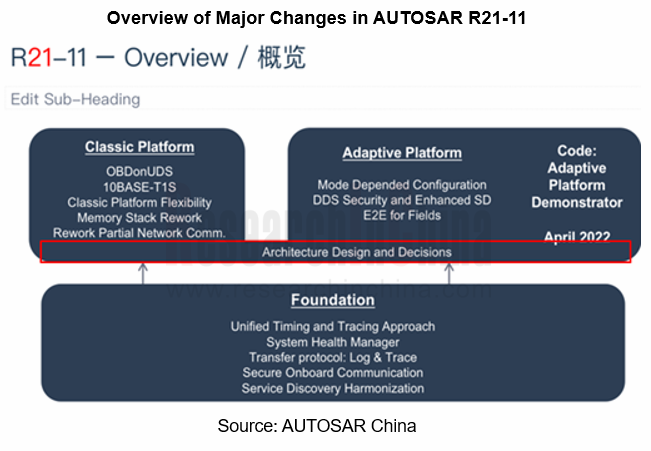
In December 2022, AUTOSAR delivered its latest release R22-11. Compared with the previous releases, the new standard proposed the cross-platform concept for the first time. Moreover, the AUTOSAR Classic Platform (AUTOSAR CP) adds V2X and DDS communication support for China; the AUTOSAR Adaptive Platform (AUTOSAR AP) offers additions or improvements in CAN, firewall, service-oriented vehicle diagnosis and other aspects. In the AUTOSAR AP architecture, compared with R20-11, the releases R21-11 and R22-11 remove ara:rest cluster and add ara:idsm and ara:fw clusters.
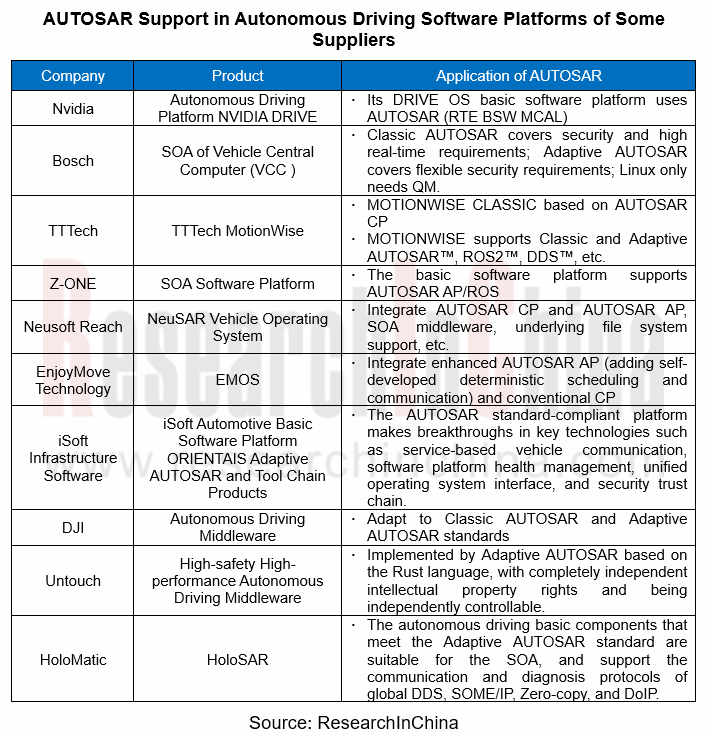
As the releases like AUTOSAR R20-11, R21-11 and R22-11 are published, the AUTOSAR AP specification is becoming mature. Some basic functions of the AP platform have been mature enough to be marketed, and the relevant software platforms compatible with the AUTOSAR AP, especially autonomous driving-related products, have been rolled out one after another. The first-generation AP-based vehicle models have come into the market, and the launch of more models equipped with the platform will also follow up.
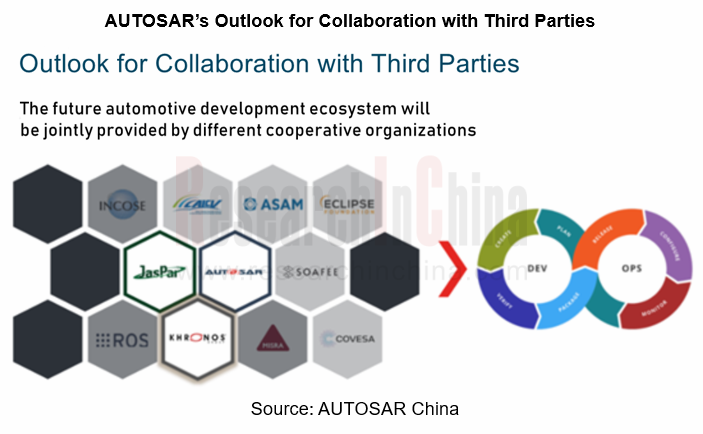
The future automotive industry will be a fully open ecosystem built by third-party collaborative organizations. This is also AUTOSAR’s future vision and important direction. As an alliance, AUTOSAR is making continuous efforts on cooperation with third parties. For example, in terms of Vehicle API for vehicle-cloud cooperation, AUTOSAR often partners with COVESA; as concerns data exchange formats, it teams up with ASAM; it cooperates with KHRONOS in hardware acceleration and image acceleration.
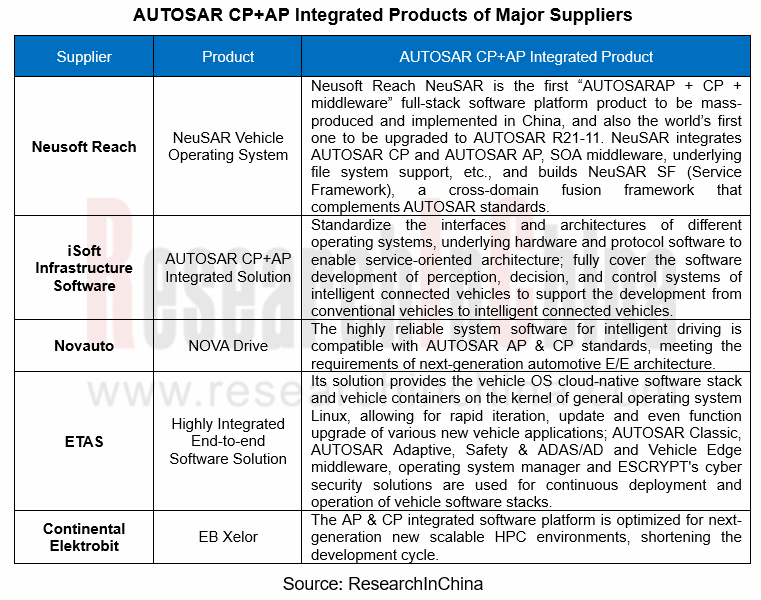
Following the development trend of E/E architecture, much more AUTOSAR CP+AP integrated products tend to be supplied.
Vehicle domain controller and vehicle central computer are developing by leaps and bounds, which is accompanied by the gradual evolution of vehicle E/E architecture towards centralized integration. For new-generation powerful processors, basic software of the two is required to pack both AUTOSAR AP and AUTOSAR CP to meet the requirements of the corresponding security domain and high-performance computing domain. The AUTOSAR CP+AP integrated supply becomes a major trend. While meeting technical performance requirements, it can greatly shorten the development cycle of software applications and reduce costs to achieve rapid iterations. In recent years, major suppliers have raced to launch their integrated solutions.
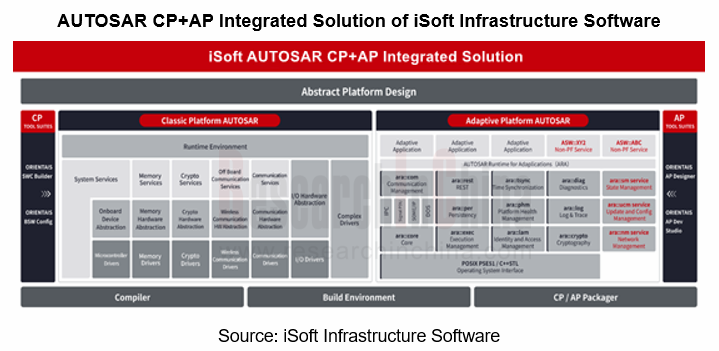
In April 2022, iSoft Infrastructure Software introduced its AUTOSAR CP+AP integrated solution. With features of hard real-time performance, high security, and low energy consumption, the solution meets automotive requirements, supports heterogeneous computing, and builds software system architecture that can be managed flexibly, enabling dynamic communication connection and deployment of applications. It also supports SOME/IP, DDS and other protocols, and can be used in intelligent driving, autonomous driving and Internet of Vehicles, covering such application scenarios as ADAS, intelligent cockpit, T-BOX, and domain controller.
In addition, in the trend for AP+CP integrated supply, the architecture and methodology of the two are tending to integrated, which has started from the release AUTOSAR R21-11. Before R20-11, the architecture and methodology of AP and CP were separated. In the latest release R22-11, the concept of cross-platform is just proposed for the first time.
Chinese suppliers are working hard to deploy, and the localization of AUTOSAR in China is accelerating.
In the context of increasingly high requirements for vehicle development speed and function iteration, conventional software products and software development modes no longer fully adapt to the current market. In the face of the fast-paced intelligent vehicle market, suppliers, especially Chinese local suppliers, make an active response and keep launching new marketable products, answering the needs of customers for rapid iteration.
Neusoft Reach joined AUTOSAR in 2017 as a Premium Member. In December 2022, Neusoft Reach announced a new release of basic software - NeuSAR 4.0. As a new automotive software application development framework, NeuSAR 4.0 provides AUTOSAR standard-compliant components, including Classic AUTOSAR - NeuSAR cCore and Adaptive AUTOSAR - NeuSAR aCore. In this upgrade, both cCore and aCore are iterated to the release AUTOSAR R21-11.
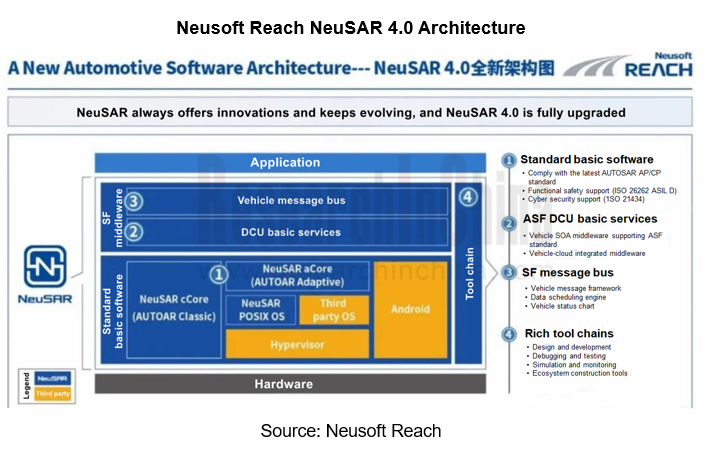
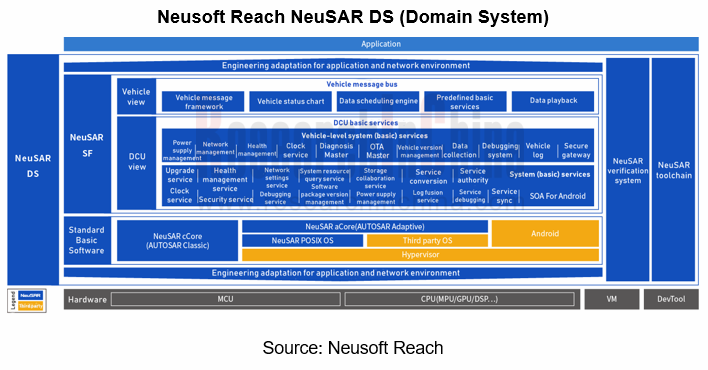
NeuSAR 4.0 not only still offers improvements in AUTOSAR, but also introduces a new automotive software application development framework for the cross-domain integration stage and upgrades the NeuSAR SF (Service Framework) and NeuSAR DevKit tool chain. It moves the development view from the domain controller level to the full vehicle level to solve the problem in software deployment for multi-core heterogeneous domain controllers, and also releases NeuSAR DS (Domain System) for prototype development platforms that integrates the latest AUTOSAR components and SF middleware.
In recent years, in the background of the boom of intelligent vehicles in China and the increasing number of Chinese partners, AUTOSAR has valued the Chinese market more highly. Based on the original AUTOSAR User Group in China, in April 2022, AUTOSAR established the AUTOSAR China Hub, the third regional center outside of Japan and the US, aiming to enhance services and support for Chinese partners and carry out a range of AUTOSAR-related training or popularization activities.
Meanwhile, in 2022, the latest release AUTOSAR R22-11 added the new feature of "V2X Support for China" to the CP to further support China’s V2X technical standards. It is known that this feature is jointly developed by Huawei, Neusoft Reach, Bosch, BMW, Volkswagen Audi, Continental and HingeTech among others.
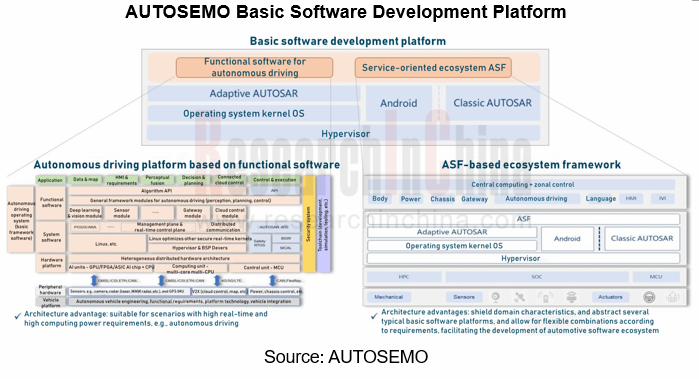
Based on the AUTOSAR architecture standards, China established the China Automotive Basic Software Ecosystem Committee (AUTOSEMO), with the aim of coordinating and organizing members to introduce a range of basic software standards and specifications, for example, providing white papers on the development of automotive basic software, ASF technical specifications, and vehicle-cloud integration technical specifications. Wherein, in the white papers on the development of automotive basic software, the basic software development platform is built on AUTOSAR AP and AUTOSAR CP; the ASF is an expansion of general basic software, and also expands the service management framework of AUTOSAR, facilitating localization of AUTOSAR in China.
Automotive Microcontroller Unit (MCU) and Application Scenario Research Report, 2026
Automotive MCU Research: Increased demand for redundant security drives ASIL D-compliant MCU shipments to exceed 100 million units
In a vehicle EEA, MCUs are widely distributed in various functional ...
China Intelligent Cockpit Patent Analysis Report, 2026
Intelligent Cockpit Patent Research: Cockpit AI, In?vehicle Health, and Infotainment Are Upgrade to Scenario?based and Proactive Functions
From a patent perspective, this report explores the cutting?...
Research Report on Application of VLA Large Model in Automobiles and Robots, 2026
Research on Automotive and Robot VLA: Hybrid Architectures Become Mainstream, VLA Integrates with General World Models, and Reinforcement Learning Serves as Core Engine
Vision?Language?Action (VLA) m...
China Charging Infrastructure (Supercharging, Battery Swapping, V2G, etc.) and High-Performance Supercharging Battery Research Report, 2026
Charging and battery swapping research: as 5C+ supercharging vehicle models go into mass production, the pace of OEMs self-building supercharging networks quickens
800-1000V high-voltage platforms ar...
China Passenger Car Electronic Controlled Suspension Industry Report, 2026
Electronic Controlled Suspension Industry Research: As the First Year of Full Active Suspension Unfolds, Three Technical Routes Race Forward
1. Penetration Rate Surges Three Times, and Electronic Con...
Intelligent Driving SoC Research Report, 2026
Research on Intelligent Driving SoCs: Competition Focus Shifts to L3/L4 Embedded Hardware, and Computing Power of Flagship Vehicle Models Exceeds 1,000 TOPS
In terms of intelligent driving system in...
Automotive AI Large Model Technology Research Report, 2026
Automotive AI Large Model Research: Competition Shifts from "Who Has the Stronger Model" to "Who Boasts Higher Link Efficiency"
ResearchInChina released the Automotive AI Large Model Technology Resea...
Intelligent Vehicle Cockpit Domain Controller Research Report, 2026
Cockpit domain controller research: L3 AIDV intelligent cockpit domain controllers are entering a boom period
Driven by multiple factors such as the continuous evolution of the automotive central int...
Automotive Acoustic System (Audio, Multi-Channel) Industry Report, 2026
Automotive Acoustics Research: Multiple Channels, AI Tuning, and Self-Developed Algorithms Drive the Transformation of High-End Cockpit Sound Fields
I. Automotive Audio Hardware Solutions with 6–9 S...
Autonomous Driving Sensor Chip Research Report, 2026
Research on Autonomous Driving Sensor Chips: Deeply Perceiving the Physical World, Sensor Chips Are Playing A “Leading Role” in Intelligence
In 2026, the autonomous driving sensor chip industr...
Passenger Car Corner Module and Wheel‑Side Control System Research Report, 2026
Wheel-side control research: the “last mile” chassis innovation
Wheel-side control dismantles the traditional drive, braking, steering, and suspension control of the chassis from a "centralized" styl...
Embodied Artificial Intelligence (& Humanoid Robot) MCU Research Report, 2026
Research on Humanoid Robot MCUs: Evolution from General-Purpose Control to High-Value Dedicated Chip Solutions Integrated with Edge AI Functions
MCU (Microcontroller Unit) refers to a compact integra...
Intelligent Vehicle Zone Control Unit (ZCU) Research Report, 2026
ZCU Research: Cross-domain integrated ZCUs are becoming the edge computing nodes of the next-generation zonal architecture
Currently, the mainstream zonal architecture is mainly the quasi-central + z...
Automotive Cybersecurity and Data Security Research Report, 2026
Cybersecurity & Data Security Research: Intelligent Connected Vehicles Enter the Era of “Systematic Offense-Defense and AI-Defined Security”.
Centering on the panorama of intelligent connect...
Report on Breakthrough Strategies of OEMs and ADAS Tier 1 Suppliers for Overseas Layout of Intelligent Driving, 2026
Regulatory Breakthrough, Local System Establishment, OEMs Competing for NOA Layout: Overall Trends of China’s Intelligent Driving Overseas Layout in 2026
Research on overseas intelligent driving layo...
OEMs and Tier1s’ Intelligent Cockpit Platform (Hardware and Software) Innovation Strategy Research Report, 2026
Intelligent Cockpit Platform Research: multi-dimensional cockpit system architecture reconstruction for multi-agent collaboration and proactive intelligent services
The intelligent cockpit software s...
Automotive AIOS Research Report, 2026
Automotive AIOS Research: Mass Production Solutions Are Implemented
Mass Production Solutions Are Implemented on A Small Scale.
In 2026, AIOS starts small-scale implementation, helping to improve v...
Automotive Telematics Service Provider (TSP) Research Report, 2026
TSP Research: Leading providers collectively turn to AI agents to provide all-scenario active services
Telematics Service Providers (TSPs) are the core hub of the telematics industry chain, connectin...