Intelligent Vehicle Cockpit-Driving Integration Research Report, 2023
Cockpit-Driving Integration Research: many companies are making layout and may implement it during 2024-2025.
1. What is the real cockpit-driving integration?
At present, automotive electronic and electrical architectures are evolving towards domain integration and central computing. Some functional domains (intelligent driving domain, cockpit domain, chassis domain, body domain, power domain, etc.) are being integrated, for example, body and chassis domain integration, and cockpit and intelligent driving domain integration.
Cockpit-driving integration refers to the integration of cockpit and intelligent driving domains into a high-performance computing unit that supports both intelligent driving and intelligent cockpit functions. It is an effective solution to reducing development cycle and vehicle cost.
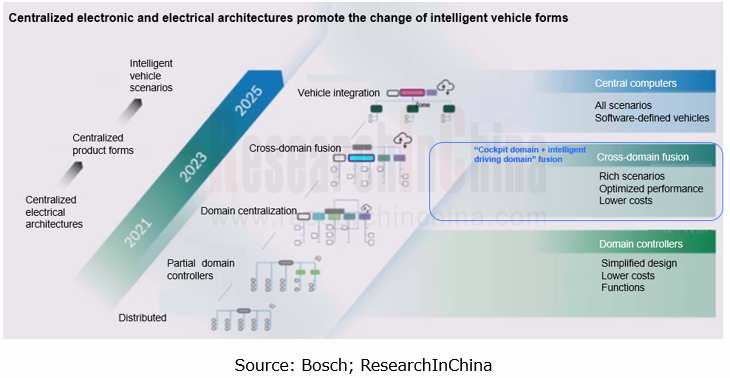
Cockpit-driving integration falls into two types: multi-SoC integration, that is, cockpit and intelligent driving functions are deployed on different boards; single SoC integration, that is, the software and algorithms of cockpit and intelligent driving are all deployed on one board.
Based on a single SoC and with a hypervisor running on the chip, the real cockpit-driving integration divides different functional modules through the hypervisor to enable different security levels of secure cockpit and driving functions. Yet limited by architecture solutions, software and hardware technologies, supply chain and other factors, the cockpit-driving integration based on a single SoC is hard to come true in a short time.
2. How to facilitate cockpit-driving integration?
Given varying maturity and requirements of cockpit and intelligent driving technologies, cockpit-driving integration is iterating and being promoted in a gradual manner.
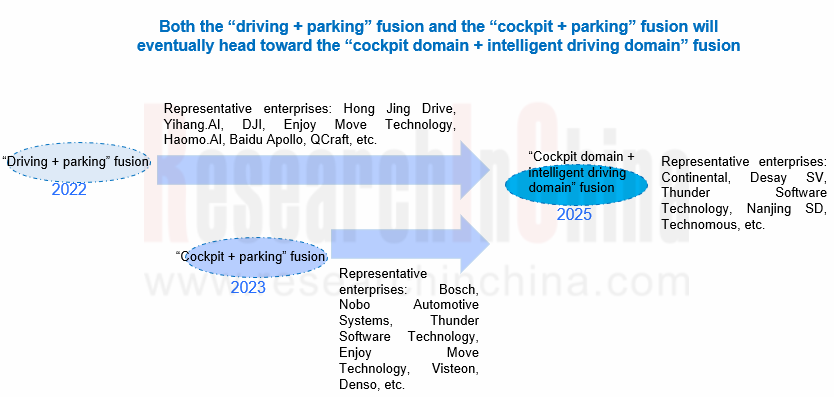
Zhao Jianhong, the vice president of product at EnjoyMove Technology, said that the company will prioritize cockpit-driving integrated solutions because of the demand from OEMs. At present, for parking solutions are relatively mature, and cockpit domain controllers offer sufficient computing power, integrating parking into cockpit domain controllers brings a cost advantage. Cockpit-parking integration signifies the first step of cockpit-driving integration, that is, cockpit-driving integration will be considered after the cockpit-parking integration technology matures.
Bosch Group also plans to achieve cockpit-driving integration around 2024 after the implementation of the Cockpit-Parking Integration 1.0 (based on Qualcomm 8155) and Cockpit-Parking Integration 2.0 (based on Qualcomm 8295).
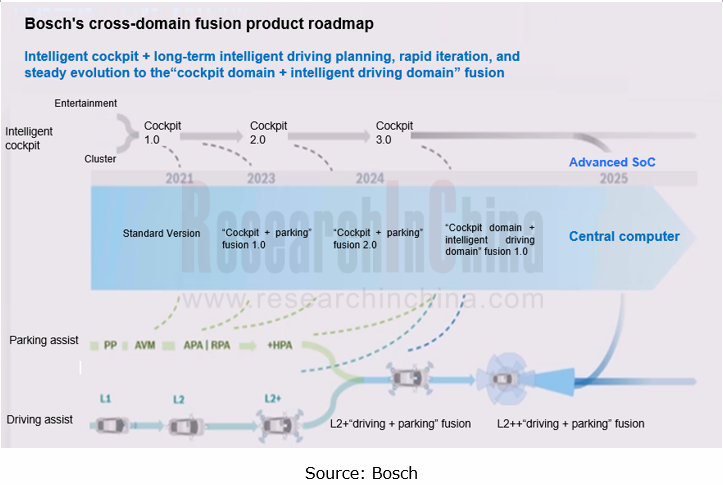
In the future, both the driving-parking integration (launched in 2022 on large scale) around intelligent driving, and the cockpit-parking integration (expected to be mass-produced in 2023) centering on the cockpit will eventually head towards the cockpit-driving integration expected to be spawned around 2025.
3. How companies deploy cockpit-driving integration?
Since 2022, cockpit-driving integration has become the focus of the industry, attracting entrants like Z-ONE, Neta Auto, Tesla, Desay SV, ThunderSoft and Continental.
Z-ONE: the Galaxy Full-stack Solution 3.0 for smart cars was released in November 2022. It adopts central computing and zonal control, and is equipped with ZXD, a cockpit-driving integrated computing platform. It is scheduled to be mass-produced in 2025.
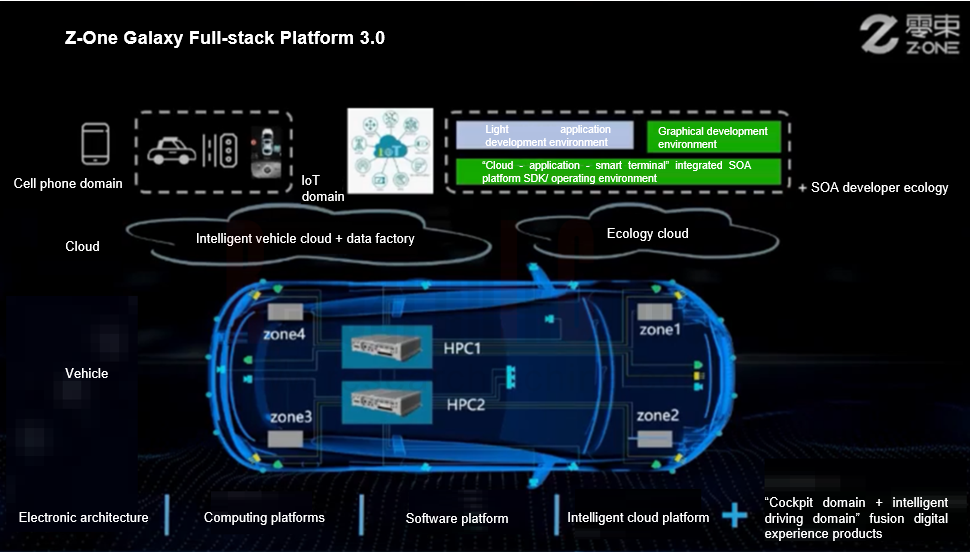
Features of ZXD:
 The conventional domain framework is broke up for the layered design of "cloud platform + central brain + zone + intelligent sensing and execution" so as to realize software and hardware decoupling, and cross-domain integration.
Based on Chinese homemade chips, the AI compute up to 1,000 TOPS supports continuously simultaneous operation of multi-domain functions (e.g., autonomous driving and in-vehicle infotainment), independent calculation of cockpit and intelligent driving domains, and hard-core information encryption, as well as L4 and above autonomous driving, and high-resolution multi-screen display of intelligent cockpit.
The pre-installed intelligent vehicle operating system ZOS can realize "software and hardware synergy" with China’s local chips, offer standard uniform interfaces for software and hardware decoupling, and provide a unified development platform for cross-domain integration.
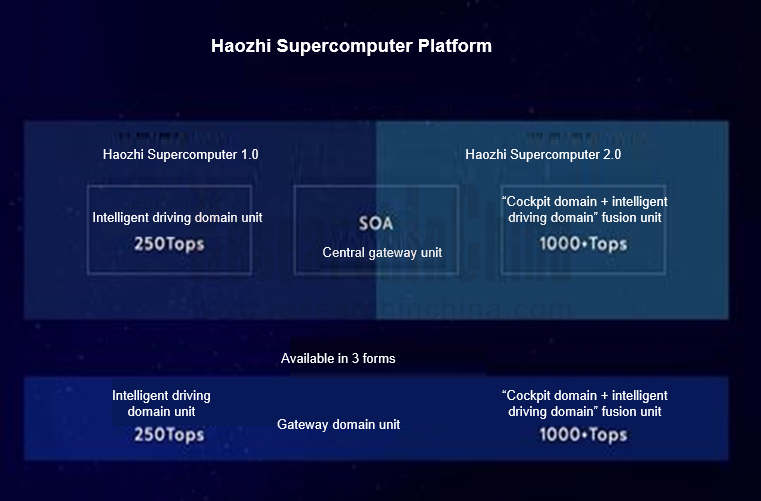
Neta Auto: the latest electronic and electrical architecture is a central computing architecture whose core is a supercomputing platform (including Haozhi Supercomputer 1.0 and Haozhi Supercomputer 2.0). With computing power up to 1,000 TOPS, it supports L4 autonomous driving integrated with intelligent driving and cockpit functions.
Haozhi Supercomputer 2.0 uses a "central + zonal" architecture composed of two boards: a cockpit-driving integration domain unit and an intelligent control unit. It will be applied to Neta S+/Shanhai Platform.
Desay SV: in April 2022, Desay SV unveiled "Aurora", an automotive intelligent computing platform. As a multi-SoC based cockpit-driving integrated solution, it realizes a leap from domain controllers to central computing platform, with the following features:
Hardware: supports mainstream heterogeneous SoCs with high computing power, such as NVIDIA Orin, Qualcomm SA8295, and Black Sesame Huashan A1000, and deliver total computing power of over 2,000 TOPS.
Function: integrate core functional domains such as intelligent cockpit domain, intelligent driving domain and connectivity services, to achieve cross-domain integration.
Structure: adopt a plug-in structure, and offer flexibly configured computing power to meet the requirements of models at varying prices.
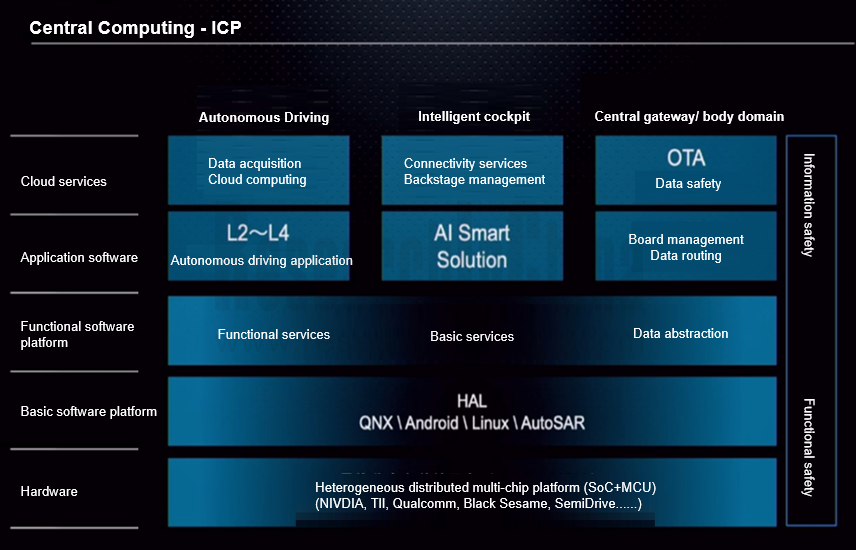
Most of the cockpit-driving integrated solutions of OEMs and Tier1 suppliers in China are based on multiple SoCs from Qualcomm, Nvidia and SemiDrive. The single SoC based solutions are still under development.
It is worth noting that NVIDIA and Qualcomm have successively released high-compute cockpit-driving integrated chips since 2022, providing strong support for application of single SoC solutions.
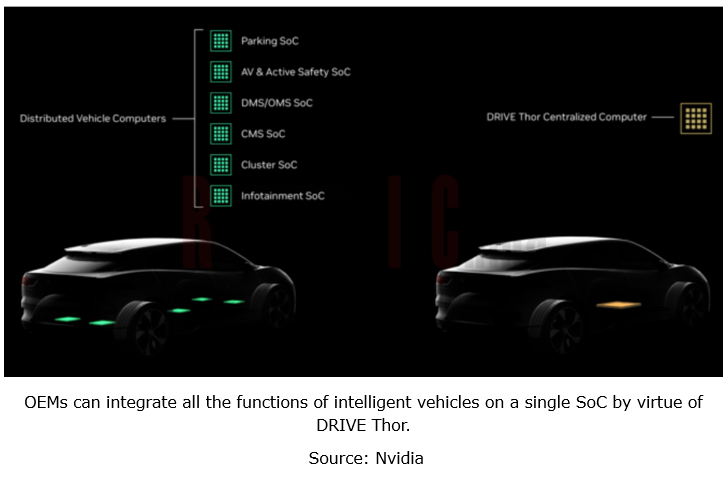
Nvidia: Nvidia announced DRIVE Thor, a superchip of epic proportions, in September 2022. With computing power of 2,000 TOPS, it is compatible with Linux, QNX and Android-based IVI systems, and supports cockpit-driving integration. Nvidia plans to put DRIVE Thor into production in 2024.
Nvidia DRIVE Thor will be installed in ZEEKR’s next-generation smart cars to be produced in early 2025. The latest news in March showed that Lenovo will also adopt Nvidia DRIVE Thor. According to Lenovo's plan, its cockpit-driving integrated controller will be launched during 2024-2025, with computing power of 1,000/2,000 TOPS.
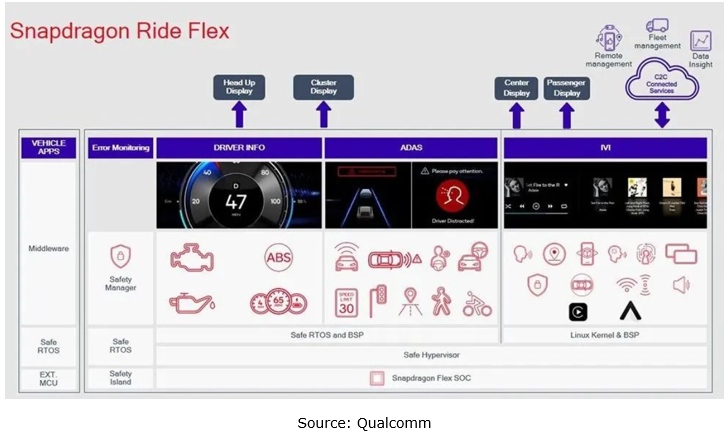
Qualcomm: in January 2023, Qualcomm launched the Snapdragon Ride Flex, the automotive industry’s first scalable family of SoCs to simultaneously support digital cockpits and ADAS. The expected start of production will begin in 2024.
The Snapdragon Ride Flex has three levels: Mid, High, and Premium. The AI compute of the single Premium SoC is above 600 TOPS. Combined with AI accelerators (probably NPUs or MAC arrays), it can support performance of up to 2,000 TOPS.
It is known that Volkswagen will adopt the Snapdragon Ride Flex to support single-chip multi-domain computing (covering driving assistance and intelligent cockpit). The Snapdragon Ride Flex will first land on the new-generation PPE-based Porsche Macan that will be launched in 2024.
Generally speaking, cockpit-driving integration is still in the exploration stage, facing quite a few problems and challenges in organizational structure, technology development and industrial chain coordination, for example: integration of high-compute chips; SOA-based software layered design, and cross-domain integration of operating systems and middleware; application of high-bandwidth, low-latency automotive Ethernet communication technology.
Vehicle-Road-Cloud Integration and C-V2X Industry Report, 2026
Vehicle-Road-Cloud and C-V2X Research: with the three-tier promotion system of "top-level planning + mandatory pilot + evaluation binding", the industry turning point is approachingThis report focuses...
China OEM Data Capability Analysis Report, 2026
OEM Data Capability Research: 24 OEMs × 9 Capability Domains, Who Takes the Lead?
An L4 autonomous driving R&D and test vehicle can generate approximately 10TB of raw data per single day — data v...
Autonomous Driving Domain Controller and Central Computing Unit (CCU) Industry Report, 2026
Autonomous Driving Domain Controller (ADCU) Research: One-Chip CCU solutions are quickly available in vehicles
In China's passenger car market, autonomous driving systems involved in mass production ...
Automotive EMS and ECU Industry Research Report, 2026
Automotive EMS Research: The boundaries between EMS providers and Tier1 suppliers are becoming blurred, and the supply chain model is evolving from a linear chain to a networked structure
Mainstream ...
Automotive Microcontroller Unit (MCU) and Application Scenario Research Report, 2026
Automotive MCU Research: Increased demand for redundant security drives ASIL D-compliant MCU shipments to exceed 100 million units
In a vehicle EEA, MCUs are widely distributed in various functional ...
China Intelligent Cockpit Patent Analysis Report, 2026
Intelligent Cockpit Patent Research: Cockpit AI, In?vehicle Health, and Infotainment Are Upgrade to Scenario?based and Proactive Functions
From a patent perspective, this report explores the cutting?...
Research Report on Application of VLA Large Model in Automobiles and Robots, 2026
Research on Automotive and Robot VLA: Hybrid Architectures Become Mainstream, VLA Integrates with General World Models, and Reinforcement Learning Serves as Core Engine
Vision?Language?Action (VLA) m...
China Charging Infrastructure (Supercharging, Battery Swapping, V2G, etc.) and High-Performance Supercharging Battery Research Report, 2026
Charging and battery swapping research: as 5C+ supercharging vehicle models go into mass production, the pace of OEMs self-building supercharging networks quickens
800-1000V high-voltage platforms ar...
China Passenger Car Electronic Controlled Suspension Industry Report, 2026
Electronic Controlled Suspension Industry Research: As the First Year of Full Active Suspension Unfolds, Three Technical Routes Race Forward
1. Penetration Rate Surges Three Times, and Electronic Con...
Intelligent Driving SoC Research Report, 2026
Research on Intelligent Driving SoCs: Competition Focus Shifts to L3/L4 Embedded Hardware, and Computing Power of Flagship Vehicle Models Exceeds 1,000 TOPS
In terms of intelligent driving system in...
Automotive AI Large Model Technology Research Report, 2026
Automotive AI Large Model Research: Competition Shifts from "Who Has the Stronger Model" to "Who Boasts Higher Link Efficiency"
ResearchInChina released the Automotive AI Large Model Technology Resea...
Intelligent Vehicle Cockpit Domain Controller Research Report, 2026
Cockpit domain controller research: L3 AIDV intelligent cockpit domain controllers are entering a boom period
Driven by multiple factors such as the continuous evolution of the automotive central int...
Automotive Acoustic System (Audio, Multi-Channel) Industry Report, 2026
Automotive Acoustics Research: Multiple Channels, AI Tuning, and Self-Developed Algorithms Drive the Transformation of High-End Cockpit Sound Fields
I. Automotive Audio Hardware Solutions with 6–9 S...
Autonomous Driving Sensor Chip Research Report, 2026
Research on Autonomous Driving Sensor Chips: Deeply Perceiving the Physical World, Sensor Chips Are Playing A “Leading Role” in Intelligence
In 2026, the autonomous driving sensor chip industr...
Passenger Car Corner Module and Wheel‑Side Control System Research Report, 2026
Wheel-side control research: the “last mile” chassis innovation
Wheel-side control dismantles the traditional drive, braking, steering, and suspension control of the chassis from a "centralized" styl...
Embodied Artificial Intelligence (& Humanoid Robot) MCU Research Report, 2026
Research on Humanoid Robot MCUs: Evolution from General-Purpose Control to High-Value Dedicated Chip Solutions Integrated with Edge AI Functions
MCU (Microcontroller Unit) refers to a compact integra...
Intelligent Vehicle Zone Control Unit (ZCU) Research Report, 2026
ZCU Research: Cross-domain integrated ZCUs are becoming the edge computing nodes of the next-generation zonal architecture
Currently, the mainstream zonal architecture is mainly the quasi-central + z...
Automotive Cybersecurity and Data Security Research Report, 2026
Cybersecurity & Data Security Research: Intelligent Connected Vehicles Enter the Era of “Systematic Offense-Defense and AI-Defined Security”.
Centering on the panorama of intelligent connect...