How to realize the commercialization of 800V will play a crucial part in the strategy of OEMs.
As new energy vehicles and battery technology boom, charging and battery swapping in the new energy vehicle industry chain have become weak links for the development of new energy vehicles. Inconvenient charging and short cruising range have become sore points that plague every consumer buying electric vehicles. In this context, 800V high-voltage charging for new energy vehicles has been a spotlight. 2022 is the first year for the development of 800V high-voltage platforms in China. In particular, a large number of 800V high-voltage platform models will go on sale during 2023-2024.
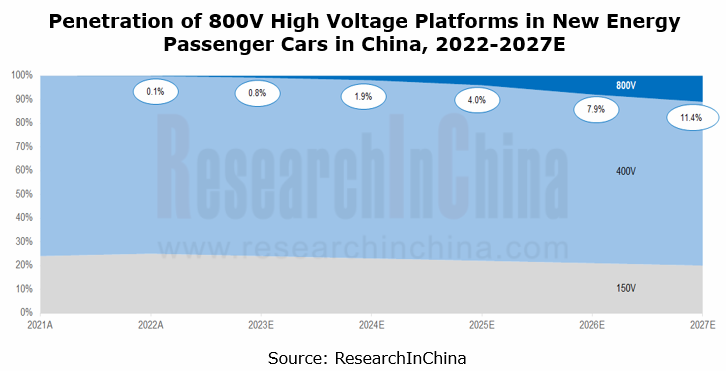
In current stage, 800V platforms are still facing a situation of loud thunder but small raindrops. ResearchInChina’s statistics about the insurance data show that insured vehicles with 800V platforms in China were still less than 10,000 units in 2022. The low cost performance and poor ultra-fast charging experience offered by 800V models are the major flaws criticized by consumers. The industry boom still requires the lower cost of upstream materials and systems, and the gradual deployment of downstream 480kW/500kW ultra-fast charging piles to cover key use scenarios, so that 800V models can be pulled into the market explosion node which is expected to come around 2024 according to the plans of large automakers.
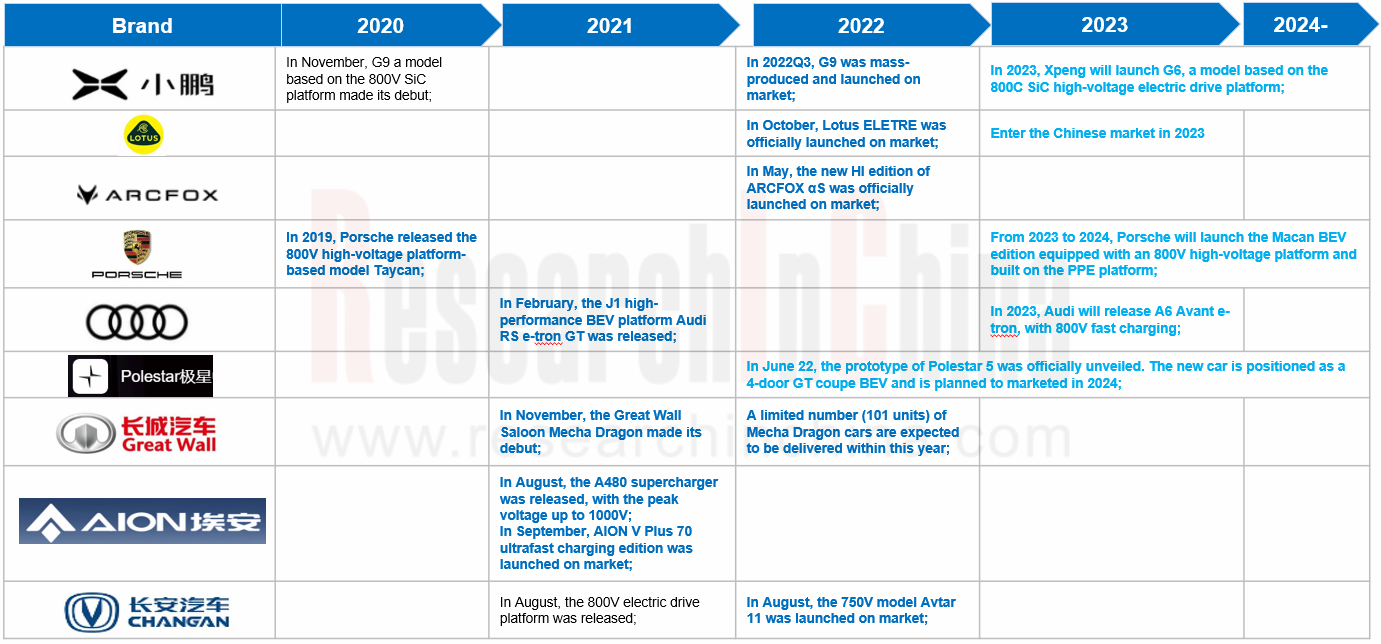
Deployment of 800V ultra-fast charging:
Xpeng: for the top ten cities by orders for G9, concentrate on building S4 ultrafast charging stations. In 2023, S4 stations will be used to provide energy replenishment in key cities and along key highways; it is estimated that in 2025, in addition to the current self-operated 1,000 charging stations, Xpeng will build another 2,000 ultrafast charging stations.
GAC: in 2021, GAC introduced a fast charging pile with maximum charging power up to 480kW. It is predicted that in 2025, 2,000 supercharging stations will be built in 300 cities across China.
NIO: in December 2022, NIO officially released a 500kW ultrafast charging pile with maximum current of 660A supporting high-power charging. The fastest charging time for 400V models is only 20 minutes; for 800V models, the fastest charge from 10% to 80% takes 12 minutes.
Li Auto: in 2023 Li Auto has started the construction of 800V high-voltage supercharging piles in Guangdong, and its goal is to build 3,000 supercharging stations in 2025.
Huawei: in March 2023, the 600kW supercharging pile exclusively for AITO came out in Huawei Base in Bantian Street, Shenzhen. This charging pile, named FusionCharge DC Supercharging Terminal, adopts single-pile single-gun design. The manufacturer is Huawei Digital Power Technologies Co., Ltd. Its external dimensions are 295mm (L) x 340mm (W) x 1700mm (H), and the product model is DT600L1-CNA1. The charging pile features output voltage range of 200-1000V, maximum output current of 600A, maximum output power of 600kW, and liquid cooling.
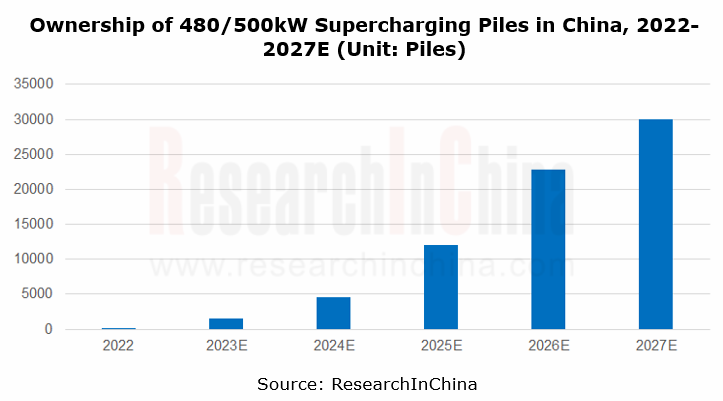
Due to the high construction cost of 480kW ultrafast charging piles, generally speaking, an ultrafast charging station is equipped with just 1 or 2 480kW supercharging piles and several 240kW fast charging piles, and supports dynamic power distribution. Overall, according to the plans of automakers, it is conceivable that in late 2027, the ownership of 800V high-voltage platform models will reach 3 million units; the ownership of 800V supercharging stations will number 15,000-20,000; the ownership of 480/500kW supercharging piles will outnumber 30,000.
As well as charging piles, in the evolution of architecture from 400V to 800V, the implementation of vehicle engineering also remains very complicated. It needs simultaneous introduction of the entire system covering from semiconductor devices and battery modules to electric vehicles, charging piles, and charging networks, and poses higher requirements for reliability, size and electrical performance of connectors. It also requires technology improvements in mechanical, electrical and environmental performance.
Tier 1 suppliers race to unveil their 800V component products. Most of the new products will become available during 2023-2024.
Leadrive Technology: in 2022, the first SiC-based "three-in-one" electric drive system jointly developed by Leadrive Technology and SAIC Volkswagen went into trial production and made a debut at the Volkswagen IVET Innovation Technology Forum. Tested by SAIC Volkswagen, this "three-in-one" system equipped with Leadrive Technology's silicon carbide (SiC) ECU can increase the cruising range of the ID. 4X model by at least 4.5%. Additionally, Leadrive Technology and Schaeffler will co-develop electric drive assembly products including 800V SiC electric axle.
Vitesco Technologies: the highly integrated electric drive system product EMR4 is projected to be mass-produced in China and supplied to global customers in 2023. EMR4 will be spawned at Vitesco Technologies’ factory in Tianjin Economic-Technological Development Area and delivered to automakers inside and outside China.
BorgWarner: the new 800V SiC inverter adopts Viper's patented power module technology. The application of SiC power modules to 800V voltage platforms reduces the use of semiconductors and SiC materials. This product will be mass-produced and installed on vehicles between 2023 and 2024.
800V is still in the ascendant, but the battle for silicon carbide (SiC) production capacity has begun.
In new 800V architecture, the key to electric drive technology is the use of third-generation SiC/GaN semiconductor devices. While bringing technical benefits to new energy vehicles, technology iterations also pose many challenges to automotive semiconductors and the entire supply chain. In the future, 800V high-voltage systems with the third-generation SiC/GaN semiconductors as the core will usher in a period of large-scale development in the fields of automotive electric drive system, electronic control system, on-board charger (OBC), DC-DC, and off-board charging pile.
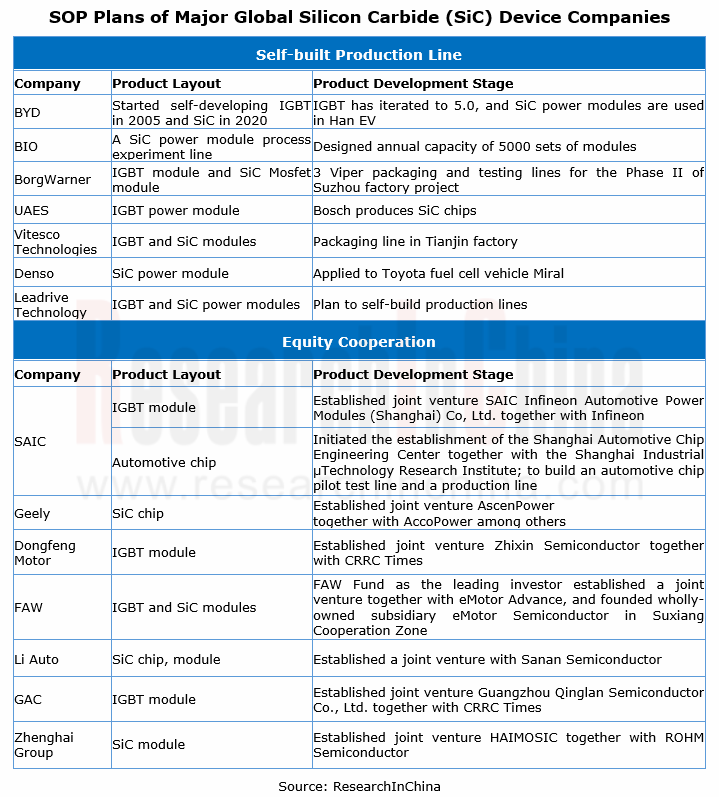
In particular, silicon carbide (SiC) is at the core of the high-voltage platform strategy of OEMs. Although 800V is still growing at present, the war for SiC production capacity has actually started. OEMs and Tier 1 suppliers compete to form strategic partnerships with suppliers of SiC chips and modules or set up joint ventures with them for production of SiC modules so as to lock in SiC chip capacity.
On the other hand, the campaign for SiC cost reduction has also been launched. At present, SiC power devices are extremely expensive. In Tesla’s case, the value of SiC-based MOSFET per vehicle is about USD1,300; at the just-concluded annual investor day, Tesla announced the progress in development of its second-generation power chip platform, mentioning reduction of 75% silicon carbide devices (SiC usage), which attracted market attention.
Tesla’s confidence lies in the fact that the automaker has independently developed TPAK SiC MOSFET module and takes a deep part in the chip definition and design. Each bare die in the TPAK can be purchased from different chip vendors to establish a multi-supplier system (ST, ON Semiconductor, etc.). TPAK also allows for application of cross-material platforms, for example, mixed use of IGBT/SiC MOSFET/GaN HEMT.
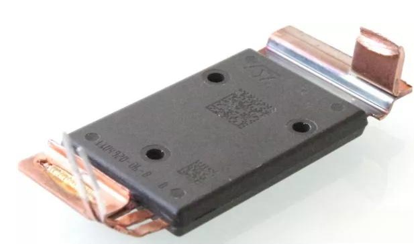
(1) China has built a SiC industry chain, but with the technology level slightly lower than the international.
SiC is a compound semiconductor material composed of silicon and carbon elements. Power devices based on SiC monocrystal materials offer the benefits of high frequency, high efficiency, and small volume (70% or 80% smaller than IGBT power devices), and have been seen in Tesla Model 3.
From the perspective of value chain, substrate makes up more than 45% of the cost of silicon carbide (SiC) devices, and its quality also directly affects the performance of epitaxy and the final product. Substrate and epitaxy take a nearly 70% share of the value, so cutting their cost will be the main development direction of the SiC industry. SiC required by 800V high voltage for new energy vehicles is mainly conductive substrate silicon carbide crystal. The current major manufacturers include Wolfspeed (Cree), II-VI, TankeBlue Semiconductor and SICC.
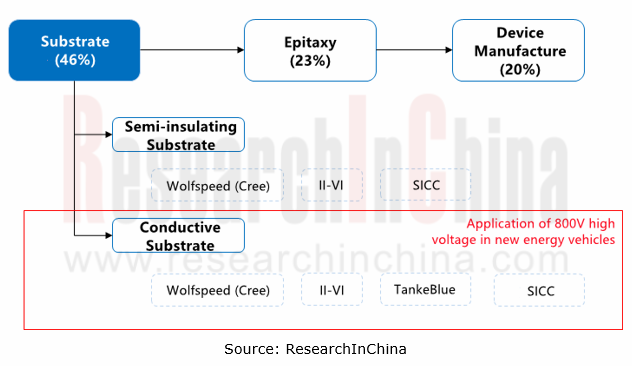
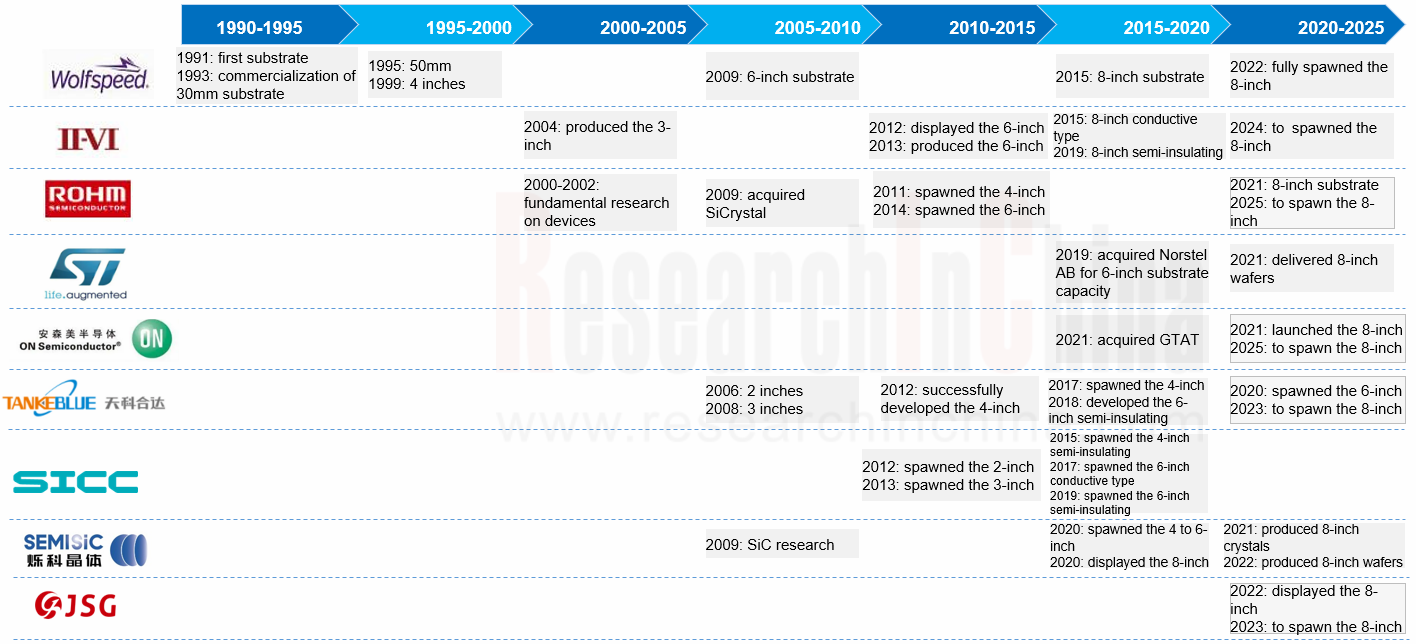
In terms of global SiC technology development, the SiC device market is monopolized by giant vendors like STMicroelectronics, Infineon, Cree and ROHM. Chinese vendors already have large-scale production capacity, and are on par with the international development level. Their capacity planning and production time are almost the same with their foreign peers.
From the development level of SiC substrates, it can be seen that 6-inch substrate currently prevails in the SiC market, and 8-inch SiC substrate is the development priority globally. At present, only Wolfspeed in the world has achieved mass production of 8-inch SiC. Chinese company SEMISiC produced 8-inch N-type SiC polished wafers on small scale in January 2022. Most international companies plan production of 8-inch SiC substrates around 2023.
(2) Gallium nitride (GaN) is still at the early stage of application in automotive, and the layout pace of related manufacturers quickens.
Gallium nitride (GaN) is largely used in consumer electronics fields such as tablet PC, TWS earbuds and notebook computer fast charging (PD). Yet as new energy vehicles thrive, electric vehicles become a potential application market for GaN. In electric vehicles, GaN field effect transistors (FETs) are very applicable to AC-DC OBC, high-voltage (HV) to low-voltage (LV) DC-DC converters, and low-voltage DC-DC converters.
In the field of electric vehicles, gallium nitride (GaN) and silicon carbide (SiC) technologies complement each other and cover different voltage ranges. GaN devices are suitable for tens of volts to hundreds of volts, and in medium and low voltage applications (less than 1200V), their switching loss is 3 times less than SiC in 650V application. SiC is more applicable to high voltage (several thousand volts). Currently the application of SiC devices in a 650V environment is mostly to enable 1200V or higher voltage in electric vehicles.
China still has a big gap with foreign counterparts in development of gallium oxide (Ga2O3), and has yet to achieve mass production.
By virtue of large band gap, high breakdown field strength and strong radiation resistance, gallium oxide (Ga2O3) is expected to dominate in the field of semiconductor power electronics in the future. Compared with common wide-bandgap SiC/GaN semiconductors, Ga2O3 boasts a higher Baliga quality factor and lower expected growth cost, and has more potential in application to high-voltage, high-power, high-efficiency, and small-size electronic devices.
In policy’s term, China also pays ever more attention to Ga2O3. As early as 2018 China has set about exploring and studying ultra-wide bandgap semiconductor materials including Ga2O3, diamond and boron nitride. In 2022, the Ministry of Science and Technology of China brought Ga2O3 into the National Key R&D Program during the "14th Five-Year Plan" Period.
On August 12, 2022, the Bureau of Industry and Security (BIS) under the U.S. Department of Commerce issued an interim final rule that establishes new export controls on four technologies that meet the criteria for emerging and foundational technologies, including: GAA technology, EDA software, PGC technology, and the two substrates of ultra-wide bandgap semiconductors, Gallium Oxide (Ga2O3) and diamond. The two export controls came into effect on August 15. Ga2O3 has drawn more attention from the global scientific research and industrial circles.
Although gallium oxide (Ga2O3) is still at the initial stage of R&D, China has made several breakthroughs within 15 months from 2022. Its gallium oxide preparation technologies from 2 inches to 6 inches in 2022, and then to the latest 8 inches are maturing. Chinese Ga2O3 material research units include: China Electronics Technology Group Corporation No.46 Research Institute (CETC46), Evolusia Semiconductor, Shanghai Institute of Optics and Fine Mechanics (SIOM), Gallium Family Technology, Beijing MIG Semiconductor, and Fujia Gallium Industry; listed companies like Xinhu Zhongbao, Sinopack Electronic Technology, Jiangsu Nata Opto-Electronic Material and San'an Optoelectronics; and dozens of colleges and universities.
Automotive Acoustic System (Audio, Multi-Channel) Industry Report, 2026
Automotive Acoustics Research: Multiple Channels, AI Tuning, and Self-Developed Algorithms Drive the Transformation of High-End Cockpit Sound Fields
I. Automotive Audio Hardware Solutions with 6–9 S...
Autonomous Driving Sensor Chip Research Report, 2026
Research on Autonomous Driving Sensor Chips: Deeply Perceiving the Physical World, Sensor Chips Are Playing A “Leading Role” in Intelligence
In 2026, the autonomous driving sensor chip industr...
Passenger Car Corner Module and Wheel‑Side Control System Research Report, 2026
Wheel-side control research: the “last mile” chassis innovation
Wheel-side control dismantles the traditional drive, braking, steering, and suspension control of the chassis from a "centralized" styl...
Embodied Artificial Intelligence (& Humanoid Robot) MCU Research Report, 2026
Research on Humanoid Robot MCUs: Evolution from General-Purpose Control to High-Value Dedicated Chip Solutions Integrated with Edge AI Functions
MCU (Microcontroller Unit) refers to a compact integra...
Intelligent Vehicle Zone Control Unit (ZCU) Research Report, 2026
ZCU Research: Cross-domain integrated ZCUs are becoming the edge computing nodes of the next-generation zonal architecture
Currently, the mainstream zonal architecture is mainly the quasi-central + z...
Automotive Cybersecurity and Data Security Research Report, 2026
Cybersecurity & Data Security Research: Intelligent Connected Vehicles Enter the Era of “Systematic Offense-Defense and AI-Defined Security”.
Centering on the panorama of intelligent connect...
Report on Breakthrough Strategies of OEMs and ADAS Tier 1 Suppliers for Overseas Layout of Intelligent Driving, 2026
Regulatory Breakthrough, Local System Establishment, OEMs Competing for NOA Layout: Overall Trends of China’s Intelligent Driving Overseas Layout in 2026
Research on overseas intelligent driving layo...
OEMs and Tier1s’ Intelligent Cockpit Platform (Hardware and Software) Innovation Strategy Research Report, 2026
Intelligent Cockpit Platform Research: multi-dimensional cockpit system architecture reconstruction for multi-agent collaboration and proactive intelligent services
The intelligent cockpit software s...
Automotive AIOS Research Report, 2026
Automotive AIOS Research: Mass Production Solutions Are Implemented
Mass Production Solutions Are Implemented on A Small Scale.
In 2026, AIOS starts small-scale implementation, helping to improve v...
Automotive Telematics Service Provider (TSP) Research Report, 2026
TSP Research: Leading providers collectively turn to AI agents to provide all-scenario active services
Telematics Service Providers (TSPs) are the core hub of the telematics industry chain, connectin...
Automotive Smart Interior Research Report, 2026
Smart Interior Research: As Technologies like Interactive Starlight Headliner, Hidden Display and Surface Projection Are Launched, Automotive Interiors Become Ever More Intelligent
The Automotive Sma...
Research Report on AI Applications in Cockpits, 2026
AI Application in Cockpits: AI Services Become More Comprehensive, Convenient, and Refined.
In the first half of 2026, cockpit AI functions underwent initial upgrades across multiple dimensions, inc...
Software-Defined Vehicles in 2026: OEM Software Development and Supply Chain Deployment Strategy Research Report
Research on OEMs’ Software Strategies: R&D Focus, Development Strategies and Supplier Building Models of 30 OEMs
In this paper, we adopt a research framework covering 13 subsystems and 48 sub-di...
Passenger Car Chassis Domain Control and Chassis Cross-Domain Integration Research Report, 2026
Chassis Control Research: Mass Production of Full Chassis-by-Wire Solutions Starts
1. A Cluster of Full Chassis-by-Wire Solutions Make Their Debut, and EMB Enters Mass Production and Adoption for the...
Central Domain Control (Powertrain, Chassis, Body) and Motion Controller Research Report, 2026
Central Domain Control and Motion Control Research: XYZ Coordinated Control and Full X-by-Wire Actuation System
With the gradual penetration of L3+ autonomous driving, the chassis control system is ...
48V Low-voltage Power Distribution Network (PDN) Architecture and Supply Chain Panorama Research Report, 2026
Research on 48V Low-Voltage Power Distribution Network (PDN): An Active 48V Supply Chain, with Priority Deployment in High-Power Scenarios Such as Steer-by-Wire Chassis
The automotive 48V low-voltage...
AI-Defined Vehicle (AIDV) OEMs' Deployment Strategies Research Report, 2026
AIDV Research: Deployment Strategies of 22 OEMs
The AI-Defined Vehicle (AIDV) OEMs' Deployment Strategies Research Report, 2026, released by ResearchInChina, analyzes the AI deployment strategies of ...
OEMs’ Passenger Car Model Planning Research Report, 2026
Vehicle Model Planning Research: Chinese OEMs Launch Sub-Brands Intensively, While Multinational OEMs Apply the Brakes to Electrification Strategies
ResearchInChina released the OEMs’ Passenger Car M...