Redundant System Research: The Last Line of Safety for Intelligent Vehicles
Redundant design refers to a technology adding more than one set of functional channels, components or parts that enable the same function to places where a system or device plays a critical role in accomplishing a task, so as to ensure that the system or device can still work normally when a part fails, lowering failure probability and improving reliability.
As the level of driving assistance gets ever higher, human drivers are gradually being replaced by vehicle systems. To ensure that vehicle systems are always in operation, redundant systems are essential. In the future, redundant systems will become standard configurations for L3 and higher-level driving assistance.
At present, the redundancy for ADAS ranges from perceptual positioning (environmental monitoring), controller (brain) and actuator (braking and steering) to communication (control over information transmission) and power supply (support for failure and degradation).
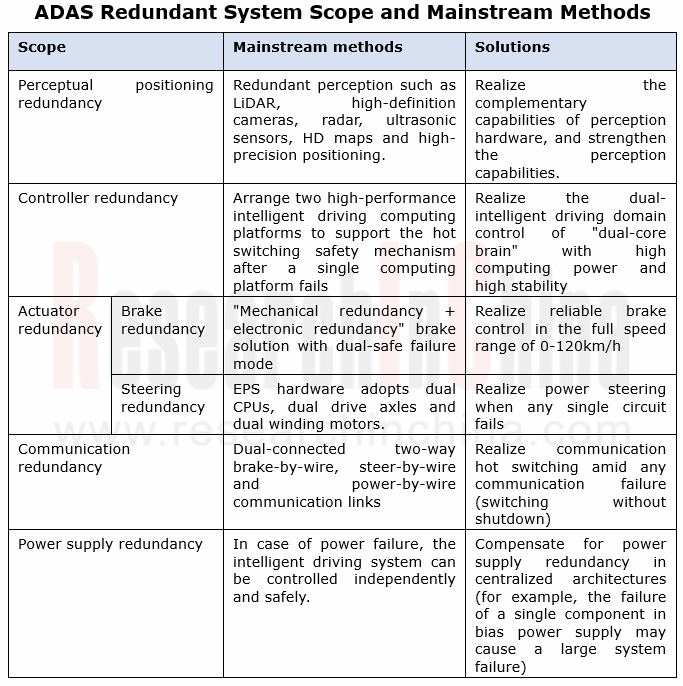
Most of vehicle models (like Great Wall WEY Mocha, NIO ET Series, Li Auto L8/L7 Max and Volvo EX90) with ADAS functions such as NOH, NGP and NOP are equipped with fully redundant systems.
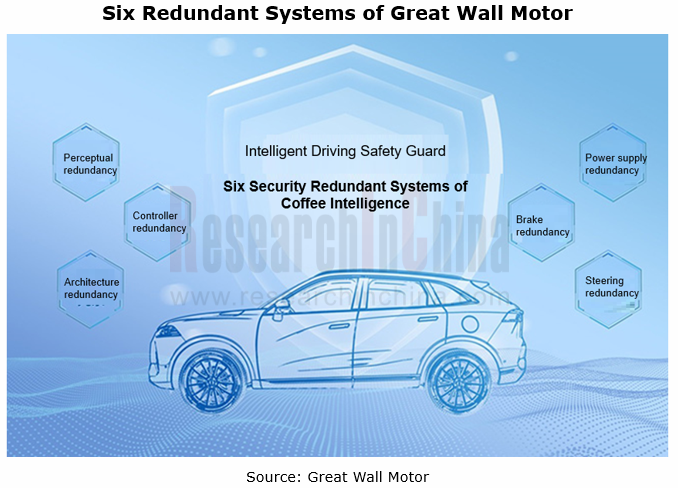
Coffee Intelligence, Great Wall Motor’s department for redundant systems, released six redundant systems in 2020, including perceptual redundancy, controller redundancy, architecture redundancy, power redundancy, brake redundancy and steering redundancy, which debuted on WEY Mocha in May 2021.
Perceptual redundancy adopts a multi-source heterogeneous sensor solution and L+R+V fusion. Controller redundancy uses dual controllers that run around the clock and back up each other. Brake redundancy uses Bosch’s ESP+iBooster combination. Steering redundancy applies the third-generation intelligent steering product developed by HYCET EPS System, an affiliate of Great Wall Motor, with dual winding motors, dual-motor position sensors, dual CPUs and dual controllers. Communication redundancy adopts dual communication architectures with three independent physical communication links supporting each other. Power redundancy applies the "double insurance" design consisting of dual power supply and dual circuits.
In November 2022, Volvo released its flagship SUV - EX90, which is its first production model equipped with a safety redundant system and is expected to be available on the Chinese market in mid-2024.
The perceptual redundancy for this car adopts a LiDAR+radar+camera+ ultrasonic radar out-cabin solution, in which LiDAR is provided by Luminar, with a detection range of 250 meters. The in-cabin solution first introduces a driver understanding system (DUS) consisting of two in-vehicle cameras and a capacitive steering wheel. As for controller redundancy, there are two sets of parallel cooperative computing platforms packing NVIDIA DRIVE Orin and NVIDIA Xavier chips with the computing power up to 286 TOPS. In addition, the vehicle features fully redundant design in braking, steering, power supply and communication.
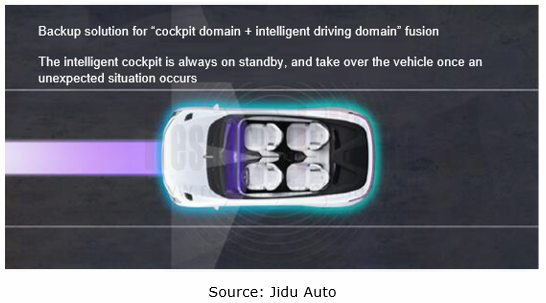
As intelligent vehicle architectures evolve, redundant systems are evolving as well. For example, JIDU ROBO-01, released by Jidu Auto in June 2022, carries Jidu Auto's self-developed high-level intelligent architecture - JET, which integrates the EEA and SOA operating system. Its backup solution for “cockpit domain + intelligent driving domain” fusion is based on Qualcomm 8295 with AI compute of 30 TOPS, supporting intelligent driving redundancy. When the intelligent driving fails in extreme cases, the intelligent cockpit can take over the vehicle and let it stop safely.
Foreign suppliers offer comprehensive redundant designs. For example, the redundancy of Bosch’s perception module adopts the multi-sensor redundancy solution composed of ultrasonic sensors, radars, cameras and LiDAR. The positioning module redundancy adopts the redundant positioning solution constituted by absolute positioning based on satellite signals and relative positioning based on road features. The decision module is redundantly configured with two core computing units (i.e. domain controllers). The actuator redundancy design covers the steering system, brake system and engine management system. For the brake system redundancy, three solutions are used: iBooster+ESP, IPB+RBU and DPB+ESP. The steering system redundancy solution adopts a steer-by-wire system, which is equipped with two motors, two sets of power supply and two sets of windings.
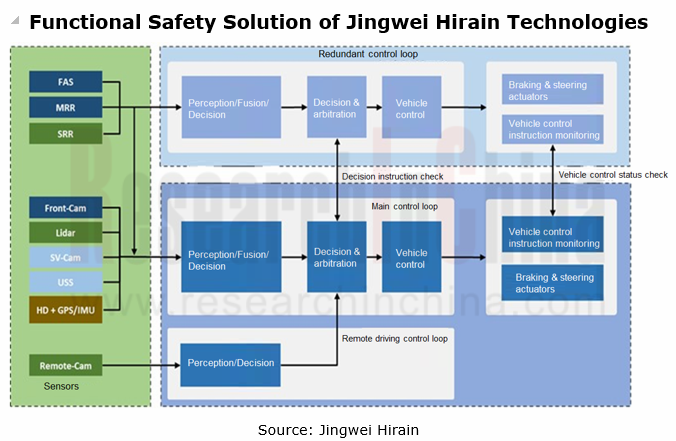
Moreover, Chinese suppliers are working to deploy redundant systems. Examples include Jingwei Hirain Technologies that developed R-EPS, a fully redundant EPS for L2-L4 autonomous driving, in August 2022.
Automotive Microcontroller Unit (MCU) and Application Scenario Research Report, 2026
Automotive MCU Research: Increased demand for redundant security drives ASIL D-compliant MCU shipments to exceed 100 million units
In a vehicle EEA, MCUs are widely distributed in various functional ...
China Intelligent Cockpit Patent Analysis Report, 2026
Intelligent Cockpit Patent Research: Cockpit AI, In?vehicle Health, and Infotainment Are Upgrade to Scenario?based and Proactive Functions
From a patent perspective, this report explores the cutting?...
Research Report on Application of VLA Large Model in Automobiles and Robots, 2026
Research on Automotive and Robot VLA: Hybrid Architectures Become Mainstream, VLA Integrates with General World Models, and Reinforcement Learning Serves as Core Engine
Vision?Language?Action (VLA) m...
China Charging Infrastructure (Supercharging, Battery Swapping, V2G, etc.) and High-Performance Supercharging Battery Research Report, 2026
Charging and battery swapping research: as 5C+ supercharging vehicle models go into mass production, the pace of OEMs self-building supercharging networks quickens
800-1000V high-voltage platforms ar...
China Passenger Car Electronic Controlled Suspension Industry Report, 2026
Electronic Controlled Suspension Industry Research: As the First Year of Full Active Suspension Unfolds, Three Technical Routes Race Forward
1. Penetration Rate Surges Three Times, and Electronic Con...
Intelligent Driving SoC Research Report, 2026
Research on Intelligent Driving SoCs: Competition Focus Shifts to L3/L4 Embedded Hardware, and Computing Power of Flagship Vehicle Models Exceeds 1,000 TOPS
In terms of intelligent driving system in...
Automotive AI Large Model Technology Research Report, 2026
Automotive AI Large Model Research: Competition Shifts from "Who Has the Stronger Model" to "Who Boasts Higher Link Efficiency"
ResearchInChina released the Automotive AI Large Model Technology Resea...
Intelligent Vehicle Cockpit Domain Controller Research Report, 2026
Cockpit domain controller research: L3 AIDV intelligent cockpit domain controllers are entering a boom period
Driven by multiple factors such as the continuous evolution of the automotive central int...
Automotive Acoustic System (Audio, Multi-Channel) Industry Report, 2026
Automotive Acoustics Research: Multiple Channels, AI Tuning, and Self-Developed Algorithms Drive the Transformation of High-End Cockpit Sound Fields
I. Automotive Audio Hardware Solutions with 6–9 S...
Autonomous Driving Sensor Chip Research Report, 2026
Research on Autonomous Driving Sensor Chips: Deeply Perceiving the Physical World, Sensor Chips Are Playing A “Leading Role” in Intelligence
In 2026, the autonomous driving sensor chip industr...
Passenger Car Corner Module and Wheel‑Side Control System Research Report, 2026
Wheel-side control research: the “last mile” chassis innovation
Wheel-side control dismantles the traditional drive, braking, steering, and suspension control of the chassis from a "centralized" styl...
Embodied Artificial Intelligence (& Humanoid Robot) MCU Research Report, 2026
Research on Humanoid Robot MCUs: Evolution from General-Purpose Control to High-Value Dedicated Chip Solutions Integrated with Edge AI Functions
MCU (Microcontroller Unit) refers to a compact integra...
Intelligent Vehicle Zone Control Unit (ZCU) Research Report, 2026
ZCU Research: Cross-domain integrated ZCUs are becoming the edge computing nodes of the next-generation zonal architecture
Currently, the mainstream zonal architecture is mainly the quasi-central + z...
Automotive Cybersecurity and Data Security Research Report, 2026
Cybersecurity & Data Security Research: Intelligent Connected Vehicles Enter the Era of “Systematic Offense-Defense and AI-Defined Security”.
Centering on the panorama of intelligent connect...
Report on Breakthrough Strategies of OEMs and ADAS Tier 1 Suppliers for Overseas Layout of Intelligent Driving, 2026
Regulatory Breakthrough, Local System Establishment, OEMs Competing for NOA Layout: Overall Trends of China’s Intelligent Driving Overseas Layout in 2026
Research on overseas intelligent driving layo...
OEMs and Tier1s’ Intelligent Cockpit Platform (Hardware and Software) Innovation Strategy Research Report, 2026
Intelligent Cockpit Platform Research: multi-dimensional cockpit system architecture reconstruction for multi-agent collaboration and proactive intelligent services
The intelligent cockpit software s...
Automotive AIOS Research Report, 2026
Automotive AIOS Research: Mass Production Solutions Are Implemented
Mass Production Solutions Are Implemented on A Small Scale.
In 2026, AIOS starts small-scale implementation, helping to improve v...
Automotive Telematics Service Provider (TSP) Research Report, 2026
TSP Research: Leading providers collectively turn to AI agents to provide all-scenario active services
Telematics Service Providers (TSPs) are the core hub of the telematics industry chain, connectin...