Smart glass research: the automotive smart dimming canopy market valued at RMB127 million in 2022 has a promising future.
Smart dimming glass is a new type of special optoelectronic glass formed by compounding a liquid crystal film into the middle of two layers of glass and bonding them under high temperature and high pressure. By implementation mode, it falls into electrically controlled, temperature-controlled, optically-controlled and pressure-controlled types.
In the automotive field, there are four major types of dimming glass: polymer dispersed liquid crystal (PDLC), suspended particle devices (SPD), electrochromic (EC) and dye liquid crystal (Dye LC). Wherein, PDLC, SPD and Dye LC feature physical dimming, and EC chemical dimming.
 PDLC appeared first. As the most mature and lowest cost technology, the majority of Chinese dimming glass manufacturers are using the solution;
SPD is mainly used in high-end models such as Mercedes S/SL and yachts due to high power consumption and high cost;
Dye LC spends a relatively short time on dimming using dichroic dye molecules;
EC features low haze, low energy consumption, good thermal insulation effect, continuous dimming, relatively long dimming time (2min on average) and medium cost.
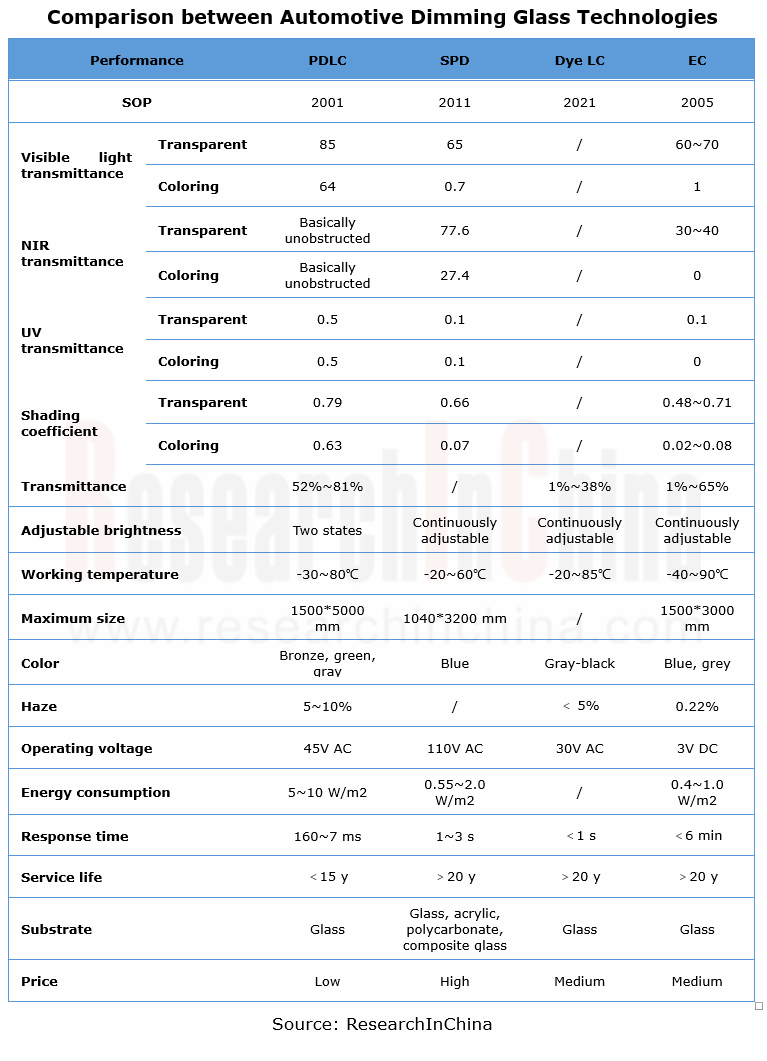
At present, smart dimming glass is often applied to panoramic canopies, not only giving a deeper spatial impression but also automatically reducing the transmittance of ultraviolet and infrared rays in the blazing sun for the purpose of lowering the temperature inside. According to the data from ResearchInChina, 1,636,900 units of new passenger cars in China were installed with panoramic canopies in 2022, 0.5% of which were smart dimming canopies. It is expected that panoramic canopies will be installed in 3,684,100 units of new passenger cars in 2025, 6.1% of which will be smart dimming canopies.
In this report, the panoramic canopy refers to: non-opening large-size sunroof without segmental structure; the dimming canopy means: enabling the smart dimming control function on the basis of panoramic canopy.
In the future, smart dimming glass may be applied to side windows and front windshield among others. For example, the side windows can display advertisements (displaying when the vehicle is stopped and becoming transparent when the vehicle is started and power on), and offers backseat graffiti function for children, human-computer interaction, entertainment and other capabilities; the front windshield incorporates AR HUD for anti-glare: combined with the front view camera, recognize the high beam of the oncoming vehicle, and automatically adjust the transmittance of the front windshield to eliminate glare and ensure safe driving.
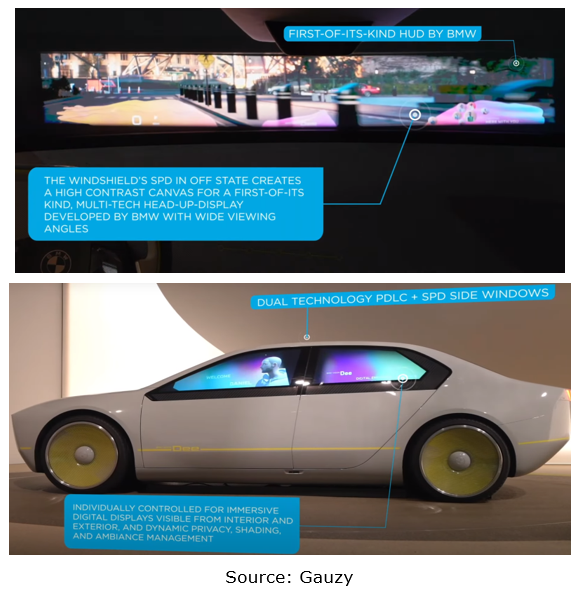
At the CES 2023, BMW iVISION Dee Concept car that features Gauzy’s PDLC and SPD smart glass technologies was showcased. The front windshield enables the HUD to provide wide viewing angles for a virtual image for all passengers; the side windows support dynamic privacy, shading, and ambiance management.
The segmented SPD-LCG? smart glass windshield for BMW iVISION Dee enables the HUD to provide wide viewing angles for a virtual image.
From the smart dimming glass industry chain, it can be seen that the upstream is mainly engaged in production of relevant dimming materials, films, glass substrates and PVBs; the midstream is responsible for integrating dimming glass that is applied to OEM markets and aftermarkets. The upstream and midstream manufacturers first started from deploying patents. Among the global top 1,000 companies by patent filings, the first five companies are BOE, Nitto Denko, Ricoh, Sony and Fuyao, of which most patents of BOE and Fuyao are filed during 2019-2022.
For example, in May 2019 BOE filed the CN 210514886 U Dimming Glass Patent, a display window technology patent in which the dimming glass layer is set up with basic dimming structure and functional dimming structure: the former is used to adjust the transmittance of light shining onto it, and the latter is used to reflect the light of a specific waveband shining onto it.
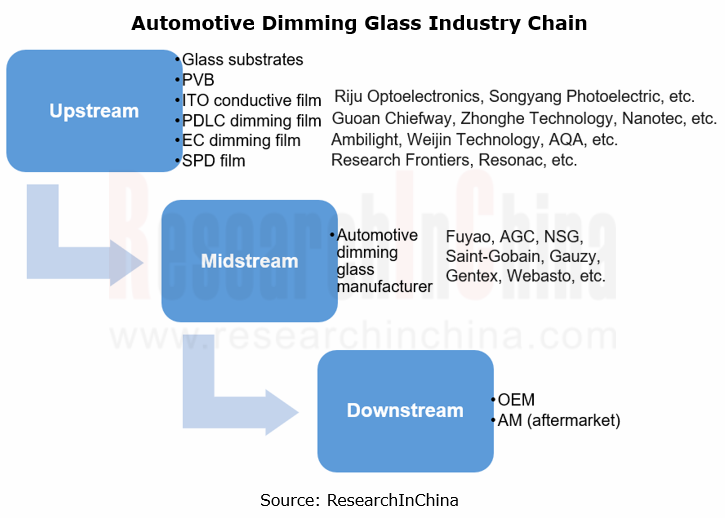
From the prospective of smart dimming glass supply, the key suppliers are Fuyao, AGC, NSG, Gauzy, Saint-Gobain, Ambilight, and Research Frontiers. Among them, Fuyao remains absolutely dominant, thanks to its stable supply relationships in the automotive glass market, as well as factors such as dimming glass technology R&D, cost balancing and occupant experience.
In the OEM market, the installed models include Toyota Venza, BYD Seal, Neta S, Lotus Eletre, NIO EC7, Porsche Taycan, Lexus RZ, and Cadillac CELESTIQ (not mass-produced). Among them, the dimming canopy glass surface of Porsche Taycan is split into nine individually controlled areas, and offers five dimming effects: transparent, matte, translucent, vivid, and user-defined. In the future, as consumers demand more beautiful, more comfortable and more intelligent vehicles, smart dimming glass will usher in a boom period in other fields in addition to panoramic canopy.
Vehicle-Road-Cloud Integration and C-V2X Industry Report, 2026
Vehicle-Road-Cloud and C-V2X Research: with the three-tier promotion system of "top-level planning + mandatory pilot + evaluation binding", the industry turning point is approachingThis report focuses...
China OEM Data Capability Analysis Report, 2026
OEM Data Capability Research: 24 OEMs × 9 Capability Domains, Who Takes the Lead?
An L4 autonomous driving R&D and test vehicle can generate approximately 10TB of raw data per single day — data v...
Autonomous Driving Domain Controller and Central Computing Unit (CCU) Industry Report, 2026
Autonomous Driving Domain Controller (ADCU) Research: One-Chip CCU solutions are quickly available in vehicles
In China's passenger car market, autonomous driving systems involved in mass production ...
Automotive EMS and ECU Industry Research Report, 2026
Automotive EMS Research: The boundaries between EMS providers and Tier1 suppliers are becoming blurred, and the supply chain model is evolving from a linear chain to a networked structure
Mainstream ...
Automotive Microcontroller Unit (MCU) and Application Scenario Research Report, 2026
Automotive MCU Research: Increased demand for redundant security drives ASIL D-compliant MCU shipments to exceed 100 million units
In a vehicle EEA, MCUs are widely distributed in various functional ...
China Intelligent Cockpit Patent Analysis Report, 2026
Intelligent Cockpit Patent Research: Cockpit AI, In?vehicle Health, and Infotainment Are Upgrade to Scenario?based and Proactive Functions
From a patent perspective, this report explores the cutting?...
Research Report on Application of VLA Large Model in Automobiles and Robots, 2026
Research on Automotive and Robot VLA: Hybrid Architectures Become Mainstream, VLA Integrates with General World Models, and Reinforcement Learning Serves as Core Engine
Vision?Language?Action (VLA) m...
China Charging Infrastructure (Supercharging, Battery Swapping, V2G, etc.) and High-Performance Supercharging Battery Research Report, 2026
Charging and battery swapping research: as 5C+ supercharging vehicle models go into mass production, the pace of OEMs self-building supercharging networks quickens
800-1000V high-voltage platforms ar...
China Passenger Car Electronic Controlled Suspension Industry Report, 2026
Electronic Controlled Suspension Industry Research: As the First Year of Full Active Suspension Unfolds, Three Technical Routes Race Forward
1. Penetration Rate Surges Three Times, and Electronic Con...
Intelligent Driving SoC Research Report, 2026
Research on Intelligent Driving SoCs: Competition Focus Shifts to L3/L4 Embedded Hardware, and Computing Power of Flagship Vehicle Models Exceeds 1,000 TOPS
In terms of intelligent driving system in...
Automotive AI Large Model Technology Research Report, 2026
Automotive AI Large Model Research: Competition Shifts from "Who Has the Stronger Model" to "Who Boasts Higher Link Efficiency"
ResearchInChina released the Automotive AI Large Model Technology Resea...
Intelligent Vehicle Cockpit Domain Controller Research Report, 2026
Cockpit domain controller research: L3 AIDV intelligent cockpit domain controllers are entering a boom period
Driven by multiple factors such as the continuous evolution of the automotive central int...
Automotive Acoustic System (Audio, Multi-Channel) Industry Report, 2026
Automotive Acoustics Research: Multiple Channels, AI Tuning, and Self-Developed Algorithms Drive the Transformation of High-End Cockpit Sound Fields
I. Automotive Audio Hardware Solutions with 6–9 S...
Autonomous Driving Sensor Chip Research Report, 2026
Research on Autonomous Driving Sensor Chips: Deeply Perceiving the Physical World, Sensor Chips Are Playing A “Leading Role” in Intelligence
In 2026, the autonomous driving sensor chip industr...
Passenger Car Corner Module and Wheel‑Side Control System Research Report, 2026
Wheel-side control research: the “last mile” chassis innovation
Wheel-side control dismantles the traditional drive, braking, steering, and suspension control of the chassis from a "centralized" styl...
Embodied Artificial Intelligence (& Humanoid Robot) MCU Research Report, 2026
Research on Humanoid Robot MCUs: Evolution from General-Purpose Control to High-Value Dedicated Chip Solutions Integrated with Edge AI Functions
MCU (Microcontroller Unit) refers to a compact integra...
Intelligent Vehicle Zone Control Unit (ZCU) Research Report, 2026
ZCU Research: Cross-domain integrated ZCUs are becoming the edge computing nodes of the next-generation zonal architecture
Currently, the mainstream zonal architecture is mainly the quasi-central + z...
Automotive Cybersecurity and Data Security Research Report, 2026
Cybersecurity & Data Security Research: Intelligent Connected Vehicles Enter the Era of “Systematic Offense-Defense and AI-Defined Security”.
Centering on the panorama of intelligent connect...