China Passenger Car HUD Industry Chain Development Research Report, 2023
Research on HUD industry chain: new technologies such as LBS and optical waveguide help AR-HUD become a “standard configuration”.
As HUD technology advances, AR-HUD, which can combine virtual information and real road scenes in the form of images, is favored by automakers. With maturing technology and declining cost, HUD has begun to penetrate into low-price vehicle models, and will become a "standard configuration" for smart cars in the future. For example, Changan Deepal S7, a model unveiled in early March 2023 with starting price of RMB169,900, cancels the dashboard and uses a 53-inch holographic AR-HUD system instead. The AR-HUD supplier is Zhejiang Crystal-Optech.
The AR-HUD industry chain covers suppliers of picture generation units (PGU), optical mirrors, glass, software and other components. Among them, the PGU plays the most crucial part at the upstream end, making up 50% of the total cost of HUD, and the optical mirror follows, taking a 20% share. The lower cost of the two major components, namely PGU and optical mirror, means a reduction in the total cost of AR-HUD, bringing an extremely fast progress in the implementation of AR-HUD. Therefore the new technologies related to the two components have developed rapidly in recent years.
Emerging projection technologies such as LCoS and LBS are capturing market shares.
PGU is used to generate pictures and control brightness. At present, the most mature PGU technology path for AR HUD is DLP, a high-cost technology monopolized by TI. Yet Chinese suppliers conduct in-depth research on emerging projection technologies like LCoS and LBS, aiming to seize the initiative and overtake on the bend.
LCoS technology uses the LCoS panel to modulate the optical signal emitted by the light source and projected to the screen, but the light emitted will not penetrate the reflective LCoS panel. LCoS offers the following benefits: 1. High light use efficiency, up to 40% or higher; 2. High resolution, up to 4k or even 8k, and wide color gamut; 3. Low cost after the process matures.
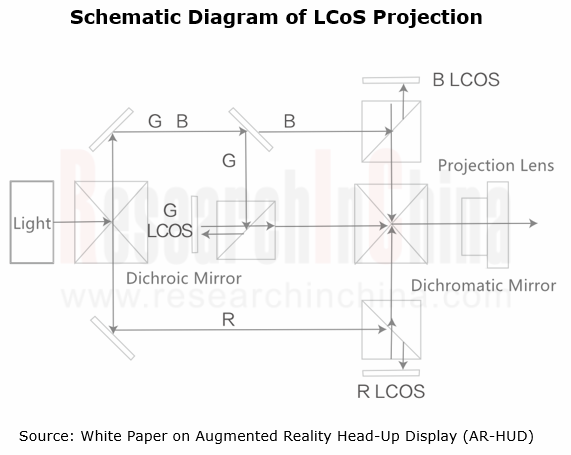
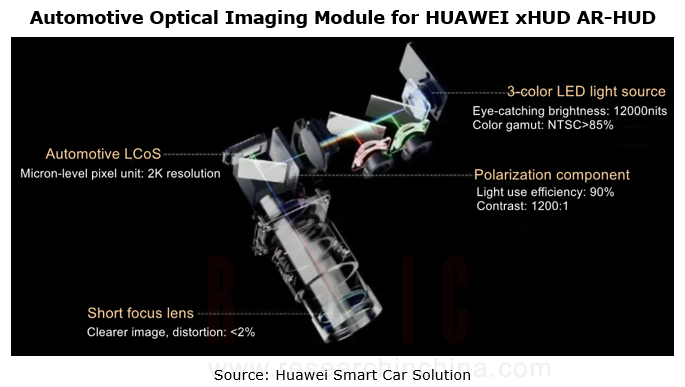
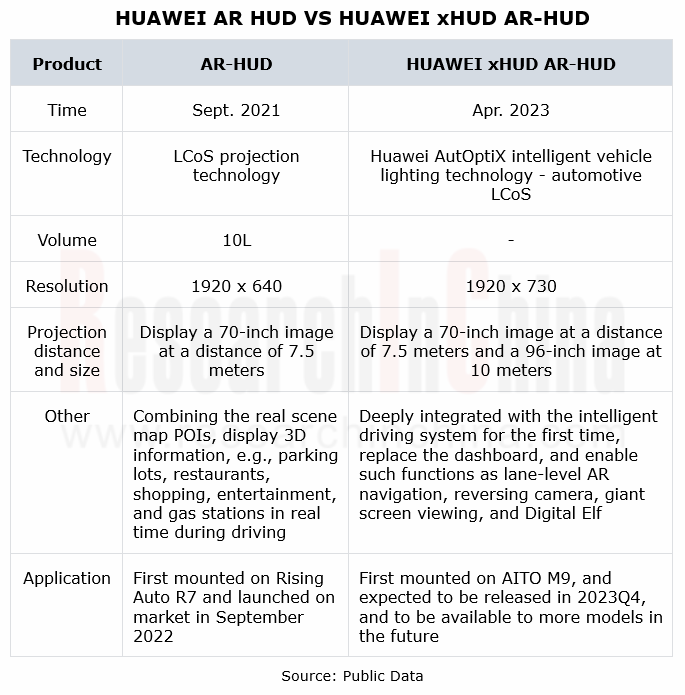
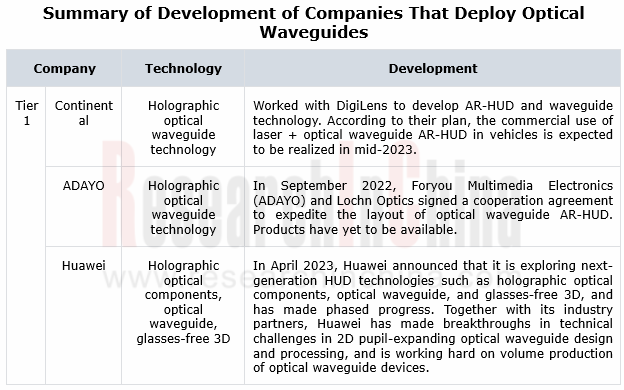
In September 2021, Huawei introduced its AR-HUD product, and in April 2023, Huawei released the xHUD AR-HUD. Both products use LCoS projection technology and feature small size and large format. HUAWEI xHUD AR-HUD can display a 70-inch image at a distance of 7.5 meters, and a 96-inch image at 10 meters. This product can support such applications as intelligent driving visualization, lane-level navigation, reversing camera, Digital Elf, and giant screen viewing.??
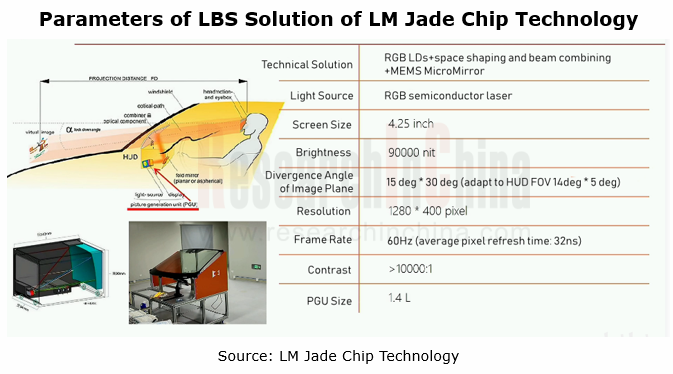
LBS, a laser scanning and projection technology, uses lasers as the light source, and realizes projection via a MEMS micro-mirror. It offers the following benefits: 1. Greatly simplified optical engine, and small size; 2. High contrast, easily up to 7000:1; 3. High brightness and wide color gamut (>150%); 4. Low power consumption (<4-6W), and low heat generation. Nevertheless, for the temperature-sensitive laser diodes fall short of the working requirements of 85°C, LBS has yet to be mature enough to be applied.???
Founded in 2021, LM Jade Chip Technology is a Chinese company engaged in development and industrial application of MEMS chips and laser scanning micro-display modules. For AR-HUD, it has developed a complete LBS-based solution LM-PGU-1000 and provided to its partners such as Sunny Optical Technology, OFILM and Aptiv. LM-PGU-1000 has the following features: 1. A solution to display speckle, speckle contrast: <4%; 2. Higher horizontal resolution and larger horizontal FOV; 3. Lower power consumption and higher brightness; 4. Higher contrast.
Waveguide technology will become the ultimate optical display solution.
Too large installation size and fairly high cost of AR HUD are currently the sore points for the industry. The waveguide technology allows for removal of the mechanical and optical mechanisms inside conventional HUDs, which means the first two reflections are omitted so that the information from the light source is directly projected onto the windshield. AR HUD occupies space one tenth of conventional mechanical solutions. In addition, the optical waveguide solution delivers high light transmittance, large FOV, and good display effect.
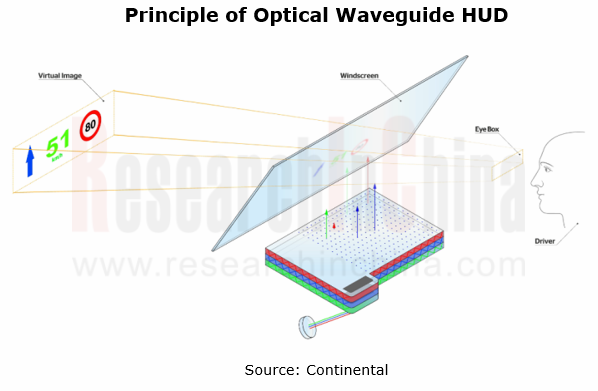
Optical waveguide falls into geometric optical waveguide and diffractive optical waveguide. Wherein, the diffractive optical waveguide technology is the key development direction of AR-HUD, and is divided into surface relief grating waveguide and volume holographic grating waveguide.
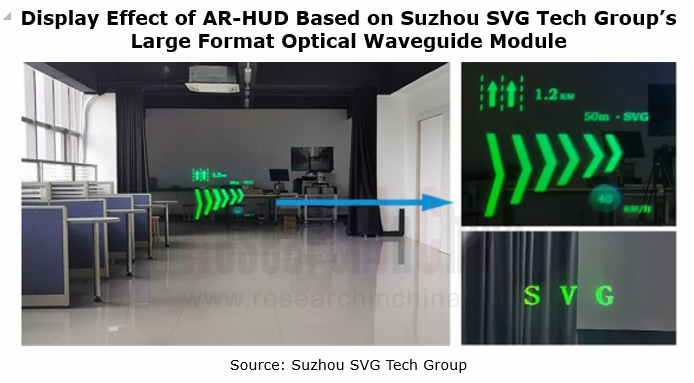
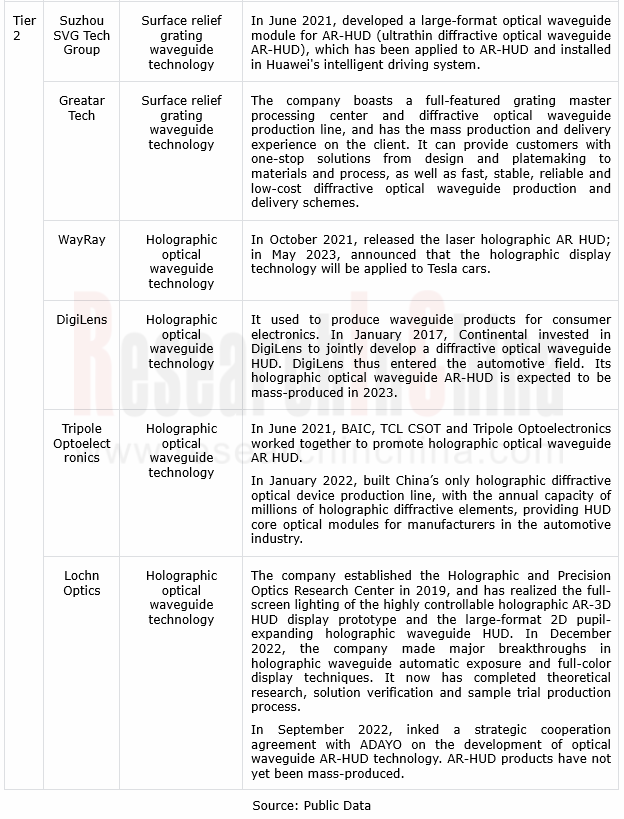
Surface relief grating waveguide, a mature technology often seen in AR near-eye display devices, provides thinness, large field of view, and large eye movement range. At present, it is a mainstream optical waveguide solution for AR-HUD, and manufacturers such as Suzhou SVG Tech Group and Greatar Tech are all making layout of it.
With independent R&D of 3D lithography equipment as the core driver, Suzhou SVG Tech Group works on research and industrialization of optoelectronic materials and devices for the fields of information photonics and new displays. In June 2021, the joint-stock private company announced a large-format optical waveguide module for AR-HUD. This module offers the display effects of ultra-thinness, large field of view, and long virtual image viewing distance. Based on the self-developed micro-nano lithography equipment and platform, this module can process about 2x10¹¹ nanometer units on the 20cmx20cm waveguide surface, and provide a projection distance longer than 15 meters. Currently this module has been used in AR-HUD and installed in Huawei's intelligent driving system.
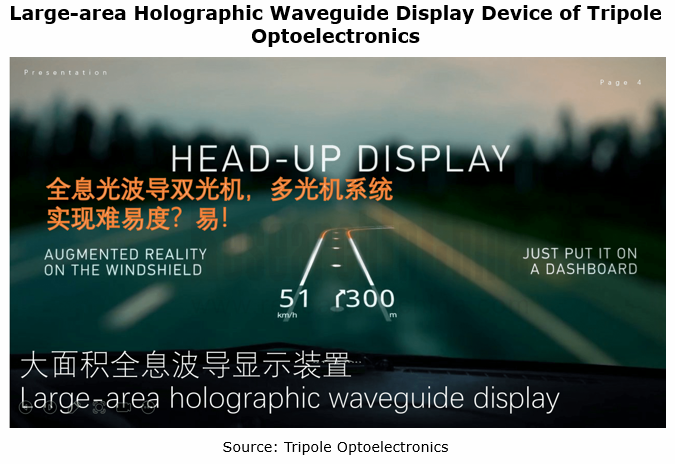
The volume holographic grating waveguide can reduce the volume of AR-HUD to one fifth to one tenth of the conventional geometric optics ones. Compared with reflector-type AR-HUD with a volume of 22L, the holographic optical waveguide enables a volume of only 2.4L; the main imaging module can also standardized and mass-produced at low cost. Such AR-HUD is promising. However the production process is complicated, and currently few manufacturers have the ability to produce in quantities. It is in 2023 that the application of corresponding AR-HUD products will start.?
Tripole Optoelectronics began to deploy volume holographic diffractive optical waveguide technology in 2019. In June 2021, Tripole Optoelectronics worked with BAIC and TCL CSOT to promote holographic optical waveguide AR-HUD. In January 2022, the company built a holographic diffractive optical device production line with the annual capacity of millions of holographic diffractive elements, providing large-area holographic optical waveguide AR-HUD products for manufacturers in automotive industry.??
Autonomous Driving Domain Controller and Central Computing Unit (CCU) Industry Report, 2026
Autonomous Driving Domain Controller (ADCU) Research: One-Chip CCU solutions are quickly available in vehicles
In China's passenger car market, autonomous driving systems involved in mass production ...
Automotive EMS and ECU Industry Research Report, 2026
Automotive EMS Research: The boundaries between EMS providers and Tier1 suppliers are becoming blurred, and the supply chain model is evolving from a linear chain to a networked structure
Mainstream ...
Automotive Microcontroller Unit (MCU) and Application Scenario Research Report, 2026
Automotive MCU Research: Increased demand for redundant security drives ASIL D-compliant MCU shipments to exceed 100 million units
In a vehicle EEA, MCUs are widely distributed in various functional ...
China Intelligent Cockpit Patent Analysis Report, 2026
Intelligent Cockpit Patent Research: Cockpit AI, In?vehicle Health, and Infotainment Are Upgrade to Scenario?based and Proactive Functions
From a patent perspective, this report explores the cutting?...
Research Report on Application of VLA Large Model in Automobiles and Robots, 2026
Research on Automotive and Robot VLA: Hybrid Architectures Become Mainstream, VLA Integrates with General World Models, and Reinforcement Learning Serves as Core Engine
Vision?Language?Action (VLA) m...
China Charging Infrastructure (Supercharging, Battery Swapping, V2G, etc.) and High-Performance Supercharging Battery Research Report, 2026
Charging and battery swapping research: as 5C+ supercharging vehicle models go into mass production, the pace of OEMs self-building supercharging networks quickens
800-1000V high-voltage platforms ar...
China Passenger Car Electronic Controlled Suspension Industry Report, 2026
Electronic Controlled Suspension Industry Research: As the First Year of Full Active Suspension Unfolds, Three Technical Routes Race Forward
1. Penetration Rate Surges Three Times, and Electronic Con...
Intelligent Driving SoC Research Report, 2026
Research on Intelligent Driving SoCs: Competition Focus Shifts to L3/L4 Embedded Hardware, and Computing Power of Flagship Vehicle Models Exceeds 1,000 TOPS
In terms of intelligent driving system in...
Automotive AI Large Model Technology Research Report, 2026
Automotive AI Large Model Research: Competition Shifts from "Who Has the Stronger Model" to "Who Boasts Higher Link Efficiency"
ResearchInChina released the Automotive AI Large Model Technology Resea...
Intelligent Vehicle Cockpit Domain Controller Research Report, 2026
Cockpit domain controller research: L3 AIDV intelligent cockpit domain controllers are entering a boom period
Driven by multiple factors such as the continuous evolution of the automotive central int...
Automotive Acoustic System (Audio, Multi-Channel) Industry Report, 2026
Automotive Acoustics Research: Multiple Channels, AI Tuning, and Self-Developed Algorithms Drive the Transformation of High-End Cockpit Sound Fields
I. Automotive Audio Hardware Solutions with 6–9 S...
Autonomous Driving Sensor Chip Research Report, 2026
Research on Autonomous Driving Sensor Chips: Deeply Perceiving the Physical World, Sensor Chips Are Playing A “Leading Role” in Intelligence
In 2026, the autonomous driving sensor chip industr...
Passenger Car Corner Module and Wheel‑Side Control System Research Report, 2026
Wheel-side control research: the “last mile” chassis innovation
Wheel-side control dismantles the traditional drive, braking, steering, and suspension control of the chassis from a "centralized" styl...
Embodied Artificial Intelligence (& Humanoid Robot) MCU Research Report, 2026
Research on Humanoid Robot MCUs: Evolution from General-Purpose Control to High-Value Dedicated Chip Solutions Integrated with Edge AI Functions
MCU (Microcontroller Unit) refers to a compact integra...
Intelligent Vehicle Zone Control Unit (ZCU) Research Report, 2026
ZCU Research: Cross-domain integrated ZCUs are becoming the edge computing nodes of the next-generation zonal architecture
Currently, the mainstream zonal architecture is mainly the quasi-central + z...
Automotive Cybersecurity and Data Security Research Report, 2026
Cybersecurity & Data Security Research: Intelligent Connected Vehicles Enter the Era of “Systematic Offense-Defense and AI-Defined Security”.
Centering on the panorama of intelligent connect...
Report on Breakthrough Strategies of OEMs and ADAS Tier 1 Suppliers for Overseas Layout of Intelligent Driving, 2026
Regulatory Breakthrough, Local System Establishment, OEMs Competing for NOA Layout: Overall Trends of China’s Intelligent Driving Overseas Layout in 2026
Research on overseas intelligent driving layo...
OEMs and Tier1s’ Intelligent Cockpit Platform (Hardware and Software) Innovation Strategy Research Report, 2026
Intelligent Cockpit Platform Research: multi-dimensional cockpit system architecture reconstruction for multi-agent collaboration and proactive intelligent services
The intelligent cockpit software s...