Baidu works on three autonomous driving development routes: Apollo Platform, Apollo Go (autonomous driving mobility service platform) and intelligent driving solutions.
Apollo Platform
In July 2017, Baidu announced the Apollo program, and released an open-source autonomous driving platform. In late 2018, Baidu officially opened up its Apollo V2X Solution. At present, Baidu Apollo boasts industry-leading solutions in three major fields: autonomous driving, intelligent vehicle and intelligent transportation. Baidu Apollo's vehicle intelligence solutions have been mass-produced for 134 models under 31 auto brands and mounted on a total of over 7 million vehicles.
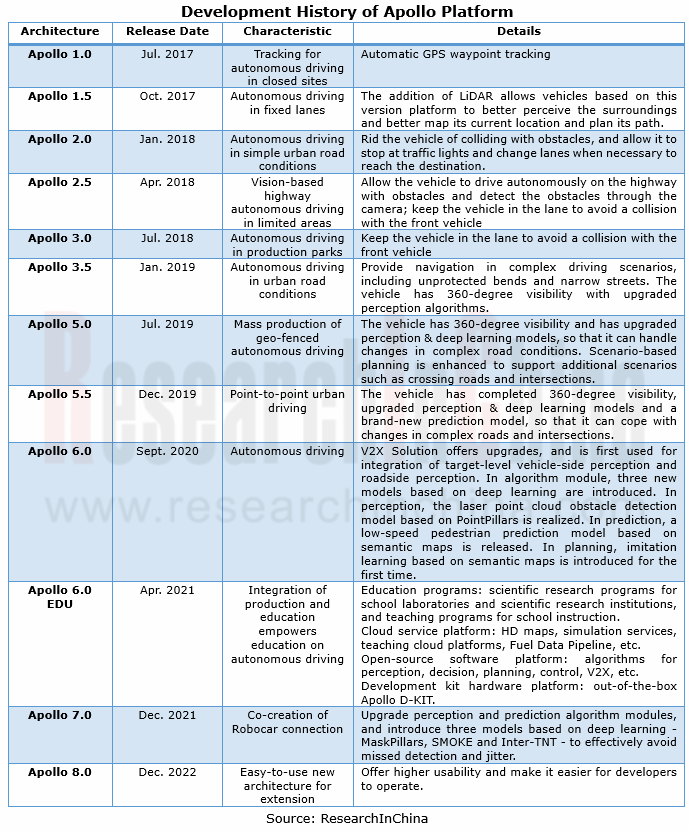
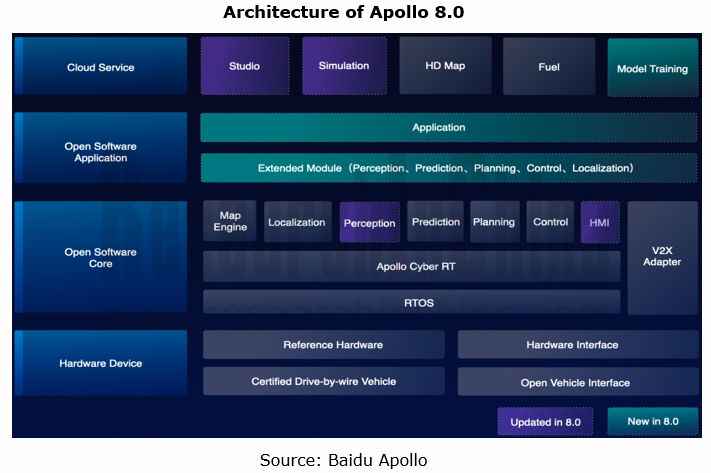
On December 28, 2022, Baidu officially launched Apollo 8.0 for all developers, which provides higher usability and makes it easier for developers to operate.
Robotaxi
By April 2023, Baidu Apollo had tested a total mileage of more than 50 million kilometers, and its mobility brand "Apollo Go" had gone into normal operation in Beijing, Shanghai, Guangzhou, Shenzhen, Chongqing and Wuhan. Apollo Go is expected to cover up to 65 cities by 2025.
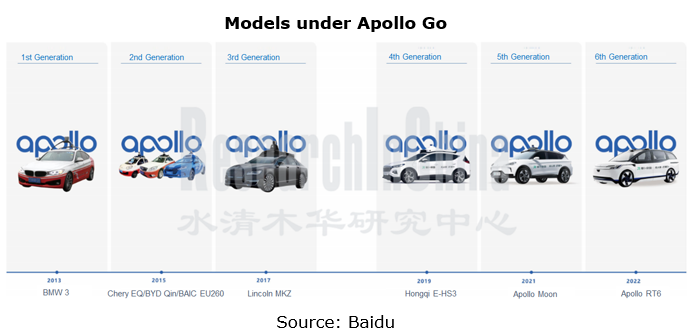
As of July 2022, Baidu had released six generations of production autonomous vehicle products, among which Apollo RT6, the sixth-generation product, is scheduled to be first available to Apollo Go in 2023.
Intelligent Driving Solutions
Baidu’s intelligent driving product matrix covers: Apollo City Driving Max, Apollo Highway Driving Pro, Apollo Parking, and Apollo Cockpit-driving Integration.
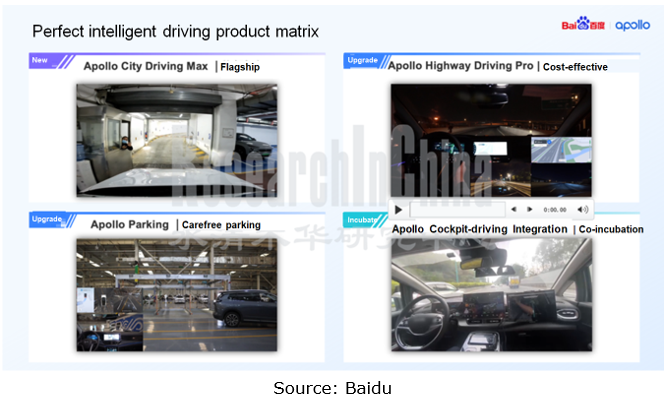
In April 2023, Apollo introduced its flagship product - Apollo City Driving Max. The "lightweight HD map" used in this system is nearly 80% “lighter” than conventional HD maps in the industry. Apollo City Driving Max packs 2 NVIDIA Orin X SoCs with the computing power of 508 TOPS, 2 high-beam LiDARs with a detection range of 180 meters, 7 8MP cameras, 4 3MP surround view cameras, 5 radars and 12 ultrasonic sensors.
Apollo City Driving Max uses only vision to enable urban navigate on autopilot (NOA). In the production stage, LiDAR will be added as a perceptual redundancy.
The new Voyah FREE, which debuted at the Auto Shanghai 2023, carries Apollo Highway Driving Pro, which offers such driving assistance functions as highway pilot, urban driving assist, and all-scenario efficient parking. The solution can provide accurate environmental perception and decision to enable multiple functions such as automated parking, automatic follow and automatic lane change.
In 2023, Apollo Highway Driving Pro was upgraded, with the computing platform upgraded to a single TDA4-VH platform. Moreover, Baidu teamed up with Black Sesame Technologies to deploy Apollo Highway Driving Pro in the HuaShan-2 A1000 chip platform.
Baidu's first-generation Apollo Cockpit-driving Integration uses Qualcomm 8295 (with the AI compute of 30 TOPS equivalent to NVIDIA Xavier) to enable intelligent cockpit and driving assistance functions.
Domain integration represents an important development trend of the intelligent driving industry in 2023. As a part of domain integration, cockpit-driving integration has begun to be laid out by many ADAS companies. Tier1 suppliers such as Baidu, Huawei and Desay SV have deployed their own product lines in the fields of intelligent driving and intelligent cockpit, making it easy for them to develop cockpit-driving integrated solutions.
For most players that only lay out intelligent driving or intelligent cockpits, it is necessary for them to cooperate with others on cockpit-driving integration. At the Auto Shanghai 2023, Banma Zhixing and HoloMatic Technology forged a strategic partnership to co-develop a cockpit-driving integrated solution. This is a typical cooperation case.
Related Reports:
Ambarella’s Intelligent Driving Business Analysis Report, 2022-2023
NXP’s Intelligence Business Analysis Report, 2022-2023
Jingwei Hirain’s Automotive and Intelligent Driving Business Analysis Report, 2022-2023
Continental’s Intelligent Cockpit Business Analysis Report, 2022-2023
Bosch’s Intelligent Cockpit Business Analysis Report, 2022-2023
Baidu’s Intelligent Driving Business Analysis Report, 2022-2023
Aptiv’s Intelligent Driving Business Analysis Report, 2022-2023
ZF’s Intelligent Driving Business Analysis Report, 2022-2023
Continental’s Intelligent Driving Business Analysis Report, 2022-2023
Bosch’s Intelligent Driving Business Analysis Report, 2022-2023
Horizon Robotics’ Business and Products Analysis Report, 2022-2023
Desay SV’s Intelligent Driving Business Analysis Report, 2022-2023
Renesas Electronics’ Automotive Business Analysis Report, 2023
Infineon’s Intelligent Vehicle Business Analysis Report
Haomo.AI’s Intelligent Driving Business Analysis Report
SenseTime’s Intelligent Vehicle Business Analysis Report
Automotive Microcontroller Unit (MCU) and Application Scenario Research Report, 2026
Automotive MCU Research: Increased demand for redundant security drives ASIL D-compliant MCU shipments to exceed 100 million units
In a vehicle EEA, MCUs are widely distributed in various functional ...
China Intelligent Cockpit Patent Analysis Report, 2026
Intelligent Cockpit Patent Research: Cockpit AI, In?vehicle Health, and Infotainment Are Upgrade to Scenario?based and Proactive Functions
From a patent perspective, this report explores the cutting?...
Research Report on Application of VLA Large Model in Automobiles and Robots, 2026
Research on Automotive and Robot VLA: Hybrid Architectures Become Mainstream, VLA Integrates with General World Models, and Reinforcement Learning Serves as Core Engine
Vision?Language?Action (VLA) m...
China Charging Infrastructure (Supercharging, Battery Swapping, V2G, etc.) and High-Performance Supercharging Battery Research Report, 2026
Charging and battery swapping research: as 5C+ supercharging vehicle models go into mass production, the pace of OEMs self-building supercharging networks quickens
800-1000V high-voltage platforms ar...
China Passenger Car Electronic Controlled Suspension Industry Report, 2026
Electronic Controlled Suspension Industry Research: As the First Year of Full Active Suspension Unfolds, Three Technical Routes Race Forward
1. Penetration Rate Surges Three Times, and Electronic Con...
Intelligent Driving SoC Research Report, 2026
Research on Intelligent Driving SoCs: Competition Focus Shifts to L3/L4 Embedded Hardware, and Computing Power of Flagship Vehicle Models Exceeds 1,000 TOPS
In terms of intelligent driving system in...
Automotive AI Large Model Technology Research Report, 2026
Automotive AI Large Model Research: Competition Shifts from "Who Has the Stronger Model" to "Who Boasts Higher Link Efficiency"
ResearchInChina released the Automotive AI Large Model Technology Resea...
Intelligent Vehicle Cockpit Domain Controller Research Report, 2026
Cockpit domain controller research: L3 AIDV intelligent cockpit domain controllers are entering a boom period
Driven by multiple factors such as the continuous evolution of the automotive central int...
Automotive Acoustic System (Audio, Multi-Channel) Industry Report, 2026
Automotive Acoustics Research: Multiple Channels, AI Tuning, and Self-Developed Algorithms Drive the Transformation of High-End Cockpit Sound Fields
I. Automotive Audio Hardware Solutions with 6–9 S...
Autonomous Driving Sensor Chip Research Report, 2026
Research on Autonomous Driving Sensor Chips: Deeply Perceiving the Physical World, Sensor Chips Are Playing A “Leading Role” in Intelligence
In 2026, the autonomous driving sensor chip industr...
Passenger Car Corner Module and Wheel‑Side Control System Research Report, 2026
Wheel-side control research: the “last mile” chassis innovation
Wheel-side control dismantles the traditional drive, braking, steering, and suspension control of the chassis from a "centralized" styl...
Embodied Artificial Intelligence (& Humanoid Robot) MCU Research Report, 2026
Research on Humanoid Robot MCUs: Evolution from General-Purpose Control to High-Value Dedicated Chip Solutions Integrated with Edge AI Functions
MCU (Microcontroller Unit) refers to a compact integra...
Intelligent Vehicle Zone Control Unit (ZCU) Research Report, 2026
ZCU Research: Cross-domain integrated ZCUs are becoming the edge computing nodes of the next-generation zonal architecture
Currently, the mainstream zonal architecture is mainly the quasi-central + z...
Automotive Cybersecurity and Data Security Research Report, 2026
Cybersecurity & Data Security Research: Intelligent Connected Vehicles Enter the Era of “Systematic Offense-Defense and AI-Defined Security”.
Centering on the panorama of intelligent connect...
Report on Breakthrough Strategies of OEMs and ADAS Tier 1 Suppliers for Overseas Layout of Intelligent Driving, 2026
Regulatory Breakthrough, Local System Establishment, OEMs Competing for NOA Layout: Overall Trends of China’s Intelligent Driving Overseas Layout in 2026
Research on overseas intelligent driving layo...
OEMs and Tier1s’ Intelligent Cockpit Platform (Hardware and Software) Innovation Strategy Research Report, 2026
Intelligent Cockpit Platform Research: multi-dimensional cockpit system architecture reconstruction for multi-agent collaboration and proactive intelligent services
The intelligent cockpit software s...
Automotive AIOS Research Report, 2026
Automotive AIOS Research: Mass Production Solutions Are Implemented
Mass Production Solutions Are Implemented on A Small Scale.
In 2026, AIOS starts small-scale implementation, helping to improve v...
Automotive Telematics Service Provider (TSP) Research Report, 2026
TSP Research: Leading providers collectively turn to AI agents to provide all-scenario active services
Telematics Service Providers (TSPs) are the core hub of the telematics industry chain, connectin...