Automotive Cockpit Domain Controller Research Report, 2023
  • July 2023
  • Hard Copy
  • USD $4,700
  • Pages:370
  • Single User License
    (PDF Unprintable)       
  • USD $4,500
  • Code: CYH111
  • Enterprise-wide License
    (PDF Printable & Editable)       
  • USD $6,800
  • Hard Copy + Single User License
  • USD $4,900
      

Research on cockpit domain controllers: various forms of products are mass-produced and mounted on vehicles, and product iteration speeds up.

Both quality and quantity have been improved, and the iteration of cockpit domain controller products has been accelerated.

In the past two years, the mass production and adoption of cockpit domain controller products has speeded up, especially the Qualcomm 8155-based cockpit domain controller products installed in models of emerging carmakers, independent brands and even some joint venture brands in China. In 2022, the installations of Qualcomm 8155-based cockpit domain controller products in China totaled about 850,000 sets, a figure to be higher in 2023. 

As new cockpit SoC products come out, cockpit domain controller products offer constant upgrades as well. At the time of mass production of Qualcomm 8155-based cockpit domain controller products, high-performance cockpit domain controller products based on Qualcomm 8295 and other chips are also production-ready. As well as Tier 1 suppliers working hard on layout, some OEMs have announced that they will unveil models with Qualcomm 8295-based cockpit domain controllers, including 2023 New Mercedes-Benz E-Class, Jidu Auto, Leapmotor and Great Wall.

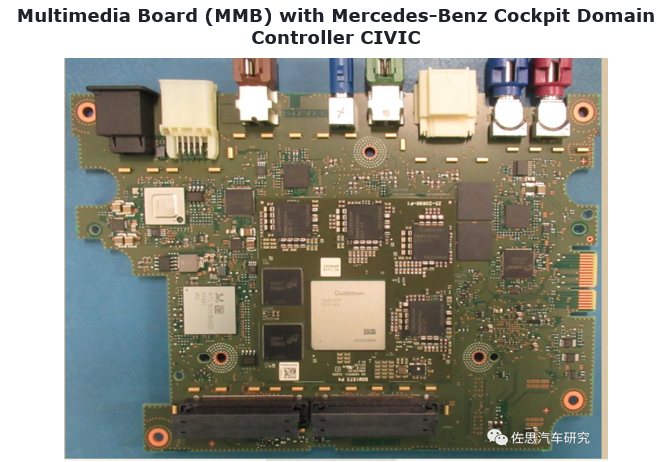
New Mercedes-Benz E-Class is the first production model to use SA8295P, and it is also a flagship model of Mercedes-Benz. In the future, the S-Class will also pack SA8295P. The SA8295P-based cockpit hardware system is code-named CIVIC (Central In-Vehicle Infotainment Computer), supplied by Bosch, and will be produced in quantities in 2023.
座舱域控 1.png

To lower cost and improve efficiency, cockpit domain controllers evolve to cross-domain integration such as "cockpit-parking integration" and "cockpit-driving integration".

Cockpit Tier 1 suppliers are no longer content to conventional IVI modules and cockpit domain control systems, as "cockpit-parking integration" and "cockpit-driving integration" are becoming mainstream. The ever higher computing power of SoCs allows cockpit domain controllers to support access to perception units. A typical example is 5*Camera+12*USS+Radar, a solution that supports L1/L2 entry-level driving assistance and automated parking and further reduces R&D and BOM costs while providing high performance.

According to the functions integrated, the cockpit domain controller product solutions evolve in the following forms:

The first form is cockpit domain controller products mainly integrating cockpit functions. This is also the prevailing form for intelligent cockpits at present and for some time to come. With improving computing power, performance, and interfaces, cockpit main control SoCs integrate ever more cockpit functions. They evolve from one chip supporting two screens to currently one chip supporting multiple screens and multiple systems, and even integrate such functions as voice, DMS, OMS, HUD, and gesture interaction. For example, Neusoft's intelligent cockpit domain controller adopts the modular design and development model, and is the first platform product. Since 2019, its controllers have been installed in multiple models of Hongqi, Chery, Hengchi Auto, and Great Wall Motor.  

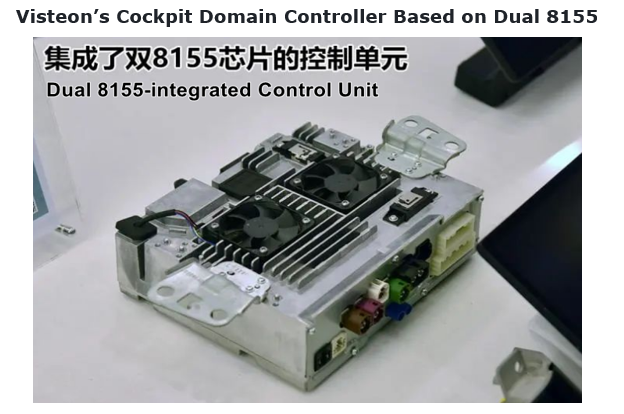
Recently there have emerged cockpit domain controller products based on dual high-compute chips to answer the needs for entertainment experiences like 3D engine and large games, amid the increasing demand for cockpit entertainment experience functions. Based on dual Qualcomm 8155 or AMD chips, quite a few companies like Visteon, Megatronix, PATEO CONNECT+ and ECARX have created cockpit domain controller products that meet high demand for entertainment, and some of them have products mass-produced and mounted on car models such as Buick L8 Century, Li Auto L9 and Lotus.   
座舱域控 2.png

The second form is cockpit-parking integrated controllers. With higher computing power and on the basis that the cockpit performance is guaranteed, the controllers integrate parking function that evolves from AVM to multiple capabilities (e.g., APA and AVP). The companies that make layout include Yuanfeng Technology, ECARX, Foryou Group and Bosch. 

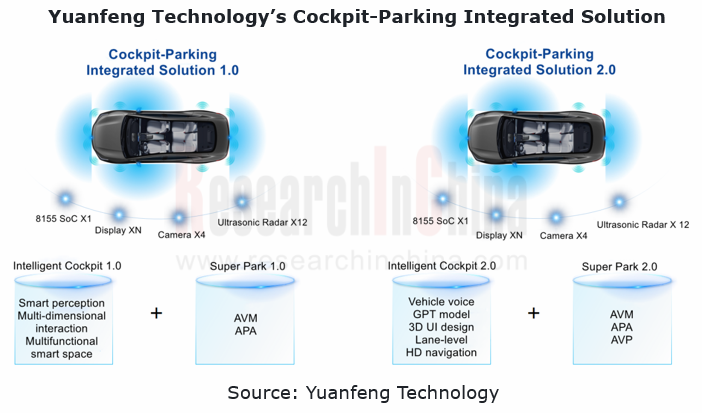
In 2022, Yuanfeng Technology’s team developed the Cockpit-Parking Integrated Solution 1.0, an intelligent cockpit platform that uses a Qualcomm 8155 SoC to support the deployment and use of 4 cameras, multiple screens and 12 ultrasonic radars, and integrates the capability baseline of Intelligent Cockpit 1.0 and Super Park 1.0 (AVM+APA). Wherein, the Super Park 1.0 delivers a parking space recognition accuracy of 97% and a parking success rate of 95%, covers more than 180 types of mainstream parking spots, and supports head-in parking; for unconventional parking spaces, the custom AR parking allows users to deal with in stride.   

Yuanfeng Technology's Cockpit-Parking Integrated Solution 1.0 was first mounted on Hycan A06 in late 2022. By 2024, there will be 6 models packing the solution to be marketed.  

The capabilities of Yuanfeng Technology's Cockpit-Parking Integrated Solution 2.0 will also be developed, and delivered via OTA updates. The Cockpit-Parking Integrated Solution 2.0 will deploy a vehicle voice GPT model, build in a more realistic and easy-to-use 3D UI, and upgrade to lane-level high-definition navigation; the Super Park 2.0 will further optimize AVM/APA performance, reducing the average parking time to less than 35s, increasing the parking success rate to 97%, and upgrading the AVP function.

Meanwhile, Yuanfeng Technology will announce its cockpit-driving-parking integrated solution in 2024. In addition to the capability baseline of Intelligent Cockpit 2.0 and Super Park 2.0, this solution will add multiple ADAS functions in rigid demand, such as ACC, LCC, AEB, and BSD.
座舱域控 3_副本.png

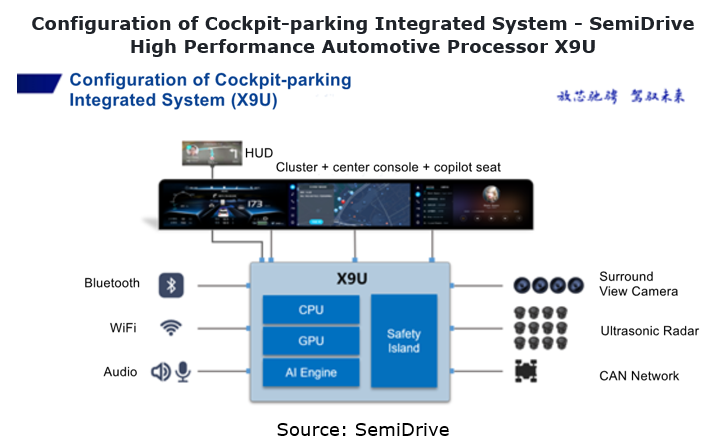
SemiDrive, an all-scenario automotive chip vendor, has also introduced its cockpit-parking integrated solution based on X9U, a high-performance automotive processor. In this solution, a single chip can enable the integration of intelligent cockpit, 360-degree surround view and parking functions, and provide users with better driving experience at a lower system BOM cost on the premise that the safety is ensured.
座舱域控 4.png

SemiDrive X9U, a powerful high-performance automotive processor with CPU compute of up to 100KDMIPS, supports up to 10 HD display outputs, and covers conventional intelligent cockpit functions such as HUD, cluster, center console, electronic rearview mirror, and co-pilot seat entertainment. Moreover the high-performance GPU of X9U can process 4-channel HD surround view cameras in real time, and allows for stitching and rendering of 360° panoramic surround views. In addition, the high-performance AI accelerator built in X9U is used for parking space recognition and obstacle detection to enable fast efficient parking assist.   

The third form is multi-domain fusion controllers. They enable the integration of some ADAS functions, gateway or body functions with the cockpit domain. A typical example is PATEO CONNECT+’s next-generation Qualcomm 8295-based multi-domain fusion cockpit product which allows for integration of the cockpit domain with multiple domains including automated driving assistance/ADAS, gateway/body, 5G communication, intelligent lighting, and vehicle intelligence (smart doors/interiors).

Neusoft creates next-generation intelligent cockpit platforms based on Qualcomm 8295 for multi-ECU and multi-domain integrations, and offers comprehensive upgrades in intelligent cockpit computing power, configuration, entertainment, safety, functions, and hardware. It has also developed and released the Neusoft C(5) Vehicle HMI Platform. The pluggable, scalable hardware architecture design not only enhances computing power but also enables intelligent cooperation between vehicle multi-domain functions. The software implements the scene engine via the SOA, providing users with immersive and personalized scene experience.

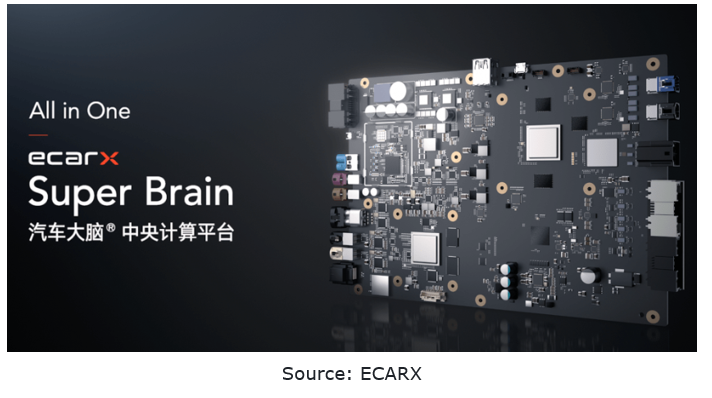
The fourth form is cockpit-driving integrated central computing platform products. Yuanfeng Technology, Desay SV, PATEO CONNECT+, Zongmu Technology, NavInfo and ECARX among others all make layout. For example, ECARX Super Brain, the central computing brain of ECARX, integrates Longying No.1 and Black Sesame A1000 chips, vehicle control MCU and ultrahigh-speed inter-process communication to enable cockpit-driving integration. The platform supports mainstream intelligent driving solutions (3R1V, 5R6V and 5R10V, realizing NOA, etc.) on the market to meet the needs of different vehicles, cutting down vehicle R&D cost by 15% and BOM cost by 20%.   
座舱域控 5.png

The supply is localized, as cockpit domain controllers based on China’s local chips enters a period of mass production.

In the trend for supply chain localization, in recent two years both OEMs and Tier 1 suppliers have been vigorously deploying local cockpit products. Their cockpit domain controller products based on local chips go into volume production the most quickly, and multiple products are about to be spawned and applied in 2023. Typical solutions include SemiDrive X9 Series-based cockpit domain controllers, SiEngine Longying No.1, Huawei Kirin IVI module, and AutoChips AC8015 integrated light cockpit solution.   

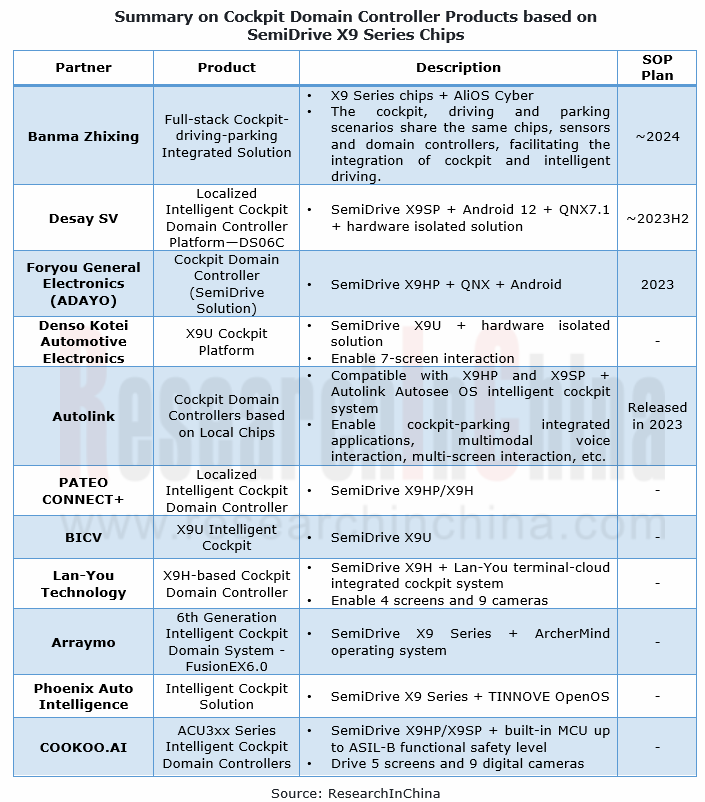
Among them, the SemiDrive X9 Series-based solutions are one of the fastest-growing cockpit products in China. SemiDrive X9 Series leads in production progress among Chinese cockpit chips. The X9 Series-based models of automakers like SAIC, Chery and Changan have been mass-produced and launched on market. The X9 Series has been designated for dozens of models. 

Chinese and foreign Tier 1 suppliers including Desay SV, Foryou Group, PATEO CONNECT+, Neusoft, Autolink and Denso have announced the launch of SemiDrive X9 Series-based cockpit domain controller products, some of which are scheduled to be mass-produced and installed in vehicles in 2023.
座舱域控 6_副本.png

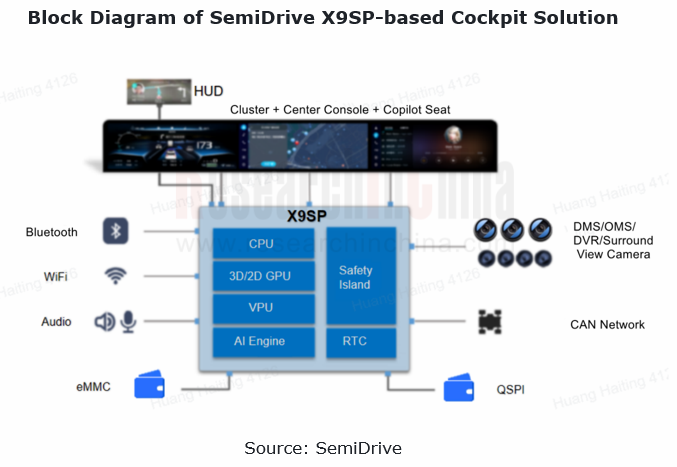
In April 2023, SemiDrive released X9SP, its latest-generation all-scenario cockpit chip. Compared with the previous-generation product X9HP, X9SP offers 2 times higher CPU performance and 1.6 times higher GPU performance, with the computing power of CPU and GPU up to 100K DMIPS and 220G FLOPS, respectively. Furthermore, X9SP integrates a new NPU, with AI compute of 8TOPS. A single X9SP supports multiple HD display screens (e.g., LCD cluster, center console navigation, co-pilot seat entertainment, HUD and intelligent rearview mirror), and abundant application scenarios (e.g., 360-degree surround view, parking assist, DMS, voice recognition, gesture recognition, game interaction and HD movies)

At the Auto Shanghai, SemiDrive signed a strategic cooperation agreement with Desay SV. DS06C, a X9SP-based cockpit domain controller, made its global debut. The volume production of this chip is projected to start in the second half of 2023.
座舱域控 7_副本.png

1 Summary on Cockpit Domain Controller Solutions of OEMs  
1.1 Cockpit Domain Controller System Solutions of OEMs 
1.1.1 Cockpit Domain Controller System Solutions of OEMs (1) 
1.1.2 Cockpit Domain Controller System Solutions of OEMs (2)
1.1.3 Cockpit Domain Controller System Solutions of OEMs (3)
1.1.4 Cockpit Domain Controller System Solutions of OEMs (4)
1.1.5 Cockpit Domain Controller System Solutions of OEMs (5)
1.1.6 Cockpit Domain Controller System Solutions of OEMs (6)
1.1.7 Cockpit Domain Controller System Solutions of OEMs (7)
1.1.8 Cockpit Domain Controller System Solutions of OEMs (8)
1.1.9 Cockpit Domain Controller System Solutions of OEMs (9) 
1.2 Characteristics of Cockpit Domain Controller Layout of OEMs
1.2.1 Characteristics of Cockpit Domain Controller Layout of OEMs (1)
1.2.2 Characteristics of Cockpit Domain Controller Layout of OEMs (2)
1.2.3 Characteristics of Cockpit Domain Controller Layout of OEMs (3)
1.2.4 Characteristics of Cockpit Domain Controller Layout of OEMs (3)
1.2.5 Characteristics of Cockpit Domain Controller Layout of OEMs (4)
1.2.6 Characteristics of Cockpit Domain Controller Layout of OEMs (5)
1.2.7 Characteristics of Cockpit Domain Controller Layout of OEMs (5): Cases
1.2.8 Characteristics of Cockpit Domain Controller Layout of OEMs (6)
1.3 Cockpit Domain Controller Cases of OEMs
1.3.1 Cockpit Domain Controller Cases of OEMs (1)
1.3.2 Cockpit Domain Controller Cases of OEMs (2)
1.3.3 Cockpit Domain Controller Cases of OEMs (2)
1.3.4 Cockpit Domain Controller Cases of OEMs (3)
1.3.5 Cockpit Domain Controller Cases of OEMs (4)
1.3.6 Cockpit Domain Controller Cases of OEMs (5)
1.3.7 Cockpit Domain Controller Cases of OEMs (6)
1.3.8 Cockpit Domain Controller Cases of OEMs (7)
1.3.9 Cockpit Domain Controller Cases of OEMs (8) 

2 Summary on Cockpit Domain Controller Solutions of Tier 1 Suppliers 
2.1 Cockpit Domain Controller System Architecture 
2.1.1 Main Components of Intelligent Cockpit Domain Controller (1)
2.1.2 Main Components of Intelligent Cockpit Domain Controller (2) 
2.1.3 Block Diagram of Cockpit Domain Controller System Based on Qualcomm 8155 
2.1.4 Block Diagram of 4-screen Intelligent Cockpit Domain Controller System Based on Renesas R-Car H3  
2.1.5 Cockpit Domain Controller Products Based on Dual High-compute Cockpit SoCs Configuration  
2.1.6 Visteon SmartCore Cockpit Domain Controller Based on Dual Cockpit SoCs and Dual Systems   
2.1.7 Challenges in Development of Intelligent Cockpit Domain Controllers 
2.2 The Latest Cockpit Domain Controller Solutions of Major Tier 1 Suppliers  
2.2.1 Key Development Characteristics of Intelligent Cockpit Domain Controllers of Suppliers 
2.2.2 Summary on Cockpit Domain Controller Solutions of 24 Tier 1 Suppliers (1) 
2.2.3 Summary on Cockpit Domain Controller Solutions of 24 Tier 1 Suppliers (2)
2.2.4 Summary on Cockpit Domain Controller Solutions of 24 Tier 1 Suppliers (3)
2.2.5 Summary on Cockpit Domain Controller Solutions of 24 Tier 1 Suppliers (4)
2.2.6 Summary on Cockpit Domain Controller Solutions of 24 Tier 1 Suppliers (5)
2.2.7 Summary on Cockpit Domain Controller Solutions of 24 Tier 1 Suppliers (6)
2.2.8 Summary on Cockpit Domain Controller Solutions of 24 Tier 1 Suppliers (7)
2.3 Evolution Trends of Cockpit Domain Controller Technology of Major Tier 1 Suppliers  
2.3.1 Evolution Trends of Cockpit Domain Controller Technology of Tier 1 Suppliers (1)
2.3.2 Evolution Trends of Cockpit Domain Controller Technology of Tier 1 Suppliers (2)
2.3.3 Evolution Trends of Cockpit Domain Controller Technology of Tier 1 Suppliers (3)
2.3.4 Evolution Trends of Cockpit Domain Controller Technology of Tier 1 Suppliers (4)
2.3.5 Evolution Trends of Cockpit Domain Controller Technology of Tier 1 Suppliers (5) 
2.3.6 Summary on Evolution of Cockpit Domain Controller Technology of 25 Tier 1 Suppliers (1)  
2.3.7 Summary on Evolution of Cockpit Domain Controller Technology of 25 Tier 1 Suppliers (2) 
2.3.8 Summary on Evolution of Cockpit Domain Controller Technology of 25 Tier 1 Suppliers (3)
2.3.9 Summary on Evolution of Cockpit Domain Controller Technology of 25 Tier 1 Suppliers (4)
2.3.10 Summary on Evolution of Cockpit Domain Controller Technology of 25 Tier 1 Suppliers (5)
2.3.11 Summary on Evolution of Cockpit Domain Controller Technology of 25 Tier 1 Suppliers (6)
2.3.12 Summary on Evolution of Cockpit Domain Controller Technology of 25 Tier 1 Suppliers (7)
2.3.13 Summary on Evolution of Cockpit Domain Controller Technology of 25 Tier 1 Suppliers (8)
2.3.14 Summary on Evolution of Cockpit Domain Controller Technology of 25 Tier 1 Suppliers (9)
2.3.15 Summary on Evolution of Cockpit Domain Controller Technology of 25 Tier 1 Suppliers (10)
2.3.16 Summary on Evolution of Cockpit Domain Controller Technology of 25 Tier 1 Suppliers (11)
2.3.17 Summary on Evolution of Cockpit Domain Controller Technology of 25 Tier 1 Suppliers (12)
2.3.18 Summary on Evolution of Cockpit Domain Controller Technology of 25 Tier 1 Suppliers (13) 

3 Research on Key Points of Cockpit Domain Controller
3.1 Cockpit Domain Controller Market Size  
3.1.1 China's Digital Cockpit Market Size 
3.1.2 China’s Intelligent Cockpit Domain Controller Shipments (10,000 Units), 2021-2026E  
3.1.3 Competitive Pattern of Intelligent Cockpit Domain Controller Market (Role Demanded by Three-Party Players)   
3.2 Cockpit Domain Controller Core SoC Solutions 
3.2.1 Competitive Pattern of Cockpit SoC Market
3.2.2 Competitive Pattern of Overseas Cockpit SoC Vendors   
3.2.3 Competitive Pattern of Cockpit SoC Vendors in China 
3.2.4 Comparison between Main Cockpit SoCs (1)
3.2.5 Comparison between Main Cockpit SoCs (2)
3.2.6 Comparison between Main Cockpit SoCs (3) 
3.2.7 Cockpit SoC Development Planning of Major Players: Overseas
3.2.8 Cockpit SoC Development Planning of Major Players: Local
3.2.9 MediaTek Teamed up with Nvidia to Deploy Cockpit SoCs
3.2.10 Performance of Next-generation Processor Products for the Cockpit of the Future  
3.3 Domain Controller Design/Production Models
3.3.1 Three Development Cooperation Models for Domain Controllers
3.3.2 Five Production Models for Domain Controllers (1)
3.3.3 Five Production Models for Domain Controllers (2)
3.3.4 Five Production Models for Domain Controllers (3) 
3.3.5 Three Profit Sharing Models for Domain Controllers
3.4 Status Quo of Cockpit-driving Integrated Domain Controller Layout
3.4.1 As EEA Evolves, Cockpit-driving Integration Is around the Corner  
3.4.2 Cockpit-driving Integration Is Expected to Be Available to Vehicles during 2024-2025
3.4.3 Cockpit-driving Integrated Solutions (1)
3.4.4 Cockpit-driving Integrated Solutions (2)
3.4.5 Cockpit-driving Integrated Solutions (3)
3.4.6 Cockpit-driving Integrated Solutions (4)
3.4.7 Cockpit-driving Integrated Solutions (5)
3.4.8 Cockpit-driving Integrated Solutions (6)

4 Foreign Cockpit Domain Controller Vendors 
4.1 Bosch
4.1.1 Established the Cross-Domain Computing Solutions (XC Division)
4.1.2 Intelligent Cockpit  
4.1.3 Evolution Route of Intelligent Cockpit Domain Controller Technology 
4.1.4 Cockpit Domain Controllers
4.1.5 Cockpit Domain Controllers: Autosee 2.0
4.1.6 Cockpit Domain Controller Platforms: System Architecture of Autosee 2.0 
4.1.7 Cockpit Domain Controllers: Product Technical Solutions and Advantages (1) 
4.1.8 Cockpit Domain Controllers: Product Technical Solutions and Advantages (2)
4.1.9 Cockpit Domain Controller Platforms: Co-developed with Autolink  
4.1.10 Cockpit Domain Controller Platforms: Co-developed Intelligent Cockpit 4.0 with Autolink 
4.1.11 Intelligent Cockpit Cross-domain Fusion: System Architecture of Integrated Controller Products (1)   
4.1.12 Intelligent Cockpit Cross-domain Fusion: System Architecture of Integrated Controller Products (2) 
4.1.13 Intelligent Cockpit Cross-domain Fusion: System Architecture Roadmap of Integrated Controller Products  
4.1.14 Evolution Route of Cockpit-driving Integration  
4.1.15 Cockpit-driving Integrated Solution Design: Hardware Architecture
4.1.16 Cockpit-driving Integrated Solution Design: Software Architecture 
4.2 Visteon
4.2.1 Development Trend Planning for Cockpit Electronics and Autonomous Driving
4.2.2 SmartCore Premium Cockpit Domain Controller
4.2.3 SmartCore High Flagship Cockpit Domain Controller
4.2.4 SmartCore High Luxury Cockpit Domain Controller
4.2.5 SmartCore Cockpit Domain Controllers Based on Chinese Chips
4.2.6 4th Generation SmartCore Cockpit Domain Controller  
4.2.7 SmartCore Versions 
4.2.8 SmartCore Cockpit Platform Architecture
4.2.9 Performance of SmartCore 
4.2.10 Multi-domain Fusion Idea
4.2.11 Summary on Intelligent Cockpit Domain Controller Product Lines 
4.2.12 Evolution Route of Intelligent Cockpit Domain Controller Technology 
4.2.13 Typical Customer Base of SmartCore
4.2.14 Partners: Co-developed Intelligent Cockpit Solutions with ECARX and Qualcomm
4.3 Continental 
4.3.1 Development Planning for Vehicle Computing Business Unit (HPC) (1)
4.3.2 Development Planning for Vehicle Computing Business Unit (HPC) (2)
4.3.3 Development Planning for Vehicle Computing Business Unit (HPC) (3) 
4.3.4 SOP Timetable of HPC Platforms in Different Domains 
4.3.5 Software Platform of Next Generation Automotive Electronics Architecture   
4.3.6 HPC Platform: Software and Hardware Architectures
4.3.7 HPC Platform: SOA-oriented Domain Controller Development Concept  
4.3.8 Cockpit High Performance Computing Unit
4.3.9 Cockpit HPC
4.3.10 Cockpit HPC: Architecture with Hardware and Software Separation
4.3.11 Cockpit HPC: Provide Cockpit Domain Controller Products for BMW iX BEV 
4.3.12 Cockpit HPC: Development Trends of Cockpit Domain Products 
4.4 Aptiv
4.4.1 Smart Vehicle Architecture (SVA)
4.4.2 SVATM Network Topology
4.4.3 Acquisition of Wind River Software
4.4.4 Wind River VxWorks Microkernel Architecture (1)
4.4.5 Wind River VxWorks Microkernel Architecture (2)
4.4.6 Intelligent Cockpit Controller: Development Process 
4.4.7 New Generation Intelligent Cockpit System 
4.4.8 Cockpit Domain Development Planning
4.4.9 Intelligent Cockpit Computing Platform and Software Architecture
4.4.10 Integrated Cockpit Domain Controller
4.4.11 Integrated Cockpit Domain Solution
4.4.12 Integrated Cockpit Domain System Architecture
4.4.13 Integrated Cockpit Controller (ICC): System Architecture
4.4.14 Integrated Cockpit Controller Solution 
4.4.15 Future-oriented VEMS for Autonomous Driving
4.4.16 Integrated Cockpit Controller (ICC): Product Features and Customers
4.4.17 Integrated Cockpit Controller (ICC): Application of In-cabin Sensing Platform
4.4.18 Integrated Cockpit Controller (ICC): Product Planning and Technology Route
4.4.19 Dynamics 
4.5 Denso
4.5.1 Cockpit Control Unit (CCU): Product Development Trends
4.5.2 Denso Kotei’s Cockpit Domain Controller: Cooperated with SemiDrive  
4.5.3 Cockpit Control Unit (CCU): Application Case (Subaru) (1)
4.5.4 Cockpit Control Unit (CCU): Application Case (Subaru) (2)
4.5.5 Intelligent Cockpit Design: Technology Roadmap  
4.5.6 Intelligent Cockpit Design: Integrated Control of Cockpit System
4.5.7 Intelligent Cockpit Design: Cockpit Integrated Control System Based on Virtualization Technology  
4.5.8 Intelligent Cockpit Design: Development of Service-Oriented Architecture (SOA) 
4.5.9 Cross-domain Layout
4.5.10 Under the 2035 "Anxin" Strategy, the Cockpit of Future and Intelligent Driving Will Be Deeply Integrated 
4.5.11 Development Blueprint of Anxin Intelligent Cockpit System
4.5.12 Anxin Intelligent Cockpit  
4.6 Forvia
4.6.1 Development of Automotive Electronics Business
4.6.2 The Cockpit Technology and Software Business Belongs to the Electronics Division
4.6.3 Software Capabilities of Automotive Electronics Division
4.6.4 Sales of Automotive Electronics Division, 2025E
4.6.5 Development Trends of Cockpit Domain Products
4.6.6 Cockpit Domain Controllers (CDC)
4.6.7 Cockpit Domain Controllers (CDC)
4.6.8 Cockpit Domain Controllers: Planning Goals
4.6.9 Cockpit Domain Controllers: Chip Collaborations 
4.6.10 Cockpit Domain Controllers: Cooperated with FAW Hongqi
4.6.11 Cockpit Intelligence Platform (CIP) 
4.7 Panasonic
4.7.1 Development Trends of Cockpit Products 
4.7.2 Evolution Route of Intelligent Cockpit Domain Controller Technology
4.7.3 New Generation Cockpit 
4.7.4 Cockpit Domain Controller Solutions (1)
4.7.5 Cockpit Domain Controller Solutions (2)
4.7.6 Cockpit Electronics Layout  
4.7.7 Computing Architecture of Cockpit Electronics 
4.7.8 Software Architecture of Cockpit System 
4.7.9 Software Architecture of Cockpit System: COQOS Operating System
4.7.10 Cockpit Domain Controller Chip
4.8 Harman
4.8.1 Profile 
4.8.2 Intelligent Cockpit Product Line 
4.8.3 Scalable Intelligent Cockpit Solutions  
4.8.4 Evolution Route of Intelligent Cockpit Domain Controller Technology
4.8.5 Proposed A Modular and Combinable Cockpit Cooperation Model 
4.8.6 Intelligent Cabin Product: Ready Upgrade
4.8.7 Cockpit Domain Controller: Technical Solution
4.8.8 Cockpit Domain Controller: Platform Solution
4.8.9 Cockpit Domain Control Concept  
4.8.10 Vision of Next Generation EEA: Multi-domain Hybrid Architecture
4.8.11 Vision of Next Generation EEA: Hardware Architecture 
4.8.12 Vision of Next Generation EEA: Software Architecture 
4.8.13 Multi-domain Fusion Planning: Cockpit Platform Pre-integrated with ADAS Functions  
4.8.14 Multi-domain Fusion Planning: Development Planning for Integration of Cockpit Platform and ADAS Functions 
4.8.15 Multi-domain Fusion Planning: Cockpit Underlying Hardware Architecture 
4.9 LG Electronics
4.9.1 Cockpit Controller: Development Process
4.9.2 Entertainment Domain Controller: ICAS3
4.9.3 Volkswagen ID.3 and ID.4 E3 Electronic Architectures
4.9.4 Entertainment Domain Controller: ICAS3 (1)
4.9.5 Entertainment Domain Controller: ICAS3 (2)
4.9.6 Entertainment Domain Controller: ICAS3 (3) 
4.9.7 Work to Create WebOS-based Automotive Platform Solutions
4.9.8 Development of Linux WebOS Platform 
4.9.9 Joined ACRN (Hypervisor) 
4.10 Marelli
4.10.1 Profile  
4.10.2 4th Generation Cockpit Domain Controller Platform: MInD-Xp
4.10.3 Cockpit Domain Controller (CDC) 
4.10.4 Cabin Digital Twin Solution: DigiMate
4.10.5 Expand Cooperation with Blackberry QNX in China 
4.10.6 Deepen Cooperation with GAC in the Development of Cockpit Domain Controllers
4.10.7 Evolution Route of Intelligent Cockpit Domain Controller Technology

5 Chinese Cockpit Domain Controller Vendors 
5.1 Yuanfeng Technology 
5.1.1 Profile 
5.1.2 Overall Automotive Solutions
5.1.3 R&D Investment 
5.1.4 Intelligent Cockpit Product Matrix
5.1.5 Evolution Route of Intelligent Cockpit Domain Controller Technology 
5.1.6 Overall Architecture of Intelligent Cockpit Domain Controller 
5.1.7 Cockpit-parking Integrated Solution  
5.1.8 Cockpit-driving-parking Integrated Solution 
5.1.9 Cooperation Model of Cockpit-driving Integration Business 
5.1.10 Cooperative Customers of Cockpit-driving Integrated Solution 
5.1.11 Product Roadmap of Cockpit-driving Integrated Solutions 
5.2 SemiDrive 
5.2.1 Profile
5.2.2 2nd Generation Central Computing Architecture: SCCA2.0
5.2.3 Cockpit-parking Integrated Solution 
5.2.4 Cooperated with Banma Zhixing to Create A Full-stack Cockpit-driving-parking Integrated Solution 
5.2.5 Four Major Processor Products
5.2.6 Cockpit Chip: X9
5.2.7 Key Features of X9
5.2.8 Block Diagram of X9 Series Application Scheme  
5.2.9 Intelligent Cockpit Chip: X9SP
5.2.10 Demo of X9SP-based Cockpit 
5.2.11 X9H-based Cockpit Core Board 
5.2.12 Co-developed A Digital Cockpit Solution with BlackBerry QNX 
5.2.13 Summary on X9-based Cockpit Domain Controller Products
5.2.14 Partners and Customers
5.3 Foryou General Electronics (ADAYO) 
5.3.1 Intelligent Cockpit Layout 
5.3.2 Cockpit Domain Controller Layout 
5.3.3 Evolution Route of Intelligent Cockpit Domain Controller Technology
5.3.4 Cockpit Domain Controllers: Three Major Solutions 
5.3.5 Localized Cluster Platform Products
5.3.6 Light Domain Controller System: AVN+ Solution 
5.3.7 Cockpit Domain Controller: Highlights of the 4th Generation
5.3.8 ADAYO Automotive Open Platform (AAOP)
5.3.9 Cockpit-parking Integration Layout 
5.3.10 AAOP Development Plan 
5.3.11 Partners
5.4 Desay SV
5.4.1 New Developments in the Three Major Businesses in 2022 (1)
5.4.2 New Developments in the Three Major Businesses in 2022 (2)
5.4.3 Newly Incubated Businesses in 2022 
5.4.4 Smart Solutions 2.0
5.4.5 Evolution Route of Intelligent Cockpit Domain Controller Technology
5.4.6 Evolution Trends of Intelligent Cockpit  
5.4.7 4th Generation Intelligent Cockpit System 
5.4.8 Localized Intelligent Cockpit Domain Controller Platform: DS06C 
5.4.9 Cooperated with BlackBerry to Create A Dual-screen Virtual Smart Cabin Domain Controller  
5.4.10 An Intelligent Cockpit Domain Controller Project Passed the ASPICE CL3 Evaluation   
5.4.11 The Central Computing Platform Integrating Multiple Domains (Cockpit, Intelligent Driving and Connectivity): Aurora (1)  
5.4.12 "Aurora" Domain Fused Central Computing Platform: Design Scheme (1) 
5.4.13 "Aurora" Domain Fused Central Computing Platform: Design Scheme (2) 
5.4.14 The Central Computing Platform Integrating Multiple Domains (Cockpit, Intelligent Driving and Connectivity): Aurora (2) 
5.4.15 Build the ICP Ecosystem
5.5 Nobo Automotive Technologies  
5.5.1 Intelligent Cockpit Business Positioning 
5.5.2 Formulate A Three-step Development Strategy 
5.5.3 Business Divisions and Product Lines
5.5.4 Layout of R&D and Production Centers 
5.5.5 Evolution Route of Intelligent Cockpit Domain Controller Technology 
5.5.6 Cockpit Domain Controllers: Product Lines (1)
5.5.7 Cockpit Domain Controllers: Product Lines (2) 
5.5.8 Cockpit Domain Controllers: Product Development Roadmap
5.5.9 IN9.0 Cockpit Domain Controller
5.5.10 IN9.0 Cockpit Domain Controller: System Frame Diagram
5.5.11 IN9.0 Cockpit Domain Controller: Technical Performance and Features
5.5.12 IN7.0 Cockpit Domain Controller
5.5.13 Cockpit Domain Controller Software Solution
5.6 Neusoft Group
5.6.1 Profile
5.6.2 Development History of Intelligent Cockpit 
5.6.3 Intelligent Cockpit Domain Controllers 
5.6.4 Next Generation Intelligent Cockpit Platform 
5.6.5 C5 Vehicle HMI Platform
5.7 PATEO CONNECT+
5.7.1 Profile
5.7.2 Businesses and Product Lines 
5.7.3 Production Bases and Capacity 
5.7.4 Evolution Route of Intelligent Cockpit Domain Controller Technology 
5.7.5 Intelligent Cockpit Domain Controller: Business and Product Line 
5.7.6 Qinggan Intelligent Cockpit Platform (1)
5.7.7 Qinggan Intelligent Cockpit Platform (2) 
5.7.8 Qinggan Vehicle Intelligent Cockpit Platform  
5.7.9 Evolution Route of Intelligent Cockpit Platform 
5.7.10 Cockpit-driving Integration Layout 
5.7.11 Cockpit-driving-parking Integrated Products
5.7.12 Dynamics in Cockpit Cooperation  
5.7.13 Application Cases of Intelligent Cockpit Domain Controllers 
5.8 Joynext 
5.8.1 Domain Controller Business of Joyson Electronic 
5.8.2 Joyson Electronic’s Domain Controller Hardware Has All-round Advantages  
5.8.3 Segmentation of Joyson Electronic’s Cockpit Domain Controller Software
5.8.4 Cockpit Domain Controller Chips of Joyson Electronic 
5.8.5 Development Directions of Joyson Electronic’s Domain Controller Technology
5.8.6 As Cockpit-driving Integration Evolves, Joyson Creates An Intelligent Empathic Cockpit  
5.8.7 Overall Technical Solution of Joynext’s Central Computing Unit
5.8.8 Joynext’s Central Computing Unit Technology Route 
5.8.9 Joynext’s SOA-based Human-Machine Co-driving System Design 
5.8.10 Evolution Trends of Cockpit Domain Controllers of Joynext 
5.9 Huawei
5.9.1 Intelligent Cockpit Solutions 
5.9.2 Intelligent Cockpit IVI Module: Pluggable Design 
5.9.3 HiSilicon Cockpit Chips: Kirin 990A
5.9.4 HiSilicon Cockpit Chips: Kirin 710A 
5.9.5 Business Model
5.9.6 Intelligent Cockpit Domain Controller Platform: Some Mass Production Cases (1)
5.9.7 Intelligent Cockpit Domain Controller Platform: Some Mass Production Cases (2) 
5.10 Autolink
5.10.1 Profile 
5.10.2 Intelligent Cockpit Domain Controller Capacity Layout 
5.10.3 Cooperated with Bosch to Develop A Qualcomm 8155-based Cockpit Domain Controller 
5.10.4 Cooperated with Bosch to Develop Intelligent Cockpit 4.0 
5.10.5 Cockpit Domain Controller Based on Local Chips: SemiDrive Solution  
5.10.6 Cockpit Domain Controller Cases (1) 
5.10.7 Cockpit Domain Controller Cases (2) 
5.10.8 Main Vehicle Models Equipped with Autolink’s Cockpit Domain Controllers 
5.10.9 Cockpit Cross-domain Fusion Planning
5.11 BDStar Intelligent & Connected Vehicle Technology (BICV)
5.11.1 Profile  
5.11.2 Business Layout
5.11.3 Business Layout of the Parent Company Bdstar Navigation 
5.11.4 Intelligent Cockpit Domain Controller Layout 
5.11.5 Cockpit Products Based on Qualcomm 8155
5.11.6 Intelligent Parking Assist (IPA) Domain Controller
5.11.7 Advanced Cockpit-driving Integrated Domain Controller Platform
5.11.8 Evolution Route of Intelligent Cockpit Domain Controller Technology
5.11.9 Dynamics in Cockpit and Major Customers  
5.12 ECARX
5.12.1 Profile 
5.12.2 Ecosystem Companies 
5.12.3 Strategic Positioning
5.12.4 Business Development 
5.12.5 Operating Results 
5.12.6 Chip Layout (1)
5.12.7 Chip Layout (2) 
5.12.8 Chip Evolution Route 
5.12.9 Intelligent Cockpit Computing Platform Product Layout
5.12.10 Intelligent Cockpit Computing Platforms: Antora 1000
5.12.11 Intelligent Cockpit Computing Platforms: Antora 1000 Pro
5.12.12 Intelligent Cockpit Computing Platform Product: Makalu
5.12.13 Immersive Intelligent Cockpit Co-created by Smart, ECARX and AMD 
5.12.14 Central Computing Platform: ECARX Super Brain
5.12.15 Evolution of Intelligent Cockpit Computing Platform 
5.12.16 Operating System Business Layout Plan
5.12.17 Evolution of Operating System
5.12.18 ECARX Cloudpeak Cross-domain Software System
5.12.19 Software Stack
5.13 Megatronix
5.13.1 Profile
5.13.2 Layout of Hardware Products 
5.13.3 Cockpit Domain Controllers: Hardware Configuration
5.13.4 Cockpit Domain Controllers Based on Qualcomm 8155  
5.13.5 Intelligent Cockpit Customization and Cooperation Model
5.13.6 Evolution Route of Intelligent Cockpit Domain Controller Technology 
5.14 Hangsheng Electronics
5.14.1 Product Layout
5.14.2 Intelligent Cockpit Ecosystem 
5.14.3 Intelligent Cockpit Rapid Iteration Capability 
5.14.4 New Generation Qualcomm 8155-based Cockpit Domain Controller
5.14.5 Core Competences in Building Next Generation Cockpits 
5.14.6 Cockpit Domain Controllers: Product Planning 
5.15 HardStone 
5.15.1 Profile 
5.15.2 Cockpit Domain Controller: Supero 200
5.15.3 Cockpit Multimedia System Products: Supero Series 
5.15.4 Cockpit Multimedia System Products: Sicuro Series 
5.16 Lan-You Technology
5.16.1 Profile
5.16.2 Evolution Route of Intelligent Cockpit Domain Controller Technology
5.16.3 One-chip, Multi-screen, Multi-system Intelligent Cockpit
5.16.4 Localized Cockpit Products
5.16.5 Lightweight Intelligent Cockpit Products
5.16.6 Exploration of Cross-domain Fusion 
5.16.7 Cockpit Ecosystem 
 

Research Report on Application of VLA Large Model in Automobiles and Robots, 2026

Research on Automotive and Robot VLA: Hybrid Architectures Become Mainstream, VLA Integrates with General World Models, and Reinforcement Learning Serves as Core Engine Vision?Language?Action (VLA) m...

China Charging Infrastructure (Supercharging, Battery Swapping, V2G, etc.) and High-Performance Supercharging Battery Research Report, 2026

Charging and battery swapping research: as 5C+ supercharging vehicle models go into mass production, the pace of OEMs self-building supercharging networks quickens 800-1000V high-voltage platforms ar...

China Passenger Car Electronic Controlled Suspension Industry Report, 2026

Electronic Controlled Suspension Industry Research: As the First Year of Full Active Suspension Unfolds, Three Technical Routes Race Forward 1. Penetration Rate Surges Three Times, and Electronic Con...

Intelligent Driving SoC Research Report, 2026

Research on Intelligent Driving SoCs: Competition Focus Shifts to L3/L4 Embedded Hardware, and Computing Power of Flagship Vehicle Models Exceeds 1,000 TOPS In terms of intelligent driving system in...

Automotive AI Large Model Technology Research Report, 2026

Automotive AI Large Model Research: Competition Shifts from "Who Has the Stronger Model" to "Who Boasts Higher Link Efficiency" ResearchInChina released the Automotive AI Large Model Technology Resea...

Intelligent Vehicle Cockpit Domain Controller Research Report, 2026

Cockpit domain controller research: L3 AIDV intelligent cockpit domain controllers are entering a boom period Driven by multiple factors such as the continuous evolution of the automotive central int...

Automotive Acoustic System (Audio, Multi-Channel) Industry Report, 2026

Automotive Acoustics Research: Multiple Channels, AI Tuning, and Self-Developed Algorithms Drive the Transformation of High-End Cockpit Sound Fields I. Automotive Audio Hardware Solutions with 6–9 S...

Autonomous Driving Sensor Chip Research Report, 2026

Research on Autonomous Driving Sensor Chips: Deeply Perceiving the Physical World, Sensor Chips Are Playing A “Leading Role” in Intelligence  In 2026, the autonomous driving sensor chip industr...

Passenger Car Corner Module and Wheel‑Side Control System Research Report, 2026

Wheel-side control research: the “last mile” chassis innovation Wheel-side control dismantles the traditional drive, braking, steering, and suspension control of the chassis from a "centralized" styl...

Embodied Artificial Intelligence (& Humanoid Robot) MCU Research Report, 2026

Research on Humanoid Robot MCUs: Evolution from General-Purpose Control to High-Value Dedicated Chip Solutions Integrated with Edge AI Functions MCU (Microcontroller Unit) refers to a compact integra...

Intelligent Vehicle Zone Control Unit (ZCU) Research Report, 2026

ZCU Research: Cross-domain integrated ZCUs are becoming the edge computing nodes of the next-generation zonal architecture Currently, the mainstream zonal architecture is mainly the quasi-central + z...

Automotive Cybersecurity and Data Security Research Report, 2026

Cybersecurity & Data Security Research: Intelligent Connected Vehicles Enter the Era of “Systematic Offense-Defense and AI-Defined Security”. Centering on the panorama of intelligent connect...

Report on Breakthrough Strategies of OEMs and ADAS Tier 1 Suppliers for Overseas Layout of Intelligent Driving, 2026

Regulatory Breakthrough, Local System Establishment, OEMs Competing for NOA Layout: Overall Trends of China’s Intelligent Driving Overseas Layout in 2026 Research on overseas intelligent driving layo...

OEMs and Tier1s’ Intelligent Cockpit Platform (Hardware and Software) Innovation Strategy Research Report, 2026

Intelligent Cockpit Platform Research: multi-dimensional cockpit system architecture reconstruction for multi-agent collaboration and proactive intelligent services The intelligent cockpit software s...

Automotive AIOS Research Report, 2026

Automotive AIOS Research: Mass Production Solutions Are Implemented Mass Production Solutions Are Implemented on A Small Scale. In 2026, AIOS starts small-scale implementation, helping to improve v...

Automotive Telematics Service Provider (TSP) Research Report, 2026

TSP Research: Leading providers collectively turn to AI agents to provide all-scenario active services Telematics Service Providers (TSPs) are the core hub of the telematics industry chain, connectin...

Automotive Smart Interior Research Report, 2026

Smart Interior Research: As Technologies like Interactive Starlight Headliner, Hidden Display and Surface Projection Are Launched, Automotive Interiors Become Ever More Intelligent The Automotive Sma...

Research Report on AI Applications in Cockpits, 2026

AI Application in Cockpits: AI Services Become More Comprehensive, Convenient, and Refined. In the first half of 2026, cockpit AI functions underwent initial upgrades across multiple dimensions, inc...

2005- www.researchinchina.com All Rights Reserved 京ICP备05069564号-1 京公网安备1101054484号