Cockpit entertainment research: vehicle games will be the next hotspot.
The Passenger Car Cockpit Entertainment Research Report, 2023 released by ResearchInChina combs through the cockpit entertainment function layout of passenger car OEMs and the cockpit entertainment product layout of suppliers, summarizes the current development of cockpit entertainment and predicts the future development trends.
Both OEMs and Tier 1 suppliers are poised to develop cockpit entertainment.
In 2022, such products as Qualcomm 8155, high-definition center console screen, rear row entertainment screen, Dolby Atmos, and AR/VR glasses became available to vehicles. OEMs worked to deploy related products, and Tier 1 suppliers provided software and hardware, so that the upstream and downstream ends of the industry chain jointly promoted the development of cockpit entertainment.
A number of OEM brands have launched AR glasses, game consoles, gaming platforms and the like to create an immersive entertainment experience:
 Li Auto and NIO sell AR glasses and game consoles in their shopping malls.
BYD plans to carry GeForce Now, a cloud gaming platform owned by Nvidia.
Mercedes-Benz MB.OS supports Antstream’s vehicle arcade games and in-car video conferencing solutions like Webex and Zoom.
BMW is partnering with the gaming platform AirConsole to bring a unique kind of in-car gaming to the new BMW 5 Series BEVs.
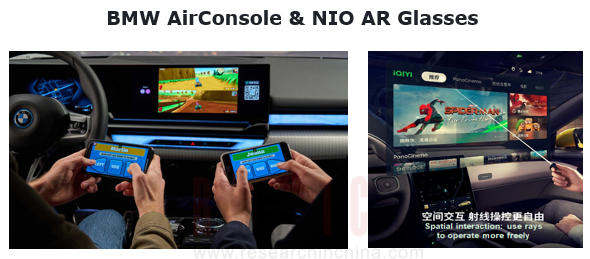
From the perspective of Tier 1 suppliers, the basic conditions for entertainment functions such as high-compute cockpit chips, audio-visual equipment and ecosystem content, have got improved.
Computing power support: high-compute chips like Qualcomm 8155, Kirin 990A, Qualcomm 8295 and AMD V1000 are mounted on cars.
Audio-visual support: ever more models carry OLED, Mini LED and AR/VR configurations; some models are even equipped with more than 20 acoustic units, supporting Dolby Atmos.
Ecosystem application support: conventional mobile phone /PC gaming platforms (Steam, MiguPlay, etc.) get on vehicles, and the IVI system can connect more external devices (Xpeng P5 can connect DJI’s drones, Xgimi’s ultra HD projector, and other devices).
Cockpit entertainment tends to embody the “scenario-based cockpit” where the gaming scenario is the highlight.
Cockpit entertainment has passed through four development phases - Listen, Chat, Watch and Play, and now it is moving towards the fifth phase featured by the “Scenario-based Cockpit”.
Listen: Before 2018, most OEMs provided users with such as FM and online music via typical applications like QQ Music and KuGou.
Chat: From 2018 to 2019, social contact was an entertainment highlight. The milestone was that Changan, Haval and Geely installed the WeChat vehicle version which allows for voice chat in the car.
Watch: From 2019 to 2020, smartphone short videos went viral in the automotive industry as applications such as Douying (TikTok) and Bilibili were available to cars.
Play: From 2021 to 2023, in-car karaoke and mini games such as Changba, MiguPlay and Tom Culture were installed in cars of auto brands like Xpeng, Aion, Tesla and AITO. At this stage, users deeply partook in cockpit entertainment, and optional components such as microphone and gamepad were introduced into cockpits.
Scenario-based Cockpit: from 2023 onwards, OEMs take cockpits as a whole, and call quite a few cockpit components such as seats, fragrance system and ambient lighting to create immersive experiences based on scenarios (e.g., gaming, movie watching and working) for users. Meanwhile, AAA games and AR/VR glasses, which originally seemed to have nothing to do with cars, are available to cars now.
In the scenario-based cockpit, gaming scenario becomes a key deployment. Tesla has launched Steam integration inside its Model S and Model X electric cars with thousands of games now playable. BMW is partnering with the gaming platform AirConsole to bring a unique kind of in-car gaming to the new BMW 5 Series BEVs. BYD plans to carry the NVIDIA GeForce NOW cloud gaming service. All of which indicates that in-car games will become the next battleground for automakers.
At present, there are four gaming platforms confirmed to be mounted on cars: MiguPlay, AirConsole, GeForce NOW and Antstream. Except for MiguPlay, the other three are all foreign platforms. MiguPlay has joined hands with multiple Chinese OEMs, including DENZA, Xpeng, Lynk & Co, HYCAN, Voyah, GAC Aion, Rising Auto, Hyper, ZEEKR and Neta Auto, and has been seen in nearly 40 car models.
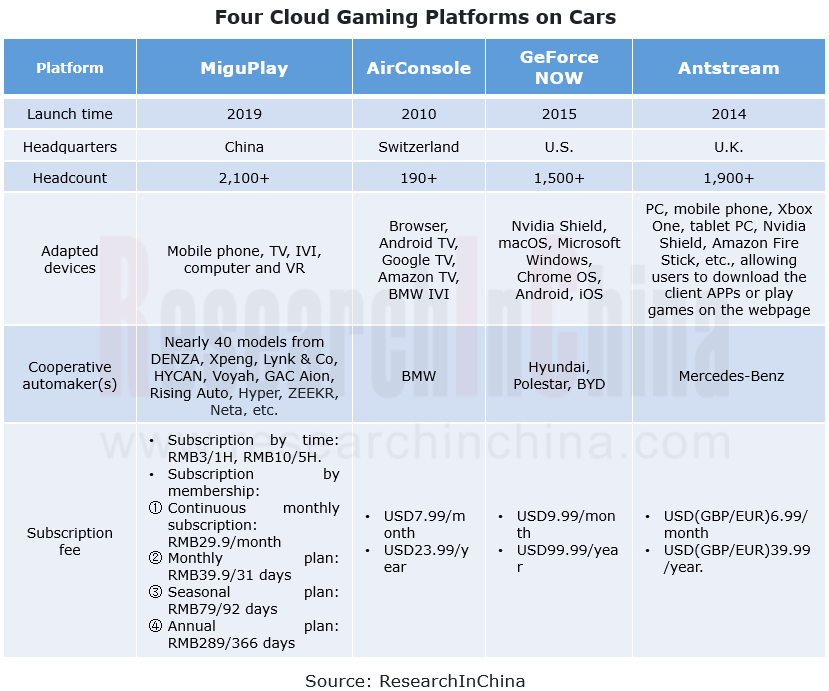
Cloud gaming platforms are the optimal in-car game option, but some urgent problems need to be solved.
In terms of their characteristics, cloud gaming platforms are the best option for cockpit entrainment featured by big games, because of offering the following benefits:
Configuration-free, download-free, cross-terminal, adaptive, and easy to integrate with AR/VR devices, metauniverse, etc.
Quantitative superiority, for example, GeForce NOW supports more than 1,500 live streaming games.
Allow users to experience a range of powerful functions, e.g., 4K resolution and ultra-low latency, without needing to deploy too high GPU configuration locally.
The cloud gaming platforms can cross terminals, for example, the IVI account can be interoperable with other terminal accounts, thus improving user loyalty.
Yet there are still some urgent problems needing to be solved before the mass adoption of cloud games in cars:
Network: At present, IVI generally uses 3G/4G networks, providing download speeds of 17Mbps~20Mbps. In terms of network delay, the current lowest delay of 4G networks is about 20 ms, but it often exceeds 100 ms actually. According to the requirements of NVIDIA GeForce NOW for network speeds, the display effect of 720p 60FPS requires the network speed of 15Mbps and the network delay of lower than 80 ms.
Display: At present, IVI displays have yet to support HDR formats, and deliver the average refresh rate of 60Hz, not enough to ensure the display effect for big games.
Data center: Cloud games need to be coupled with data centers. Among the several adopted gaming platforms researched in this report, only MiguPlay comes from China, and the other three are foreign. For example, if Nvidia GeForce NOW wants to enter the Chinese market, data centers will be a big challenge, because its foreign data centers will inevitably have network delay, but the establishment of a new data center in China incurs cost and local supervision.
Business model: It is necessary for gaming platforms to solve some problems, for example, how game providers cooperate with automakers and how to divide the proceeds of in-car gaming platforms between game providers and OEMs.
Intelligent Driving SoC Research Report, 2026
Research on Intelligent Driving SoCs: Competition Focus Shifts to L3/L4 Embedded Hardware, and Computing Power of Flagship Vehicle Models Exceeds 1,000 TOPS
In terms of intelligent driving system in...
Automotive AI Large Model Technology Research Report, 2026
Automotive AI Large Model Research: Competition Shifts from "Who Has the Stronger Model" to "Who Boasts Higher Link Efficiency"
ResearchInChina released the Automotive AI Large Model Technology Resea...
Intelligent Vehicle Cockpit Domain Controller Research Report, 2026
Cockpit domain controller research: L3 AIDV intelligent cockpit domain controllers are entering a boom period
Driven by multiple factors such as the continuous evolution of the automotive central int...
Automotive Acoustic System (Audio, Multi-Channel) Industry Report, 2026
Automotive Acoustics Research: Multiple Channels, AI Tuning, and Self-Developed Algorithms Drive the Transformation of High-End Cockpit Sound Fields
I. Automotive Audio Hardware Solutions with 6–9 S...
Autonomous Driving Sensor Chip Research Report, 2026
Research on Autonomous Driving Sensor Chips: Deeply Perceiving the Physical World, Sensor Chips Are Playing A “Leading Role” in Intelligence
In 2026, the autonomous driving sensor chip industr...
Passenger Car Corner Module and Wheel‑Side Control System Research Report, 2026
Wheel-side control research: the “last mile” chassis innovation
Wheel-side control dismantles the traditional drive, braking, steering, and suspension control of the chassis from a "centralized" styl...
Embodied Artificial Intelligence (& Humanoid Robot) MCU Research Report, 2026
Research on Humanoid Robot MCUs: Evolution from General-Purpose Control to High-Value Dedicated Chip Solutions Integrated with Edge AI Functions
MCU (Microcontroller Unit) refers to a compact integra...
Intelligent Vehicle Zone Control Unit (ZCU) Research Report, 2026
ZCU Research: Cross-domain integrated ZCUs are becoming the edge computing nodes of the next-generation zonal architecture
Currently, the mainstream zonal architecture is mainly the quasi-central + z...
Automotive Cybersecurity and Data Security Research Report, 2026
Cybersecurity & Data Security Research: Intelligent Connected Vehicles Enter the Era of “Systematic Offense-Defense and AI-Defined Security”.
Centering on the panorama of intelligent connect...
Report on Breakthrough Strategies of OEMs and ADAS Tier 1 Suppliers for Overseas Layout of Intelligent Driving, 2026
Regulatory Breakthrough, Local System Establishment, OEMs Competing for NOA Layout: Overall Trends of China’s Intelligent Driving Overseas Layout in 2026
Research on overseas intelligent driving layo...
OEMs and Tier1s’ Intelligent Cockpit Platform (Hardware and Software) Innovation Strategy Research Report, 2026
Intelligent Cockpit Platform Research: multi-dimensional cockpit system architecture reconstruction for multi-agent collaboration and proactive intelligent services
The intelligent cockpit software s...
Automotive AIOS Research Report, 2026
Automotive AIOS Research: Mass Production Solutions Are Implemented
Mass Production Solutions Are Implemented on A Small Scale.
In 2026, AIOS starts small-scale implementation, helping to improve v...
Automotive Telematics Service Provider (TSP) Research Report, 2026
TSP Research: Leading providers collectively turn to AI agents to provide all-scenario active services
Telematics Service Providers (TSPs) are the core hub of the telematics industry chain, connectin...
Automotive Smart Interior Research Report, 2026
Smart Interior Research: As Technologies like Interactive Starlight Headliner, Hidden Display and Surface Projection Are Launched, Automotive Interiors Become Ever More Intelligent
The Automotive Sma...
Research Report on AI Applications in Cockpits, 2026
AI Application in Cockpits: AI Services Become More Comprehensive, Convenient, and Refined.
In the first half of 2026, cockpit AI functions underwent initial upgrades across multiple dimensions, inc...
Software-Defined Vehicles in 2026: OEM Software Development and Supply Chain Deployment Strategy Research Report
Research on OEMs’ Software Strategies: R&D Focus, Development Strategies and Supplier Building Models of 30 OEMs
In this paper, we adopt a research framework covering 13 subsystems and 48 sub-di...
Passenger Car Chassis Domain Control and Chassis Cross-Domain Integration Research Report, 2026
Chassis Control Research: Mass Production of Full Chassis-by-Wire Solutions Starts
1. A Cluster of Full Chassis-by-Wire Solutions Make Their Debut, and EMB Enters Mass Production and Adoption for the...
Central Domain Control (Powertrain, Chassis, Body) and Motion Controller Research Report, 2026
Central Domain Control and Motion Control Research: XYZ Coordinated Control and Full X-by-Wire Actuation System
With the gradual penetration of L3+ autonomous driving, the chassis control system is ...