Automotive gateway research: integrated gateways have become an important trend in zonal architecture.
Automotive gateway is a core component in the automotive electronic/electrical architecture. As the hub of in-vehicle networks, it enables such functions as data transmission, security prevention and control, and remote diagnostics.
As E/E architecture evolves from the distributed to the centralized domain architecture, gateway also changes accordingly. Its evolution route is as follows:
 Phase I: Conventional CAN gateway in distributed architecture
Phase II: Central gateway in domain-centralized architecture
Phase III: Distributed gateway in zonal architecture
1. Conventional CAN gateway in distributed architecture
Phase I: the distributed ECU architecture means that many single functional ECUs provide hardware/software solutions. These functional ECU clusters (e.g. power, chassis, body, safety and IVI systems) are combined together and connected via conventional bus systems such as CAN, LIN or FlexRay?. While sensors and actuators are directly connected to the ECUs, the interaction between domains is realized through CAN gateways.
2. Central gateway in domain-centralized architecture
Phase II: the "domain" of a domain controller generally refers to functional domains which fall into: Powertrain, Chassis Control, Body Control, Entertainment System (Cockpit), and ADAS. Systems in these domains are interconnected still using CAN and FlexRay communication buses. For inter-domain communication, the Ethernet with higher performance serves as the backbone network for information exchange. In such architecture, a central gateway is needed for inter-domain communication. This gateway allows for data exchange with OEM vehicle clouds, and is thus regarded as a "service gateway".
3. Distributed gateway in zonal architecture
Phase III: in the zonal architecture, the central gateway will evolve into a HPC or a central computer, while the domain gateways will evolve into zonal gateways. The gateway is not only responsible for routing of in-vehicle network communication buses, but also takes charge of more complex functions, for example, data association and processing between safety and functional domains (e.g., powertrain, chassis and safety, body control, IVI and ADAS) via the MCU+SoC computing platform. The biggest benefit offered by this architecture is to greatly reduce wiring harnesses and thus cut down the weight and cost by about 30%.
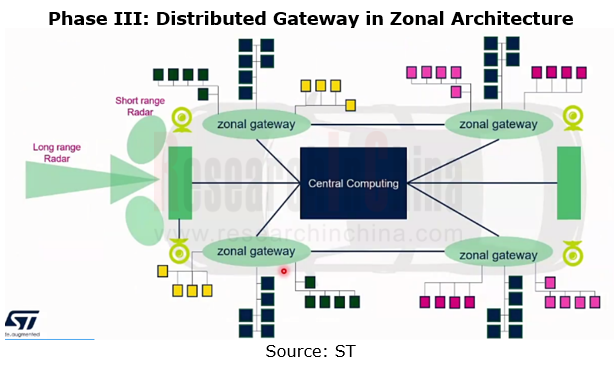
Currently, gateways are in a transitional phase from centralized gateways in domain centralized architecture to distributed gateways in zonal architecture.
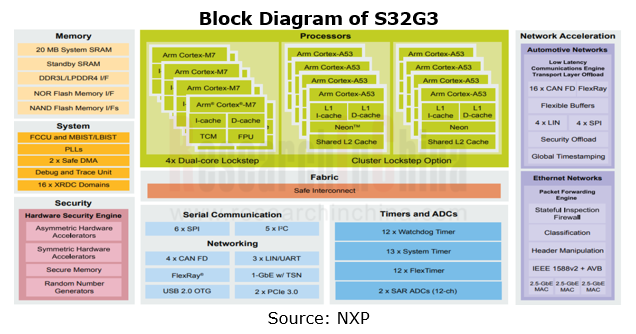
In response to the major trend for cross-domain integration, many gateway chip vendors propose their solutions. For example, NXP S32G3 network processors released at the end of 2021 feature real-time processing capability, service-oriented high-performance computing power, cross-domain integration, and high-performance safety processing, and also provide complete software development tools, which can meet the development requirements of various new automotive E/E architectures: service-oriented gateways, vehicle computers, domain controllers, zonal processors, and safety processors.
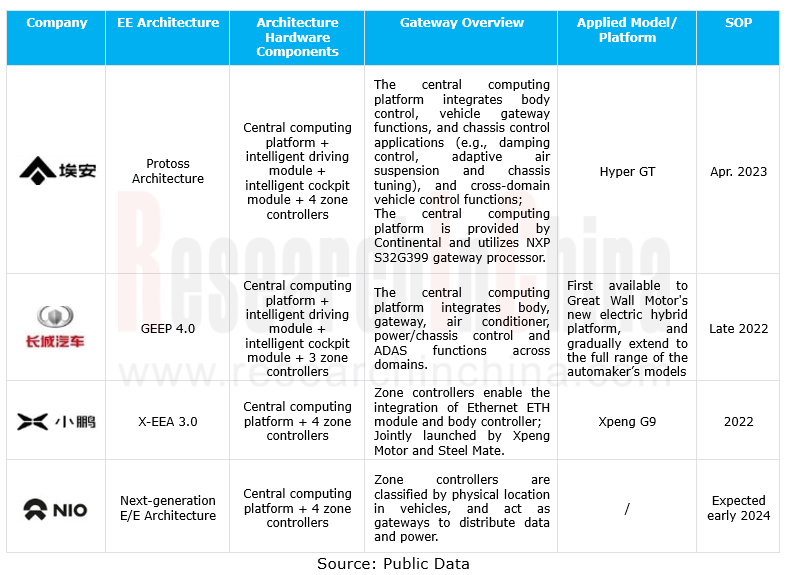
NXP S32G3 network processors were mass-produced in February 2023, and were first installed in GAC Hyper GT in April 2023.
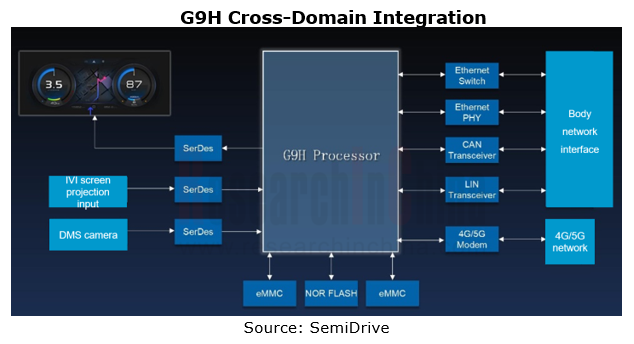
The G9H chip SemiDrive unveiled in July 2022 is mainly used in such scenarios as next-generation high-performance central gateways, vehicle computing units, and cross-domain controllers. In addition to body network interfaces, G9H also supports video input/output interfaces, including 1-channel MIPI DSI and 2-channel MIPI CSIs. Coupled with PowerVR’s high-performance 3D GPU, G9H can integrate 3D cluster, DMS and other features into the central gateway, further lowering the BOM cost of the system.
Gateway suppliers make a gradual shift to integrated gateways from independent gateways. The main integration modes include integration between gateways and body domains, between gateways and zone controllers, and between gateways and central computer. In 2023, quite a few suppliers have announced integrated gateway solutions.
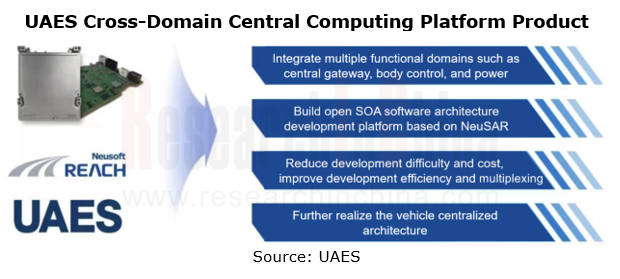
Examples include the cross-domain central computing platform product for next-generation E/E architectures, released by UAES in April 2023. This solution integrates central gateway, body control, power and other functional domains, and Neusoft Reach provides underlying software and middleware development support.
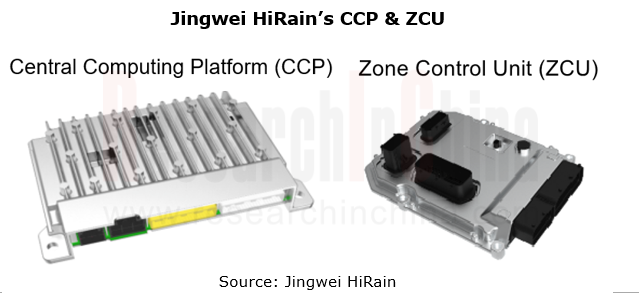
Another example is the physical zone control unit (ZCU) and the central computing platform (CCP), released by Jingwei HiRain in May 2023:
ZCU: Integrates vehicle power distribution function, zonal gateway routing function (100M Ethernet, CANFD, LIN, etc.), body comfort domain, new energy power domain, and partial chassis domain, as well as input/output signal acquisition and control for air conditioner and thermal management.
CCP: Integrates centralized gateway, body and comfort control, new energy vehicle power control, air conditioner and thermal management, vehicle management, full-volume data acquisition, OTA update, SOA service and other functions.
At present the above two products have been developed, tested and produced in small volume. They will be spawned and delivered by the end of 2023. Wherein, the CCP has been mass-produced to support four cooperative mainstream automakers in China.
As gateway chip and integrated gateway technologies mature, OEMs race to implement their "quasi-centralized" architecture solutions on production models, most of which will be rolled out during 2022-2024.
Automotive Microcontroller Unit (MCU) and Application Scenario Research Report, 2026
Automotive MCU Research: Increased demand for redundant security drives ASIL D-compliant MCU shipments to exceed 100 million units
In a vehicle EEA, MCUs are widely distributed in various functional ...
China Intelligent Cockpit Patent Analysis Report, 2026
Intelligent Cockpit Patent Research: Cockpit AI, In?vehicle Health, and Infotainment Are Upgrade to Scenario?based and Proactive Functions
From a patent perspective, this report explores the cutting?...
Research Report on Application of VLA Large Model in Automobiles and Robots, 2026
Research on Automotive and Robot VLA: Hybrid Architectures Become Mainstream, VLA Integrates with General World Models, and Reinforcement Learning Serves as Core Engine
Vision?Language?Action (VLA) m...
China Charging Infrastructure (Supercharging, Battery Swapping, V2G, etc.) and High-Performance Supercharging Battery Research Report, 2026
Charging and battery swapping research: as 5C+ supercharging vehicle models go into mass production, the pace of OEMs self-building supercharging networks quickens
800-1000V high-voltage platforms ar...
China Passenger Car Electronic Controlled Suspension Industry Report, 2026
Electronic Controlled Suspension Industry Research: As the First Year of Full Active Suspension Unfolds, Three Technical Routes Race Forward
1. Penetration Rate Surges Three Times, and Electronic Con...
Intelligent Driving SoC Research Report, 2026
Research on Intelligent Driving SoCs: Competition Focus Shifts to L3/L4 Embedded Hardware, and Computing Power of Flagship Vehicle Models Exceeds 1,000 TOPS
In terms of intelligent driving system in...
Automotive AI Large Model Technology Research Report, 2026
Automotive AI Large Model Research: Competition Shifts from "Who Has the Stronger Model" to "Who Boasts Higher Link Efficiency"
ResearchInChina released the Automotive AI Large Model Technology Resea...
Intelligent Vehicle Cockpit Domain Controller Research Report, 2026
Cockpit domain controller research: L3 AIDV intelligent cockpit domain controllers are entering a boom period
Driven by multiple factors such as the continuous evolution of the automotive central int...
Automotive Acoustic System (Audio, Multi-Channel) Industry Report, 2026
Automotive Acoustics Research: Multiple Channels, AI Tuning, and Self-Developed Algorithms Drive the Transformation of High-End Cockpit Sound Fields
I. Automotive Audio Hardware Solutions with 6–9 S...
Autonomous Driving Sensor Chip Research Report, 2026
Research on Autonomous Driving Sensor Chips: Deeply Perceiving the Physical World, Sensor Chips Are Playing A “Leading Role” in Intelligence
In 2026, the autonomous driving sensor chip industr...
Passenger Car Corner Module and Wheel‑Side Control System Research Report, 2026
Wheel-side control research: the “last mile” chassis innovation
Wheel-side control dismantles the traditional drive, braking, steering, and suspension control of the chassis from a "centralized" styl...
Embodied Artificial Intelligence (& Humanoid Robot) MCU Research Report, 2026
Research on Humanoid Robot MCUs: Evolution from General-Purpose Control to High-Value Dedicated Chip Solutions Integrated with Edge AI Functions
MCU (Microcontroller Unit) refers to a compact integra...
Intelligent Vehicle Zone Control Unit (ZCU) Research Report, 2026
ZCU Research: Cross-domain integrated ZCUs are becoming the edge computing nodes of the next-generation zonal architecture
Currently, the mainstream zonal architecture is mainly the quasi-central + z...
Automotive Cybersecurity and Data Security Research Report, 2026
Cybersecurity & Data Security Research: Intelligent Connected Vehicles Enter the Era of “Systematic Offense-Defense and AI-Defined Security”.
Centering on the panorama of intelligent connect...
Report on Breakthrough Strategies of OEMs and ADAS Tier 1 Suppliers for Overseas Layout of Intelligent Driving, 2026
Regulatory Breakthrough, Local System Establishment, OEMs Competing for NOA Layout: Overall Trends of China’s Intelligent Driving Overseas Layout in 2026
Research on overseas intelligent driving layo...
OEMs and Tier1s’ Intelligent Cockpit Platform (Hardware and Software) Innovation Strategy Research Report, 2026
Intelligent Cockpit Platform Research: multi-dimensional cockpit system architecture reconstruction for multi-agent collaboration and proactive intelligent services
The intelligent cockpit software s...
Automotive AIOS Research Report, 2026
Automotive AIOS Research: Mass Production Solutions Are Implemented
Mass Production Solutions Are Implemented on A Small Scale.
In 2026, AIOS starts small-scale implementation, helping to improve v...
Automotive Telematics Service Provider (TSP) Research Report, 2026
TSP Research: Leading providers collectively turn to AI agents to provide all-scenario active services
Telematics Service Providers (TSPs) are the core hub of the telematics industry chain, connectin...