Intelligent Vehicle Multi-Domain Computing Industry Report, 2023
  • Aug.2023
  • Hard Copy
  • USD $4,000
  • Pages:270
  • Single User License
    (PDF Unprintable)       
  • USD $3,800
  • Code: ZHP132
  • Enterprise-wide License
    (PDF Printable & Editable)       
  • USD $5,700
  • Hard Copy + Single User License
  • USD $4,200
      

Multi-domain computing research: in the coming first year of cross-domain fusion, major suppliers will quicken their pace of launching new solutions.

As vehicle intelligence develops, electrical/electronic architecture begins to evolve from domain control centralized architecture to multi-domain fusion computing/central computing architecture. In this development trend, OEMs, Tier 1 suppliers and chip companies enjoy new market opportunities.  
 
20120114.gifIn July 2023, SAIC unveiled a vehicle motion controller (VMC) for central coordination. Based on vehicle central fusion motion control, it enables a shorter cross-domain control link for vehicles, and allows for more efficient control over the body and chassis in the state of human driving or intelligent driving.
20120114.gifIn July 2023, BYD first introduced "Eyes of the God", its advanced intelligent driving assistance system that adopts the central computing platform + zonal domain controller deep collaboration system architecture.  
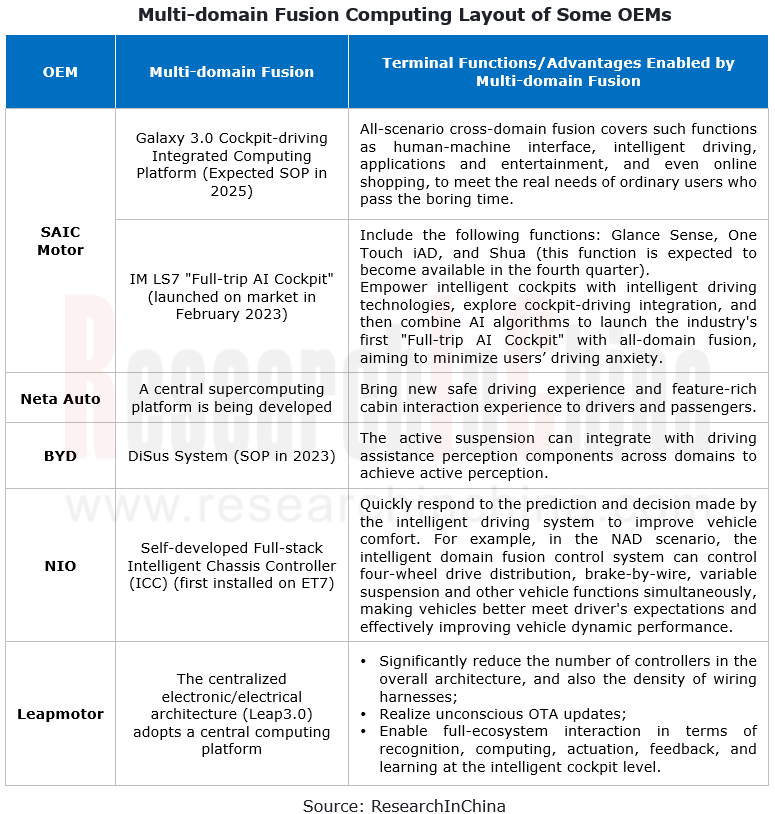
多域计算 1_副本.png

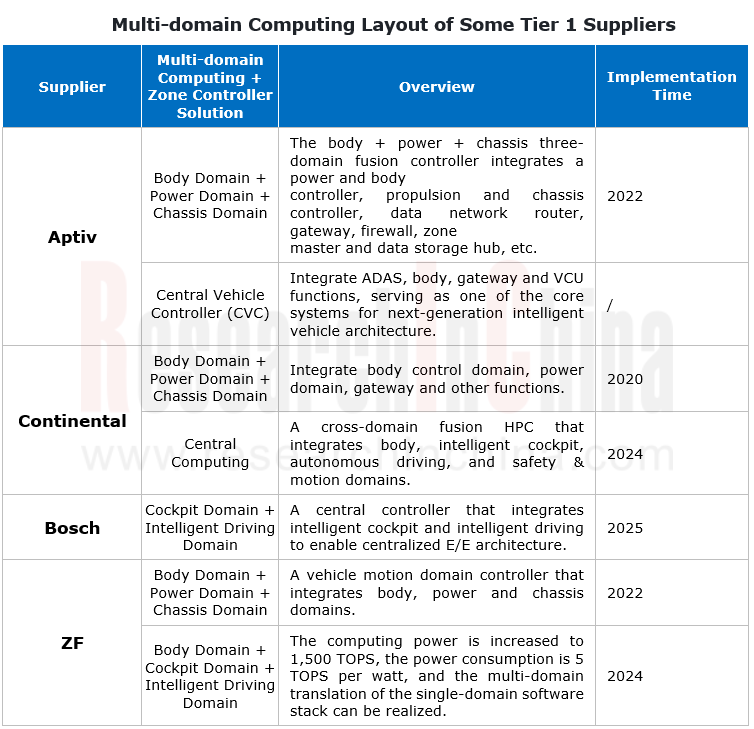
Major Tier 1 suppliers step into the multi-domain computing field by virtue of their own strengths.

From the perspective of layout, Tier 1 suppliers deploy multi-domain computing in a relatively flexible way. They rely on their own superiorities to lay out multi-domain fusion, for example, body and chassis, body and cockpit, and chassis and intelligent driving domains.  
多域计算 2-1_副本.png

多域计算 2-2_副本.png

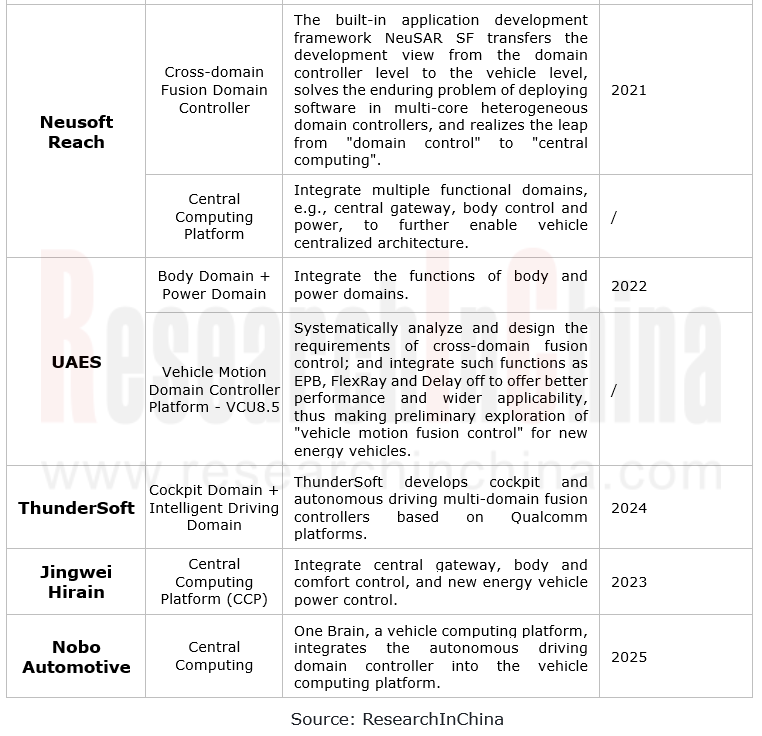
UAES

UAES has established the special cross-domain control division, and has signed strategic cooperation agreements with ecosystem partners like Horizon Robotics, Neusoft Reach, ABUP, LEADMOVE, and TE Connectivity. 

In December 2022, UAES released its vehicle computing platform (VCP), which uses the new-generation NXP S32G SoC and integrates functions of power and body domains, including vehicle control, BCM and gateway. For some projects, driving assistance functions are integrated;

In May 2023, UAES launched VCU8.5, a vehicle motion domain controller platform which systematically analyzes and designs the requirements of cross-domain fusion control and integrates such functions as EPB, FlexRay and Delay off.

Continental

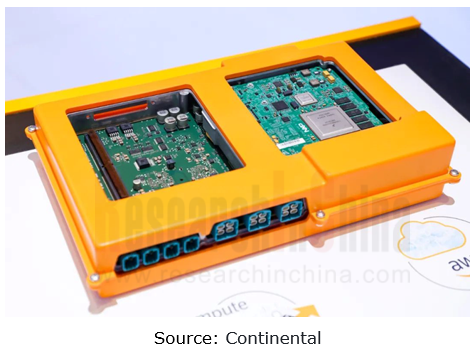
In April 2023, Continental exhibited its cross-domain vehicle control high performance computer (HPC) for the first time. In addition to the original body control and gateway functions, this product also integrates chassis control applications. At present, Continental has secured two local orders in China, and the model GAC Aion Hyper GT will become the first production car carrying the product. It is expected that in 2024, this HPC will be installed on more than 30 different models of several automakers.  
多域计算 3_副本.png

PATEO CONNECT+

In June 2023, PATEO CONNECT+ managed to develop its first vehicle central computing module (CCM). Based on the central gateway, this platform expands computing power, and integrates intelligent cockpit, ADAS, body and vehicle control functions.   
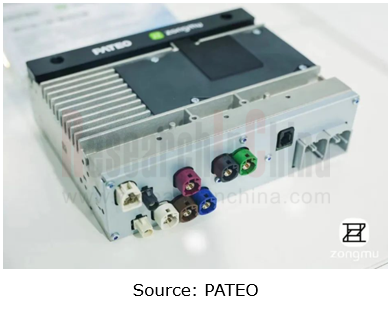
多域计算 4_副本.png

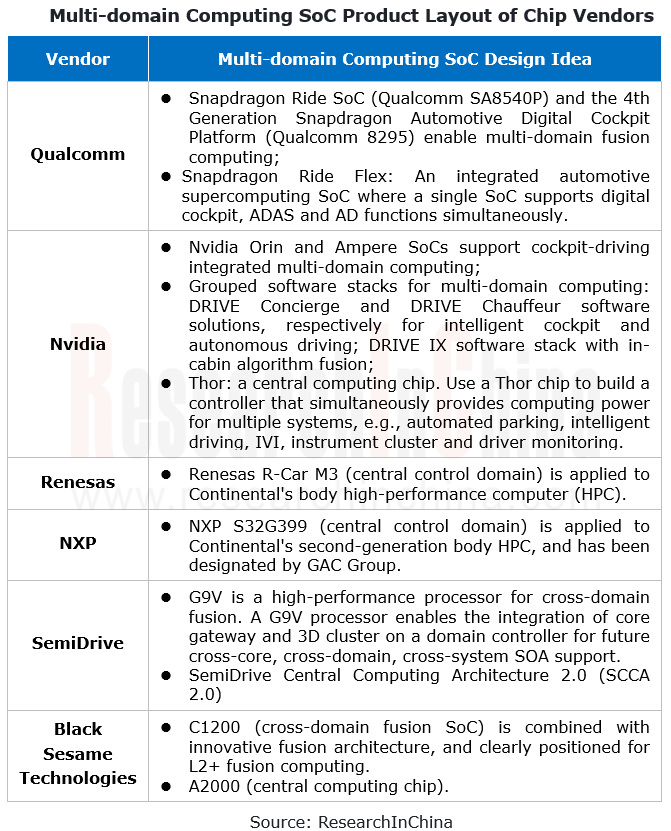
Key technical support for multi-domain computing: multi-domain computing SoC, and cross-domain fusion software platform.

At present, multi-domain fusion is seen mainly in two aspects: hardware and software. From a hardware integration perspective, multi-domain fusion features multi-SoC integration, that is, different domain controllers are integrated into one box composed of multiple SoCs or MCUs, and different functions are supported by different chips. The multi-domain fusion enabled by a single chip requires a SoC to complete different functions. There are now still some challenges in realizing single-SoC multi-domain fusion.  
多域计算 5_副本.png

Black Sesame Technologies

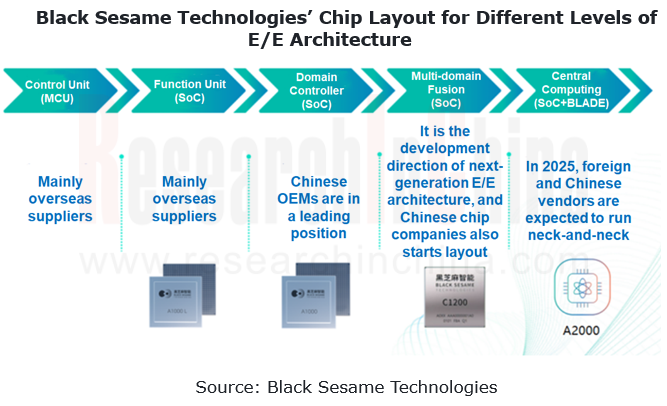
In July 2023, Black Sesame Technologies announced C1200, the first product of the Wudang Series. As China’s first automotive cross-domain multifunctional fusion computing chip, C1200 meets the requirements of autonomous driving, intelligent cockpit, body control and other computing functions. 

Wudang C1200 packs A78AE (performance up to 150KDMIPS), an automotive high-performance CPU core that supports lockstep, the automotive high-performance GPU core G78AE, a built-in mature high-performance Audio DSP module, and the self-developed new-generation NeuralIQ ISP module that processes 1.5G pixels per second online. Moreover, C1200 also has a built-in ASIL-D Safety Island, and a Security Module subject to the National Cryptography Level 2 and EVITA full, meeting the reliability requirements of the highest vehicle safety level.      
多域计算 6_副本.png

In addition to chips, the development of cross-domain fusion also needs to be supported by vehicle OS. In current stage, vehicle functional domains have yet to be fully integrated, and there is no intelligent vehicle operating system that can be applied directly for a long time in the world. This is an opportunity for Chinese vehicle OS providers to overtake on the bend.  

Arraymo (ArcherMind Technology)

In April 2023, Arraymo, an arm of ArcherMind Technology, launched Fusion OS, a cross-domain fusion vehicle software computing platform which is mainly compatible with operating systems in different domains. Fusion OS quickly connects core functional domains such as intelligent cockpit, central control, and intelligent driving from the bottom layer for high integration of functional modules. 

Intelligent Vehicle Multi-Domain Computing Industry Report, 2023 highlights the following:
20120114.gifMulti-domain computing development ideas, including central domain controller, cockpit-driving integration, integration of cockpit and body domains, integration of chassis and intelligent driving domains, and central computing platform + zone controllers (development, main cases, etc.);
20120114.gifKey technologies of multi-domain computing, including multi-domain fusion computing SoC, multi-domain computing software OS, multi-domain computing Ethernet, multi-domain computing gateway, and zone controller, (development trends, actual cases, etc.);
20120114.gifOEMs’ multi-domain fusion development planning, product R&D, technology layout, etc.;
20120114.gifChinese and foreign Tier 1 suppliers’ products, technology layout, cooperation, etc. in multi-domain computing and zone controller.

1 Typical Multi-Domain Computing Architecture Ideas
1.1 Multi-domain Fusion Computing Development Ideas 
1.1.1 Multi-domain Fusion Requires "Integrated" Development 
1.1.2 The Most Common Evolution Logic of Multi-domain Computing 
1.1.3 Status Quo of Multi-Domain Computing: Five Design Ideas
1.1.4 Multi-domain Fusion Technology Trends  
1.1.5 Multi-domain Computing Solutions of Overseas Tier 1 Suppliers 
1.1.6 Multi-domain Computing Solutions of Chinese Tier 1 Suppliers (1)
1.1.7 Multi-domain Computing Solutions of Chinese Tier 1 Suppliers (2)
1.1.8 Summary on Multi-domain Computing Cooperation Ideas of Tier 1 Suppliers (1)
1.1.9 Summary on Multi-domain Computing Cooperation Ideas of Tier 1 Suppliers (2)

1.2 Multi-domain Fusion Computing Idea 1
1.2.1 Layout of Central Control Domain Software Functions
1.2.2 Central Domain Controller Solutions of OEMs 
1.2.3 Multi-domain Fusion Computing in Central Control Domain: ZEEKR 
1.2.4 Multi-domain Fusion Computing in Central Control Domain: ZEEKR’s Driving Domain Controller Planning 
1.2.5 Multi-domain Fusion Computing in Central Control Domain: Volkswagen iCAS1
1.2.6 Multi-domain Fusion Computing in Central Control Domain: Installation Position of Volkswagen iCAS1 
1.2.7 Multi-domain Fusion Computing in Central Control Domain: Hardware Resources of Volkswagen iCAS1 
1.2.8 Multi-domain Fusion Computing in Central Control Domain: UAES’ Vehicle Motion Domain Controller Platform - VCU8.5 
1.2.9 Multi-domain Fusion Computing in Central Control Domain: UAES’ Computing Platform for Vehicle Fusion 
1.2.10 Multi-domain Fusion Computing in Central Control Domain: Continental’s Cross-domain Vehicle Control High Performance Computer 
1.2.11 Multi-domain Fusion Computing in Central Control Domain: Neusoft Reach Builds A General-purpose Domain Controller Based on NXP S32G  

1.3 Multi-domain Fusion Computing Idea 2
1.3.1 Necessity of Cockpit-driving Integration for Different Levels of Autonomous Driving
1.3.2 Main Cockpit-driving Integration Forms 
1.3.3 Cockpit-driving Integration Technology Evolution Route
1.3.4 Status Quo 1 of Cockpit-driving Integration Market  
1.3.5 Case 1
1.3.6 Case 2
1.3.7 Case 3 
1.3.8 Status Quo 2 of Cockpit-driving Integration Market 
1.3.9 Cockpit-driving Integration Deployment Case 1 of Tier 1 Suppliers
1.3.10 Cockpit-driving Integration Deployment Case 2 of Tier 1 Suppliers
1.3.11 Cockpit-driving Integration Deployment Case 3 of Tier 1 Suppliers
1.3.12 Cockpit-driving Integration Deployment Case 4 of Tier 1 Suppliers
1.3.13 Cockpit-driving Integration Deployment Case 1 of OEMs: SAIC Z-One’s Cockpit-driving Integration Computing Platform 3.0 (1)  
1.3.14 Cockpit-driving Integration Deployment Case 1 of OEMs: SAIC Z-One’s Cockpit-driving Integration Computing Platform 3.0 (2) 
1.3.15 Cockpit-driving Integration Deployment Case 2 of OEMs
1.3.16 Cockpit-driving Integration Deployment Case 3 of OEMs

1.4 Multi-domain Fusion Computing Idea 3 
1.4.1 Cockpit + Body Multi-domain Fusion Computing: PATEO CONNECT+
1.4.2 Cockpit + Body Multi-domain Fusion Computing: PATEO CONNECT+ Will Further Integrate Intelligent Driving Domain in the Future
1.4.3 Cockpit + Body Multi-domain Fusion Computing: Geely 

1.5 Multi-domain Fusion Computing Idea 4
1.5.1 BYD DiSus Body Control System  
1.5.2 Chassis + Intelligent Driving Multi-domain Fusion Computing (1)
1.5.3 Chassis + Intelligent Driving Multi-domain Fusion Computing (2)
1.5.4 Chassis + Intelligent Driving Multi-domain Fusion Computing (3)
1.5.5 Chassis + Intelligent Driving Multi-domain Fusion Computing (4)
1.5.6 Chassis + Intelligent Driving Multi-domain Fusion Computing (5)

1.6 Multi-domain Fusion Computing Idea 5 
1.6.1 Central Computing Platform of Jingwei Hirain
1.6.2 Central Computing Platform of PATEO CONNECT+ 

2 Key Multi-Domain Computing Technologies 
2.1 Multi-domain Fusion Computing SoC
2.1.1 Cross-domain Fusion Facilitates Closer Cooperation between Chip Vendors and OEMs/Tier 1 Suppliers 
2.1.2 Focus of Chip Vendors: Multi-domain Computing SoC 
2.1.3 Multi-domain Computing SoC Product Solutions of Chip Vendors (1)
2.1.4 Multi-domain Computing SoC Product Solutions of Chip Vendors (2)
2.1.5 Multi-domain Computing SoC Product Solutions of Chip Vendors (3)
2.1.6 Multi-domain Fusion Computing Trend: Integration at Single SoC Level   
2.1.7 Single SoC Case 1: Qualcomm Integrated Automotive Supercomputing SoC (1)
2.1.8 Single SoC Case 1: Qualcomm Integrated Automotive Supercomputing SoC (2) 
2.1.9 Single SoC Case 1: Qualcomm's Single SoC-based Cockpit-driving Integration
2.1.10 Single SoC Case 2: NVIDIA Thor (1)
2.1.11 Single SoC Case 2: NVIDIA Thor (2)
2.1.12 Single SoC Case 2: NVIDIA Thor (3)
2.1.13 Single SoC Case 3: Layout of Black Sesame Technologies in Multi-Domain Computing SoC 
2.1.14 Single SoC Case 3: Black Sesame Technologies’ Automotive Cross-domain Multifunctional Fusion Computing Chip - C1200 (1)
2.1.15 Single SoC Case 3: Black Sesame Technologies’ Automotive Cross-domain Multifunctional Fusion Computing Chip - C1200 (2) 
2.1.16 Single SoC Case 4: Layout of Horizon Robotics in Multi-Domain Computing SoC
2.1.17 Single SoC Case 4: Leapmotor’s Two Chips Fuse Four Domains 
2.1.18 Multi-domain Multi-SoC Computing Solutions (1)
2.1.19 Multi-domain Multi-SoC Computing Solutions (2)
2.1.20 Multi-domain Multi-SoC Computing Solutions (3) 

2.2 Multi-domain Computing Software OS 
2.2.1 Development of Centralized Architecture Promotes Software and Hardware Decoupling (1) 
2.2.2 Development of Centralized Architecture Promotes Software and Hardware Decoupling (2) 
2.2.3 Automotive Computing Platform Architecture
2.2.4 Development Priority in Multi-domain Computing Software: Unified Software Architecture Platform
2.2.5 Software Platform Architecture Case 1
2.2.6 Software Platform Architecture Case 2
2.2.7 Software Platform Architecture Case 3
2.2.8 Changes in OS Requirements in E/E Architecture Evolution 
2.2.9 Development Trend of Multi-domain Software OS: Evolution to Vehicle OS
2.2.10 Vehicle OS (1)
2.2.11 Vehicle OS (2)
2.2.12 Vehicle OS Architecture
2.2.13 Multi-domain Computing OS Case 1
2.2.14 Multi-domain Computing OS Case 1
2.2.15 Multi-domain Computing OS Case 2
2.2.16 Multi-domain Computing OS Case 3
2.2.17 Multi-domain Computing OS Case 4
2.2.18 Multi-domain Computing OS Case 5

2.3 Multi-domain Computing Communication: Ethernet
2.3.1 Communication Architecture Evolves from CAN/LIN Bus to Ethernet in the Trend for Multi-domain Computing (1) 
2.3.2 Communication Architecture Evolves from CAN/LIN Bus to Ethernet in the Trend for Multi-domain Computing (2) 
2.3.3 The Key to Zonal Architecture: New-generation Ethernet TSN
2.3.4 The Key to Zonal Architecture: Advantages of Next-generation Ethernet TSN 
2.3.5 Vehicle Cross-domain Ethernet Deployment Case 1 
2.3.6 Vehicle Cross-domain Ethernet Deployment Case 2
2.3.7 Vehicle Cross-domain Ethernet Deployment Case 2
2.3.8 OEM Communication Architecture Upgrade: Ethernet + High-speed Gateway Server

2.4 Multi-domain Computing Communication: Gateway
2.4.1 Body Domain Control and Gateway Fusion Has Been Realized
2.4.2 Integration Case 1
2.4.3 Integration Case 2
2.4.4 Development of Body Domain Integration Gateway

2.5 Zone Controller
2.5.1 Role of Zone Controllers in E/E Architecture 
2.5.2 Introduction to Zone Controller
2.5.3 Typical Layout Schemes and Function Allocation of Zone Controllers 
2.5.4 Three Major Functions of Zone Controllers: Vehicle Zone Power Distribution Center (1)
2.5.5 Three Major Functions of Zone Controllers: Vehicle Zone Power Distribution Center (2) 
2.5.6 Three Major Functions of Zone Controllers: Vehicle Zone Communication Center
2.5.7 Three Major Functions of Zone Controllers: Zone Functions and Drive Centers
2.5.8 Advantage 1 of Zonal Control Architecture
2.5.9 Advantage 2 of Zonal Control Architecture 
2.5.10 Huawei iDVP Hardware Architecture
2.5.11 Quantity and Functions of Zone Controllers of OEMs 
2.5.12 Zone Controller Solutions of Tier 1 Suppliers
2.5.13 Case 1: Zone Controller Products of UAES (1)
2.5.14 Case 1: Zone Controller Products of UAES (2) 
2.5.15 Case 2
2.5.16 Case 3

3 Multi-domain Computing and Zone Controller Technology Layout of OEMs
3.1 Multi-domain Fusion Development Planning of OEMs 
3.1.1 2024 Will Be the First Year of Cross-domain Fusion (Central Computing + Zone Controllers) 
3.1.2 Multi-domain Fusion Development Planning of OEMs 
3.1.3 Summary on (Quasi) Central Computing + Zone Controller Solutions of Chinese OEMs (1) 
3.1.4 Summary on (Quasi) Central Computing + Zone Controller Solutions of Chinese OEMs (2)
3.1.5 Summary on (Quasi) Central Computing + Zone Controller Solutions of Chinese OEMs (3)
3.1.6 Summary on (Quasi) Central Computing + Zone Controller Solutions of Foreign OEMs
3.1.7 Multi-domain Fusion Development Helps OEMs to Enhance Their Competitive Edges 
3.1.8 Focus of OEMs in Multi-domain Fusion (1)
3.1.9 Focus of OEMs in Multi-domain Fusion (2)  
 
3.2 Geely 
3.2.1 Multi-domain Computing Hardware Layout: Black Sesame Technologies and JICA Intelligent Robot Cooperated to Participate in ECARX Central Computing Platform Project  
3.2.2 Multi-domain Computing Software Layout: SOA Software Service Architecture
3.2.3 Multi-domain Computing Software Layout: Geely Galaxy OS Cross-domain Fusion Operating System 
3.2.4 Multi-domain Computing Software Layout: ZEEKR EE 3.0 Central Computing Platform (1)
3.2.4 Multi-domain Computing Software Layout: ZEEKR EE 3.0 Central Computing Platform (2) 

3.3 SAIC
3.3.1 Multi-domain Computing Layout: All-domain Motion Control Platform (VMC) (1)
3.3.2 Multi-domain Computing Layout: All-domain Motion Control Platform (VMC) (2)  
3.3.3 Multi-domain Computing Layout: Cockpit-driving Integration (1)
3.3.4 Multi-domain Computing Layout: Cockpit-driving Integration (2) 
3.3.5 Z-one’s Multi-domain Computing Layout: SOA Software Platform (1)
3.3.6 Z-one’s Multi-domain Computing Layout: SOA Software Platform (2)  

3.4 GAC
3.4.1 Multi-domain Computing Layout: X-Soul Architecture in GA3.0
3.4.2 Multi-domain Computing Layout: SOA Software Platform 

3.5 Great Wall Motor
3.5.1 Evolution to (Quasi) Central Multi-domain Fusion Computing + Zone Controllers Architecture
3.5.2 GEEP 4.0 Quasi Central Multi-domain Computing Layout: 3 Computing Platforms + 3 Zone Controllers
3.5.3 GEEP 5.0 Central Computing Platform: One Brain + Zone Controllers

3.6 FAW Hongqi
3.6.1 FEEA3.0 Multi-domain Computing Layout: Three Platforms - Intelligent Control, Intelligent Sharing and Intelligent Driving 
3.6.2 FEEA3.0 Multi-domain Computing Layout: TSN Ethernet Multi-domain Controller

3.7 BYD
3.7.1 Multi-domain Computing Layout: "Yisifang" System
3.7.2 Multi-domain Computing Layout: Advanced Intelligent Driving Assistance System - "Eyes of the God"
3.7.3 Multi-domain Computing Layout: Self-developed High-compute Platform

3.8 Changan Automobile
3.8.1 CIIA 2.0 Multi-domain Computing Layout: Vehicle Control Domain (1)
3.8.2 CIIA 2.0 Multi-domain Computing Layout: Vehicle Control Domain (2)
3.8.3 CIIA 2.0 Multi-domain Computing Layout: Software-Driven Architecture (SDA)

3.9 Li Auto
3.9.1 Iteration of Multi-domain Fusion Computing to Centralized Architecture
3.9.2 LEEA 2.0 Multi-domain Computing Layout: Central Domain Controller (XCU) in L9
3.9.3 LEEA 3.0 Centralized Computing Layout: CCU (3 Computing Clusters) + Zone Controllers
3.9.4 LEEA 3.0 Centralized Computing Layout: Zone Controller
3.9.5 LEEA 3.0 Centralized Computing Layout: Connected with TSN Switch via PCIe Switch 

3.10 Xpeng Motors
3.10.1 Evolution to Multi-domain Computing + Zone Controllers
3.10.2 X-EEA 3.0: Central Supercomputing (3 Computing Clusters) + Zone Controllers (Z-DCU) 
3.10.3 X-EEA 3.0 Multi-domain Computing Layout: Central Supercomputing Platform Architecture
3.10.4 X-EEA 3.0 Multi-domain Computing Layout: Software Architecture of Central Computing Domain and Intelligent Driving Domain

3.11 NIO
3.11.1 Multi-domain Computing Layout: Evolution to Central Computing
3.11.2 Multi-domain Computing Layout: Connected Central Gateway LION Fusion Body Domain
3.11.3 Multi-domain Computing Layout: Cross-domain Integration of Intelligent Chassis Controller (ICC) and Intelligent Driving Domain (1) 

3.12 Neta Auto
3.12.1 Evolution to Multi-domain Fusion Computing and Central Computing
3.12.2 Multi-domain Fusion Computing Layout: Self-developed Central Computing Platform
3.12.3 Multi-domain Fusion Computing Layout: Supercomputing Platform for Cockpit-driving Integration

3.13 Leapmotor
3.13.1 Released ‘Four-Leaf Clover’ Central Integrated Electronic/Electrical Architecture
3.13.2 ‘Four-Leaf Clover’ Central Integrated Electronic/Electrical Architecture Adopts the SOC+MCU Solution 
3.13.3 The Central Integrated Electronic/Electrical Architecture Enables Self-development and Self-manufacturing Capabilities to Share 70% of Vehicle Cost

3.14 Volkswagen
3.14.1 Multi-domain Computing Layout: ICAS1 Vehicle Control Domain Controller
3.14.2 Multi-domain Computing Layout: Functional Architecture of ICAS3 Cabin Domain Controller 
3.14.3 Multi-domain Computing Layout: System Architecture of ICAS3 Cabin Domain Controller 
3.14.4 Multi-domain Computing Layout: Domain Extension and Domain Fusion of ICAS3 Cabin Domain Controller 

4 Multi-domain Computing and Zone Controller Technology Layout of Chinese Tier 1 Suppliers 

4.1 Neusoft Reach
4.1.1 Multi-domain Computing Products: Developed A Cross-domain Central Computing Unit Together with UAES    
4.1.2 Multi-domain Computing Products: X-Center Cross-domain Fusion Domain Controller 
4.1.3 Multi-domain Computing Products: NeuSAR Software Development Platform (1)
4.1.4 Multi-domain Computing Products: NeuSAR Software Development Platform (2) 
4.1.5 Multi-domain Computing Products: NeuSAR SF Software Application Development Framework (1)
4.1.6 Multi-domain Computing Products: NeuSAR SF Software Application Development Framework (2) 

4.2 Desay SV
4.2.1 Multi-domain Computing Layout: Evolution to Central Computing Platform
4.2.2 Multi-domain Computing Layout: Build an ICP Ecosystem
4.2.3 Multi-domain Computing Products: Aurora Intelligent Computing Platform
4.2.4 Multi-domain Computing Products: Key Features of Aurora Intelligent Computing Platform
4.2.5 Multi-domain Computing Products: Computing in Memory Fusion in Aurora Intelligent Computing Platform 
4.2.6 Multi-domain Computing Products: Cockpit-driving Integration Is Being Developed

4.3 PATEO CONNECT+
4.3.1 Profile 
4.3.2 Major Customers
4.3.3 Multi-domain Fusion Layout: Walking on Two Legs
4.3.4 Multi-domain Fusion Products: Fusion of Body and Cockpit Domains
4.3.5 Multi-domain Fusion Products: Vehicle Central Computing Platform
4.3.6 Multi-domain Fusion Products: Next-generation Multi-domain Fusion Intelligent Cockpit Platform
4.3.7 Multi-domain Fusion Products: Create Cockpit-driving Integration

4.4 Huawei
4.4.1 Computing and Communication Architecture (CCA): VCU Central Computing + 3-5 VIU Zone Controllers
4.4.2 Computing and Communication Architecture (CCA): System Framework and Full-Stack Solution

4.5 Technomous
4.5.1 Technical Strength
4.5.2 Multi-domain Fusion Layout: Evolution to Cockpit-driving Integration
4.5.3 Multi-domain Fusion Product: Cockpit-driving Integrated Domain Controller  

4.6 UAES
4.6.1 Product Supply Model
4.6.2 Established the Cross-Domain Control Division 
4.6.3 Multi-domain Fusion Solution: HPC+Zone
4.6.4 Multi-domain Computing Products: Zone Controller & Software Platform 
4.6.5 Multi-domain Computing Products: Vehicle Computing Platform - VCP 1.0
4.6.6 Multi-domain Computing Products: Extended Domain Controller Platform - XCU 8.0
4.6.7 Multi-domain Computing Products: the First Zone Controller Adopts A Four-zone Scheme  
4.6.8 Multi-domain Computing Products: Technical Features of Zone Controllers
4.6.9 Multi-domain Computing Products: New-generation Vehicle Motion Fusion Control Platform - VCU8.5 (1)  
4.6.10 Multi-domain Computing Products: New-generation Vehicle Motion Fusion Control Platform - VCU8.5 (2)
4.6.11 Multi-domain Computing Products: New-generation Vehicle Motion Fusion Control Platform - VCU8.5 (3)
4.6.12 Multi-domain Computing Products: New-generation Vehicle Motion Fusion Control Platform - VCU8.5 (4)

4.7 EnjoyMove Technology
4.7.1 Profile
4.7.2 Multi-domain Fusion Solutions: EMOS Software Platform (1)
4.7.3 Multi-domain Fusion Solutions: EMOS Software Platform (2)
4.7.4 Multi-domain Fusion Solutions: EMOS Software Platform (3)
4.7.5 Multi-domain Fusion Solutions: TSN Protocol Stack  

4.8 ThunderSoft
4.8.1 Profile 
4.8.2 Multi-domain Fusion Layout: Plan Mass-production of Cockpit-driving Integrated Platforms in 2024  
4.8.3 Multi-domain Fusion Products: Intelligent Cockpit 4.5 Realizes Integration of Cockpit Domain and Driving Assistance
4.8.4 Multi-domain Fusion Products: SOA Middleware Platform
4.8.5 Multi-domain Fusion Products: Plan Launch of A Cockpit-driving Integrated Solution in Late 2023 

4.9 ArcherMind Technology
4.9.1 Multi-domain Computing Products: Central Control Domain Software Platform - FusionWise3.0
4.9.2 Multi-domain Computing Products: Cross-domain Fusion Vehicle Software Computing Platform

4.10 Jingwei Hirain
4.10.1 Multi-domain Fusion Layout 
4.10.2 Multi-domain Computing Products: Central Computing Platform
4.10.3 Multi-domain Computing Products: SOA-based Vehicle Test

4.11 G-Pulse Electronics 
4.11.1 Launched Front and Back Zone Controller Solutions

5 Multi-domain Computing and Zone Controller Technology Layout of Overseas Tier 1 Suppliers
 
5.1 Bosch
5.1.1 Multi-domain Fusion Computing Layout: Established the Cross-Domain Computing Solutions Division (XC Division) 
5.1.2 Multi-domain Fusion Computing Layout: Evolution to Cockpit-driving Integrated Platform 
5.1.3 Multi-domain Fusion Computing Layout: R&D Route of Cockpit-driving Integrated Products 
5.1.4 Multi-domain Fusion Computing Products: Mass Production of Cockpit-driving Integration 

5.2 Continental
5.2.1 Multi-domain Fusion Computing Layout: Established China Software and System R&D Center
5.2.2 Multi-domain Fusion Computing Layout: Evolution to Four-domain Fusion HPC
5.2.3 Multi-domain Fusion Computing Products: 1st and 2nd Generation Body HPCs 
5.2.4 Multi-domain Fusion Computing Products: Four-in-one Cockpit HPC
5.2.5 Multi-domain Fusion Computing Products: Plug and Play HPC

5.3 ZF
5.3.1 Multi-domain Fusion Computing Layout
5.3.2 Multi-domain Fusion Computing Products: Multi-Domain Capable Edition of ProAI High Performance Computing Platform
5.3.3 Multi-domain Fusion Computing Products: ProAI
5.3.4 Multi-domain Fusion Computing Products: Chinese Edition of ProAI
5.3.5 Multi-domain Fusion Computing Products: Vehicle Motion Domain Control Unit

5.4 Aptiv
5.4.1 Multi-domain Fusion Computing Layout: Cross-domain Fusion Architecture - SVA 
5.4.2 Smart Vehicle Architecture (SVA): Structural Features
5.4.3 Smart Vehicle Architecture (SVA): Main Advantages
5.4.4 Multi-domain Fusion Computing Products: Zone Controller (PDC)
5.4.5 Multi-domain Fusion Computing Products: Body Domain + Chassis Domain Fusion Central Vehicle Controller (CVC) 

5.5 Harman
5.5.1 Multi-domain Fusion Computing Layout: to Introduce Multi-Domain Hybrid Architecture in 2024 
5.5.2 Multi-domain Computing Products: Functional Domain Controller + Zone Controller (1) 
5.5.3 Multi-domain Computing Products: Functional Domain Controller + Zone Controller (2) 
5.5.4 Multi-domain Fusion Computing Products: Cockpit-driving Integration
5.5.5 Multi-domain Fusion Computing Products: Cockpit-driving Integrated
Underlying Hardware Architecture 

5.6 LG Electronics
5.6.1 Cooperated with Qualcomm and Magna to Deploy Multi-domain Fusion


OEMs and Tier1s’ Intelligent Cockpit Platform (Hardware and Software) Innovation Strategy Research Report, 2026

Intelligent Cockpit Platform Research: multi-dimensional cockpit system architecture reconstruction for multi-agent collaboration and proactive intelligent services The intelligent cockpit software s...

Automotive AIOS Research Report, 2026

Automotive AIOS Research: Mass Production Solutions Are Implemented Mass Production Solutions Are Implemented on A Small Scale. In 2026, AIOS starts small-scale implementation, helping to improve v...

Automotive Telematics Service Provider (TSP) Research Report, 2026

TSP Research: Leading providers collectively turn to AI agents to provide all-scenario active services Telematics Service Providers (TSPs) are the core hub of the telematics industry chain, connectin...

Automotive Smart Interior Research Report, 2026

Smart Interior Research: As Technologies like Interactive Starlight Headliner, Hidden Display and Surface Projection Are Launched, Automotive Interiors Become Ever More Intelligent The Automotive Sma...

Research Report on AI Applications in Cockpits, 2026

AI Application in Cockpits: AI Services Become More Comprehensive, Convenient, and Refined. In the first half of 2026, cockpit AI functions underwent initial upgrades across multiple dimensions, inc...

Software-Defined Vehicles in 2026: OEM Software Development and Supply Chain Deployment Strategy Research Report

Research on OEMs’ Software Strategies: R&D Focus, Development Strategies and Supplier Building Models of 30 OEMs In this paper, we adopt a research framework covering 13 subsystems and 48 sub-di...

Passenger Car Chassis Domain Control and Chassis Cross-Domain Integration Research Report, 2026

Chassis Control Research: Mass Production of Full Chassis-by-Wire Solutions Starts 1. A Cluster of Full Chassis-by-Wire Solutions Make Their Debut, and EMB Enters Mass Production and Adoption for the...

Central Domain Control (Powertrain, Chassis, Body) and Motion Controller Research Report, 2026

Central Domain Control and Motion Control Research: XYZ Coordinated Control and Full X-by-Wire Actuation System With the gradual penetration of L3+ autonomous driving, the chassis control system is ...

48V Low-voltage Power Distribution Network (PDN) Architecture and Supply Chain Panorama Research Report, 2026

Research on 48V Low-Voltage Power Distribution Network (PDN): An Active 48V Supply Chain, with Priority Deployment in High-Power Scenarios Such as Steer-by-Wire Chassis The automotive 48V low-voltage...

AI-Defined Vehicle (AIDV) OEMs' Deployment Strategies Research Report, 2026

AIDV Research: Deployment Strategies of 22 OEMs The AI-Defined Vehicle (AIDV) OEMs' Deployment Strategies Research Report, 2026, released by ResearchInChina, analyzes the AI deployment strategies of ...

OEMs’ Passenger Car Model Planning Research Report, 2026

Vehicle Model Planning Research: Chinese OEMs Launch Sub-Brands Intensively, While Multinational OEMs Apply the Brakes to Electrification Strategies ResearchInChina released the OEMs’ Passenger Car M...

Autonomous Driving Simulation and World Model Research Report, 2026

Autonomous driving simulation research: "Simulation test + world model"-driven test system has become R&D infrastructure. The "Autonomous Driving Simulation and World Model Research Report, 2026"...

Cockpit-Driving Integration Central Domain Controller SoC and AI Supercomputing Architecture Research Report, 2026

Cockpit-Driving integration and AI supercomputing research: The One Chip solution is rapidly installed in vehicles, and AI supercomputing architectures are moving towards full-domain integration. AI ...

Intelligent Driving End-to-End Large Model Research Report, 2026

Research on Intelligent Driving Large Models: A Critical Period for Technological Competition and Paradigm Integration As autonomous driving technology rapidly iterates from L2 to L3?L4, intelligent...

Automotive Digital Key Industry Trend Report, 2026

Digital Key Research: Automotive BLE, UWB and SLE Hardware Layout The Automotive Digital Key Industry Trend Report, 2026, released by ResearchInChina, analyzes and predicts the digital key market, co...

Monthly Report on Automotive New Technology (May 2026)

UHD gaze technology, full-color LiDAR, UWB, etc. promote the upgrade of intelligent driving perception capabilities This report is published once a month and is available for annual subscription.The...

In-Cabin Monitoring Systems (DMS, OMS, etc.) Research Report, 2026

In-Cabin Monitoring System Research: DMS to Become Mandatory in 2027, Expected to be Installed in Over 14 Million Vehicles ResearchInChina released the In-Cabin Monitoring Systems (DMS, OMS, etc.) Re...

Automotive Service-Oriented Architecture (SOA) and Cross-Domain Middleware Industry Report, 2026

Research on automotive SOA and cross-domain middleware: The era of AI atomic services and AI cross-domain fusion agents is coming. Automotive SOA evolves towards AI + full SOA servitization Driv...

2005- www.researchinchina.com All Rights Reserved 京ICP备05069564号-1 京公网安备1101054484号