OEMs’ Model Planning Research Report, 2023-2025, released by ResearchInChina, combs through model planning and features of Chinese independent brands, emerging carmakers, and joint venture brands in the next 3-5 years.
1. China will launch 388 new vehicle models during 2023-2025.
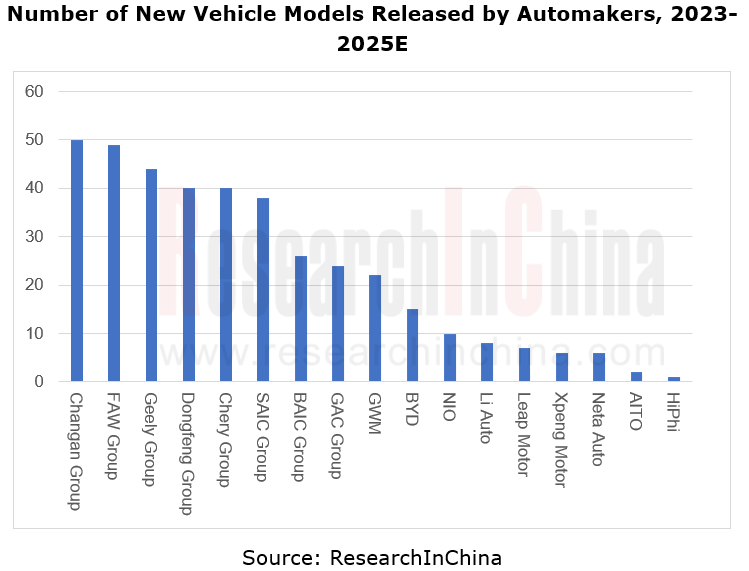
According to the summary on automakers’ strategic planning, automakers in China will launch about 388 new passenger car models (including brand new/refitted models) from 2023 to 2025, and Changan, FAW, Chery, Geely, SAIC, Dongfeng and other large groups stay far ahead in terms of number of new car models.
 Changan Auto plans to release 50 new models during 2023-2025, including 22 Changan brand models, 5 Qiyuan brand models (Changan’s newest brand), 12 Deepal brand models (6 all-new + 6 refitted), 4 Avatr brand models, and 7 joint venture brand models.
FAW Group plans to release 49 new models from 2023 to 2025, including 15 Hongqi brand models, 13 Bestune brand models, and 21 models under joint venture brands such as FAW Volkswagen, FAW Audi, FAW Jetta, and FAW Toyota.
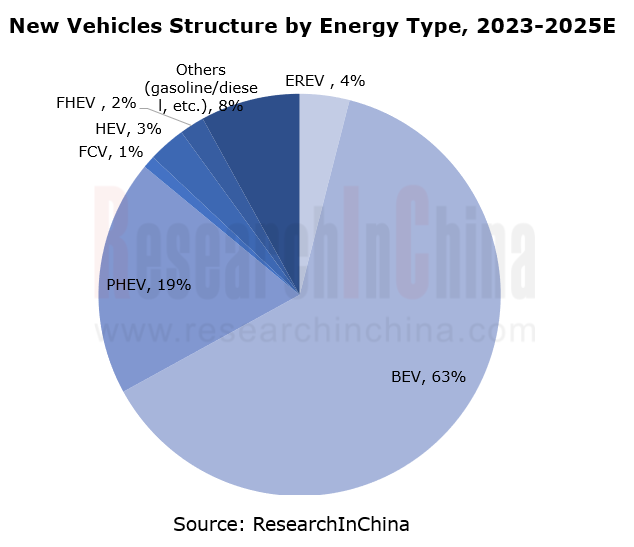
In terms of energy type, of the new vehicle models to be launched in the next three years, BEV will make up 63% and PHEV will share 19%, showing that automakers head in the direction of new energy. For example, FAW Group promotes its "All in" new energy strategy starting from 2023, and plans to launch 11 BEV models and 11 PHEV models in 2028.
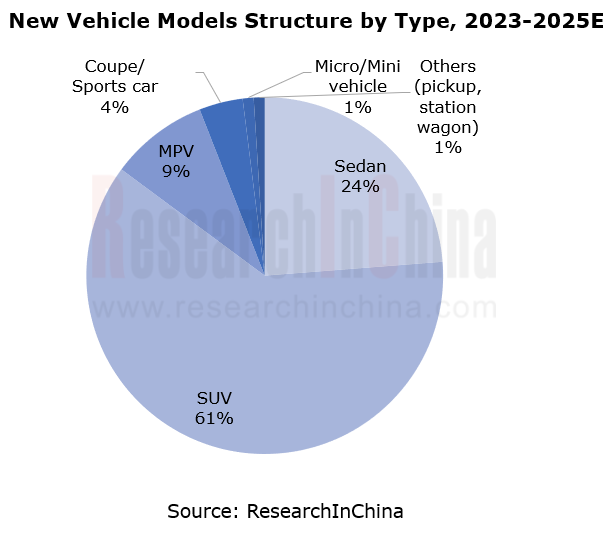
In terms of vehicle type, of the new vehicle models to be launched in the next three years, SUV will account for 61% and become the mainstream type. Among conventional OEMs, upcoming SUVs of Great Wall Motor and BYD will sweep more than 60% of the new vehicle models. Among emerging carmakers, SUVs to be launched by Li Auto and Leapmotor will take an over 70% share.
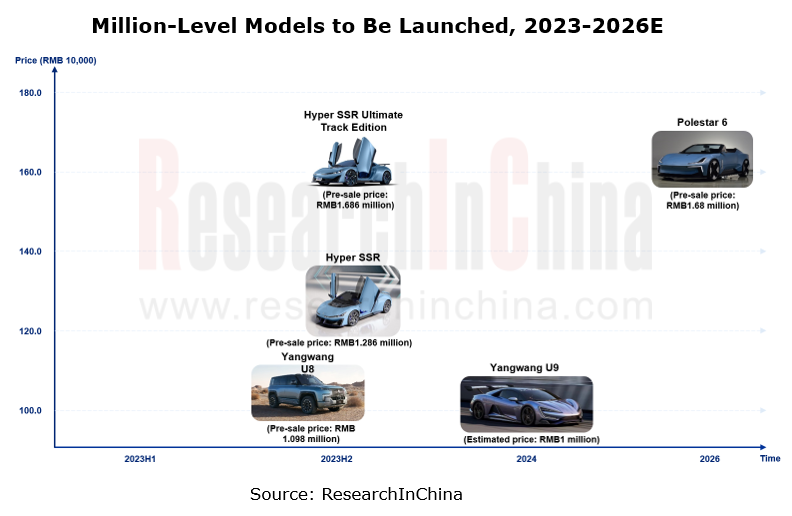
By price range, automakers still target models priced at RMB100,000-300,000. However, as brands orient to high-end market, some OEMs will enter million-level luxury vehicle market. Examples include Yangwang U8, BYD’s first all-electric SUV with a pre-sale price of RMB1.098 million; Yangwang U9, BYD’s all-electric sports car with a price estimated at around RMB1 million; Hyper SSR, GAC Aion’s supercar with a pre-sale price of RMB1.286-1.686 million; AITO’s all-electric MPV with an estimated price of around RMB1 million; and Polestar 6 with a pre-sale price of RMB1.68 million. These models are further explorations by Chinese independent brands in their efforts to advance upward.
2. Automakers create abundant brand matrices through multi-brand strategy.
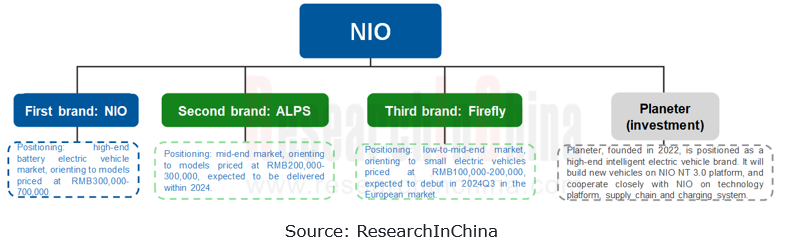
In the intelligence track, OEMs like Geely, GWM, and Chery, which suffered a setback in the strategy of "more brands for bigger market share", return to the multi-brand strategy. Moreover, BYD and NIO (emerging brand), which have been carrying out a single-brand strategy, have also made multi-brand layout, hoping to set up a high-end, intelligent product image by introducing new brands and creating a richer brand matrix.
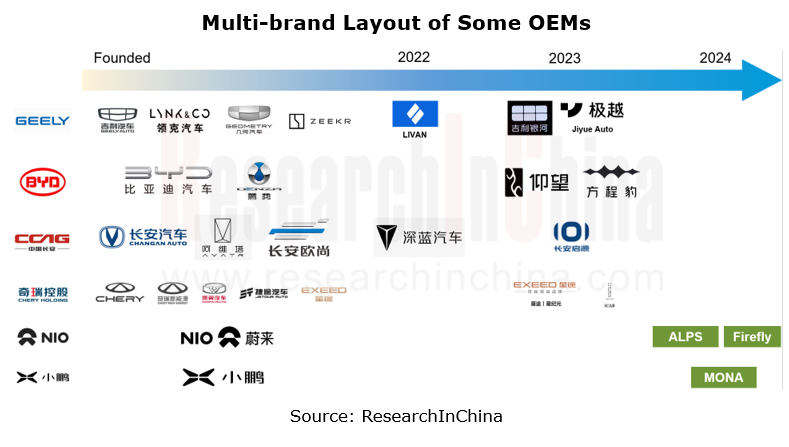
Geely Group has brewed three rounds of multi-brand strategy, and has boasted over 10 passenger car brands after a range of acquisitions and investments. In terms of brand layout, Geely targets low-to-mid-end fuel vehicle and hybrid electric vehicle markets below RMB120,000, with Emgrand + Vision series positioned in the low-end market below RMB100,000; Lynk & Co targets the mid-to-high-end market; Geometry, ZEEKR, and LIVAN build a solid foothold in the battery electric vehicle market, and target low-to-mid-end BEV, high-end BEV and battery-swap markets, respectively. In August 2023, Geely Holdings and Baidu jointly created the brand "Jiyue", which orients to high-end intelligent vehicle market.
In 2023, BYD Auto launched Yangwang and Formula Leopard, together with BYD (Dynasty and Ocean) and Denza constituting BYD’s four-brand matrix, which covers products from the household to the luxury, from the general to the personalized, meeting the needs of using vehicles in all scenarios.
Yangwang, positioned as a "high-end intelligent electric vehicle" brand, targets the high-end new energy vehicle market above RMB500,000, having unveiled million-level new energy models Yangwang U8 and U9.
Formula Leopard, positioned between Denza and Yangwang, insists on "providing new energy luxury vehicles only". It is BYD’s key layout in its attempt to complete the full range coverage "from household to luxury, from general to personalized". Formula Leopard’s products will cover hardcore SUVs, sports cars and other professional new energy vehicles.
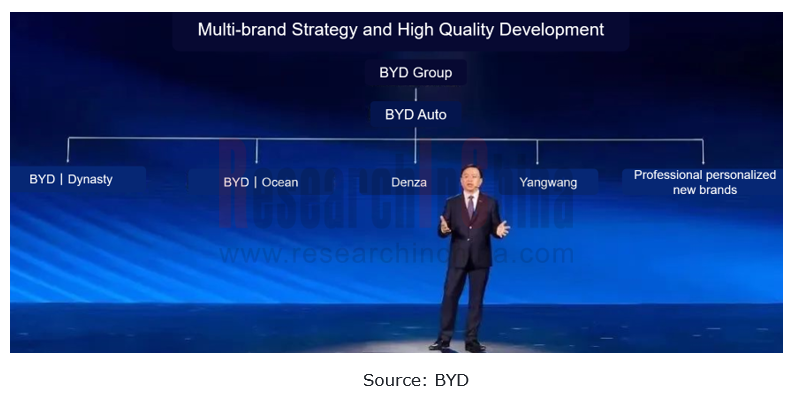
In 2024, NIO will launch its second brand, ALPS, and third brand, Firefly, forming a brand matrix with NIO brand, which will cover low-, mid- and high-end vehicles markets ranging from RMB100,000 to RMB700,000.
ALPS will build models based on NIO NT3.0 platform, supporting high-voltage fast charging technology. It targets mid-end models priced at RMB200,000-300,000. Its first product will be announced in late 2024.
Firefly works to develop A0/A00-class small cars, and equips them with L2+ driving assistance functions. It targets low-to-mid-end models priced at RMB100,000-200,000. The first product will be mass-produced in 2024 and begin to be delivered in the European market.
While trying hard to deploy its new brand matrix, NIO also invested tens of millions of US dollars (seed round) in electric vehicle startup Planeter (positioned as a high-end intelligent electric vehicle brand) in early 2023. NIO’s president describes this incubation project as NIO’s "strategic layout in the market segment". Planeter will build its first product on NIO’s NT3.0 platform, benchmarking against high-end luxury SUVs such as Land Rover Range Rover and Mercedes-Benz S-Class.
3. Central computing platform, large AI model, and urban NOA will come into mass production in the next 3-5 years.
In terms of product functions, China’s passenger car market will see mass production of central computing platform, large AI model and urban NOA among other functions in the 3-5 years to come.
1.Central computing platform
Starting from 2023, intelligent vehicles have entered a rapid iteration cycle of hardware architecture.
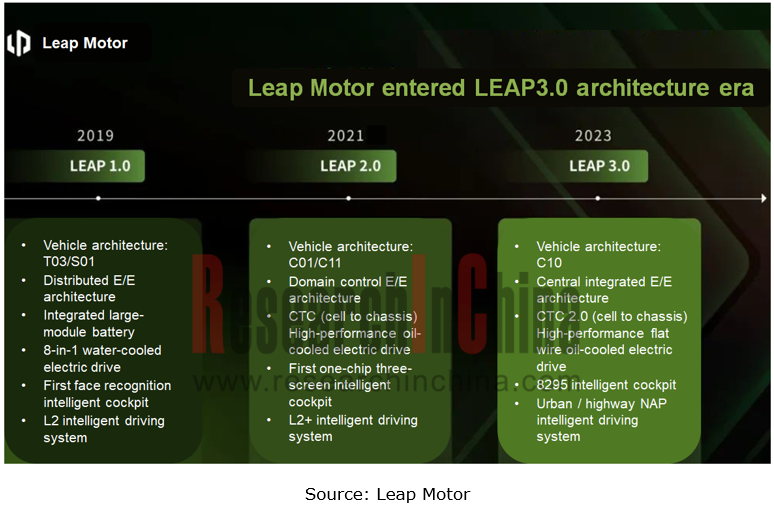
Leap Motor released LEAP 3.0 architecture in September 2023;
SAIC’s Z-ONE Galaxy Full-stack Solution 3.0 featuring "central computing + zone controller" will be mass-produced in 2024;
Geely will launch central computing platform architecture GEEA 3.0 in 2025.
According to technology plans announced by automakers, E/E architecture has evolved from the distributed to the current centralized. The release of new-generation E/E architecture also brings more comprehensive functions, including high computing performance, high functional safety/information security, and continuous software update capability.
For example, Leapmotor’s LEAP 3.0 architecture can cover A-E class models and multiple vehicle types, carries both EV and hybrid modes, and allows for unconscious vehicle OTA updates. Empowered by Leapmotor’s self-developed full-stank technologies, in LEAP 3.0 architecture the self-developed self-built components of Leapmotor take up 70% of vehicle cost, and the generalization rate of the architecture reaches up to 88%, effectively reducing cost and improving efficiency.
2. Large AI model
The combination of large AI models with intelligent vehicles brings far better intelligent driving and cockpit experiences, and enables a variety of functions such as human-machine natural interaction, voice control, knowledge quiz, and coding. For example, Chery STERRA voice assistant is added in LION AI model platform; Changan, Hongqi, Voyah, Great Wall, Geely, Dongfeng Nissan and Leapmotor among others connect Baidu ERNIE Bot large language model.
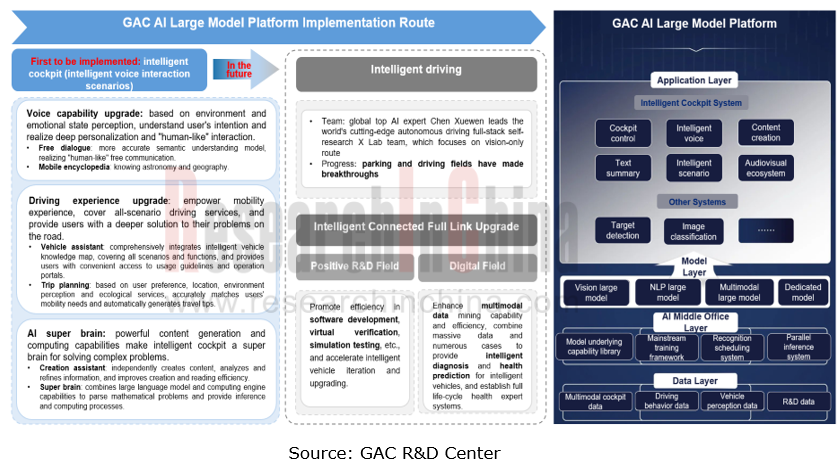
In August 2023, GAC launched its large AI model platform, which will be first available to intelligent voice interaction scenarios. This platform allows intelligent voice to combine benefits of various models, and uses vehicle local inference capabilities and cloud hybrid model technology for "accurate contextual semantic understanding". Coupled with GAC’s ADIGO MAGIC scenario co-creation platform and cloud ecosystem services, it comprehensively enhances voice intelligence and emotion, and upgrades the “Q&A” mode to no-threshold, instinctive and natural dialogue. It will be firstly applied to Hyper GT.
3. Advanced autonomous driving assistance
NOA function is a key breakthrough for automakers in their efforts to realize L3. Mature NOA solutions enable navigation-based urban and highway point-to-point autonomous driving. At present, automakers are making urban NOA layout. At the Shanghai Auto 2023, Xpeng Motor and Huawei first implemented urban NOA. In the second half of 2023, NOA solutions of NIO, Li Auto, Great Wall and other automakers will also be pushed.
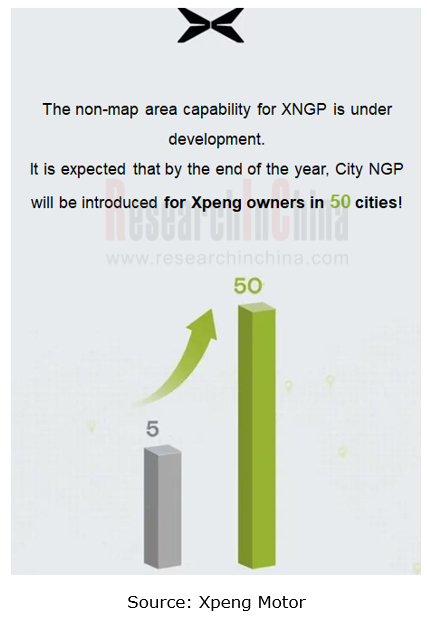
Xpeng’s City NGP has been introduced in 5 cities covered by HD maps. Xpeng plans to launch XNGP driving assistance technology in 50 cities by the end of 2023. It is also developing non-map area capability for XNGP.
In 2023, the first year of urban NOA, almost all leading companies in the new energy vehicle competition have released their own urban NOA plans. Their priority in the next 3-5 years is to provide urban coverage and promote vehicle models from top to bottom.
Autonomous Driving Domain Controller and Central Computing Unit (CCU) Industry Report, 2026
Autonomous Driving Domain Controller (ADCU) Research: One-Chip CCU solutions are quickly available in vehicles
In China's passenger car market, autonomous driving systems involved in mass production ...
Automotive EMS and ECU Industry Research Report, 2026
Automotive EMS Research: The boundaries between EMS providers and Tier1 suppliers are becoming blurred, and the supply chain model is evolving from a linear chain to a networked structure
Mainstream ...
Automotive Microcontroller Unit (MCU) and Application Scenario Research Report, 2026
Automotive MCU Research: Increased demand for redundant security drives ASIL D-compliant MCU shipments to exceed 100 million units
In a vehicle EEA, MCUs are widely distributed in various functional ...
China Intelligent Cockpit Patent Analysis Report, 2026
Intelligent Cockpit Patent Research: Cockpit AI, In?vehicle Health, and Infotainment Are Upgrade to Scenario?based and Proactive Functions
From a patent perspective, this report explores the cutting?...
Research Report on Application of VLA Large Model in Automobiles and Robots, 2026
Research on Automotive and Robot VLA: Hybrid Architectures Become Mainstream, VLA Integrates with General World Models, and Reinforcement Learning Serves as Core Engine
Vision?Language?Action (VLA) m...
China Charging Infrastructure (Supercharging, Battery Swapping, V2G, etc.) and High-Performance Supercharging Battery Research Report, 2026
Charging and battery swapping research: as 5C+ supercharging vehicle models go into mass production, the pace of OEMs self-building supercharging networks quickens
800-1000V high-voltage platforms ar...
China Passenger Car Electronic Controlled Suspension Industry Report, 2026
Electronic Controlled Suspension Industry Research: As the First Year of Full Active Suspension Unfolds, Three Technical Routes Race Forward
1. Penetration Rate Surges Three Times, and Electronic Con...
Intelligent Driving SoC Research Report, 2026
Research on Intelligent Driving SoCs: Competition Focus Shifts to L3/L4 Embedded Hardware, and Computing Power of Flagship Vehicle Models Exceeds 1,000 TOPS
In terms of intelligent driving system in...
Automotive AI Large Model Technology Research Report, 2026
Automotive AI Large Model Research: Competition Shifts from "Who Has the Stronger Model" to "Who Boasts Higher Link Efficiency"
ResearchInChina released the Automotive AI Large Model Technology Resea...
Intelligent Vehicle Cockpit Domain Controller Research Report, 2026
Cockpit domain controller research: L3 AIDV intelligent cockpit domain controllers are entering a boom period
Driven by multiple factors such as the continuous evolution of the automotive central int...
Automotive Acoustic System (Audio, Multi-Channel) Industry Report, 2026
Automotive Acoustics Research: Multiple Channels, AI Tuning, and Self-Developed Algorithms Drive the Transformation of High-End Cockpit Sound Fields
I. Automotive Audio Hardware Solutions with 6–9 S...
Autonomous Driving Sensor Chip Research Report, 2026
Research on Autonomous Driving Sensor Chips: Deeply Perceiving the Physical World, Sensor Chips Are Playing A “Leading Role” in Intelligence
In 2026, the autonomous driving sensor chip industr...
Passenger Car Corner Module and Wheel‑Side Control System Research Report, 2026
Wheel-side control research: the “last mile” chassis innovation
Wheel-side control dismantles the traditional drive, braking, steering, and suspension control of the chassis from a "centralized" styl...
Embodied Artificial Intelligence (& Humanoid Robot) MCU Research Report, 2026
Research on Humanoid Robot MCUs: Evolution from General-Purpose Control to High-Value Dedicated Chip Solutions Integrated with Edge AI Functions
MCU (Microcontroller Unit) refers to a compact integra...
Intelligent Vehicle Zone Control Unit (ZCU) Research Report, 2026
ZCU Research: Cross-domain integrated ZCUs are becoming the edge computing nodes of the next-generation zonal architecture
Currently, the mainstream zonal architecture is mainly the quasi-central + z...
Automotive Cybersecurity and Data Security Research Report, 2026
Cybersecurity & Data Security Research: Intelligent Connected Vehicles Enter the Era of “Systematic Offense-Defense and AI-Defined Security”.
Centering on the panorama of intelligent connect...
Report on Breakthrough Strategies of OEMs and ADAS Tier 1 Suppliers for Overseas Layout of Intelligent Driving, 2026
Regulatory Breakthrough, Local System Establishment, OEMs Competing for NOA Layout: Overall Trends of China’s Intelligent Driving Overseas Layout in 2026
Research on overseas intelligent driving layo...
OEMs and Tier1s’ Intelligent Cockpit Platform (Hardware and Software) Innovation Strategy Research Report, 2026
Intelligent Cockpit Platform Research: multi-dimensional cockpit system architecture reconstruction for multi-agent collaboration and proactive intelligent services
The intelligent cockpit software s...