Autonomous driving is rapidly advancing from highway NOA to urban NOA, and poses ever higher technical requirements for high-precision positioning, highlighting the following:
1. Higher accuracy: urban lanes are changeable and traffic flow is complex. In particular, to achieve urban NOA in complex areas such as urban intersections, it needs centimeter-level high-precision positioning accuracy;
2. Introduction of PPP-RTK: PPP and RTK technologies are unified at the algorithm level for fast, real-time and high-precision positioning. Moreover, PPP-RTK can support both satellite broadcast and mobile communication modes, of which satellite broadcast can use low-orbit satellites;
3. Dual-frequency RTK is mainstream: in the industry there is a common belief that dual-frequency RTK has become mainstream after years of iteration, and it enables higher precision positioning, playing a critical role in the development of urban NOA technology;
4. Deep coupling algorithm is superior: compared with loose coupling and tight coupling technologies, deep coupling can effectively improve the accuracy and reliability of integrated navigation, especially in harsh environments like urban overpasses and roundabouts, and can greatly reduce positioning errors;
5. Introduction of low-orbit satellites: in urban scenarios where signals are often blocked by high-rise buildings and overpasses, the use of low-orbit satellites can enhance signal coverage and further improve reliability of satellite signals.
The application of low-orbit satellites in autonomous driving helps improve accuracy of high-precision positioning.
Low-orbit satellites offer some benefits in the fields of autonomous driving and even intelligent transportation and smart city. For example, in remote areas covered by unstable signals, they are a solution to the problem of insufficient positioning accuracy and real-time connection.
During the 19th Asian Games Hangzhou and the Hangzhou 4th Asian Para Games, Geespace used aerospace technology to support the Hangzhou Asian games, providing stable, safe, and uninterrupted satellite application services for nearly 2 months. On September 3, 2023, Geely delivered more than 2,000 officially designated vehicles to the Asian Games Organizing Committee. These vehicles are equipped with high-precision positioning products provided by Geespace, an arm of Geely. Relying on the high-precision positioning products and services, the location information of each of the vehicles is displayed in real time and accurately on the map of the Traffic Command Center of the Asian Games Organizing Committee, enabling precise management and scheduling of vehicles to ensure the mobility safety of the official designated vehicles for the Asian Games. In addition, some vehicles pack Geespace’s satellite communication terminals, further ensuring mobility safety.
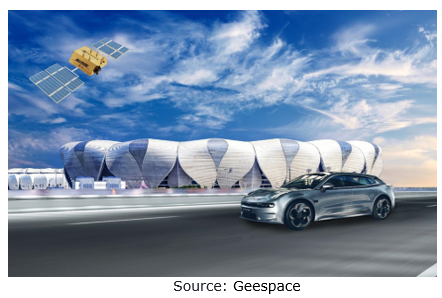
Geespace: it is a technology start-up under Geely Holding Group and China’s only private commercial aerospace company that has built a commercial closed loop. It has implemented vehicle satellite application products and services on large scale. In June 2022, it successfully launched the first nine self-developed “GeeSAT” satellites at one time.
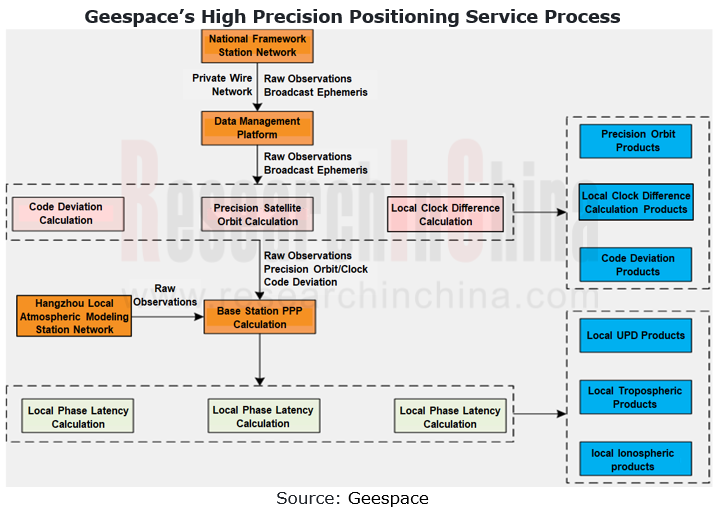
Based on the self-developed low-orbit satellite system and constellation ground-based data station network, Geespace “GeeSAT” satellites build an intelligent space-time base, and make full use of the Beidou-3 system to provide industry-leading satellite-based high-precision positioning services and satellite communication services.
In the field of high-precision positioning, Geespace’s satellite-based high-precision positioning services have been largely available to vehicles for the first time in the world. On typical autonomous driving routes, Geespace’s satellite-based high-precision positioning services deliver positioning accuracy better than 10 centimeters (CEP95), higher than the industry level of 20 centimeters (CEP95), and up to the world’s leading level.
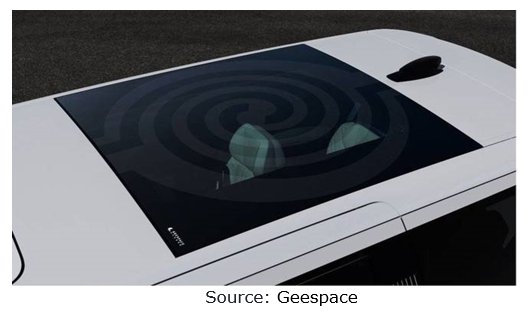
In the field of satellite communications, Geespace self-developed the world's first satellite communication terminal for production vehicles, Jishixun?, and has produced and used it in quantities. This terminal was first mounted on ZEEKR 001 FR, providing two-way satellite messaging and satellite call services. In addition, in terms of installation form in vehicles, Geespace has developed a high-throughput satellite Internet terminal featuring "vehicle-terminal" integrated design. The use of phased array technology allows it to be hidden into the existing shape of vehicles, without the antenna protruding. At present, Geespace’s satellite communication integrated vehicle glass antenna has also been tested, making the sunroof of vehicles turn into an antenna that integrates multiple communication capabilities in the future.
With the core technologies of GeeSAT and independent R&D capabilities, Geespace has built a full-stack software and hardware integrated product matrix covering data and algorithm services, chip-module-terminal products, and industry solutions, which are widely used in new energy vehicles, consumer electronics like drones, and public service fields. Geespace has built a complete R&D quality management system, achieved full-link management of software and hardware from requirements import to project filing, and then to technology R&D, test and acceptance, and mass production and delivery, expediting the creation of a commercial application closed loop.
P-box starts mass adoption in vehicles, and major suppliers scrabble for market share.
With regard to installation form of high-precision positioning in vehicles, currently GNSS and IMU are installed separately, integrated into an independent box (P-box), or directly attached into the domain controller. For P-box is calibrated before leaving factory, it features mature process and low cost. It is currently a cost-effective high-precision positioning option for automakers. It has now entered the phase of mass production and delivery. It is expected that for some time to come P-box will gradually become the mainstream installation form of high-precision positioning in vehicles.
In China, mainstream P-box suppliers such as Asensing and DAISCH have spawned P-box and installed it in vehicles. At present, Asensing prevails in the P-box market and its P-box has been widely used by Chinese independent auto brands:
Hyper GT, the flagship model of Hyper, a high-end luxury brand under GAC Aion, carries Asensing’s high-precision integrated positioning system, enabling centimeter-level high-precision global positioning;
"AD Max Intelligent Driving System" of Li Auto is equipped with P-Box, a high-precision integrated navigation and positioning system developed by Asensing;
Boyue L released by Geely packs P-Box, Asensing’s high-precision integrated positioning system;
NID3.0 advanced intelligent driving assistance system for Changan Deepal SL03 is equipped with P-Box, Asensing’s high-precision integrated positioning system.
As established P-box suppliers secure orders frequently, more players are attracted to enter the market.
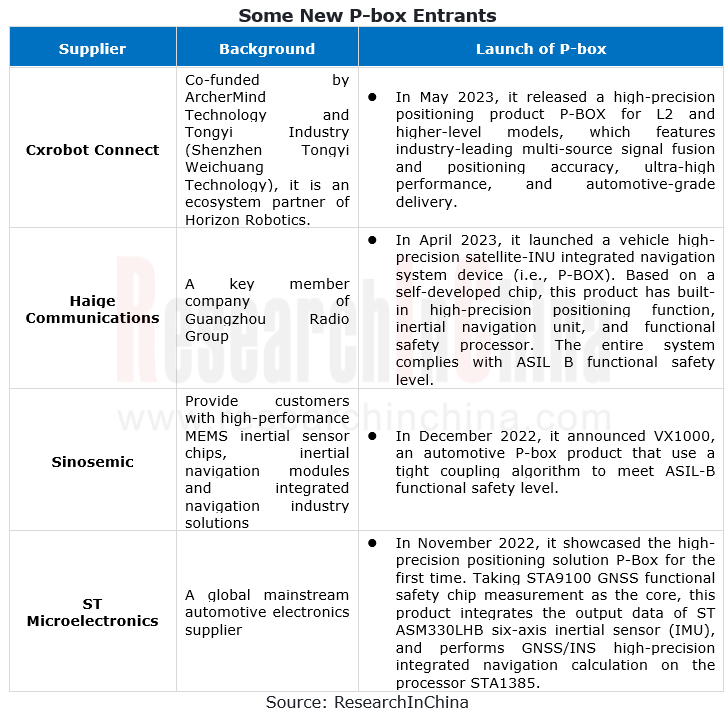
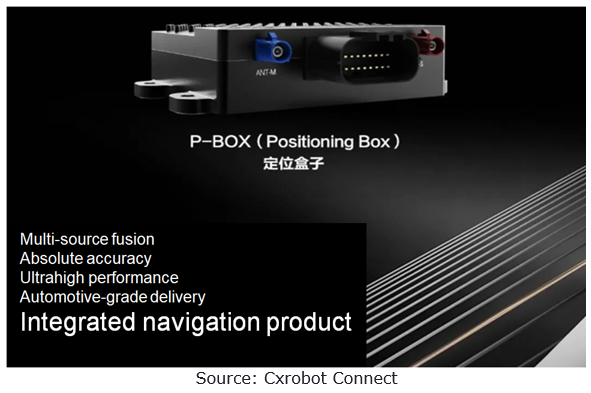
Cxrobot Connect: co-funded by ArcherMind Technology and Tongyi Industry (Shenzhen Tongyi Weichuang Technology), this company is an ecosystem partner of Horizon Robotics. In May 2023, it released a high-precision positioning product P-BOX for L2 and higher-level models, which features industry-leading multi-source signal fusion and positioning accuracy, ultra-high performance, and automotive-grade delivery.
High-precision positioning solutions for next-generation electronic/electrical architecture
In the future, the centralization and integration of automotive E/E architecture will be a megatrend. While laying out P-box, some suppliers therefore are also working to develop products that integrate positioning modules into domain controllers.
In addition, OEMs also try hard to pursue lower vehicle hardware cost. The domain controller integration helps to lower the requirements for hardware and increase the complexity of algorithms, so as to ultimately achieve the goal of cost control.
In currant stage there are mainly several ways to integrate high-precision positioning hardware into domain controllers:
1. Integrate IMU separately into the domain control board;
2. Integrate GNSS and IMU separately into the domain control board;
3. Integrate the module composed of GNSS and IMU into the domain control board.
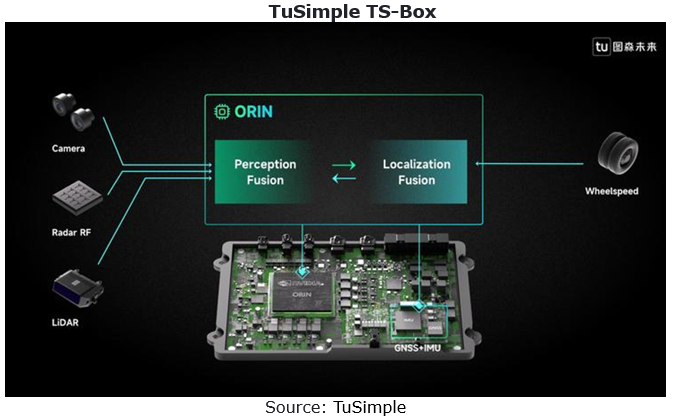
In April 2023, TuSimple launched TS-Box, a domain control centralized perception box that is designed according to commercial vehicle operating conditions, but supports both commercial vehicle and passenger car scenarios. It is expected to be mass-produced and delivered in 2024.
TuSimple TS-Box integrates TuSimple's self-developed autonomous driving domain controller, 4D radar solution, centralized RTK-GNSS/INS positioning module, and perception and positioning fusion algorithms. Compared with purchasing each component separately, TS-Box can cut down the overall cost by about 25%.
High Precision Positioning Industry Report, 2023-2024 highlights the following:
 Autonomous driving high-precision positioning industry (policies & standards, market size, market pattern, etc.);
Main autonomous driving high-precision positioning technologies (GNSS, IMU, GNSS+IMU integrated positioning, etc.) (supplier pattern, technology trends, etc.)
The main development trends of autonomous driving high-precision positioning technologies (fusion algorithm, PPP-RTK, low-orbit satellite, etc.);
Autonomous driving high-precision positioning in vehicles (new integration modes, installation by OEMs, installation scale, etc.);
Classification of main application scenarios of high-precision positioning in autonomous driving (highway NOA, urban NOA, AVP, autonomous delivery, autonomous trucks, etc.);
High-precision positioning basic service companies (technology layout, developments, etc.);
High-precision positioning module suppliers (profile, product layout, technology status, product application, etc.).
China Charging Infrastructure (Supercharging, Battery Swapping, V2G, etc.) and High-Performance Supercharging Battery Research Report, 2026
Charging and battery swapping research: as 5C+ supercharging vehicle models go into mass production, the pace of OEMs self-building supercharging networks quickens
800-1000V high-voltage platforms ar...
China Passenger Car Electronic Controlled Suspension Industry Report, 2026
Electronic Controlled Suspension Industry Research: As the First Year of Full Active Suspension Unfolds, Three Technical Routes Race Forward
1. Penetration Rate Surges Three Times, and Electronic Con...
Intelligent Driving SoC Research Report, 2026
Research on Intelligent Driving SoCs: Competition Focus Shifts to L3/L4 Embedded Hardware, and Computing Power of Flagship Vehicle Models Exceeds 1,000 TOPS
In terms of intelligent driving system in...
Automotive AI Large Model Technology Research Report, 2026
Automotive AI Large Model Research: Competition Shifts from "Who Has the Stronger Model" to "Who Boasts Higher Link Efficiency"
ResearchInChina released the Automotive AI Large Model Technology Resea...
Intelligent Vehicle Cockpit Domain Controller Research Report, 2026
Cockpit domain controller research: L3 AIDV intelligent cockpit domain controllers are entering a boom period
Driven by multiple factors such as the continuous evolution of the automotive central int...
Automotive Acoustic System (Audio, Multi-Channel) Industry Report, 2026
Automotive Acoustics Research: Multiple Channels, AI Tuning, and Self-Developed Algorithms Drive the Transformation of High-End Cockpit Sound Fields
I. Automotive Audio Hardware Solutions with 6–9 S...
Autonomous Driving Sensor Chip Research Report, 2026
Research on Autonomous Driving Sensor Chips: Deeply Perceiving the Physical World, Sensor Chips Are Playing A “Leading Role” in Intelligence
In 2026, the autonomous driving sensor chip industr...
Passenger Car Corner Module and Wheel‑Side Control System Research Report, 2026
Wheel-side control research: the “last mile” chassis innovation
Wheel-side control dismantles the traditional drive, braking, steering, and suspension control of the chassis from a "centralized" styl...
Embodied Artificial Intelligence (& Humanoid Robot) MCU Research Report, 2026
Research on Humanoid Robot MCUs: Evolution from General-Purpose Control to High-Value Dedicated Chip Solutions Integrated with Edge AI Functions
MCU (Microcontroller Unit) refers to a compact integra...
Intelligent Vehicle Zone Control Unit (ZCU) Research Report, 2026
ZCU Research: Cross-domain integrated ZCUs are becoming the edge computing nodes of the next-generation zonal architecture
Currently, the mainstream zonal architecture is mainly the quasi-central + z...
Automotive Cybersecurity and Data Security Research Report, 2026
Cybersecurity & Data Security Research: Intelligent Connected Vehicles Enter the Era of “Systematic Offense-Defense and AI-Defined Security”.
Centering on the panorama of intelligent connect...
Report on Breakthrough Strategies of OEMs and ADAS Tier 1 Suppliers for Overseas Layout of Intelligent Driving, 2026
Regulatory Breakthrough, Local System Establishment, OEMs Competing for NOA Layout: Overall Trends of China’s Intelligent Driving Overseas Layout in 2026
Research on overseas intelligent driving layo...
OEMs and Tier1s’ Intelligent Cockpit Platform (Hardware and Software) Innovation Strategy Research Report, 2026
Intelligent Cockpit Platform Research: multi-dimensional cockpit system architecture reconstruction for multi-agent collaboration and proactive intelligent services
The intelligent cockpit software s...
Automotive AIOS Research Report, 2026
Automotive AIOS Research: Mass Production Solutions Are Implemented
Mass Production Solutions Are Implemented on A Small Scale.
In 2026, AIOS starts small-scale implementation, helping to improve v...
Automotive Telematics Service Provider (TSP) Research Report, 2026
TSP Research: Leading providers collectively turn to AI agents to provide all-scenario active services
Telematics Service Providers (TSPs) are the core hub of the telematics industry chain, connectin...
Automotive Smart Interior Research Report, 2026
Smart Interior Research: As Technologies like Interactive Starlight Headliner, Hidden Display and Surface Projection Are Launched, Automotive Interiors Become Ever More Intelligent
The Automotive Sma...
Research Report on AI Applications in Cockpits, 2026
AI Application in Cockpits: AI Services Become More Comprehensive, Convenient, and Refined.
In the first half of 2026, cockpit AI functions underwent initial upgrades across multiple dimensions, inc...
Software-Defined Vehicles in 2026: OEM Software Development and Supply Chain Deployment Strategy Research Report
Research on OEMs’ Software Strategies: R&D Focus, Development Strategies and Supplier Building Models of 30 OEMs
In this paper, we adopt a research framework covering 13 subsystems and 48 sub-di...