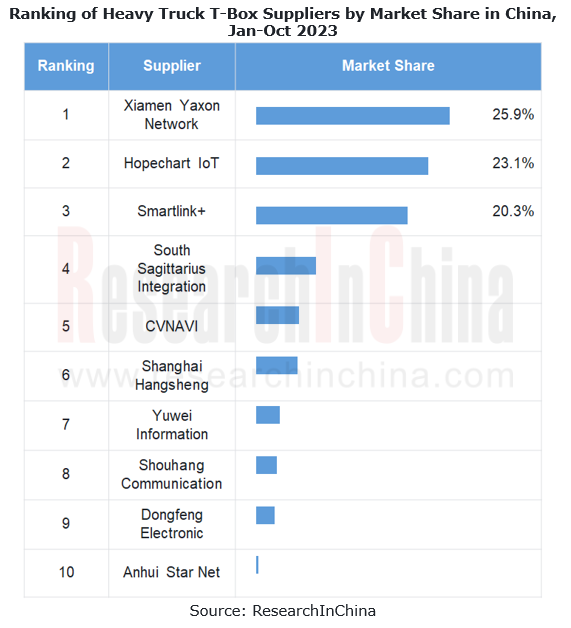
The market tends to be more concentrated in leading companies in terms of hardware.
The commercial vehicle telematics industry chain covers several key links such as OEMs, operators, terminal device manufacturers, communication service providers, and content service providers, and the market value is mainly distributed among hardware manufacturers and service operators. Wherein, hardware, the basis for realizing telematics, mainly includes T-Box, driving recorder, human-computer interaction terminal, and smart gateway.
T-Box: It is a telematics information exchange center, which can communicate directly with vehicle CAN, collect, transmit and analyze data such as vehicle status and condition, and then upload the data and analysis results to the backend via the mobile communication network. It can also receive the commands issued by the backend and send back execution results, achieving the purpose of reducing vehicle loss, fuel consumption and carbon emission and improving operation efficiency. In the field of commercial vehicles, telematics services with T-Box as the data center are oriented to business, consumer and government users, and empower them in multiple dimensions, helping automakers to supervise and manage vehicles in full life cycle, fleets to cut down cost and improve efficiency, dealers to reduce financial risks, and drivers to enhance vehicle use experience.
Driving recorder: it is a special digital recording device installed on large passenger and goods vehicles to record such data as vehicle speed, time and location, according to "Regulations on Implementation of Road Traffic Safety Law" and "Technical Specifications for Safety of Power-driven Vehicles Operating on Roads" (GB 7258).
IVI: As a vehicle intelligent terminal, center console screen is the core outlet of information and functions related to in-vehicle human-computer interaction, telematics, ADAS, infotainment system, fleet management system, and repair & maintenance. It not only enhances driver's experience, but also is of great significance to reducing fuel consumption and cost and improving vehicle efficiency. From early 7 inches to current mainstream 8 inches and 10 inches, and then gradually to 12 inches, large touch screens have become a design trend of truck center console screen in recent years.
Smart gateway: It is an entry point that allows vehicles to communicate with the outside world. For example, SAIC Maxus’ Smart Gateway 2.0 integrates 5G communication terminals, wireless communication WIFI module, high-precision positioning module, electronic exterior rearview mirror module and V2X module, and can flexibly adapt to various platform projects of commercial vehicles and passenger cars to enable more optimized comprehensive costs of related products and meet more intelligent needs at the same cost.
As leading players gain greater technical strength and their supply relationships become stable, the commercial vehicle hardware device market tends to be more concentrated in leading companies. In H1 2023, TOP3 suppliers (Xiamen Yaxon Network, Hopechart IoT and Smartlink+) took a combined 71.4% share in the heavy truck T-Box market. With regard to supply relationships, Xiamen Yaxon Network mainly supported Sinotruk, Foton and JAC.; Hopechart IoT was a supplier of Shaanxi Automobile, Beiben and Foton; Smartlink+, a joint-venture subsidiary of FAW Jiefang, had its T-Box products downwards adapting to T-Box hardware of multiple manufacturers in software and hardware separation mode, and upwards was tightly bond with FAW, with a surging market share.
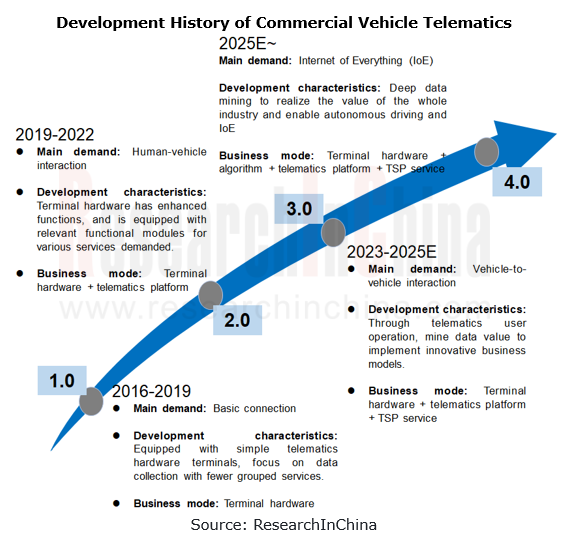
The market more needs a hardware + algorithm + platform + service integrated business model.
Commercial vehicle telematics has passed through Phase 1.0 (basic connection) and Phase 2.0 (human-vehicle interaction), and is now entering Phase 3.0 (V2V interaction/Internet of everything). As edge computing, cloud storage and other infrastructures develop and the demand for connected services for different scenarios increases, the hardware + algorithm + platform + service integrated business model makes it easier to enable multi-dimensional vehicle data interaction and provides differentiated scenario services for users. It will become a mainstream business model of commercial vehicle telematics in the future.
In the process of promoting connected and intelligent upgrade, how to break down the barriers between hardware, data, and service for integration of ecological resources is a big enduring problem faced by OEMs. Wherein, openness of OEM data and responsiveness of supplier services is the key to vehicle intelligence. On this basis, some OEMs try to break down this barrier by way of setting up subsidiaries specializing in telematics. Examples include Smartlink+ set up by FAW Jiefang and iTink set up by Foton Motor.
Smartlink+ is a joint venture subsidiary established by FAW Jiefang in 2020. It provides complete T-Box-centered solutions of hardware, algorithm, platform and service in the field of commercial vehicle telematics, which can help drivers and other consumer users expand value-added services and also assist business users such as OEMs and fleets reducing cost and improving efficiency.
Based on multi-dimensional big data (200+ kinds of vehicle raw data, 500+ kinds of label data pre-processed by intelligent devices, and 300+ kinds of scenario-based model calculation data), Smartlink+ can monitor and analyze different scenario applications of different vehicles. Coupled with financial platform, operation & management platform and fleet management platform, it can provide vehicle full lifecycle management services, digital fleet management services, intelligent vehicle eco-services, and intelligent vehicle control services for automakers, meeting the needs of automakers, dealers, fleets, as well as retail drivers.
iTink Telematics, a wholly-owned subsidiary of Foton, specializes in commercial vehicle telematics business, and has the ability to provide customers with hardware + platform + application + data + operation integrated solutions. Based on product data, telematics data and customer data and combing product characteristics data, it builds big data analysis models. Based on 436 data algorithms, it builds 158 data models and outputs 214 types of intelligent prediction results, which are intelligently pushed to prompt users through mobile phone + Foton e-Home + vehicle screen, and intelligently match tools, accessories and maintenance schemes to enhance service accuracy and efficiency.
Commercial vehicle telematics suppliers expand business towards AD/ADAS and intelligent cockpit.
In terms of intelligence and connectivity, commercial vehicles are developing along the path of passenger cars. For intelligence, dual warning functions have come into mass production, and L2 functions such as LKA and ACC will be largely seen in vehicles in the next 2-3 years. As for connectivity, as more sensors are used in vehicles, commercial vehicles will generate far more data, and need more vehicle connectivity and analysis technologies for predictive analysis. In addition, as new-generation drivers come into service, cockpit entertainment and interaction intelligence will become new development directions of telematics applications.
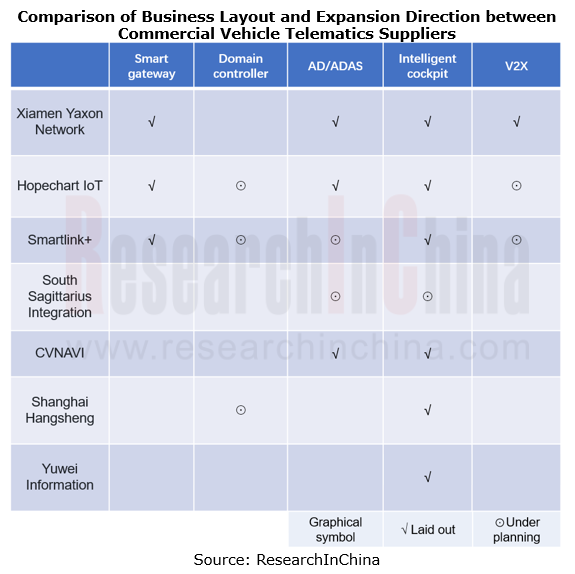
Commercial vehicle telematics suppliers head in the following detections in business expansion:
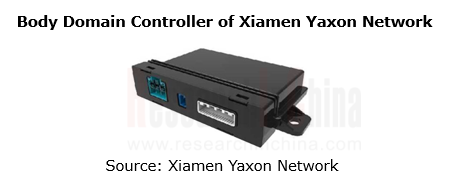
1. Smart gateway and domain controller: Leading OEMs such as FAW Jiefang, Sinotruk, and BAIC Foton are developing domain controller architectures, and connected terminals like T-Box will develop in the direction of domain control and gateway. The body domain controller developed by Xiamen Yaxon Network takes Ethernet as the core and integrates such functions as BCM, PEPS, TPMS and Gateway. It allows for addition of seat adjustment, rearview mirror control, air conditioning control and other functions, and finds application in all kinds of commercial vehicles and passenger cars for intelligent control.
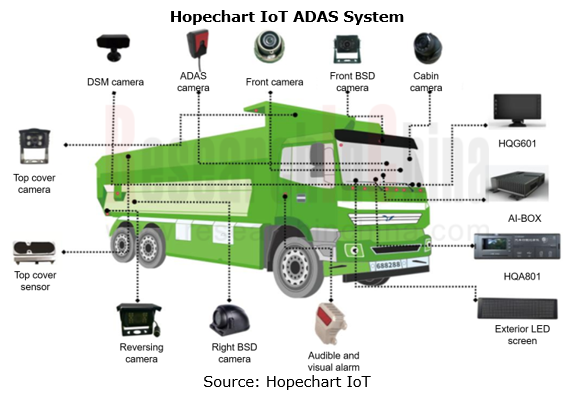
2. AD/ADAS: According to Intelligent Connected Vehicle Technology Roadmap 2.0, intelligent connected freight vehicles will realize conditional driving automation and platooning on highways by 2025, and high driving automation on highways by 2030. AD/ADAS is one of the expansion focuses of suppliers at this stage. Xiamen Yaxon Network, Hopechart IoT, and Smartlink+ among others combine ADAS map data and vehicle sensor data to develop PCC (Predictive Cruise Control), which saves energy through power optimization. According to test and verification by Jiefang Yingtu, the rate of fuel saving per 100km by PCC in commercial vehicles can reach 4%-8%. Moreover, Xiamen Yaxon Network, Hopechart IoT, and CVNAVI are developing BSD, DMS, and dual warning (FCW+LDW) systems to improve driving safety as the top priority. In the next step, suppliers will utilize data analysis and algorithms to improve system accuracy.
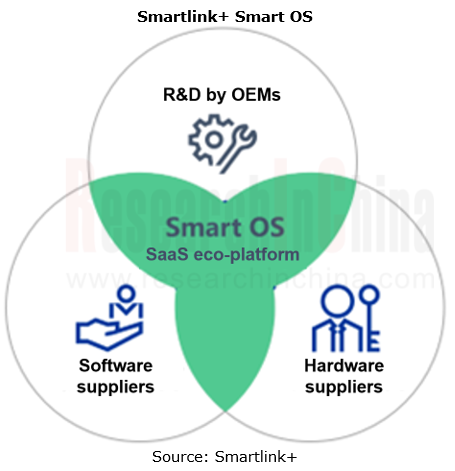
3. Intelligent cockpit: In the future, while developing towards intelligent cockpits for passenger cars, commercial vehicle cockpits will add more services for specific scenarios such as logistics and transportation, and cockpit OS developed specifically for commercial vehicle scenarios will become software foundation for cockpit intelligence. The most typical example is Smartlink+, which can link more ecosystems in line with commercial vehicle scenarios and provide users with richer intelligent vehicle ecosystem services, using Smart OS, a cockpit operating system with software-hardware separation architecture.
4. V2X: 5G network offers benefits of high bandwidth, low latency, high reliability, etc. In the field of commercial vehicle telematics, 5G plays a role in the following: ①Connection efficiency improvement; ②V2X application acceleration. For example, Xiamen Yaxon Network's V2X solution covers such scenarios as urban roads, highways, smart buses, autonomous ports, smart mines, and AVP-enabled parking lots.
Research Report on Application of VLA Large Model in Automobiles and Robots, 2026
Research on Automotive and Robot VLA: Hybrid Architectures Become Mainstream, VLA Integrates with General World Models, and Reinforcement Learning Serves as Core Engine
Vision?Language?Action (VLA) m...
China Charging Infrastructure (Supercharging, Battery Swapping, V2G, etc.) and High-Performance Supercharging Battery Research Report, 2026
Charging and battery swapping research: as 5C+ supercharging vehicle models go into mass production, the pace of OEMs self-building supercharging networks quickens
800-1000V high-voltage platforms ar...
China Passenger Car Electronic Controlled Suspension Industry Report, 2026
Electronic Controlled Suspension Industry Research: As the First Year of Full Active Suspension Unfolds, Three Technical Routes Race Forward
1. Penetration Rate Surges Three Times, and Electronic Con...
Intelligent Driving SoC Research Report, 2026
Research on Intelligent Driving SoCs: Competition Focus Shifts to L3/L4 Embedded Hardware, and Computing Power of Flagship Vehicle Models Exceeds 1,000 TOPS
In terms of intelligent driving system in...
Automotive AI Large Model Technology Research Report, 2026
Automotive AI Large Model Research: Competition Shifts from "Who Has the Stronger Model" to "Who Boasts Higher Link Efficiency"
ResearchInChina released the Automotive AI Large Model Technology Resea...
Intelligent Vehicle Cockpit Domain Controller Research Report, 2026
Cockpit domain controller research: L3 AIDV intelligent cockpit domain controllers are entering a boom period
Driven by multiple factors such as the continuous evolution of the automotive central int...
Automotive Acoustic System (Audio, Multi-Channel) Industry Report, 2026
Automotive Acoustics Research: Multiple Channels, AI Tuning, and Self-Developed Algorithms Drive the Transformation of High-End Cockpit Sound Fields
I. Automotive Audio Hardware Solutions with 6–9 S...
Autonomous Driving Sensor Chip Research Report, 2026
Research on Autonomous Driving Sensor Chips: Deeply Perceiving the Physical World, Sensor Chips Are Playing A “Leading Role” in Intelligence
In 2026, the autonomous driving sensor chip industr...
Passenger Car Corner Module and Wheel‑Side Control System Research Report, 2026
Wheel-side control research: the “last mile” chassis innovation
Wheel-side control dismantles the traditional drive, braking, steering, and suspension control of the chassis from a "centralized" styl...
Embodied Artificial Intelligence (& Humanoid Robot) MCU Research Report, 2026
Research on Humanoid Robot MCUs: Evolution from General-Purpose Control to High-Value Dedicated Chip Solutions Integrated with Edge AI Functions
MCU (Microcontroller Unit) refers to a compact integra...
Intelligent Vehicle Zone Control Unit (ZCU) Research Report, 2026
ZCU Research: Cross-domain integrated ZCUs are becoming the edge computing nodes of the next-generation zonal architecture
Currently, the mainstream zonal architecture is mainly the quasi-central + z...
Automotive Cybersecurity and Data Security Research Report, 2026
Cybersecurity & Data Security Research: Intelligent Connected Vehicles Enter the Era of “Systematic Offense-Defense and AI-Defined Security”.
Centering on the panorama of intelligent connect...
Report on Breakthrough Strategies of OEMs and ADAS Tier 1 Suppliers for Overseas Layout of Intelligent Driving, 2026
Regulatory Breakthrough, Local System Establishment, OEMs Competing for NOA Layout: Overall Trends of China’s Intelligent Driving Overseas Layout in 2026
Research on overseas intelligent driving layo...
OEMs and Tier1s’ Intelligent Cockpit Platform (Hardware and Software) Innovation Strategy Research Report, 2026
Intelligent Cockpit Platform Research: multi-dimensional cockpit system architecture reconstruction for multi-agent collaboration and proactive intelligent services
The intelligent cockpit software s...
Automotive AIOS Research Report, 2026
Automotive AIOS Research: Mass Production Solutions Are Implemented
Mass Production Solutions Are Implemented on A Small Scale.
In 2026, AIOS starts small-scale implementation, helping to improve v...
Automotive Telematics Service Provider (TSP) Research Report, 2026
TSP Research: Leading providers collectively turn to AI agents to provide all-scenario active services
Telematics Service Providers (TSPs) are the core hub of the telematics industry chain, connectin...
Automotive Smart Interior Research Report, 2026
Smart Interior Research: As Technologies like Interactive Starlight Headliner, Hidden Display and Surface Projection Are Launched, Automotive Interiors Become Ever More Intelligent
The Automotive Sma...
Research Report on AI Applications in Cockpits, 2026
AI Application in Cockpits: AI Services Become More Comprehensive, Convenient, and Refined.
In the first half of 2026, cockpit AI functions underwent initial upgrades across multiple dimensions, inc...