AUTOSAR Platform research: the pace of spawning the domestic basic software + full-stack chip solutions quickens.
In the trend towards software-defined vehicles, AUTOSAR is evolving towards a more open and cooperative ecosystem.
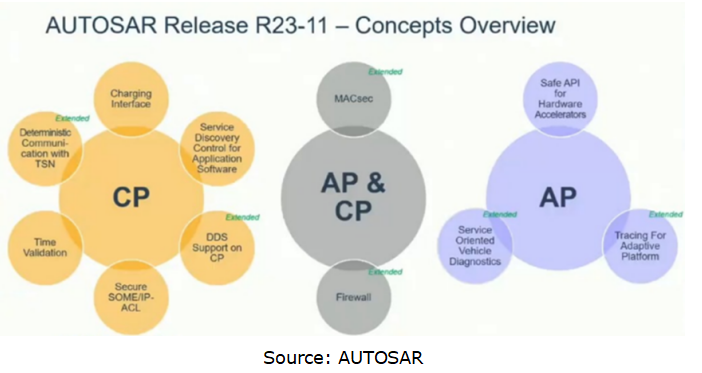
On December 7, 2023, AUTOSAR released the latest standard AUTOSAR Release R23-11. From a functional perspective, the update focuses on three aspects: information security, functional safety and communication protocol stack.
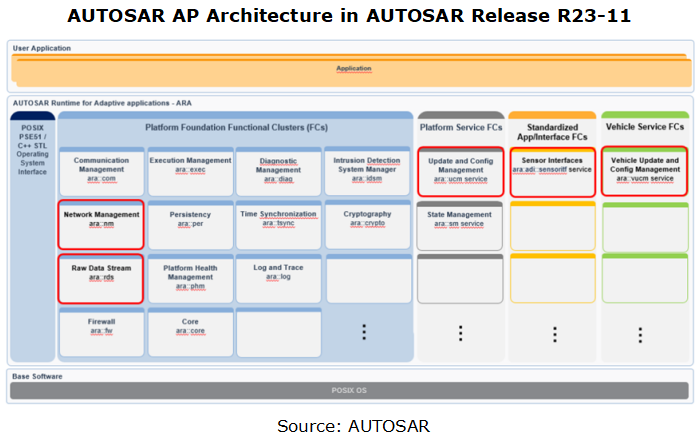
In the Release R23-11, the architecture of AUTOSAR Adaptive Platform (AP) is readjusted, and its functions are reorganized and described. The architecture is re-divided into Foundation, Platform Service, Standardized App/Interface and Vehicle Service.
Wherein, the function components (FC) of Vehicle Service are not required to be deployed on every Machine of the AP, but available within the vehicle. Platform Service is partially responsible for providing specific functions for a single AP Machine; Standardized App/Interface provides standard interfaces or applications; Foundation provides local functions and C++ library of an AP Machine.
In addition to continuous efforts to upgrade and improve functional standards, AUTOSAR will take a more open attitude and cooperate with other third-party organizations to build a new automotive ecosystem and favor the boom of the intelligent vehicle market, in the face of new trends such as software-defined vehicles.
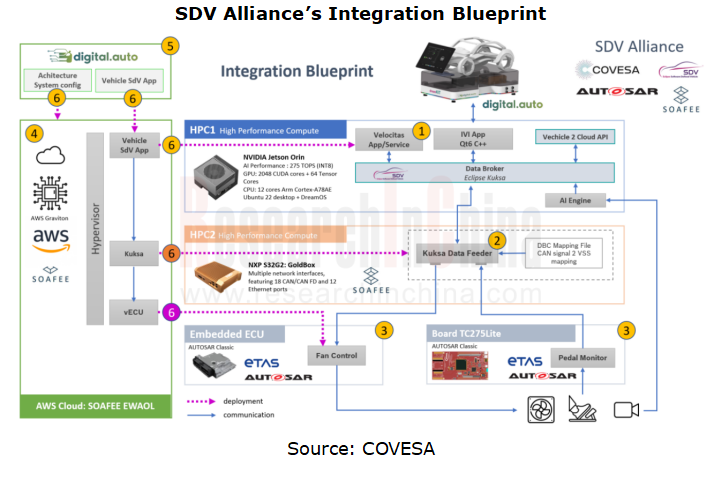
In March 2023, AUTOSAR, COVESA, Eclipse SDV and SOAFE jointly formed the SDV Alliance, a “collaboration of collaborations”. The main purpose of the collaboration is to align efforts in the SDV ecosystem. By embracing existing descriptions of SDV from each of these efforts, as well as other external organizations, the SDV Alliance will agree on a clear and unified definition of what constitutes an SDV.
The Alliance will then look at the different technologies, methodologies, and standards of each organization and show how they can work together for the development of the SDV. Recognizing that the SDV is conceptually too complex to be handled in a single industry consortium, and by looking at each of the organization’s core competencies and varied execution environments, the Alliance will pool these skills to create a joint SDV vision.
At CES 2024, the SDV Alliance announced its first integration blueprint, contributing to promoting software-defined vehicles.
Mass production of intelligent driving solutions based on AUTOSAR AP is increasing.
As autonomous driving domain controllers are spawned and installed in vehicles, supported by solutions of major suppliers, intelligent driving software based on AUTOSAR AP has also achieved mass production and application, and keeps increasing. As well as intelligent driving domain controllers for Volkswagen ID series that use AUTOSAR AP basic software, intelligent driving solutions for multiple vehicle models of Chinese independent brands, like Geely Boyue L and Changan NEVO A05, have also adopted AUTOSAR AP solutions since 2022.
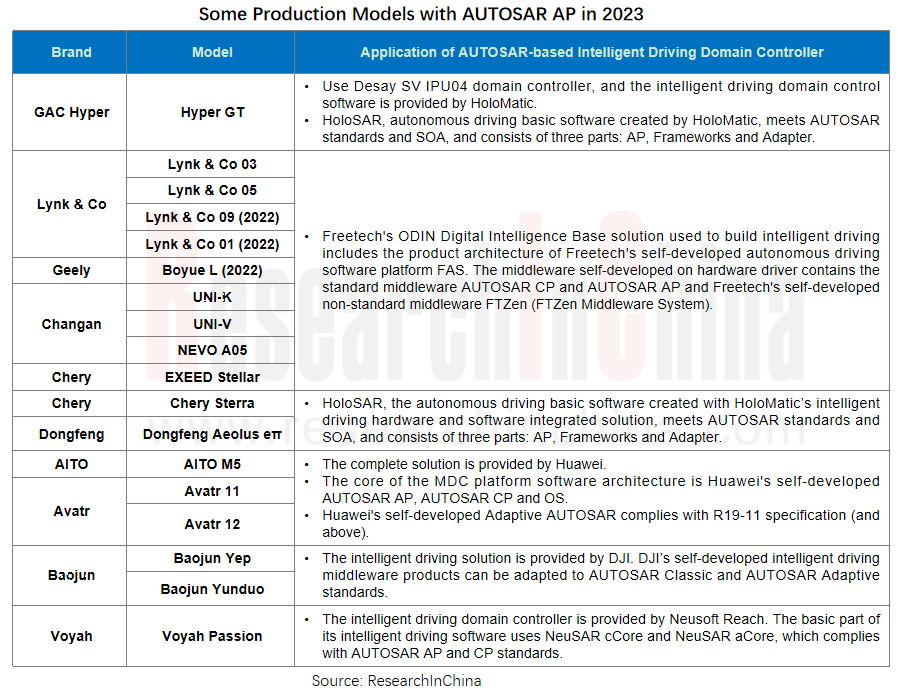
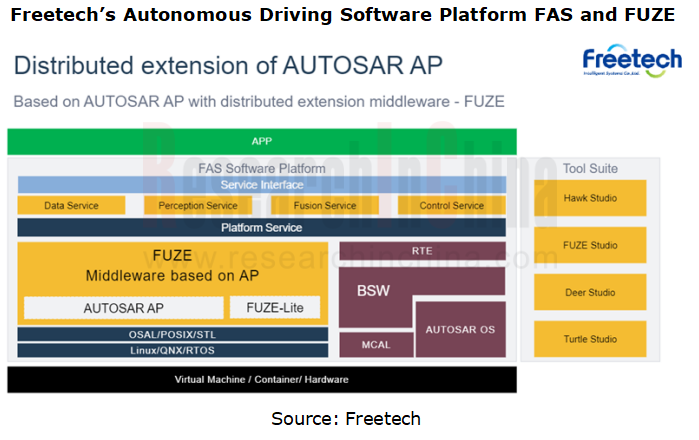
Freetech launched ODIN Digital Intelligence Base, a domain control solution that includes FAS, its self-developed autonomous driving software platform. FAS, middleware self-developed on hardware driver, contain standard middleware AUTOSAR CP and AUTOSAR AP and non-standard middleware FTZen (FTZen Middleware System), and enables EM management, status machine management, EOL, communication management and data services, node services and so on. Accordingly, the FAS toolchain also provides configurations for AP, CP, and non-standard middleware.
Based on ODIN Digital Intelligence Base, Freetech has launched multiple domain controller products such as ADC 15, ADC 20, ADC 25 and ADC30, and has mass-produced them.
AUTOSAR attracts increasing attention in the Chinese market, and localization is accelerating.
Driven by the boom of intelligent vehicles in China, AUTOSAR catches the increasing attention of the Chinese market, specifically:
First, AUTOSAR works hard on layout in the Chinese market. In 2022, the organization established China Center in the country. By organizing AUTOSAR-related public training, cooperating with universities, and holding AUTOSAR open conferences, it makes greater efforts to promote and improve its services in the Chinese market.
Moreover, the number of AUTOSAR’s Chinese members is increasing, and they have a bigger say. The number of AUTOSAR’s members in China increased from 21 in 2019 to over 60 in 2023, and Neusoft Reach, iSoft, Jingwei HiRain are all its premium partners. In 2023, Huawei became AUTOSAR’s Premium Partner Plus (there are only three worldwide, and the other two are Vector and Denso). Premium Partner Plus need to send a Project Leader to participate in management of formulation of AUTOSAR standards, and co-decision on standardization, In the future, ever more Chinese voices will be heard in formulation of AUTOSAR specifications.
Second, in China there are increasing software vendors using AUTOSAR. Neusoft Reach, iSoft, Jingwei HiRain, Huawei, Baidu, EnjoyMove Tech, HoloMatic Technology, Freetech, Novauto, Hinge Tech, Zhicong Technology, and CICV among others make product layout in line with AUTOSAR standards.
Third, in the trend towards localization of automotive chips and OS in China, AUTOSAR software vendors vigorously adapt to domestic MCUs and other chip products, accelerating mass production and application of Chinese full-stack solutions. Under the wave of localization of basic software and chips, there is an increasing demand for independent R&D of automotive software platforms. In China, AUTOSAR-based software development has also transitioned from the "introduction phase" to the "application phase", and will enter the "innovation phase" in the future, absorbing the quintessence of AUTOSAR and empowering independent automotive software development. In recent years, quite a few basic software vendors have worked on adaptation to domestic MCU and OS products to accelerate the mass production of domestic solutions and application in vehicles.
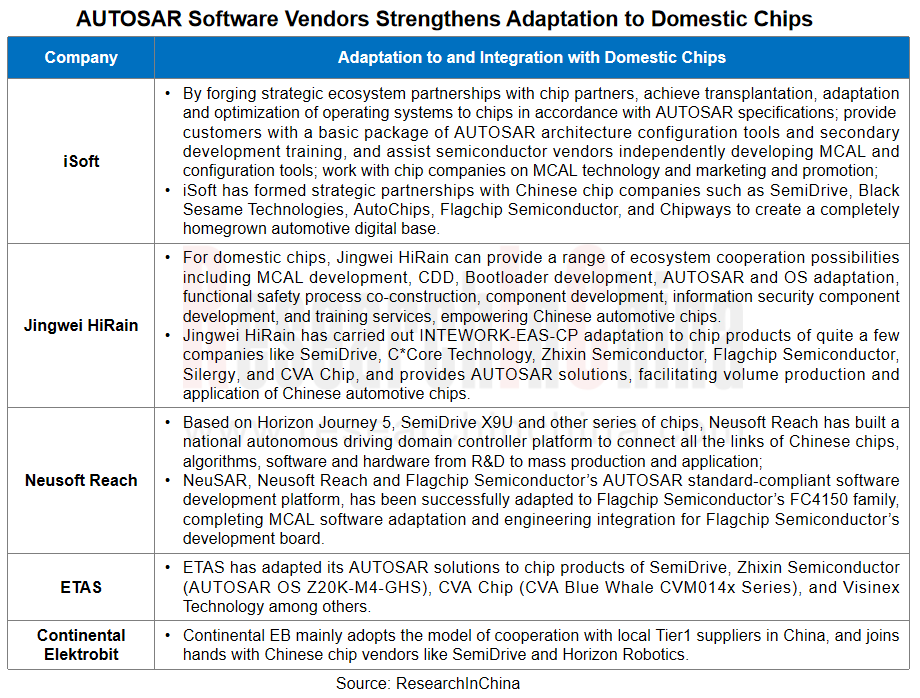
Finally, factors including intelligent vehicle development and policies will bring the opportunities of domestic replacement of AUTOSAR, especially in the field of intelligent driving.
With the rapid iteration of EEA, a unified standard for intelligent driving basic software middleware has yet to form. Currently AUTOSAR AP is one of the options, and many OEMs or suppliers with software strength, such as Technomous, Zuxia Technology and IMotion Automotive Technology, will choose to self-develop middleware products.
Automotive EMS and ECU Industry Research Report, 2026
Automotive EMS Research: The boundaries between EMS providers and Tier1 suppliers are becoming blurred, and the supply chain model is evolving from a linear chain to a networked structure
Mainstream ...
Automotive Microcontroller Unit (MCU) and Application Scenario Research Report, 2026
Automotive MCU Research: Increased demand for redundant security drives ASIL D-compliant MCU shipments to exceed 100 million units
In a vehicle EEA, MCUs are widely distributed in various functional ...
China Intelligent Cockpit Patent Analysis Report, 2026
Intelligent Cockpit Patent Research: Cockpit AI, In?vehicle Health, and Infotainment Are Upgrade to Scenario?based and Proactive Functions
From a patent perspective, this report explores the cutting?...
Research Report on Application of VLA Large Model in Automobiles and Robots, 2026
Research on Automotive and Robot VLA: Hybrid Architectures Become Mainstream, VLA Integrates with General World Models, and Reinforcement Learning Serves as Core Engine
Vision?Language?Action (VLA) m...
China Charging Infrastructure (Supercharging, Battery Swapping, V2G, etc.) and High-Performance Supercharging Battery Research Report, 2026
Charging and battery swapping research: as 5C+ supercharging vehicle models go into mass production, the pace of OEMs self-building supercharging networks quickens
800-1000V high-voltage platforms ar...
China Passenger Car Electronic Controlled Suspension Industry Report, 2026
Electronic Controlled Suspension Industry Research: As the First Year of Full Active Suspension Unfolds, Three Technical Routes Race Forward
1. Penetration Rate Surges Three Times, and Electronic Con...
Intelligent Driving SoC Research Report, 2026
Research on Intelligent Driving SoCs: Competition Focus Shifts to L3/L4 Embedded Hardware, and Computing Power of Flagship Vehicle Models Exceeds 1,000 TOPS
In terms of intelligent driving system in...
Automotive AI Large Model Technology Research Report, 2026
Automotive AI Large Model Research: Competition Shifts from "Who Has the Stronger Model" to "Who Boasts Higher Link Efficiency"
ResearchInChina released the Automotive AI Large Model Technology Resea...
Intelligent Vehicle Cockpit Domain Controller Research Report, 2026
Cockpit domain controller research: L3 AIDV intelligent cockpit domain controllers are entering a boom period
Driven by multiple factors such as the continuous evolution of the automotive central int...
Automotive Acoustic System (Audio, Multi-Channel) Industry Report, 2026
Automotive Acoustics Research: Multiple Channels, AI Tuning, and Self-Developed Algorithms Drive the Transformation of High-End Cockpit Sound Fields
I. Automotive Audio Hardware Solutions with 6–9 S...
Autonomous Driving Sensor Chip Research Report, 2026
Research on Autonomous Driving Sensor Chips: Deeply Perceiving the Physical World, Sensor Chips Are Playing A “Leading Role” in Intelligence
In 2026, the autonomous driving sensor chip industr...
Passenger Car Corner Module and Wheel‑Side Control System Research Report, 2026
Wheel-side control research: the “last mile” chassis innovation
Wheel-side control dismantles the traditional drive, braking, steering, and suspension control of the chassis from a "centralized" styl...
Embodied Artificial Intelligence (& Humanoid Robot) MCU Research Report, 2026
Research on Humanoid Robot MCUs: Evolution from General-Purpose Control to High-Value Dedicated Chip Solutions Integrated with Edge AI Functions
MCU (Microcontroller Unit) refers to a compact integra...
Intelligent Vehicle Zone Control Unit (ZCU) Research Report, 2026
ZCU Research: Cross-domain integrated ZCUs are becoming the edge computing nodes of the next-generation zonal architecture
Currently, the mainstream zonal architecture is mainly the quasi-central + z...
Automotive Cybersecurity and Data Security Research Report, 2026
Cybersecurity & Data Security Research: Intelligent Connected Vehicles Enter the Era of “Systematic Offense-Defense and AI-Defined Security”.
Centering on the panorama of intelligent connect...
Report on Breakthrough Strategies of OEMs and ADAS Tier 1 Suppliers for Overseas Layout of Intelligent Driving, 2026
Regulatory Breakthrough, Local System Establishment, OEMs Competing for NOA Layout: Overall Trends of China’s Intelligent Driving Overseas Layout in 2026
Research on overseas intelligent driving layo...
OEMs and Tier1s’ Intelligent Cockpit Platform (Hardware and Software) Innovation Strategy Research Report, 2026
Intelligent Cockpit Platform Research: multi-dimensional cockpit system architecture reconstruction for multi-agent collaboration and proactive intelligent services
The intelligent cockpit software s...
Automotive AIOS Research Report, 2026
Automotive AIOS Research: Mass Production Solutions Are Implemented
Mass Production Solutions Are Implemented on A Small Scale.
In 2026, AIOS starts small-scale implementation, helping to improve v...