Intelligent Driving Fusion Algorithm Research: sparse algorithms, temporal fusion and enhanced planning and control become the trend.
China Intelligent Driving Fusion Algorithm Research Report, 2024 released by ResearchInChina analyzes the status quo and trends of intelligent driving fusion algorithms (including perception, positioning, prediction, planning, decision, etc.), sorts out algorithm solutions and cases of chip vendors, OEMs, Tier1 & Tier2 suppliers and L4 algorithm providers, and summarizes the development trends of intelligent driving algorithms.
Since the period of eight months from Musk's live test drive of FSD V12 Beta in August 2023 to the 30-day free trial of FSD V12 Supervised in March 2024, advanced intelligent driving such as urban NOA has begun to become the arena of major OEMs, and there have been ever more application cases for end-to-end algorithms, BEV Transformer algorithms, and AI foundation model algorithms.
1. Sparse algorithms improve efficiency and reduce intelligent driving cost.
At present, most BEV algorithms are dense and consume considerable computing power and storage. The smoothness of more than 30 frames per second requires expensive computing resources such as NVIDIA A100. Even so, only 5 to 6 2MP cameras can be supported. For 8MP cameras, extremely expensive resources like multiple H100 GPUs are needed.
Our real world has sparse features. Sparsification helps sensors reduce noise and improve robustness. In addition, as distance increases, grids are bound to be sparse, and a dense network can only be maintained within about 50 meters. By reducing queries and feature interactions, sparse perception algorithms speed up calculations and lower storage requirements, greatly improve the computing efficiency and system performance of the perception model, shorten the system latency, expand the perception accuracy range, and ease the impact of vehicle speed.
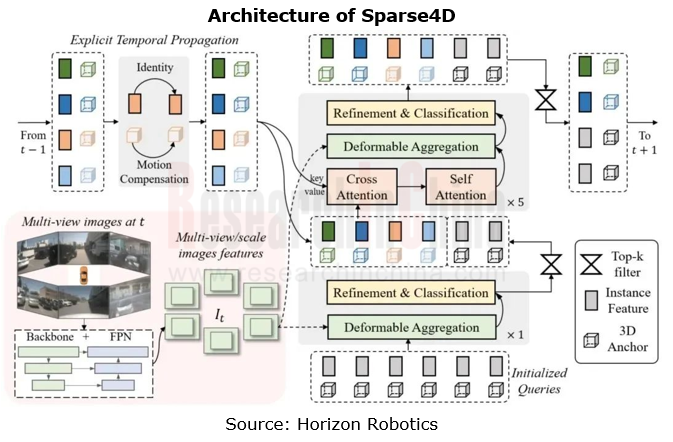
Therefore, the academia has shifted to sparse target-level algorithms rather than dense grid-based algorithms since 2021. With long-term efforts, sparse target-level algorithms can perform almost as well as dense grid-based algorithms. The industry also keeps iterating sparse algorithms. Recently, Horizon Robotics has open-sourced Sparse4D, its vision-only algorithm which ranks first on both nuScenes vision-only 3D detection and 3D tracking lists.?
Sparse4D is a series of algorithms moving towards long-time-sequence sparse 3D target detection, belonging to the scope of multi-view temporal fusion perception technology. Facing the industry development trend of sparse perception, Sparse4D builds a pure sparse fusion perception framework, which makes perception algorithms more efficient and accurate and simplifies perception systems. Compared with dense BEV algorithms, Sparse4D reduces the computational complexity, breaks the limit of computing power on the perception range, and outperforms dense BEV algorithms in perception effect and reasoning speed.
Another significant advantage of sparse algorithms is to cut down the cost of intelligent driving solutions by reducing dependence on sensors and consuming less computing power. For example, Megvii Technology mentioned that taking a range of measures, for example, optimizing the BEV algorithm, reducing computing power, removing HD maps, RTK and LiDAR, unifying the algorithm framework, and automatic annotation, it has lowered the costs of its intelligent driving solutions based on PETR series sparse algorithms by 20%-30%, compared with conventional solutions on the market.
2. 4D algorithms offer higher accuracy and make intelligent driving more reliable.
As seen from the sensor configurations of OEMs, in recent three years ever more sensors have been installed, with increasing intelligent driving functions and application scenarios. Most urban NOA solutions are equipped with 10-12 cameras, 3-5 radars, 12 ultrasonic radars and 1-3 LiDARs.?
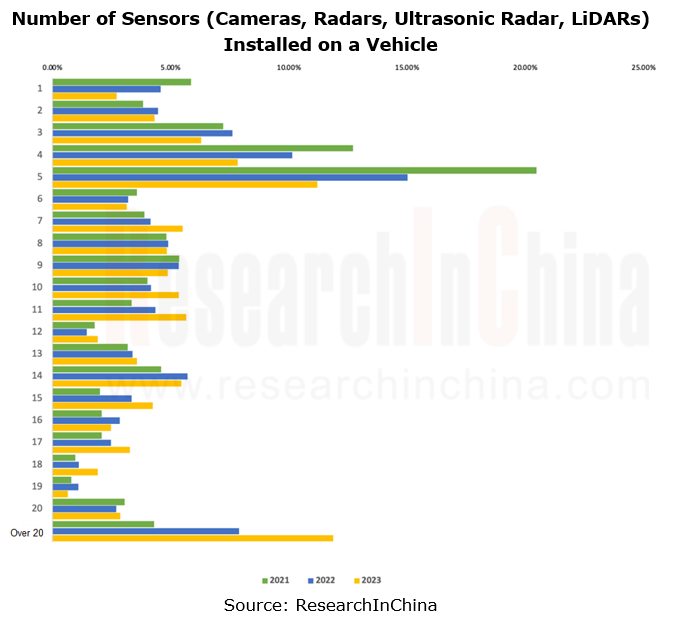
With the increasing number of sensors, ever more perception data are generated. How to improve the utilization of the data is also placed on the agenda of OEMs and algorithm providers. Although the algorithm details of companies are a little different, the general ideas of the current mainstream BEV Transformer solutions are basically the same: conversion from 2D to 3D and then to 4D.
Temporal fusion can greatly improve the algorithm continuity, and the memory of obstacles can handle occlusion and allows for better perception the speed information. The memory of road signs can improve the driving safety and the accuracy of vehicle behavior prediction. The fusion of information from historical frames can improve the perception accuracy of the current object, while the fusion of information from future frames can verify the object perception accuracy, thereby enhancing the algorithm reliability and accuracy.
?
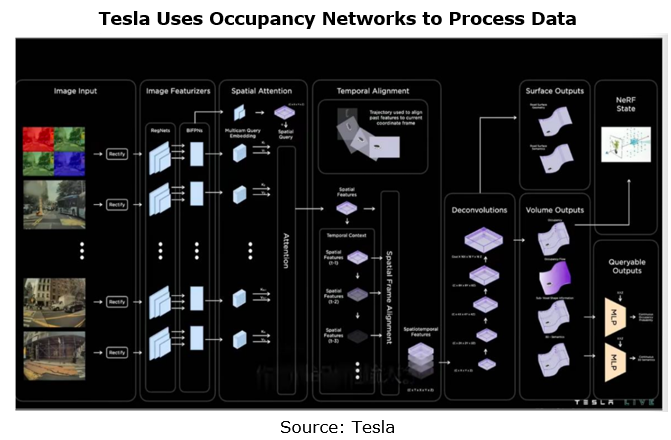
Tesla's Occupancy Network algorithm is a typical 4D algorithm.
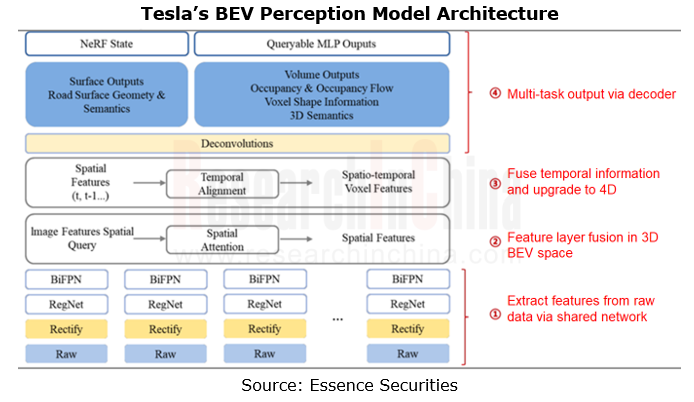
Tesla adds the height information to the vector space of 2D BEV+ temporal information output by the original Transformer algorithm to build the 4D space representation form of 3D BEV + temporal information. The network runs every 10ms on the FSD, that is, it runs at 100FPS, which greatly improves the speed of model detection.?
3. End-to-end algorithms integrating perception, planning and control enable more anthropomorphic intelligent driving.
Mainstream intelligent driving algorithms have adopted the “BEV+Transformer” architecture, and many innovative perception algorithms have emerged. However, rule-based algorithms still prevail among planning and control algorithms. Some OEMs face technical and practical challenges in both perception and planning & control systems, which are sometimes in a "split" state. In some complex scenarios, the perception module may fail to accurately recognize or understand the environmental information, and the decision module may make incorrect driving decisions due to improper handling of the perception results or algorithm limitations. This restricts the development of advanced intelligent driving to some extent.?
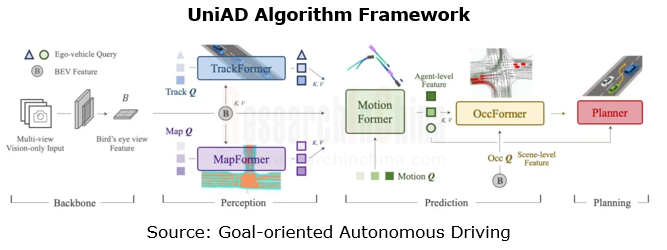
UniAD, an end-to-end intelligent driving algorithm jointly released by SenseTime, OpenDriveLab and Horizon Robotics, was rated as the Best Paper in CVPR2023. UniAD integrates three main tasks (perception, prediction and planning) and six sub-tasks (target detection, target tracking, scene mapping, trajectory prediction, grid prediction and path planning) into a unified end-to-end network framework based on Transformer for the first time to attain a general model of full-stack task-critical driving. Under the nuScenes real scene dataset, UniAD performs all tasks best in the field, especially in terms of the prediction and planning results far better the previous best solution.?????
The basic end-to-end algorithm enables direct inputs from sensors and predictive control outputs, but it is difficult to optimize, because of lacking effective feature communication between network modules and effective interaction between tasks and needing to output results in phases. The decision-oriented perception and decision integrated design proposed by the UniAD algorithm uses token features for deep fusion according to the perception-prediction-decision process, so that the indicators of all tasks targeting decision are consistently improved.??
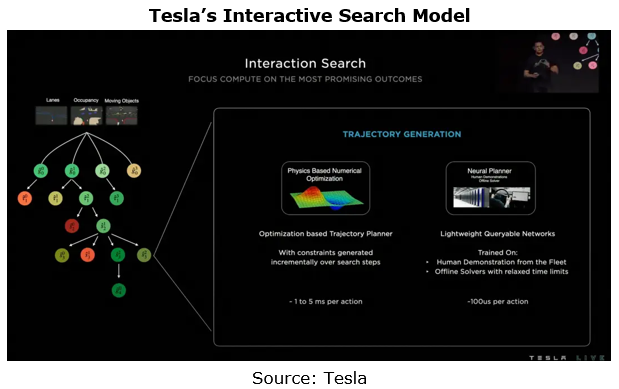
In terms of planning and control algorithms, Tesla adopts an approach of interactive search + evaluation model to enable a comfortable and effective algorithm that combines conventional search algorithms with artificial intelligence:
Firstly, candidate objects are obtained according to lane lines, occupancy networks and obstacles, and then decision trees and candidate object sequences are generated.
The trajectory for reaching the above objects is constructed synchronously using conventional search and neural networks;
The interaction between the vehicle and other participants in the scene is predicted to form a new trajectory. After multiple evaluations, the final trajectory is selected. During the trajectory generation, Tesla applies conventional search algorithms and neural networks, and then scores the generated trajectory according to collision check, comfort analysis, the possibility of the driver taking over and the similarity with people, to finally decide the implementation strategy.??
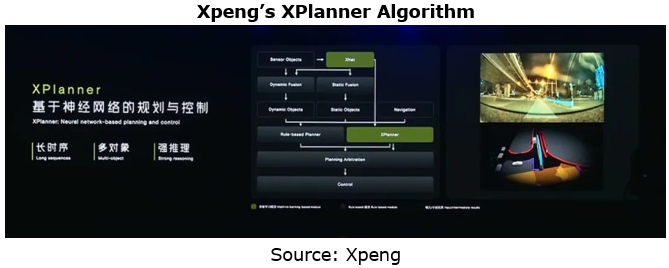
XBrain, the ultimate architecture of Xpeng’s all-scenario intelligent driving, is composed of XNet 2.0, a deep vision neural network, and XPlanner, a planning and control module based on a neural network. XPlanner is a planning and control algorithm based on a neural network, with the following features:
Rule algorithm
Long time sequence (minute-level)
Multi-object (multi-agent decision, gaming capability)
Strong reasoning
The previous advanced algorithms and ADAS functional architectures were separated and consisted of many small logic planning and control algorithms for sub-scenes, while XPlanner has a unified planning and control algorithm architecture. XPlanner is supported by a foundation model and a large number of extreme driving scenes for simulation training, thus ensuring that it can cope with various complex situations.
Automotive Microcontroller Unit (MCU) and Application Scenario Research Report, 2026
Automotive MCU Research: Increased demand for redundant security drives ASIL D-compliant MCU shipments to exceed 100 million units
In a vehicle EEA, MCUs are widely distributed in various functional ...
China Intelligent Cockpit Patent Analysis Report, 2026
Intelligent Cockpit Patent Research: Cockpit AI, In?vehicle Health, and Infotainment Are Upgrade to Scenario?based and Proactive Functions
From a patent perspective, this report explores the cutting?...
Research Report on Application of VLA Large Model in Automobiles and Robots, 2026
Research on Automotive and Robot VLA: Hybrid Architectures Become Mainstream, VLA Integrates with General World Models, and Reinforcement Learning Serves as Core Engine
Vision?Language?Action (VLA) m...
China Charging Infrastructure (Supercharging, Battery Swapping, V2G, etc.) and High-Performance Supercharging Battery Research Report, 2026
Charging and battery swapping research: as 5C+ supercharging vehicle models go into mass production, the pace of OEMs self-building supercharging networks quickens
800-1000V high-voltage platforms ar...
China Passenger Car Electronic Controlled Suspension Industry Report, 2026
Electronic Controlled Suspension Industry Research: As the First Year of Full Active Suspension Unfolds, Three Technical Routes Race Forward
1. Penetration Rate Surges Three Times, and Electronic Con...
Intelligent Driving SoC Research Report, 2026
Research on Intelligent Driving SoCs: Competition Focus Shifts to L3/L4 Embedded Hardware, and Computing Power of Flagship Vehicle Models Exceeds 1,000 TOPS
In terms of intelligent driving system in...
Automotive AI Large Model Technology Research Report, 2026
Automotive AI Large Model Research: Competition Shifts from "Who Has the Stronger Model" to "Who Boasts Higher Link Efficiency"
ResearchInChina released the Automotive AI Large Model Technology Resea...
Intelligent Vehicle Cockpit Domain Controller Research Report, 2026
Cockpit domain controller research: L3 AIDV intelligent cockpit domain controllers are entering a boom period
Driven by multiple factors such as the continuous evolution of the automotive central int...
Automotive Acoustic System (Audio, Multi-Channel) Industry Report, 2026
Automotive Acoustics Research: Multiple Channels, AI Tuning, and Self-Developed Algorithms Drive the Transformation of High-End Cockpit Sound Fields
I. Automotive Audio Hardware Solutions with 6–9 S...
Autonomous Driving Sensor Chip Research Report, 2026
Research on Autonomous Driving Sensor Chips: Deeply Perceiving the Physical World, Sensor Chips Are Playing A “Leading Role” in Intelligence
In 2026, the autonomous driving sensor chip industr...
Passenger Car Corner Module and Wheel‑Side Control System Research Report, 2026
Wheel-side control research: the “last mile” chassis innovation
Wheel-side control dismantles the traditional drive, braking, steering, and suspension control of the chassis from a "centralized" styl...
Embodied Artificial Intelligence (& Humanoid Robot) MCU Research Report, 2026
Research on Humanoid Robot MCUs: Evolution from General-Purpose Control to High-Value Dedicated Chip Solutions Integrated with Edge AI Functions
MCU (Microcontroller Unit) refers to a compact integra...
Intelligent Vehicle Zone Control Unit (ZCU) Research Report, 2026
ZCU Research: Cross-domain integrated ZCUs are becoming the edge computing nodes of the next-generation zonal architecture
Currently, the mainstream zonal architecture is mainly the quasi-central + z...
Automotive Cybersecurity and Data Security Research Report, 2026
Cybersecurity & Data Security Research: Intelligent Connected Vehicles Enter the Era of “Systematic Offense-Defense and AI-Defined Security”.
Centering on the panorama of intelligent connect...
Report on Breakthrough Strategies of OEMs and ADAS Tier 1 Suppliers for Overseas Layout of Intelligent Driving, 2026
Regulatory Breakthrough, Local System Establishment, OEMs Competing for NOA Layout: Overall Trends of China’s Intelligent Driving Overseas Layout in 2026
Research on overseas intelligent driving layo...
OEMs and Tier1s’ Intelligent Cockpit Platform (Hardware and Software) Innovation Strategy Research Report, 2026
Intelligent Cockpit Platform Research: multi-dimensional cockpit system architecture reconstruction for multi-agent collaboration and proactive intelligent services
The intelligent cockpit software s...
Automotive AIOS Research Report, 2026
Automotive AIOS Research: Mass Production Solutions Are Implemented
Mass Production Solutions Are Implemented on A Small Scale.
In 2026, AIOS starts small-scale implementation, helping to improve v...
Automotive Telematics Service Provider (TSP) Research Report, 2026
TSP Research: Leading providers collectively turn to AI agents to provide all-scenario active services
Telematics Service Providers (TSPs) are the core hub of the telematics industry chain, connectin...