C-V2X and CVIS Research: In 2023, the OEM scale will exceed 270,000 units, and large-scale verification will start.
The pilot application of "vehicle-road-cloud integration” commenced, and C-V2X entered a large-scale verification cycle.
C-V2X has basically beaten DSRC in the global standard competition:
?United States: In 2023, it was made clear that C-V2X should be deployed throughout the country. By 2034, C-V2X will cover 100% of national highways and 75% of urban intersections, and a C-V2X boarding plan was formulated to mainly handle traffic accidents.
?Europe: Although the status of C-V2X is not clear, the European Union has indicated that each country can choose C-V2X according to its own judgment on technology, so that C-V2X and ITS-G5 coexist as two technical standard systems in Europe.
?South Korea: In December 2023, it officially announced to abandon DSRC technology and adopt LTE-V2X as the only Internet of Vehicles communication technology.
In 2024, China officially launched the pilot application of "vehicle-road-cloud integration” of intelligent connected vehicles, with the pilot period from 2024 to 2026:
?It will gradually improve the connectivity rate of vehicles, and 100% of pilot vehicles will be equipped with C-V2X and digital identity certificate carriers;
?In public areas such as city buses, official vehicles, and taxis, existing vehicles are encouraged to install C-V2X; 50% of new vehicles should be fitted with C-V2X.
?Pilot cities are advocated to install C-V2X in new production vehicles with L2 and higher-level autonomous driving functions.
According to ResearchInChina’s statistics, more than 270,000 Chinese passenger cars (accounting for 1.2%) were equipped with C-V2X by OEMs in 2023. It is expected that large-scale installation will occur from 2026 to 2027, with optimistic predictions that the OEM installation rate can exceed 9%.
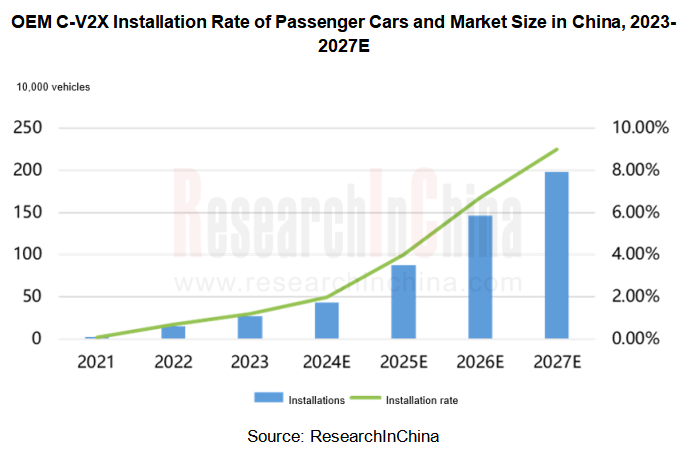
The basic logic behind the increasing OEM penetration rate of C-V2X:
?The 2024 version of C-NCAP officially includes V2X in the evaluation scope. C-V2X can ensure that OEMs score more points in the field of active safety for new cars. This rule will be implemented from July 2024;
?The pilot application policy of "vehicle-road-cloud integration” of intelligent connected vehicles has been enforced, and C-V2X has entered the development stage of large-scale urban operation and scenario verification;
?BYD, Volkswagen, Audi and the like have begun to deploy C-V2X technology in new models, and GAC, FAW Hongqi, Ford and other OEMs that dabbled in the field of C-V2X earlier are actively promoting the evolution of C-V2X technology to the second stage;
?C-V2X empowers intelligent transportation and more and more application scenarios that reach consumers who are more willing to pay for C-V2X as they feel better, which will then push OEMs to install C-V2X. For example, during the implementation of urban NOA, the prediction of traffic light status, real-time road conditions, driving risks and other information in the city has become very important. Based on the C-V2X system, accurate roadside data is provided to the vehicle, which is conducive to the development of urban NOA;
?The integration of C-V2X is getting higher and higher, and the installation cost of OEMs continues to decline. C-V2X will be more integrated into the 5G intelligent cockpit or the 5G communication module to help improve its OEM installation rate;
?With the higher and higher "C-V2X roadside equipment coverage rate" and "automotive terminal penetration rate", the development node from quantitative change to qualitative change will appear.
C-V2X chips/modules are developing towards high performance and high integration.
Only a few suppliers who can provide C-V2X chips in the world, such as Qualcomm, Autotalks, Morningcore Technology, Huawei and ZTE. Among them, Qualcomm has a leading position in the field of C-V2X chips.
Qualcomm said in 2023 that it would acquire Autotalks. Through the acquisition, the production-ready, dual mode, Autotalks standalone safety solutions will be incorporated into Qualcomm Technologies’ expanding Snapdragon? Digital Chassis product portfolio in a bid to help accelerate the development and adoption of V2X solutions to improve traffic efficiency and help with driver and road user safety. In March 2024, the anticipated acquisition by Qualcomm of Autotalks was abandoned due to regulatory inspections, including investigations by the European Commission, UK, and Israeli antitrust regulators.
From the technical layout of major suppliers, C-V2X chip technology is becoming more and more integrated in its evolution to the second stage.
Qualcomm: There are three sets of C-V2X chip platforms: 9150 chipset, 9250 chipset and 2150 chipset. In addition, Qualcomm's 5G SA415/SA515M platform can choose to plug in V2X functions.
Qualcomm’s latest 5G platform features a highly integrated V2X solution, which includes an application processor, ITS stack, Aerolink Security, message signing, up to 2500 message verification per second, PC5/Uu modem connectivity, Wi-Fi 6 and BT 5.1 connectivity, MF-GNSS, and controller area network (CAN) support. In addition, Qualcomm's fourth-generation cockpit platform is pre-integrated with Qualcomm’s Snapdragon Automotive 5G platform supporting C-V2X technology.
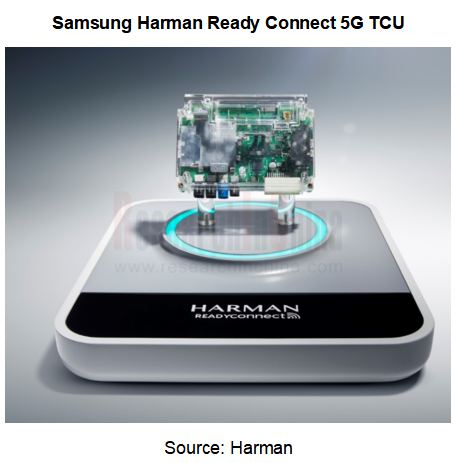
Mass production and application: Based on the Snapdragon? Auto 5G Modem-RF Gen 2, HARMAN Ready Connect 5G TCU launched in February 2024 represents a significant advancement in upgradeability and scalability.
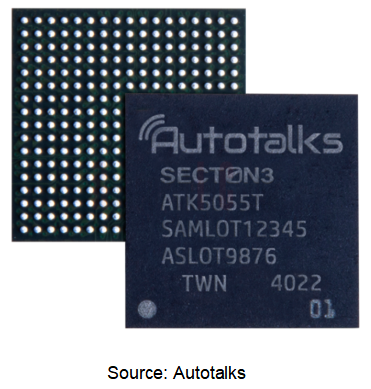
Autotalks: The C-V2X chipset has evolved to the third-generation TEKTON3 and SECTON3, which are suitable for the first and second phases of C-V2X. Autotalks is working with Hyundai Mobis to develop MTCU (Multi-functional Telematics Control Unit) connectivity modules (based on Autotalks' third-generation chipset) which will debut in 2024. Models equipped with Autotalks' third-generation chipset will be launched in 2025.
At present, C-V2X is developing in the direction of high integration. In the future, C-V2X will exist in an integrated form on vehicles, while independent modules may be mainly used in roadside communication components.
ZTE: The ZM9300, a full-stack self-developed 5G/V2X automotive module series launched in the second half of 2023, uses 3GPP Rel-16 technology and is developed based on ZTE’s full-stack self-developed automotive 5G Modem chip platform. At present, the module has landed in the automotive communication terminal platform project of GAC R&D Center which will unveil the first production model in 2024.
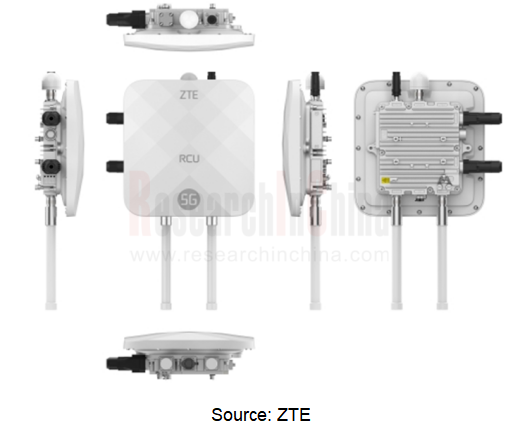
ZTE launched Y2002, the industry's first CVIS integrated equipment, which boasts a powerful AI chip based on the previous Y2001 and integrates RSU with roadside edge calculation.
The computing power of Y2002 hits 100TOPS. It can access 16 cameras, 8 radars, and 2 LiDARs.
?
C-V2X may give priority to autonomous driving application scenarios such as C-AEB, L2+ urban NOA, and navigation maps.
One of the main reasons for the slow development of C-V2X is that the business model is unclear and consumers are not willing to pay the bill. In order to improve consumers' willingness to pay, roadside infrastructure coverage and application scenario construction are crucial, especially in the fields of autonomous driving application scenarios such as C-AEB, L2+ urban NOA and navigation maps.
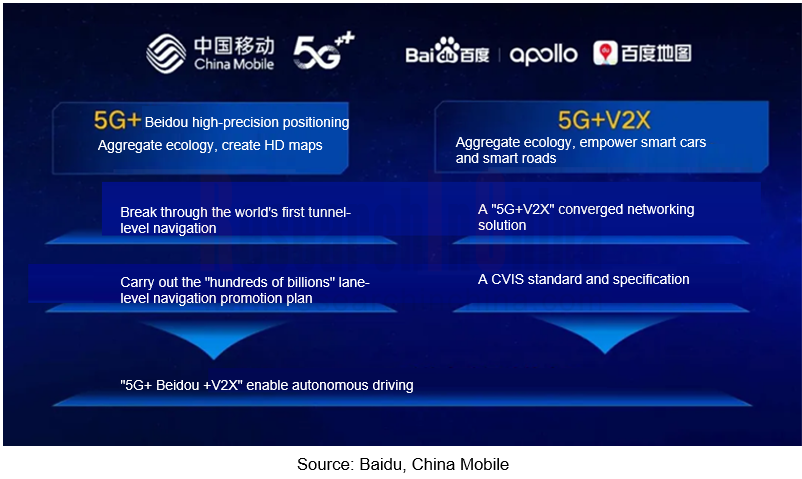
Baidu and China Mobile have jointly released the "5G+Beidou+V2X" intelligent transportation plan, created a "5G+V2X" integrated networking solution, and promoted "5G+Beidou High Precision+V2X" applications that empower autonomous driving.
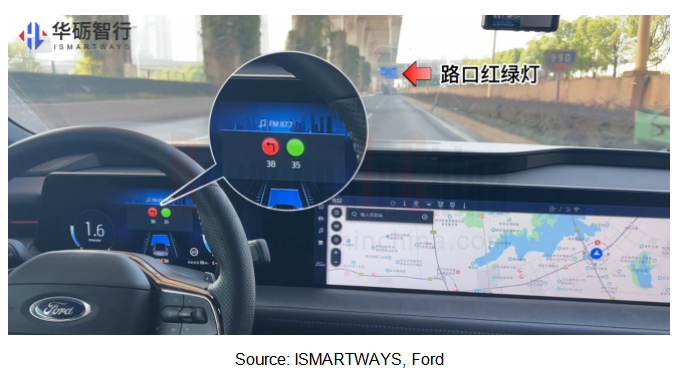
ISMARTWAYS has launched a traffic light service. The massive traffic light data accumulated in the early stage is safely processed and pushed to OEMs who then push it to car owners as a value-added service, including traffic light countdown reminder, green light start reminder, Green Light Optimal Speed Advisory (GLOSA), red light warning and other functions.
At the beginning of 2024, China Mobile put forward the concept of "four integrations": 5G+V2X communication integration, car-road computing power integration, car+city+cloud integration and people+car+home integration. China Mobile believes that the road-network-vehicle basic communication construction must be integrated and unified to jointly improve the coverage, and the roadside equipment coverage is of great significance for the large-scale promotion of C-V2X.
C-V2X and CVIS Industry Research Report, 2024 by ResearchInChina highlights the following:
 The promotion policy, standard trends, market size, market structure and so on of China C-V2X industry;
Mass production and application of C-V2X by OEMs and governments;
C-V2X installation modes, technical layout of OEMs, installation cases, etc.
Key technologies of C-V2X, including chips, module, roadside, cloud, network communication, HD maps, information security and so on;
The latest technical layout and solution layout of main C-V2X terminal and system solution suppliers;
Technology evolution and main products of major C-V2X chip and module vendors.
Automotive Microcontroller Unit (MCU) and Application Scenario Research Report, 2026
Automotive MCU Research: Increased demand for redundant security drives ASIL D-compliant MCU shipments to exceed 100 million units
In a vehicle EEA, MCUs are widely distributed in various functional ...
China Intelligent Cockpit Patent Analysis Report, 2026
Intelligent Cockpit Patent Research: Cockpit AI, In?vehicle Health, and Infotainment Are Upgrade to Scenario?based and Proactive Functions
From a patent perspective, this report explores the cutting?...
Research Report on Application of VLA Large Model in Automobiles and Robots, 2026
Research on Automotive and Robot VLA: Hybrid Architectures Become Mainstream, VLA Integrates with General World Models, and Reinforcement Learning Serves as Core Engine
Vision?Language?Action (VLA) m...
China Charging Infrastructure (Supercharging, Battery Swapping, V2G, etc.) and High-Performance Supercharging Battery Research Report, 2026
Charging and battery swapping research: as 5C+ supercharging vehicle models go into mass production, the pace of OEMs self-building supercharging networks quickens
800-1000V high-voltage platforms ar...
China Passenger Car Electronic Controlled Suspension Industry Report, 2026
Electronic Controlled Suspension Industry Research: As the First Year of Full Active Suspension Unfolds, Three Technical Routes Race Forward
1. Penetration Rate Surges Three Times, and Electronic Con...
Intelligent Driving SoC Research Report, 2026
Research on Intelligent Driving SoCs: Competition Focus Shifts to L3/L4 Embedded Hardware, and Computing Power of Flagship Vehicle Models Exceeds 1,000 TOPS
In terms of intelligent driving system in...
Automotive AI Large Model Technology Research Report, 2026
Automotive AI Large Model Research: Competition Shifts from "Who Has the Stronger Model" to "Who Boasts Higher Link Efficiency"
ResearchInChina released the Automotive AI Large Model Technology Resea...
Intelligent Vehicle Cockpit Domain Controller Research Report, 2026
Cockpit domain controller research: L3 AIDV intelligent cockpit domain controllers are entering a boom period
Driven by multiple factors such as the continuous evolution of the automotive central int...
Automotive Acoustic System (Audio, Multi-Channel) Industry Report, 2026
Automotive Acoustics Research: Multiple Channels, AI Tuning, and Self-Developed Algorithms Drive the Transformation of High-End Cockpit Sound Fields
I. Automotive Audio Hardware Solutions with 6–9 S...
Autonomous Driving Sensor Chip Research Report, 2026
Research on Autonomous Driving Sensor Chips: Deeply Perceiving the Physical World, Sensor Chips Are Playing A “Leading Role” in Intelligence
In 2026, the autonomous driving sensor chip industr...
Passenger Car Corner Module and Wheel‑Side Control System Research Report, 2026
Wheel-side control research: the “last mile” chassis innovation
Wheel-side control dismantles the traditional drive, braking, steering, and suspension control of the chassis from a "centralized" styl...
Embodied Artificial Intelligence (& Humanoid Robot) MCU Research Report, 2026
Research on Humanoid Robot MCUs: Evolution from General-Purpose Control to High-Value Dedicated Chip Solutions Integrated with Edge AI Functions
MCU (Microcontroller Unit) refers to a compact integra...
Intelligent Vehicle Zone Control Unit (ZCU) Research Report, 2026
ZCU Research: Cross-domain integrated ZCUs are becoming the edge computing nodes of the next-generation zonal architecture
Currently, the mainstream zonal architecture is mainly the quasi-central + z...
Automotive Cybersecurity and Data Security Research Report, 2026
Cybersecurity & Data Security Research: Intelligent Connected Vehicles Enter the Era of “Systematic Offense-Defense and AI-Defined Security”.
Centering on the panorama of intelligent connect...
Report on Breakthrough Strategies of OEMs and ADAS Tier 1 Suppliers for Overseas Layout of Intelligent Driving, 2026
Regulatory Breakthrough, Local System Establishment, OEMs Competing for NOA Layout: Overall Trends of China’s Intelligent Driving Overseas Layout in 2026
Research on overseas intelligent driving layo...
OEMs and Tier1s’ Intelligent Cockpit Platform (Hardware and Software) Innovation Strategy Research Report, 2026
Intelligent Cockpit Platform Research: multi-dimensional cockpit system architecture reconstruction for multi-agent collaboration and proactive intelligent services
The intelligent cockpit software s...
Automotive AIOS Research Report, 2026
Automotive AIOS Research: Mass Production Solutions Are Implemented
Mass Production Solutions Are Implemented on A Small Scale.
In 2026, AIOS starts small-scale implementation, helping to improve v...
Automotive Telematics Service Provider (TSP) Research Report, 2026
TSP Research: Leading providers collectively turn to AI agents to provide all-scenario active services
Telematics Service Providers (TSPs) are the core hub of the telematics industry chain, connectin...