Cockpit AI Agent: Autonomous scenario creation becomes the first step to personalize cockpits
In AI Foundation Models’ Impacts on Vehicle Intelligent Design and Development Research Report, 2024, ResearchInChina mentioned that the core of an AI Agent uses a large language model (LLM) as its core computing engine (LLM OS). In the AI service framework, the LLM acts as AI core and the Agent acts as AI APP.? With the help of reasoning and generation capabilities of? AI foundation model, the Agent can create more cockpit scenarios, while further improving current multimodal interaction, voice processing and other technologies in the cockpit.
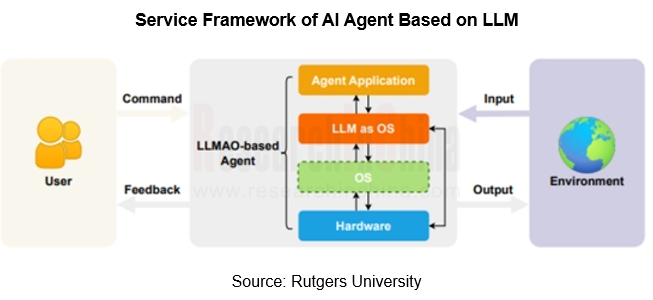
Compared with the traditional OS, AI OS is programmed in natural language, which is more suitable for human operation and convenient for customization and personalized human-computer interaction. The Agent responds to user prompts or instructions in natural language, and can perform a lot of tasks according to its interaction with physical or digital environment.
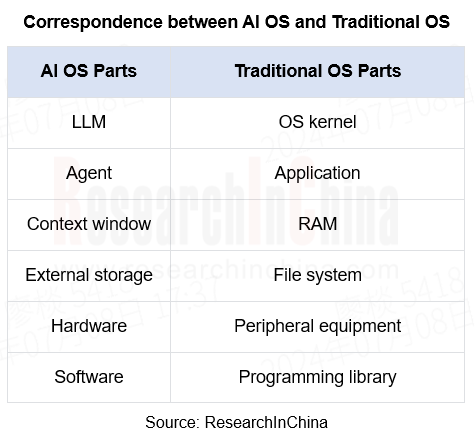
Foundation models spawn Agent customized scenarios
Since AI foundation models were installed in cars, they have been widely used in multimodal interaction scenarios. OEMs have started from voice assistants to further improve? intelligent processing of user commands:
Before foundation models got on cars, the wake-up rate and effective instructions of voice assistants in cockpits are at a low level;
After foundation models were available in cars, not only has voice recognition become more intelligent, but the application of expression monitoring and gesture control have also been improved, with effective commands and daily active rates increasing significantly.
AI foundation models further enhance the user experience of smart cockpits through strong context processing and reasoning capabilities. Please refer to the following dialogue:
(Mobility scenario)
--**Tongxue! (the name of a voice assistant)
-I am here!
-There seems to be a prairie ahead. Please take a picture for me!
-Wait a moment, and I will capture the beautiful scenariory of the prairie for you. I'll let you know when the photo is taken. Is there anything else I can help you with?
-Send it to Moments immediately. I want my friends to have a look at this beautiful scenariory.
-Ok, according to your authorized account, please choose the material and filter style.
-Just this one, with a caption.
-Ok, three captions have been generated for you. Which one do you like?
-Just this one.
(You enter the office and receive a phone call)
-There is a phone call from a customer, and I have transferred it to the IVI for you.? Would you like to answer it?
-Yes, and turn on the office mode.
-Ok, I will generate an avatar of the customer for you and start the conversation. Do you have any questions or things to discuss? I will record the conversation and provide you with the minutes of the meeting after it is over.
(The avatar is generated)
-Now you can start the conversation.
The above scenarios will not be materialized in the cockpit until 2024 when foundation models are installed on vehicles by some OEMs.
For example, IM L6 has built Carlog and City Drive scenarios to enable the AI foundation models to proactively recommend food and attractions and allow users to post them on social media:
Carlog: Actively perceive the scenario during driving through AI vision foundation model, mobilize four cameras to take photos, automatically save and edit them, and support one-click share in Moments.
City Drive: Cooperate with Volcengine to model nearby food, scenic spots and landmarks in real time in the digital screen, and push them according to users' habits and preferences.

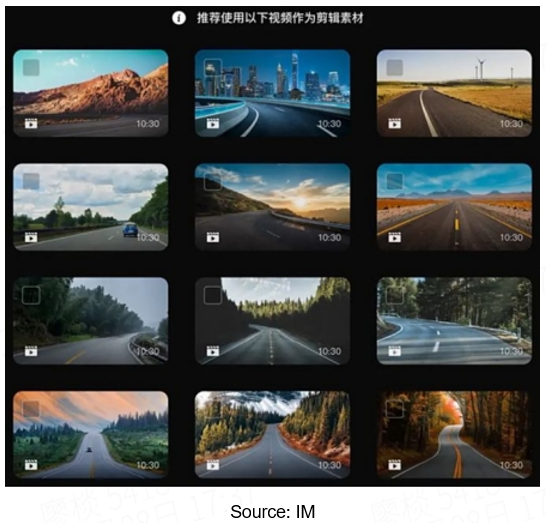
The applicability of foundation models in various scenarios has stimulated users' demand for intelligent agents that can uniformly manage cockpit functions. In 2024, OEMs such as NIO, Li Auto, and Hozon successively launched Agent frameworks, using voice assistants as the starting point to manage functions and applications in cockpits.
Agent service frameworks can not only manage cockpit functions in a unified way, but also provide more abundant scenario modes according to customers' needs and preferences, especially supporting customized scenarios for users, which accelerates the advent of the cockpit personalization era.
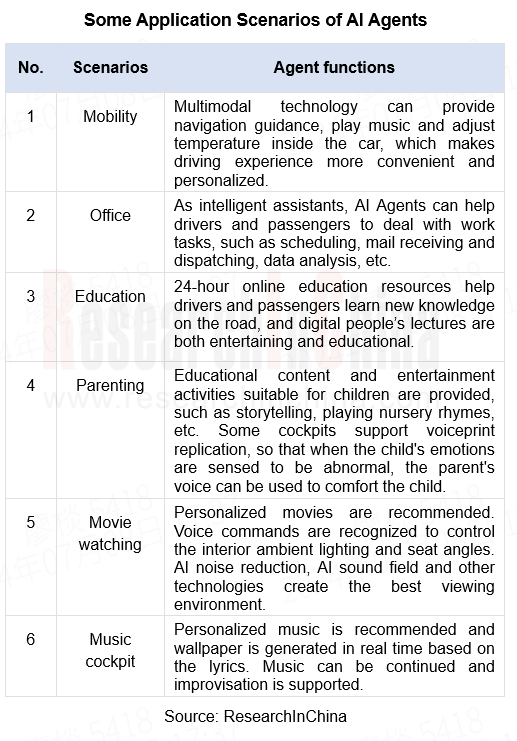
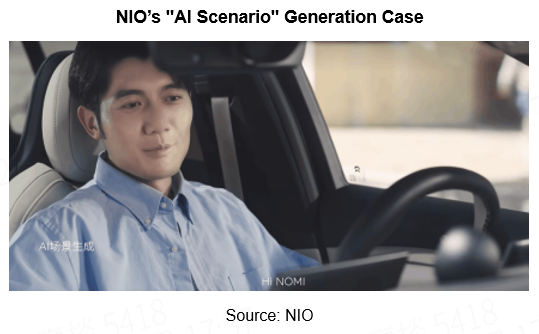
For example, NIO’s NOMI GPT allows users to set an AI scenario with just one sentence:
Core competence of cockpit Agents
AI Agents in the era of foundation models are based on LLMs, whose powerful reasoning expands the applicable scenarios of AI Agents that can improve the thinking capability of foundation models through feedback obtained during operation. In the cockpit, the Agent capability paradigm can be roughly divided into "Understanding" + "Planning" + "Tool Use" + "Reflection".
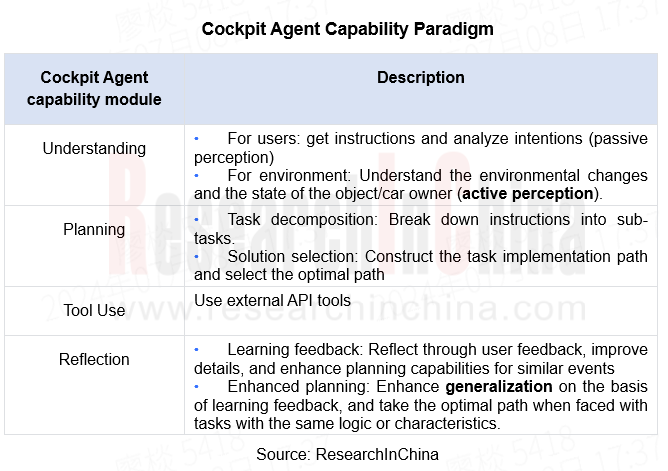
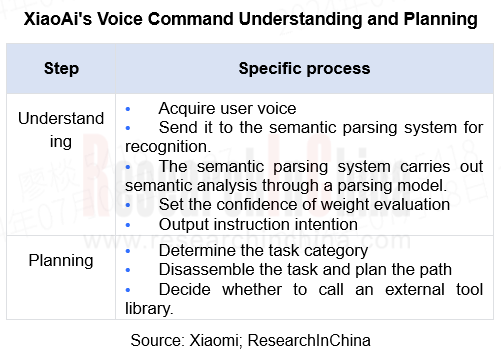
When Agents first get on cars, cognitive and planning abilities are more important. The understanding of task goals and the choice of implementation paths directly determine the accuracy of performance results, which in turn affect the scenario utilization rate of Agents.
For example, in Xiaomi's voice interaction process, semantic understanding is the difficulty of the entire automotive voice processing process. XiaoAi handles semantic parsing through a semantic parsing model.
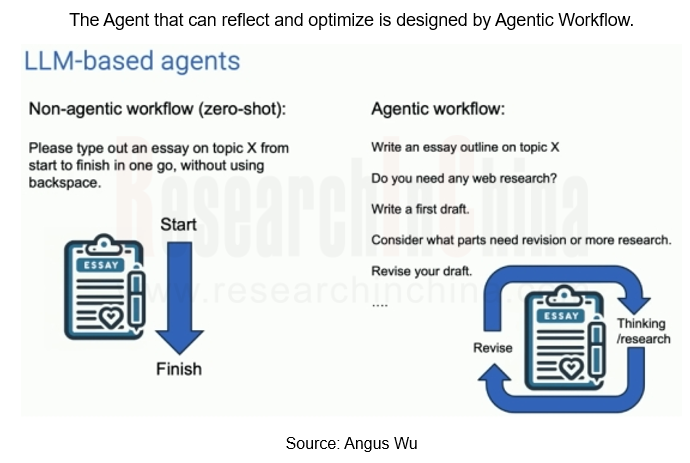
After the mass production of Agents, the personalized cockpits that support users to customize scenario modes become the highlight, and Reflection becomes the most important core competence at this stage, so it is necessary to build an Agentic Workflow that is constantly learning and optimizing.
For example, Lixiang Tongxue offered by Li Auto supports the creation of one-sentence scenarios. It is backed by Mind GPT's built-in memory network and online reinforcement learning capabilities. Mind GPT can remember personalized preferences and habits based on historical conversations. When similar scenarios recur, it can automatically set scenario parameters through historical data to fit the user's original intentions.
At the AI OS architecture setting level, we take SAIC Z-One as an example:
Z-One accesses the LLM kernel (LLM OS) at the kernel layer, which controls the interfaces of AI OS SDK and ASF with the original microkernel respectively, in which AI OS SDK receives the scheduling of the LLM to promote the Agent service framework of the application layer. The Z-One AI OS architecture highly integrates AI with CPU. Through SOA atomic services, AI is then connected to the vehicle's sensors, actuators and controllers. This architecture, based on a terminal-cloud foundation model, can enhance the computing power of the terminal-side foundation model and reduce operational latency.
Application Difficulty of Cockpit AI Agents
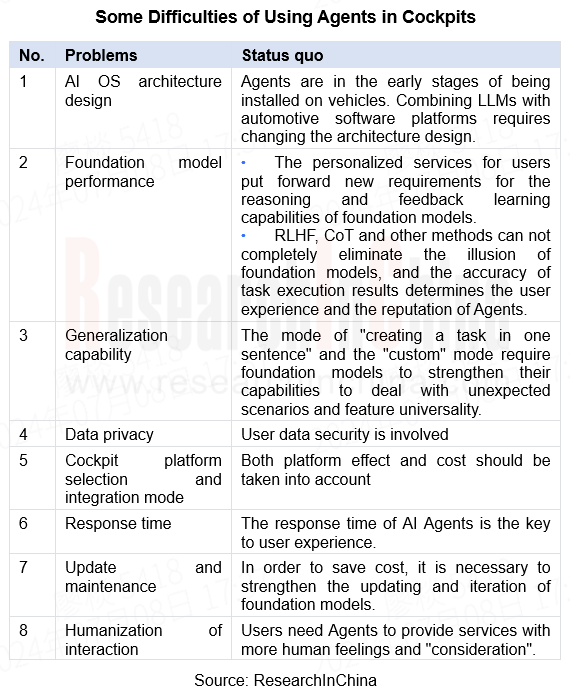
Agents connect to users and execute commands. In the application process, in addition to the technical difficulties of putting foundation models on cars, they also face scenario difficulties. In the process of command reception-semantic analysis-intention reasoning-task execution, the accuracy of the performance results and the delay in human-computer interaction directly affect the user's riding experience.
Humanization of interaction
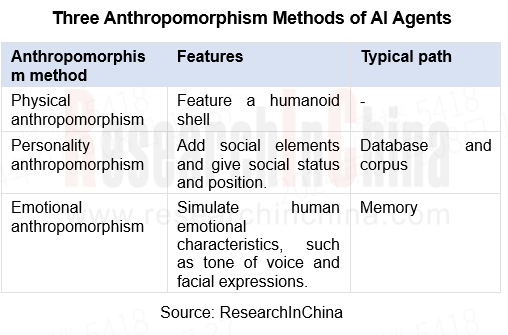
For example, in the "emotional consultant" scenario, Agents should resonate emotionally with car owners and perform anthropomorphism. Generally, there are three forms of anthropomorphism of AI Agents: physical anthropomorphism, personality anthropomorphism, and emotional anthropomorphism.
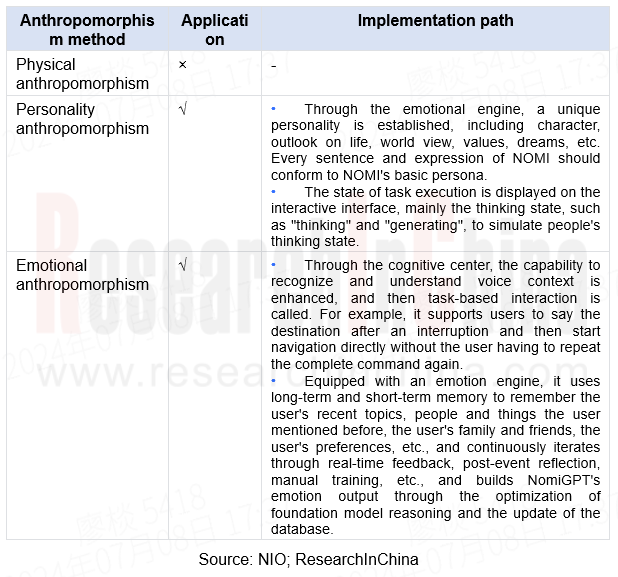
NIO's NOMI GPT uses "personality anthropomorphism" and "emotional anthropomorphism":
Foundation model performance
In the "encyclopedia question and answer" scenario, Agents may be unable to answer the user's questions, especially open questions, accurately because of LLM illusion after semantic analysis, database search, answer generation and the like.
Current solutions include advanced prompting, RAG+knowledge graph, ReAct, CoT/ToT, etc., which cannot completely eliminate “LLM illusion”. In the cockpit, external databases, RAG, self-consistency and other methods are more often used to reduce the frequency of “LLM illusion”.
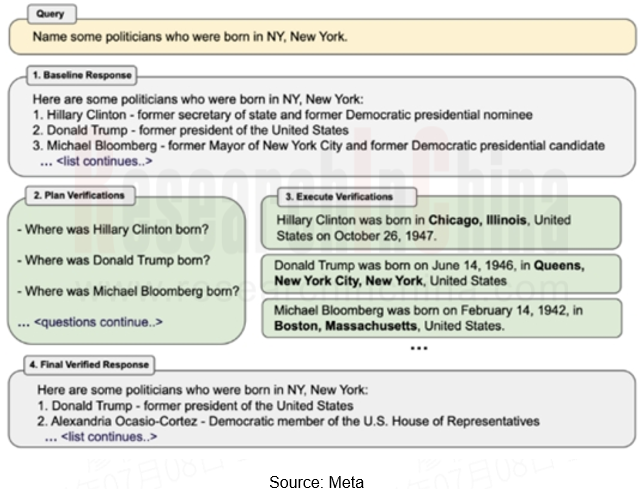
Some foundation model manufacturers have improved the above solutions. For example, Meta has proposed to reduce “LLM illusion” through Chain-of-Verification (CoVe). This method breaks down fact-checking into more detailed sub-questions to improve response accuracy and is consistent with the human-driven fact-checking process. It can effectively improve the FACTSCORE indicator in long-form generation tasks.
CoVe includes four steps: query, plan verification, execute verification and? final verified response.
Automotive Microcontroller Unit (MCU) and Application Scenario Research Report, 2026
Automotive MCU Research: Increased demand for redundant security drives ASIL D-compliant MCU shipments to exceed 100 million units
In a vehicle EEA, MCUs are widely distributed in various functional ...
China Intelligent Cockpit Patent Analysis Report, 2026
Intelligent Cockpit Patent Research: Cockpit AI, In?vehicle Health, and Infotainment Are Upgrade to Scenario?based and Proactive Functions
From a patent perspective, this report explores the cutting?...
Research Report on Application of VLA Large Model in Automobiles and Robots, 2026
Research on Automotive and Robot VLA: Hybrid Architectures Become Mainstream, VLA Integrates with General World Models, and Reinforcement Learning Serves as Core Engine
Vision?Language?Action (VLA) m...
China Charging Infrastructure (Supercharging, Battery Swapping, V2G, etc.) and High-Performance Supercharging Battery Research Report, 2026
Charging and battery swapping research: as 5C+ supercharging vehicle models go into mass production, the pace of OEMs self-building supercharging networks quickens
800-1000V high-voltage platforms ar...
China Passenger Car Electronic Controlled Suspension Industry Report, 2026
Electronic Controlled Suspension Industry Research: As the First Year of Full Active Suspension Unfolds, Three Technical Routes Race Forward
1. Penetration Rate Surges Three Times, and Electronic Con...
Intelligent Driving SoC Research Report, 2026
Research on Intelligent Driving SoCs: Competition Focus Shifts to L3/L4 Embedded Hardware, and Computing Power of Flagship Vehicle Models Exceeds 1,000 TOPS
In terms of intelligent driving system in...
Automotive AI Large Model Technology Research Report, 2026
Automotive AI Large Model Research: Competition Shifts from "Who Has the Stronger Model" to "Who Boasts Higher Link Efficiency"
ResearchInChina released the Automotive AI Large Model Technology Resea...
Intelligent Vehicle Cockpit Domain Controller Research Report, 2026
Cockpit domain controller research: L3 AIDV intelligent cockpit domain controllers are entering a boom period
Driven by multiple factors such as the continuous evolution of the automotive central int...
Automotive Acoustic System (Audio, Multi-Channel) Industry Report, 2026
Automotive Acoustics Research: Multiple Channels, AI Tuning, and Self-Developed Algorithms Drive the Transformation of High-End Cockpit Sound Fields
I. Automotive Audio Hardware Solutions with 6–9 S...
Autonomous Driving Sensor Chip Research Report, 2026
Research on Autonomous Driving Sensor Chips: Deeply Perceiving the Physical World, Sensor Chips Are Playing A “Leading Role” in Intelligence
In 2026, the autonomous driving sensor chip industr...
Passenger Car Corner Module and Wheel‑Side Control System Research Report, 2026
Wheel-side control research: the “last mile” chassis innovation
Wheel-side control dismantles the traditional drive, braking, steering, and suspension control of the chassis from a "centralized" styl...
Embodied Artificial Intelligence (& Humanoid Robot) MCU Research Report, 2026
Research on Humanoid Robot MCUs: Evolution from General-Purpose Control to High-Value Dedicated Chip Solutions Integrated with Edge AI Functions
MCU (Microcontroller Unit) refers to a compact integra...
Intelligent Vehicle Zone Control Unit (ZCU) Research Report, 2026
ZCU Research: Cross-domain integrated ZCUs are becoming the edge computing nodes of the next-generation zonal architecture
Currently, the mainstream zonal architecture is mainly the quasi-central + z...
Automotive Cybersecurity and Data Security Research Report, 2026
Cybersecurity & Data Security Research: Intelligent Connected Vehicles Enter the Era of “Systematic Offense-Defense and AI-Defined Security”.
Centering on the panorama of intelligent connect...
Report on Breakthrough Strategies of OEMs and ADAS Tier 1 Suppliers for Overseas Layout of Intelligent Driving, 2026
Regulatory Breakthrough, Local System Establishment, OEMs Competing for NOA Layout: Overall Trends of China’s Intelligent Driving Overseas Layout in 2026
Research on overseas intelligent driving layo...
OEMs and Tier1s’ Intelligent Cockpit Platform (Hardware and Software) Innovation Strategy Research Report, 2026
Intelligent Cockpit Platform Research: multi-dimensional cockpit system architecture reconstruction for multi-agent collaboration and proactive intelligent services
The intelligent cockpit software s...
Automotive AIOS Research Report, 2026
Automotive AIOS Research: Mass Production Solutions Are Implemented
Mass Production Solutions Are Implemented on A Small Scale.
In 2026, AIOS starts small-scale implementation, helping to improve v...
Automotive Telematics Service Provider (TSP) Research Report, 2026
TSP Research: Leading providers collectively turn to AI agents to provide all-scenario active services
Telematics Service Providers (TSPs) are the core hub of the telematics industry chain, connectin...