Keywords of Chinese OEMs going to Germany: electric vehicles, cost performance, intelligence, ecological construction, localization
The European Union's temporary tariffs on electric vehicles in China came into effect on July 5, 2024, and will last for up to four months. SAIC Motor Group's additional tax rate is 37.6%, Geely's is 19.9%, and BYD's is 17.4%. Other OEMs that cooperate with European Union investigation have an average additional tax rate of 20.8%, and those that do not cooperate with the investigation have an additional tax rate of 37.6%. Compared with the data disclosed by the European Union on June 12, the tax rate determined this time has been slightly reduced.
A number of German OEMs and institutions have joined forces to express their clear opposition to European Union's policy of imposing tariffs on electric vehicles in China. They believe that this will not only seriously harm the interests of European consumers and European companies, but also delay the low-carbon development of European transportation industry.
In this context, ResearchInChina recently released "Chinese OEMs (Passenger Car) Going Overseas Report, 2024--Germany", which provides a detailed analysis of strategic layout and planning adopted by automakers when entering German automotive market, with the aim of providing valuable reference and inspiration for the industry.
1. Sales of Chinese cars in Germany account for only 3.0%, and 96% are new energy vehicles?
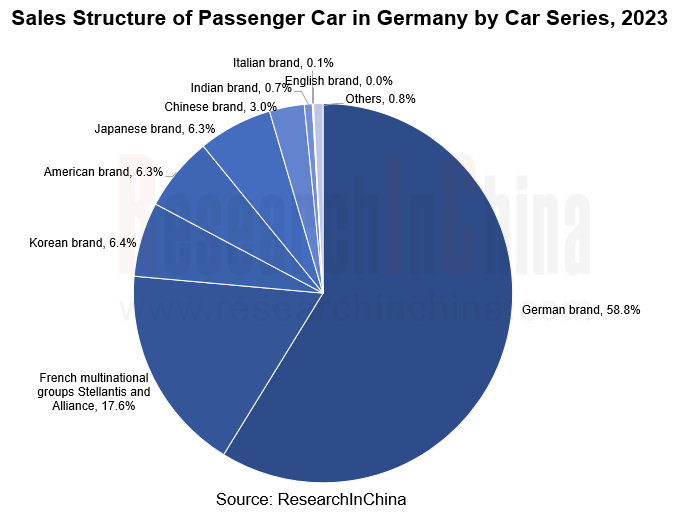
In 2023, German passenger car market sales totaled 2.845 million units, an increase of 7.3% year-on-year. In terms of the proportion of car sales of different car series, German cars hold a stable share of more than half of German market. This is followed by French multinational groups Stellantis and Renault-Nissan Alliance, as well as Korean, American and Japanese brands. In contrast, Chinese cars performed slightly worse in German market, with sales accounting for only 3.0%.
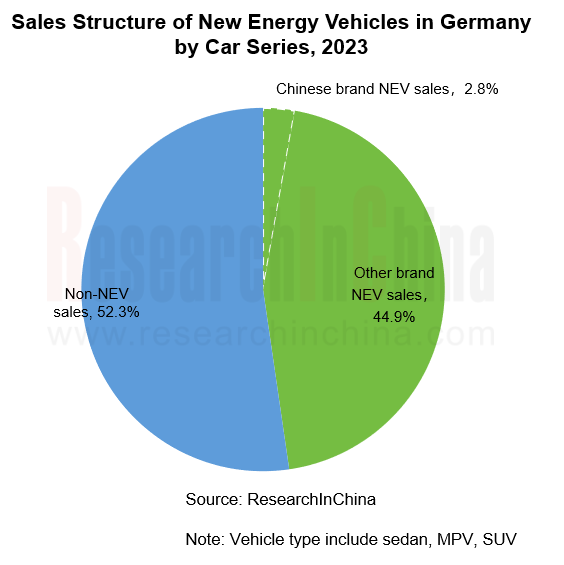
In addition, Germany's new energy vehicle sales were 1.358 million, accounting for 47.7% of total sales, an increase of 5.5% year-on-year. Among them, Chinese automakers sold 2.8% of new energy vehicles in Germany.
2. Export of Chinese brands to Germany focuses on cost performance and advanced configuration
According to the German car consumer survey by T-online in 2023, 30% of German consumers who are willing to buy a mid-range car are due to the lower price of mid-range car, and another 15% are due to advanced configuration.
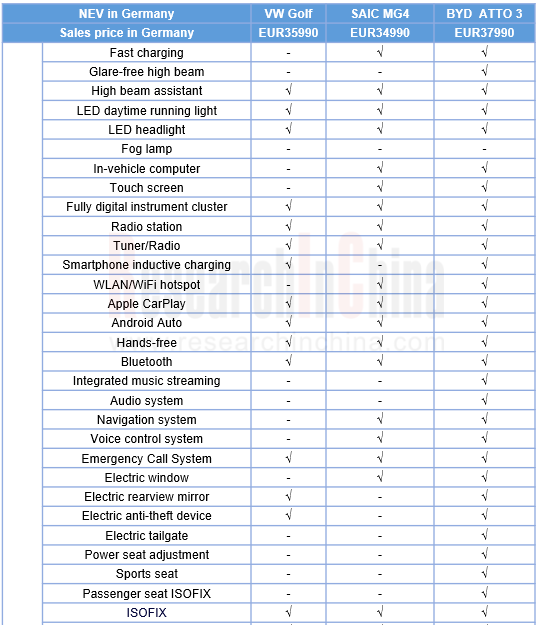
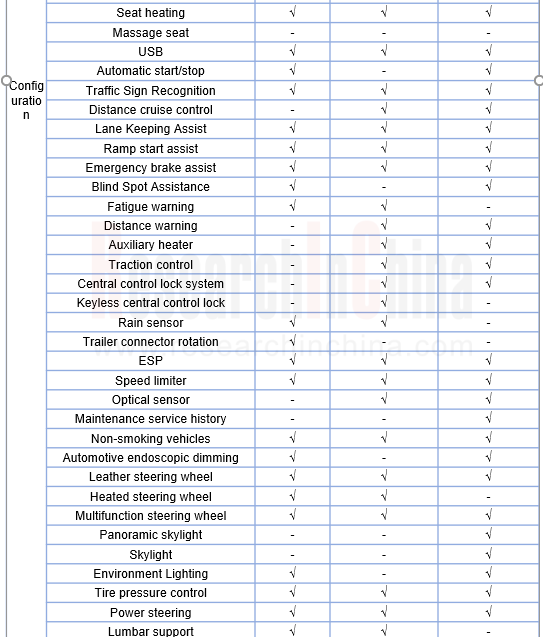
According to configuration provided by mobile.de, Germany's largest car market, new energy vehicles such as BYD ATTO 3 and SAIC MG4 at the same price can provide more vehicle functions/services than Volkswagen Golf.
In terms of vehicle navigation functions that German consumers are most concerned about, the best-selling models of BYD and SAIC MG both use Here Map intelligent navigation system. The system not only has basic navigation functions, but also automatically displays charging stations that can be replenished along the way when planning the driving route. The system supports automatic planning of reasonable driving and charging routes, effectively solving the problem of charging anxiety for users during long-distance driving.
In addition to offering more abundant configurations at the same price to attract German consumers, Chinese automakers are also actively planning and deploying a network of electric charging facilities in Germany to ease the charging anxiety of local electric vehicle users. In response to the common pain points of underground garages in the German market, such as poor signal, high failure rate of charging piles, poor compatibility of charging apps, and different charging facilities standards, Chinese automakers such as NIO have partnered with German energy supplier EnBW, charging infrastructure company Mer, and RWE to accelerate the construction of substation stations in Germany, striving to fundamentally improve the charging experience. In addition, BYD and Shell have also reached a strategic cooperation agreement. The two companies will set up BYD-Shell EV charging centers in major European markets, integrate the resources of both parties, optimize the charging process and digital services, and enhance the user experience.
3. European Union's response strategy after adding tariffs, localized factory building is the optimal but not the only solution
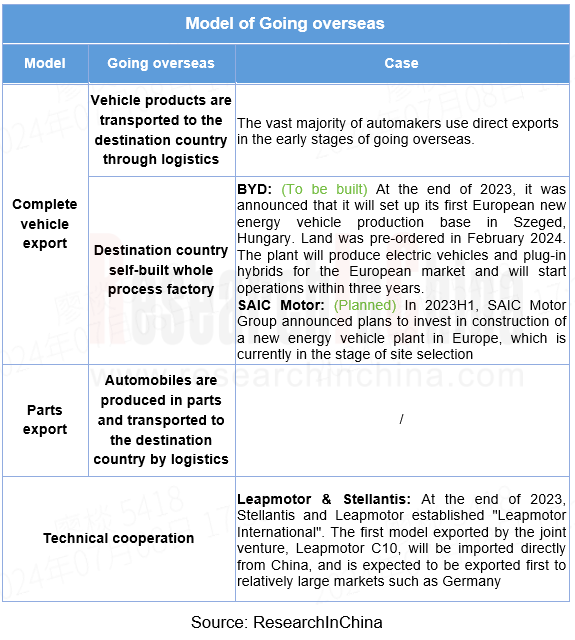
The three major export strategies of Chinese automakers to expand overseas markets are vehicle exports, parts exports and technical cooperation exports. For German market, Chinese automakers mainly adopt two key paths of vehicle exports and technical cooperation exports to deepen market penetration.
Chinese automakers enter German market by exporting complete vehicles:
In the early stage of overseas market expansion, the export of complete vehicles is the preferred strategy of most OEMs. With increase in sales of models in German market and implementation of European Union tariff policy, some Chinese OEMs such as BYD (announced at the end of 2023 that it will build the first new energy vehicle factory in Hungary) and SAIC (also plans to build a factory in Europe) have adopted the local factory approach to avoid tariff barriers, cut production costs and further enhance market competitiveness of products.
?????
Chinese automakers enter German market through technical cooperation:
In addition to the factory construction model that focuses on asset investment, Leopmotor, an emerging automaker whose sales in German market are still in their infancy, has adopted? overseas strategy of technical cooperation. In 2023, Leopmotor and Stellantis Group jointly established a joint venture "Leopmotor International". Based on Stellantis' global network resources and channel advantages, Leopmotor can achieve rapid penetration of overseas markets and enhance its global market competitiveness. Under this cooperation framework, Leopmotor will focus on core technology R&D, design and manufacturing, while Stellantis will provide marketing, sales network, after-sales services and other support. Finally, Leopmotor will be launched to nine European countries including Germany based on Leopmotor International.
Chinese automakers set up different technology centers to deepen German market:
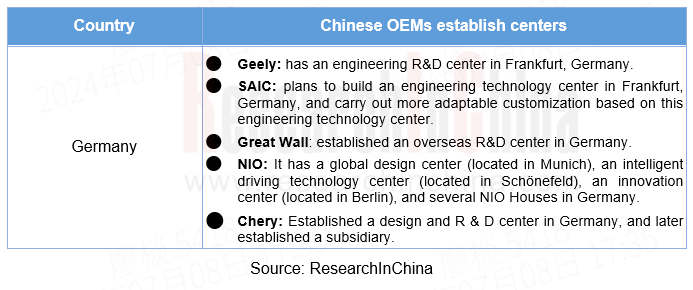
In order to integrate more deeply into overseas markets and achieve more stable and long-term development in? German automotive market, Chinese automakers have also established R&D centers, design centers, and intelligent driving centers in Germany.
In April 2024, NIO officially established? Smart Driving Technology Center in the Sch?nefeld area next to its Berlin Innovation Center, which opened in 2023. This strategic layout aims to create an excellent smart driving experience for users in European market through deep integration and efficient collaboration of the two centers, closely combining the unique driving environment in Europe, the individual needs of users, and the strict regulatory framework.
In June 2024, SAIC announced that it would establish an engineering and technology center in Frankfurt, Germany, and send SAIC engineers to directly connect with European automotive industry chain, dealers, and users to create an efficient local R & D system.
Different Chinese car brands flexibly adjust their expansion strategies in German market:
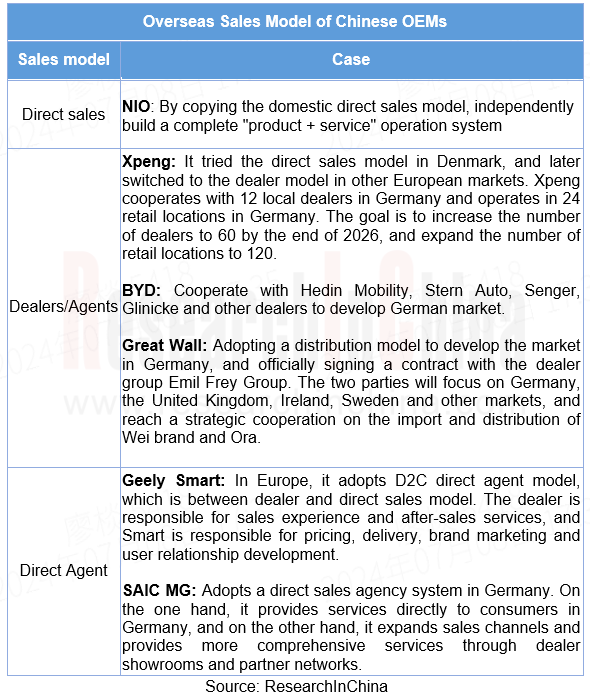
In addition, the market expansion strategies of Chinese OEMs in German market also have their own characteristics. NIO adheres to the direct sales method, and builds a complete operation system of "product + service" independently by copying the successful experience in China. It does not cooperate with local dealers. In contrast, Xpeng initially tried direct sales in Denmark, adjusted its strategy, and switched to a dealer model in most European markets. In particular, it cooperated with 12 dealers in Germany, and plans to significantly expand its distribution network and retail terminals in the next few years. BYD and Great Wall have chosen to cooperate with dealers, working with different partners to explore German market.
Geely's Smart and SAIC MG have adopted a unique direct agent model in Germany, which combines the advantages of dealers and direct sales. This model can not only directly face consumers, but also use the dealer network to achieve multi-channel sales and service coverage. These different sales models reflect the flexibility of each brand to adjust according to its own strategy and market environment.
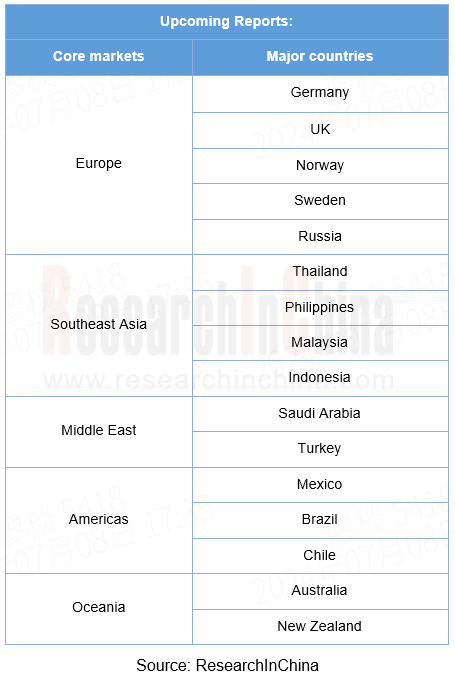
In the future, ResearchInChina will continue to expand the scope of research based on the key markets of Chinese automakers going overseas, and successively launch a series of reports such as Thailand and Brazil, providing a more comprehensive and in-depth reference for the industry's overseas strategy.
Automotive Microcontroller Unit (MCU) and Application Scenario Research Report, 2026
Automotive MCU Research: Increased demand for redundant security drives ASIL D-compliant MCU shipments to exceed 100 million units
In a vehicle EEA, MCUs are widely distributed in various functional ...
China Intelligent Cockpit Patent Analysis Report, 2026
Intelligent Cockpit Patent Research: Cockpit AI, In?vehicle Health, and Infotainment Are Upgrade to Scenario?based and Proactive Functions
From a patent perspective, this report explores the cutting?...
Research Report on Application of VLA Large Model in Automobiles and Robots, 2026
Research on Automotive and Robot VLA: Hybrid Architectures Become Mainstream, VLA Integrates with General World Models, and Reinforcement Learning Serves as Core Engine
Vision?Language?Action (VLA) m...
China Charging Infrastructure (Supercharging, Battery Swapping, V2G, etc.) and High-Performance Supercharging Battery Research Report, 2026
Charging and battery swapping research: as 5C+ supercharging vehicle models go into mass production, the pace of OEMs self-building supercharging networks quickens
800-1000V high-voltage platforms ar...
China Passenger Car Electronic Controlled Suspension Industry Report, 2026
Electronic Controlled Suspension Industry Research: As the First Year of Full Active Suspension Unfolds, Three Technical Routes Race Forward
1. Penetration Rate Surges Three Times, and Electronic Con...
Intelligent Driving SoC Research Report, 2026
Research on Intelligent Driving SoCs: Competition Focus Shifts to L3/L4 Embedded Hardware, and Computing Power of Flagship Vehicle Models Exceeds 1,000 TOPS
In terms of intelligent driving system in...
Automotive AI Large Model Technology Research Report, 2026
Automotive AI Large Model Research: Competition Shifts from "Who Has the Stronger Model" to "Who Boasts Higher Link Efficiency"
ResearchInChina released the Automotive AI Large Model Technology Resea...
Intelligent Vehicle Cockpit Domain Controller Research Report, 2026
Cockpit domain controller research: L3 AIDV intelligent cockpit domain controllers are entering a boom period
Driven by multiple factors such as the continuous evolution of the automotive central int...
Automotive Acoustic System (Audio, Multi-Channel) Industry Report, 2026
Automotive Acoustics Research: Multiple Channels, AI Tuning, and Self-Developed Algorithms Drive the Transformation of High-End Cockpit Sound Fields
I. Automotive Audio Hardware Solutions with 6–9 S...
Autonomous Driving Sensor Chip Research Report, 2026
Research on Autonomous Driving Sensor Chips: Deeply Perceiving the Physical World, Sensor Chips Are Playing A “Leading Role” in Intelligence
In 2026, the autonomous driving sensor chip industr...
Passenger Car Corner Module and Wheel‑Side Control System Research Report, 2026
Wheel-side control research: the “last mile” chassis innovation
Wheel-side control dismantles the traditional drive, braking, steering, and suspension control of the chassis from a "centralized" styl...
Embodied Artificial Intelligence (& Humanoid Robot) MCU Research Report, 2026
Research on Humanoid Robot MCUs: Evolution from General-Purpose Control to High-Value Dedicated Chip Solutions Integrated with Edge AI Functions
MCU (Microcontroller Unit) refers to a compact integra...
Intelligent Vehicle Zone Control Unit (ZCU) Research Report, 2026
ZCU Research: Cross-domain integrated ZCUs are becoming the edge computing nodes of the next-generation zonal architecture
Currently, the mainstream zonal architecture is mainly the quasi-central + z...
Automotive Cybersecurity and Data Security Research Report, 2026
Cybersecurity & Data Security Research: Intelligent Connected Vehicles Enter the Era of “Systematic Offense-Defense and AI-Defined Security”.
Centering on the panorama of intelligent connect...
Report on Breakthrough Strategies of OEMs and ADAS Tier 1 Suppliers for Overseas Layout of Intelligent Driving, 2026
Regulatory Breakthrough, Local System Establishment, OEMs Competing for NOA Layout: Overall Trends of China’s Intelligent Driving Overseas Layout in 2026
Research on overseas intelligent driving layo...
OEMs and Tier1s’ Intelligent Cockpit Platform (Hardware and Software) Innovation Strategy Research Report, 2026
Intelligent Cockpit Platform Research: multi-dimensional cockpit system architecture reconstruction for multi-agent collaboration and proactive intelligent services
The intelligent cockpit software s...
Automotive AIOS Research Report, 2026
Automotive AIOS Research: Mass Production Solutions Are Implemented
Mass Production Solutions Are Implemented on A Small Scale.
In 2026, AIOS starts small-scale implementation, helping to improve v...
Automotive Telematics Service Provider (TSP) Research Report, 2026
TSP Research: Leading providers collectively turn to AI agents to provide all-scenario active services
Telematics Service Providers (TSPs) are the core hub of the telematics industry chain, connectin...