Passenger Car Intelligent Chassis Controller and Chassis Domain Controller Research Report, 2024
Chassis controller research: More advanced chassis functions are available in cars, dozens of financing cases occur in one year, and chassis intelligence has a bright future.
The report combs through the development and application of passenger car chassis controllers and chassis domain controllers, and interprets the status quo of the industry from three perspectives: suppliers, OEMs, and capital.
1. From the perspective of the capital market, intelligent chassis has an eye-catching ability to attract capital.
According to incomplete statistics from ResearchInChina, dozens of financing cases have been completed in the field of intelligent chassis in 2024, with the financing amount exceeding RMB3 billion.
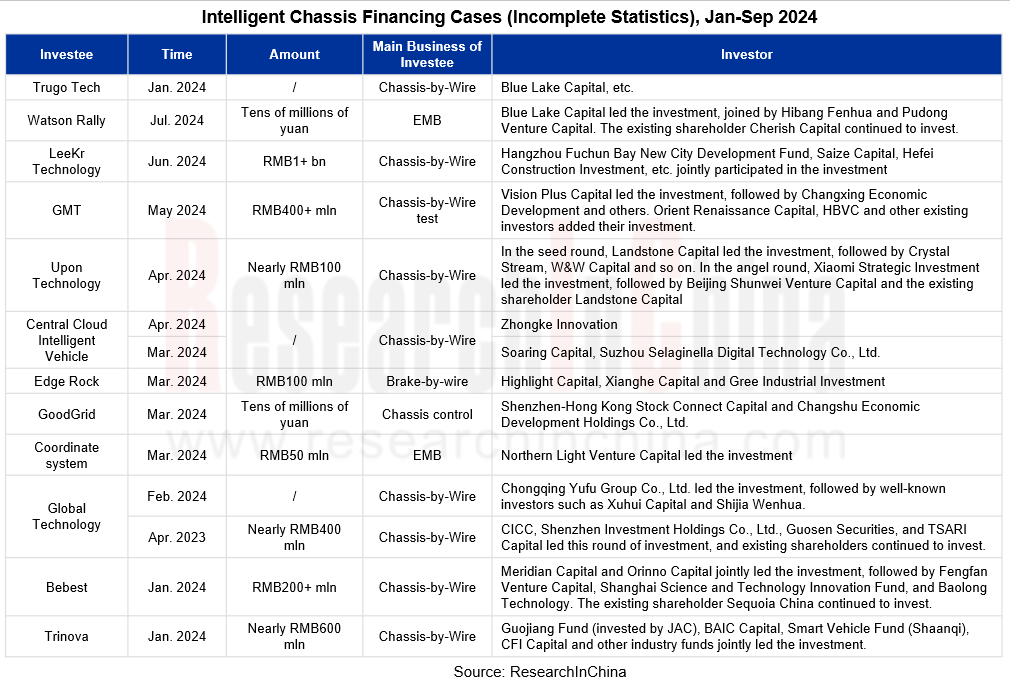
For example, Trugo Tech closed a Series B funding round in January 2024, only 6 months away from its A++ funding round, thanks to the capital market's sustained attention to intelligent chassis and Trugo Tech's own technical strength.
It is known that Trugo Tech has supplied over 80,000 ESC products monthly. Based on the mature development experience of ESC, Trugo Tech has deployed EHB and EMB products.
EHB. The product adopts the One-Box technology route and can be matched with <3.2t vehicle models. It integrates more than 30 intelligent functions such as power assist control, coordinated braking energy recovery, wheel anti-lock control and body stability control, and supports multi-sensor fusion. It features pressure build-up in less than 150ms, and the maximum pressure build-up greater than 180bar, and can recover over 90% of energy.
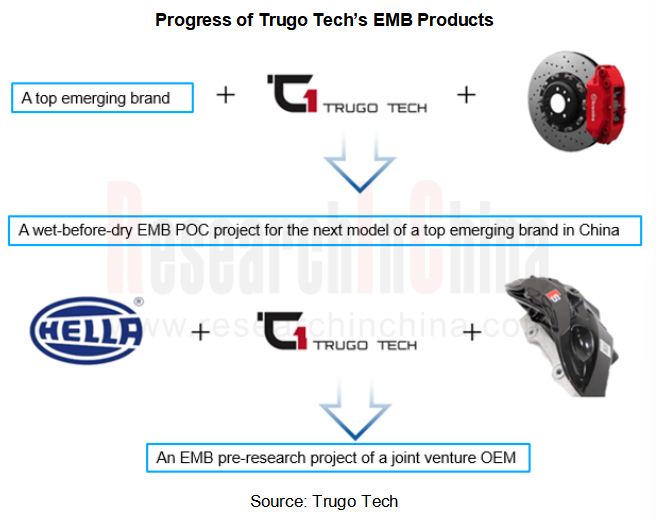
EMB. Starting from actuators and core algorithms, Trugo Tech has started pre-research on dry EMB products and related solutions, providing full dry EMB POC projects for the models to be released by domestic leading emerging OEMs. The EMB products are expected to land on vehicles for testing in 2024, and come into small volume production in 2026.
2. From the perspective of OEMs, some have expanded multiple chassis functions.
NIO 4D Comfort Pilot + Adaptive Suspension Predictive Control Solution
As the first OEM in the industry to install chassis domain controllers on cars, NIO released the Banyan 2.4.0 via OTA in January 2024, adding 4D Comfort Pilot (the horizontal, vertical and longitudinal axes of the body and the time dimension). NIO claims that it is "the industry's first intelligent chassis system powered by AI technology". Enabling the functions is inseparable from NIO's intelligent chassis hardware system composed of intelligent chassis controller (ICC), air spring and continuous damping control system (CDC).
4D Comfort Pilot means that the vehicle generates road surface features in advance according to the intelligent driving hardware on the body, and then through real-time or offline big data processing, the features are finally fed back to the chassis domain to adjust the suspension height and damping control strategy in real time to improve driving comfort. The navigation layer of 4D Comfort Pilot can be generated as long as four NIO cars (equipped with air springs + CDC) pass by on a road section. Subsequent NIO cars passing through this road section can confirm the bumpy layer and achieve real-time updates.
Geely's AI digital chassis supports such functions as crab walk mode, tank turn and super magic carpet.
In April 2024, Geely released an AI digital chassis based on the GEA. The self-developed chassis integrates domain controllers and is equipped with steer-by-wire, brake-by-wire, active suspension and four-wheel motor system, supporting three-way (XYZ), six-degree-of-freedom intelligent decision. Supported by the above hardware and Geely's AI algorithm control system, the AI ??digital chassis can enable the following intelligent chassis functions:
Crab walk mode (front and rear wheels roll in the same direction)
Tank turn
Super magic carpet (active suspension adjustment)
"Zero" impact when passing over bumps (real-time perception of road information; tire height adjusted by the suspension actively)
Automatic adjustment for wading (the front suspension is automatically lifted before wading, and the suspension height is adjusted in real time during wading)
Side active defense (when there is a risk of a side collision, one side of the body will quickly rise to reduce the damage caused by the collision)
Geely's AI digital chassis makes a reaction in just 4 milliseconds (25 times faster than the human extreme reaction), enabling "automatic vehicle control for risk avoidance" in extreme conditions. It is known that Geely's AI digital chassis will be mass-produced and installed in Geely Galaxy, Lynk & Co and other products by 2025 at the latest.
3. From the prospective of suppliers, some OEMs in China have made significant progress in chassis domain controllers in 2024.
In research and development of cooperative intelligent chassis controllers, foreign players benefit from their technical expertise and first-mover advantages in traditional automobiles. Some foreign suppliers already have some mature products, such as Bosch's integrated vehicle dynamic control system and ZF's cubiX chassis integrated controller. Chinese parts suppliers have started R&D of cooperative intelligent chassis controllers since 2000, and quickened their pace in recent years, gradually narrowing the gap with international giants.
Currently, there are three main types of players in China that are developing chassis domain controllers:
First, companies that focus on chassis domain controllers, such as MXD. They can provide full-stack services from hardware platforms to application layer, but they have a short history and limited development capital reserve.
Second, Chinese chassis suppliers that deploy one or more components for brake-by-wire, steer-by-wire or suspension-by-wire. They have mature chassis development experience and have initially achieved mass production of actuators. Representatives including Global Technology, Tongyu Automobile and Trinova often have profound technical expertise in a single actuator, but still face obstacles in horizontal expansion for domain control solutions.
Third, traditional automotive electronics companies represented by Jingwei Hirain. They often have mature development experience in domain controllers. For example, Jingwei Hirain has deployed products in the body domain, driving domain, and chassis domain, and participated in the R&D and supply of chassis domain controllers for NIO, with certain mass production experience.
MXD
In April 2024, MXD debuted at the Auto China with VCC 1.0, its first-generation Lingkong Series chassis domain controller which integrates CDC, ECAS, EPB and onboard IMU and realizes the function of dual-control EPB through the EPB module. It is known that VCC 1.0 has been designated by JAC.
In July 2024, MXD announced that it would integrate its self-developed rear wheel steering control on the first-generation chassis domain controller, providing the market with VCC 1.5, a new chassis controller with software and hardware decoupled.
Tongyu Automotive
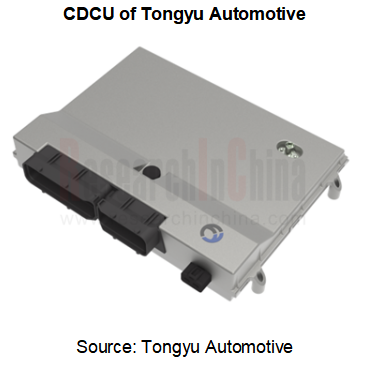
In July 2024, Mr. Shu Qiang, founder, chairman and general manager, said that Tongyu Automotive had released its first-generation chassis domain controller which can enable integrate control of braking, steering, suspension, parking, driving and other systems, and decouple the high-level functional algorithms related to vehicle dynamic performance in the original components (VDC, TCS, etc.) from the braking system and place them in the chassis domain controller instead. In addition, the solution supports dual MCU redundancy and integrates a combined positioning module. The two MCUs and CAN form vehicle architecture ring network redundancy. In terms of hardware redundancy, key power supplies, sensors, actuators, and communications are redundant.
As early as March 2024, Tongyu Automotive formed a partnership with C*Core Technology. They will create a localized automotive electronic chassis-by-wire controller solution.
Jingwei Hirain
In June 2022, NIO announced China's first full-stack self-developed suspension control system equipped with a full-stack self-developed intelligent chassis controller (ICC). It was first available to the production vehicle ET7. Jingwei Hirain participated in the R&D and production of this domain controller.
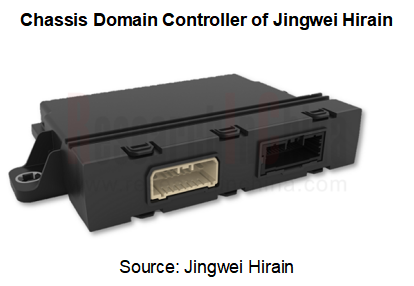
In February 2024, Jingwei Hirain started mass production of its full-stack self-developed chassis domain controller. So far, it has mass-produced controllers, underlying software, air springs, suspension algorithm modules, and realized functions such as welcoming and seeing off, active prediction, and magic carpet suspension. Jingwei Hirain’s full-stack self-developed chassis domain controller has the following features:
It integrates damping control, air spring height control and other functions, and simplifies the chassis control system
It can also integrate rear wheel steering, electronic stabilizer bars, steering column position control, engine mounting, etc.
In the combination with intelligent actuators, the chassis domain controller with enough computing power reserved can integrate longitudinal, lateral and vertical control functions of vehicles, such as steering, braking and suspension to perform high-level cooperative chassis control and vehicle motion trajectory control.
Automotive Microcontroller Unit (MCU) and Application Scenario Research Report, 2026
Automotive MCU Research: Increased demand for redundant security drives ASIL D-compliant MCU shipments to exceed 100 million units
In a vehicle EEA, MCUs are widely distributed in various functional ...
China Intelligent Cockpit Patent Analysis Report, 2026
Intelligent Cockpit Patent Research: Cockpit AI, In?vehicle Health, and Infotainment Are Upgrade to Scenario?based and Proactive Functions
From a patent perspective, this report explores the cutting?...
Research Report on Application of VLA Large Model in Automobiles and Robots, 2026
Research on Automotive and Robot VLA: Hybrid Architectures Become Mainstream, VLA Integrates with General World Models, and Reinforcement Learning Serves as Core Engine
Vision?Language?Action (VLA) m...
China Charging Infrastructure (Supercharging, Battery Swapping, V2G, etc.) and High-Performance Supercharging Battery Research Report, 2026
Charging and battery swapping research: as 5C+ supercharging vehicle models go into mass production, the pace of OEMs self-building supercharging networks quickens
800-1000V high-voltage platforms ar...
China Passenger Car Electronic Controlled Suspension Industry Report, 2026
Electronic Controlled Suspension Industry Research: As the First Year of Full Active Suspension Unfolds, Three Technical Routes Race Forward
1. Penetration Rate Surges Three Times, and Electronic Con...
Intelligent Driving SoC Research Report, 2026
Research on Intelligent Driving SoCs: Competition Focus Shifts to L3/L4 Embedded Hardware, and Computing Power of Flagship Vehicle Models Exceeds 1,000 TOPS
In terms of intelligent driving system in...
Automotive AI Large Model Technology Research Report, 2026
Automotive AI Large Model Research: Competition Shifts from "Who Has the Stronger Model" to "Who Boasts Higher Link Efficiency"
ResearchInChina released the Automotive AI Large Model Technology Resea...
Intelligent Vehicle Cockpit Domain Controller Research Report, 2026
Cockpit domain controller research: L3 AIDV intelligent cockpit domain controllers are entering a boom period
Driven by multiple factors such as the continuous evolution of the automotive central int...
Automotive Acoustic System (Audio, Multi-Channel) Industry Report, 2026
Automotive Acoustics Research: Multiple Channels, AI Tuning, and Self-Developed Algorithms Drive the Transformation of High-End Cockpit Sound Fields
I. Automotive Audio Hardware Solutions with 6–9 S...
Autonomous Driving Sensor Chip Research Report, 2026
Research on Autonomous Driving Sensor Chips: Deeply Perceiving the Physical World, Sensor Chips Are Playing A “Leading Role” in Intelligence
In 2026, the autonomous driving sensor chip industr...
Passenger Car Corner Module and Wheel‑Side Control System Research Report, 2026
Wheel-side control research: the “last mile” chassis innovation
Wheel-side control dismantles the traditional drive, braking, steering, and suspension control of the chassis from a "centralized" styl...
Embodied Artificial Intelligence (& Humanoid Robot) MCU Research Report, 2026
Research on Humanoid Robot MCUs: Evolution from General-Purpose Control to High-Value Dedicated Chip Solutions Integrated with Edge AI Functions
MCU (Microcontroller Unit) refers to a compact integra...
Intelligent Vehicle Zone Control Unit (ZCU) Research Report, 2026
ZCU Research: Cross-domain integrated ZCUs are becoming the edge computing nodes of the next-generation zonal architecture
Currently, the mainstream zonal architecture is mainly the quasi-central + z...
Automotive Cybersecurity and Data Security Research Report, 2026
Cybersecurity & Data Security Research: Intelligent Connected Vehicles Enter the Era of “Systematic Offense-Defense and AI-Defined Security”.
Centering on the panorama of intelligent connect...
Report on Breakthrough Strategies of OEMs and ADAS Tier 1 Suppliers for Overseas Layout of Intelligent Driving, 2026
Regulatory Breakthrough, Local System Establishment, OEMs Competing for NOA Layout: Overall Trends of China’s Intelligent Driving Overseas Layout in 2026
Research on overseas intelligent driving layo...
OEMs and Tier1s’ Intelligent Cockpit Platform (Hardware and Software) Innovation Strategy Research Report, 2026
Intelligent Cockpit Platform Research: multi-dimensional cockpit system architecture reconstruction for multi-agent collaboration and proactive intelligent services
The intelligent cockpit software s...
Automotive AIOS Research Report, 2026
Automotive AIOS Research: Mass Production Solutions Are Implemented
Mass Production Solutions Are Implemented on A Small Scale.
In 2026, AIOS starts small-scale implementation, helping to improve v...
Automotive Telematics Service Provider (TSP) Research Report, 2026
TSP Research: Leading providers collectively turn to AI agents to provide all-scenario active services
Telematics Service Providers (TSPs) are the core hub of the telematics industry chain, connectin...