Automotive cloud services: AI foundation model and NOA expand cloud demand, deep integration of cloud platform tool chain
In 2024, as the penetration rate of intelligent connected vehicles continues to increase, the development of automotive cloud services will show the following trends:
 AI foundation model and NOA installed in vehicles expand the demand for automotive cloud services
Deep integration of cloud platform tool chain
Cloud native further changes the way automotive software is developed
Terminal-cloud integration
Cloud infrastructure resources are further in short supply, and cloud vendors are increasing their investment costs
......
1. AI foundation model and NOA installed in vehicles expand the demand for automotive cloud services
In 2024, after experiencing a price war, OEMs’ cost reduction has become a focus, the pace of business cloudification has slowed down, and the demand for cloud has declined; but with the mass production of NOA and the installation of cloud-based AI foundation models in vehicles, the demand for automotive cloud services has increased instead of decreased.
AI foundation model and NOA installed in vehicles have the following requirements for cloud services:
1.Hardware infrastructure: The operation of AI foundation model/NOA requires a lot of computing power. In addition to placing higher demands on the performance and number of cloud servers, it also tests the network performance of server facilities.
2.Software solution:
AI foundation model: As of September 2024, the foundation model installed in domestic mass-produced models mainly adopts cloud-based deployment. Some emerging OEMs (such as NIO/ Xpeng Motors/Li Auto) adopt terminal-cloud integration deployment, in which complex functional modes still need to call cloud-based models to complete.
After the foundation model was installed in vehicles, the frequency of user interactions increased, from a few interaction requests per day to dozens or even hundreds of interaction requests per day, which led to an increase in demand for cloud services.
NOA: NOA’s installation volume has surged significantly, and the frequency of use has also increased, which has led to an increase in the amount of data processed and stored, an increase in the demand for cloud services, and an increase in the supporting tool chain.
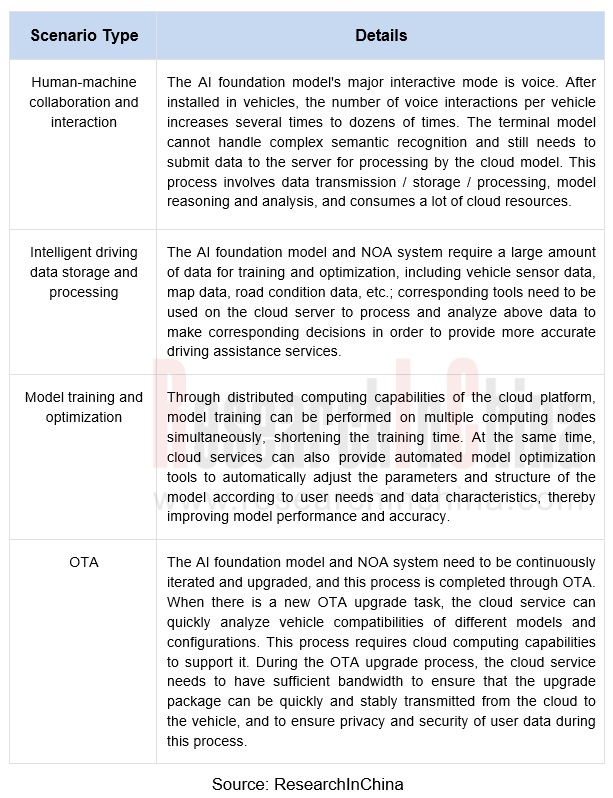
After the AI foundation model and NOA are installed in vehicles, the demand for cloud services in some key scenarios is as follows:
In 2024, Alibaba Cloud provides Momenta with stable and flexible cloud-native computing resources to build automated closed-loop data. The solution supports an end-to-end technical framework, covers visual perception AI capabilities, and can promote large-scale deployment and application of intelligent driving solutions. Momenta uses Spot cases to achieve high cost- effectiveness based on the elasticity of Alibaba Cloud ESS&HPA mechanisms.
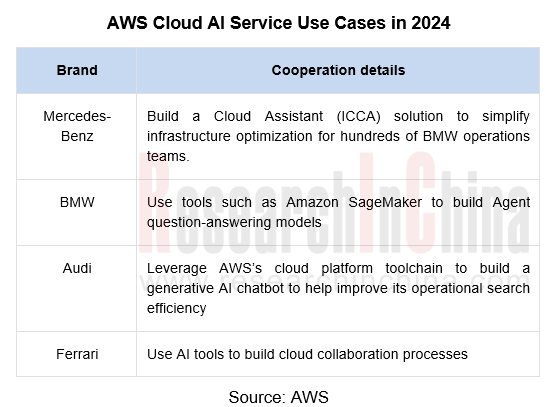
In the same year, AWS cooperates with international brands such as Mercedes-Benz and BMW to build AI assistants through cloud platform tool chain to improve operational efficiency.
2. Deep Integration of cloud platform tool chain
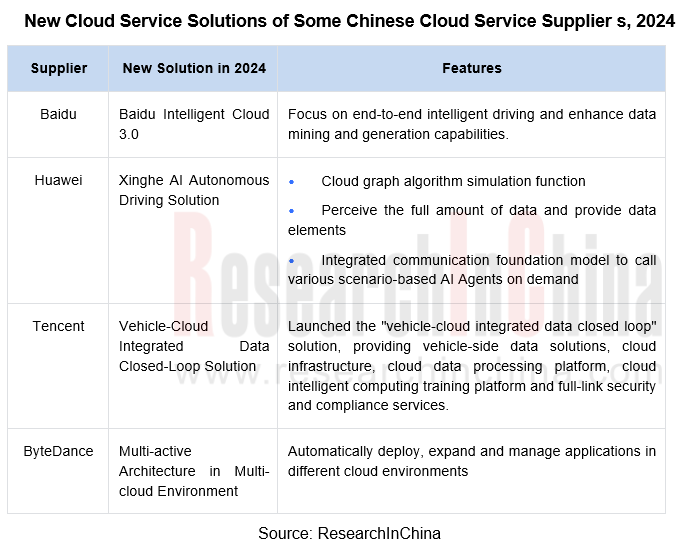
In 2024, automotive cloud service solutions will further develop in the direction of deep integration, realizing data integration and intelligent decision support for the entire chain from design and development to production management, supply chain optimization, marketing promotion and even after-sales service. New solutions of cloud vendors reflect characteristics of deep functional integration and perfect tool chain:
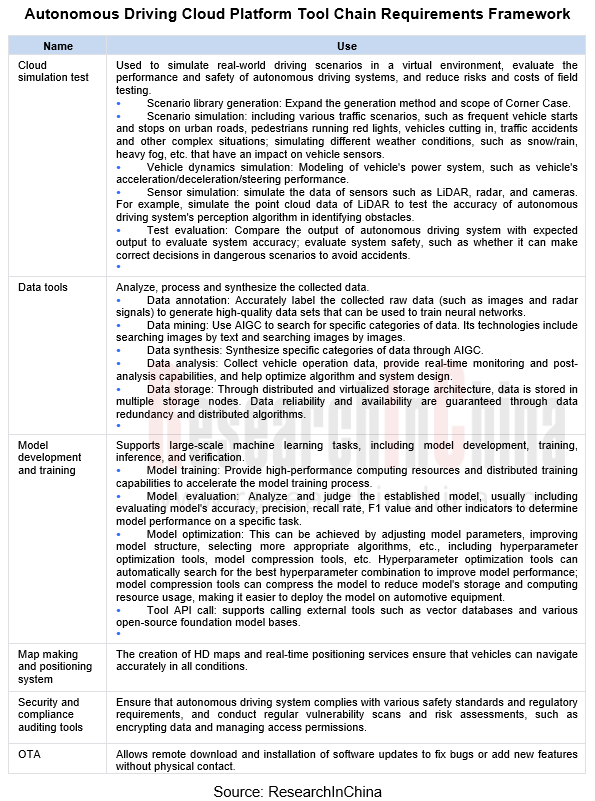
In 2024, taking the autonomous driving cloud platform as an example, most cloud service solutions include the following tool chains:
In September 2024, Baidu launched Intelligent Cloud 3.0, focusing on end-to-end intelligent driving development. Features include:
It can be used for full-process intelligent driving training from vehicle to cloud, including building virtual simulation data;
By improving training efficiency in the cloud and breaking down data barriers between the vehicle and the road, a real-time vehicle-road cloud platform is built; the platform provides services including early avoidance of congested sections, beyond-visual-range risk warnings, traffic light reminders, and remote live bird's-eye view.
Provides a cloud-based cockpit foundation model for R&D scenarios such as semantic understanding scheduling, content generation, vector search, and cross-modality.
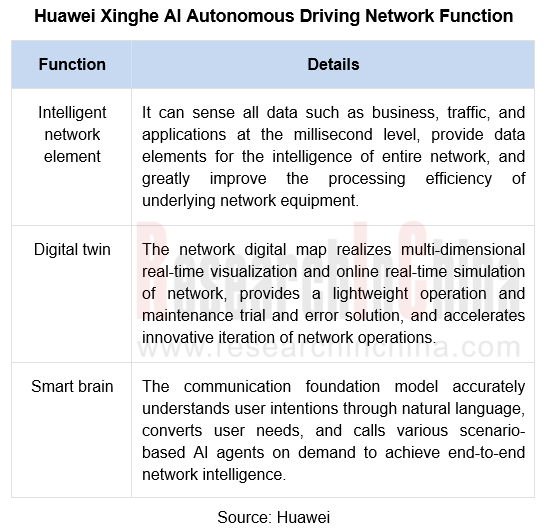
In September 2024, Huawei launched the L4 autonomous driving network solution - Xinghe AI autonomous driving network, which implements network data analysis, multi - scenario simulation and Agent calling in the cloud:
3. Cloud native further changes the way automotive software is developed
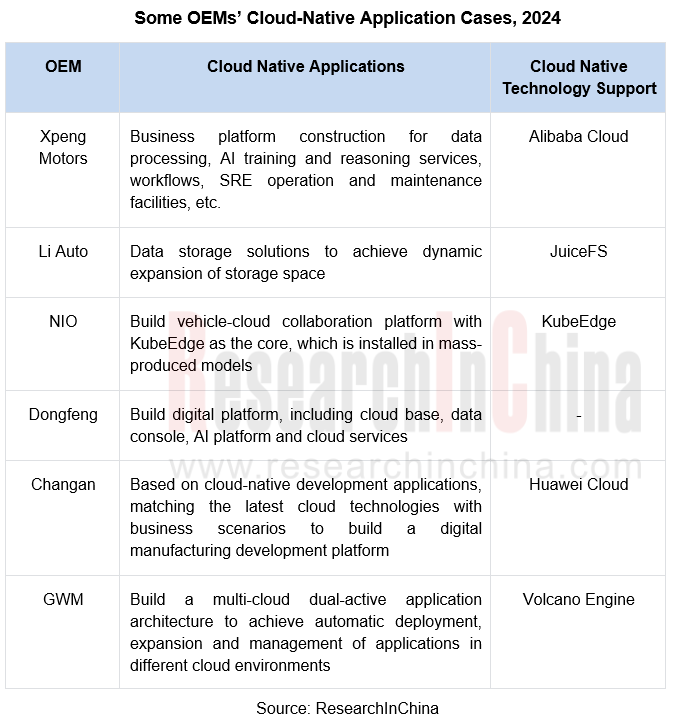
As some OEMs/Tier1s begin to build a vehicle-cloud collaborative infrastructure and try to upload vehicle-side data to the cloud for analysis and processing, and send cloud-side commands to the vehicle to achieve simple vehicle-cloud interaction. Cloud native technology has begun to be applied to the cloud-vehicle collaborative development process in automotive industry.
Cloud native is a software approach to building and running scalable applications in new dynamic environments such as public clouds, private clouds, and hybrid clouds. The concept of "cloud native" was proposed before 2020, but its application in automobiles has been in the exploratory stage and has not been widely used. It is mainly concentrated in telematics and some intelligent cockpit functions. In 2024, with the application of multi-cloud environments and AI technologies, the application scenarios of cloud native will increase greatly, and begin to affect construction logic of PaaS/SaaS cloud service solutions in the automotive industry from underlying layer:
On the vehicle side, in addition to in-vehicle infotainment system, cloud native has been used for the development and optimization of related technologies for autonomous driving and intelligent cockpit. For example, through large-scale computing and training functions of cloud-based autonomous driving platform, more accurate models and more comprehensive algorithms are provided for autonomous driving system, improving the safety and reliability of autonomous driving.
In the cloud, OEMs use a more complete cloud platform to store, mine, analyze and process vehicle data, provide support for intelligent vehicle operations, and gradually apply cloud-native software development models to OEM supply chain management, production and manufacturing and other fields, achieving collaborative optimization of entire industry chain. For example, container orchestration technology (Kubernetes, etc.) has gradually become the core technology for OEMs to build cloud-vehicle software collaborative development platforms.
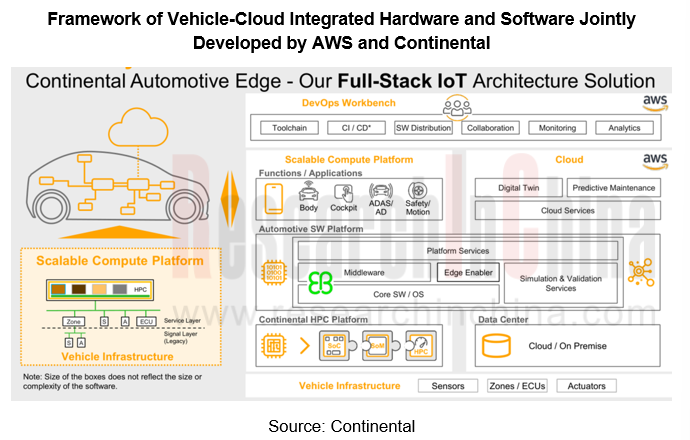
Taking the cooperation between AWS and Continental to develop cloud-based ECU as an example, Continental used AWS Graviton to simulate the hardware environment, then selected operating system and middleware to run on AWS EC2, and completed the creation of virtualized development environment through AWS EC2.
In 2024, cloud native applications will focus on:
1.Computing power management: The cloud-native platform can provide efficient computing power management technologies, including GPU computing power scheduling and distributed training, to meet the needs of AI algorithm training and real-time reasoning.
2.Optimization of service mesh and API gateway: Besides 5G communication, performance optimization of service mesh, collaboration with Kubernetes scheduler, flexible configuration and security protection of API gateway also have a great impact on cloud communication.
3.Data management and governance: Data management capabilities of Automotive Cloud Native Platform include data storage, backup, cleaning, labeling, and data security & compliance management. As OEMs increasingly value the circulation of data assets, efficient data circulation and sharing have become one of factors affecting the cloud native platform.
4.Cloud resource utilization: Some OEMs are beginning to pay attention to factors such as energy efficiency and resource utilization of cloud native technologies. Some energy-saving technologies and strategies reduce the energy consumption of cloud native platforms, while improving resource utilization efficiency and reducing operating costs.
NIO uses cloud-native technology to build a vehicle-cloud collaborative development platform
In order to solve problems such as scarce computing power, chaotic edge node management, and unstable cloud communications, NIO uses KubeEdge as the core of platform and builds a complete vehicle-cloud collaborative development platform with Kubernetes + KubeEdge as the technical base.
NIO's vehicle-cloud collaboration platform uses KubeEdge's cloud-edge communication mechanism to solve the tidal effect problem of node connections.
Typical application scenarios of this technology include:
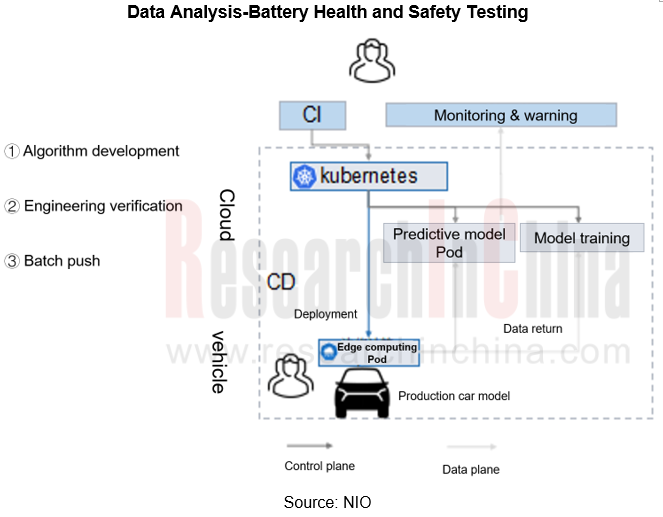
1. New energy vehicle battery health and safety data analysis: In the algorithm development stage, use containerization to develop edge algorithms; in the engineering vehicle verification stage, deploy edge computing container applications in small batches; after verification, replace the corresponding mass production base image.
2. Build a vehicle-side software test management platform: After introducing cloud native capabilities, Virtual car, test benches, and real vehicles can be connected to K8s for unified monitoring and management, which can arrange test tasks more reasonably and improve the utilization of test resources.
Automotive Microcontroller Unit (MCU) and Application Scenario Research Report, 2026
Automotive MCU Research: Increased demand for redundant security drives ASIL D-compliant MCU shipments to exceed 100 million units
In a vehicle EEA, MCUs are widely distributed in various functional ...
China Intelligent Cockpit Patent Analysis Report, 2026
Intelligent Cockpit Patent Research: Cockpit AI, In?vehicle Health, and Infotainment Are Upgrade to Scenario?based and Proactive Functions
From a patent perspective, this report explores the cutting?...
Research Report on Application of VLA Large Model in Automobiles and Robots, 2026
Research on Automotive and Robot VLA: Hybrid Architectures Become Mainstream, VLA Integrates with General World Models, and Reinforcement Learning Serves as Core Engine
Vision?Language?Action (VLA) m...
China Charging Infrastructure (Supercharging, Battery Swapping, V2G, etc.) and High-Performance Supercharging Battery Research Report, 2026
Charging and battery swapping research: as 5C+ supercharging vehicle models go into mass production, the pace of OEMs self-building supercharging networks quickens
800-1000V high-voltage platforms ar...
China Passenger Car Electronic Controlled Suspension Industry Report, 2026
Electronic Controlled Suspension Industry Research: As the First Year of Full Active Suspension Unfolds, Three Technical Routes Race Forward
1. Penetration Rate Surges Three Times, and Electronic Con...
Intelligent Driving SoC Research Report, 2026
Research on Intelligent Driving SoCs: Competition Focus Shifts to L3/L4 Embedded Hardware, and Computing Power of Flagship Vehicle Models Exceeds 1,000 TOPS
In terms of intelligent driving system in...
Automotive AI Large Model Technology Research Report, 2026
Automotive AI Large Model Research: Competition Shifts from "Who Has the Stronger Model" to "Who Boasts Higher Link Efficiency"
ResearchInChina released the Automotive AI Large Model Technology Resea...
Intelligent Vehicle Cockpit Domain Controller Research Report, 2026
Cockpit domain controller research: L3 AIDV intelligent cockpit domain controllers are entering a boom period
Driven by multiple factors such as the continuous evolution of the automotive central int...
Automotive Acoustic System (Audio, Multi-Channel) Industry Report, 2026
Automotive Acoustics Research: Multiple Channels, AI Tuning, and Self-Developed Algorithms Drive the Transformation of High-End Cockpit Sound Fields
I. Automotive Audio Hardware Solutions with 6–9 S...
Autonomous Driving Sensor Chip Research Report, 2026
Research on Autonomous Driving Sensor Chips: Deeply Perceiving the Physical World, Sensor Chips Are Playing A “Leading Role” in Intelligence
In 2026, the autonomous driving sensor chip industr...
Passenger Car Corner Module and Wheel‑Side Control System Research Report, 2026
Wheel-side control research: the “last mile” chassis innovation
Wheel-side control dismantles the traditional drive, braking, steering, and suspension control of the chassis from a "centralized" styl...
Embodied Artificial Intelligence (& Humanoid Robot) MCU Research Report, 2026
Research on Humanoid Robot MCUs: Evolution from General-Purpose Control to High-Value Dedicated Chip Solutions Integrated with Edge AI Functions
MCU (Microcontroller Unit) refers to a compact integra...
Intelligent Vehicle Zone Control Unit (ZCU) Research Report, 2026
ZCU Research: Cross-domain integrated ZCUs are becoming the edge computing nodes of the next-generation zonal architecture
Currently, the mainstream zonal architecture is mainly the quasi-central + z...
Automotive Cybersecurity and Data Security Research Report, 2026
Cybersecurity & Data Security Research: Intelligent Connected Vehicles Enter the Era of “Systematic Offense-Defense and AI-Defined Security”.
Centering on the panorama of intelligent connect...
Report on Breakthrough Strategies of OEMs and ADAS Tier 1 Suppliers for Overseas Layout of Intelligent Driving, 2026
Regulatory Breakthrough, Local System Establishment, OEMs Competing for NOA Layout: Overall Trends of China’s Intelligent Driving Overseas Layout in 2026
Research on overseas intelligent driving layo...
OEMs and Tier1s’ Intelligent Cockpit Platform (Hardware and Software) Innovation Strategy Research Report, 2026
Intelligent Cockpit Platform Research: multi-dimensional cockpit system architecture reconstruction for multi-agent collaboration and proactive intelligent services
The intelligent cockpit software s...
Automotive AIOS Research Report, 2026
Automotive AIOS Research: Mass Production Solutions Are Implemented
Mass Production Solutions Are Implemented on A Small Scale.
In 2026, AIOS starts small-scale implementation, helping to improve v...
Automotive Telematics Service Provider (TSP) Research Report, 2026
TSP Research: Leading providers collectively turn to AI agents to provide all-scenario active services
Telematics Service Providers (TSPs) are the core hub of the telematics industry chain, connectin...