Automotive audio systems in 2024: intensified stacking, and involution on number of hardware and software tuning
Sales of vehicle models equipped with more than 8 speakers have made steady growth.
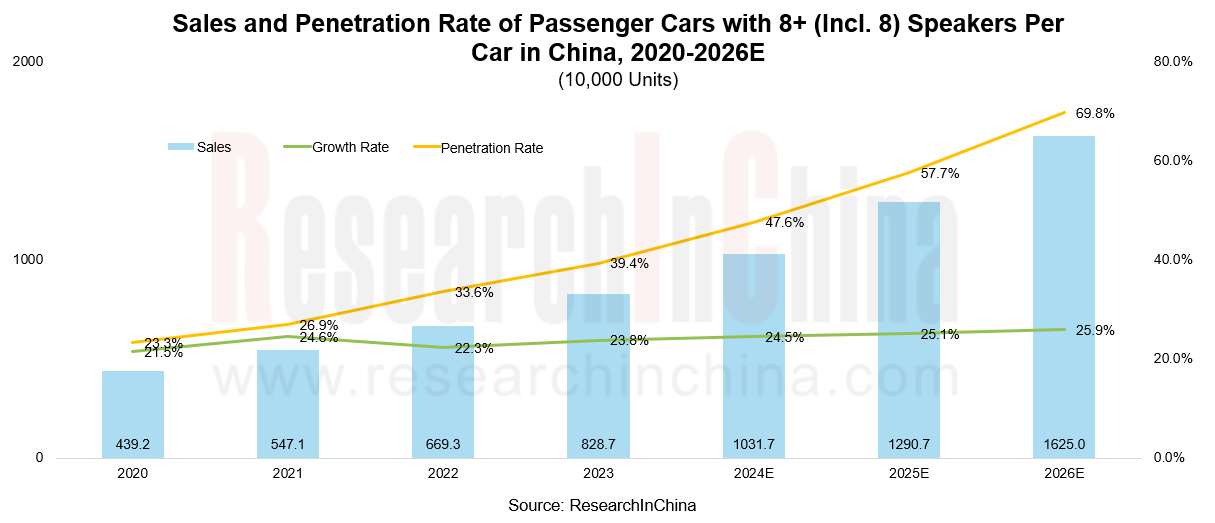
In 2024, the automotive audio market makes steady growth. In the case of models equipped with at least 8 speakers, the annual sales of such models in 2023 were 8.287 million units, with a penetration rate of 39.4%; the sales from January to July 2024 reached 5.419 million units, with a penetration rate of 47.5%. It is expected to sustain growth rate of about 24% in the next two years, and will be up to about 16.25 million units in 2026.
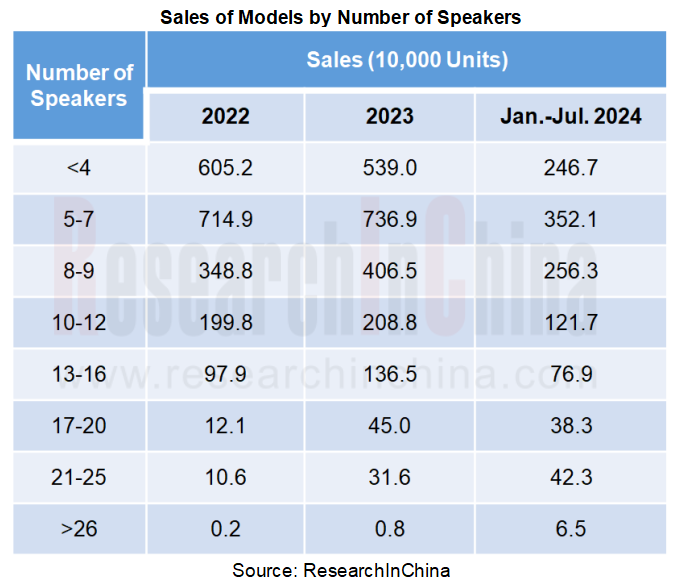
From 2022 to July 2024 the sales of models by number of speakers are shown below. Overall, the sales of models with more speakers were on the rise year on year.
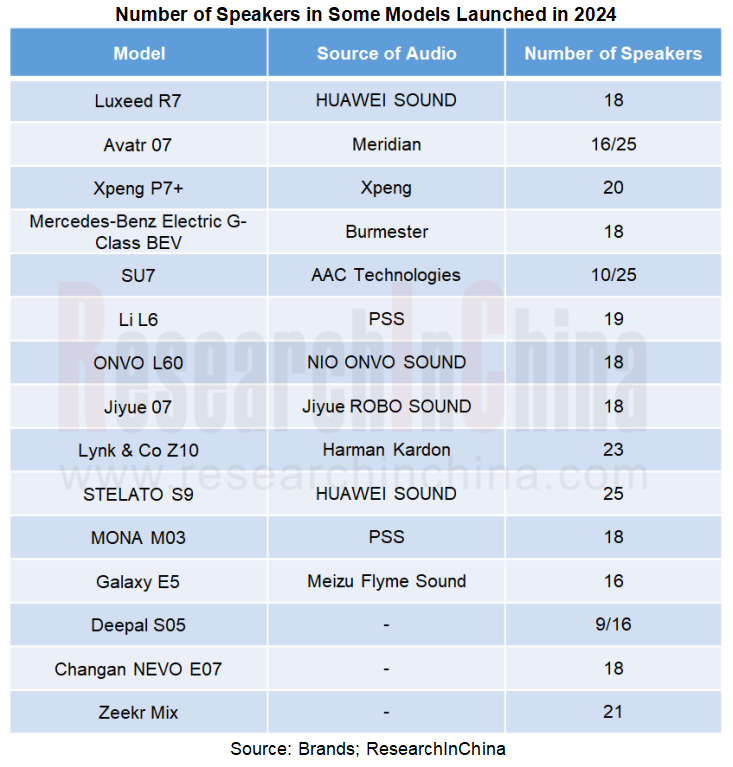
Luxeed R7
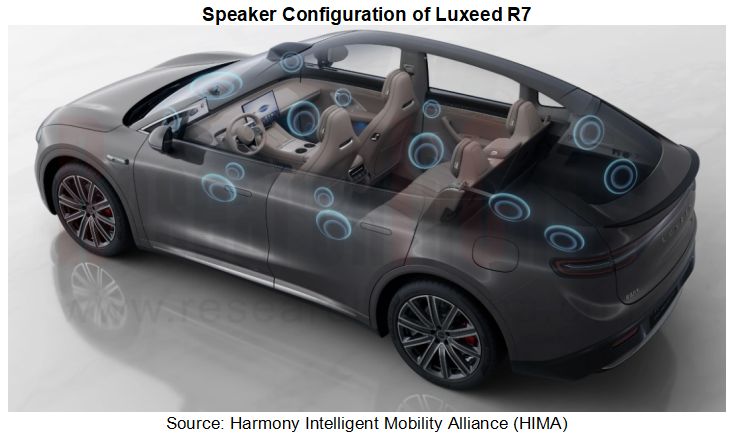
Luxeed R7 packs Huawei's HUAWEI SOUND audio system. Of the 17 speakers arranged inside the car, 15 constitute a 7.1 surround sound field, and combined with the star ring diffusor (equipped with Schroeder diffusor technology, achieving 180° full-angle sound diffusion and balanced sound field performance) and the unique turbo subwoofer, enable stronger low-frequency dive in a smaller volume; 1 speaker is deployed outside the car, and used to play specific sound effects.
ONVO L60
ONVO L60's intelligent cockpit is equipped with a 1000W ONVO SOUND audio system with 18 speakers. It supports 7.1.14 Dolby Atmos, can be linked with the 16-million-color ring cabin waterfall ambient lights, and allows for generation of an exclusive tuning equalizer via AI algorithms.
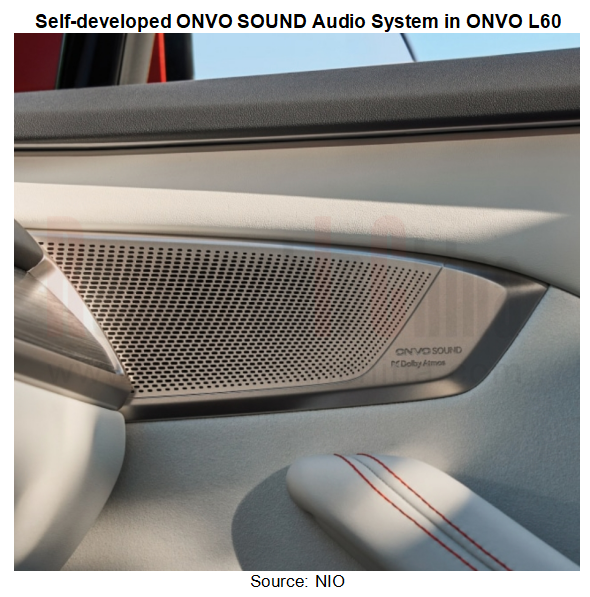
OEMs deeply self-develop audio systems, and the share of audio brands remains unchanged.
The more speakers and microphones not only means more hardware devices, but also involves a range of tasks such as reconstruction of the sound field, redesign of the audio architecture, and readjustment of the software tuning function. If all of the work is outsourced to suppliers, the total development cost will increase.
To control costs, OEMs have further deepened independent R&D of audio systems. Some of them directly purchase key components, leverage the advantages of the supply chain, and independently design and manufacture speakers, achieving self-development of audio systems, involving audio architecture design, solution integration, device manufacturing, and sound effect adjustment.
Xpeng
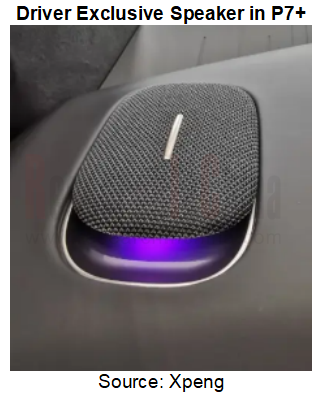
In Xpeng’s case, the audio systems of both X9 and P7+ are self-developed. Wherein, Xpeng X9 carries 23 self-developed Xopera speakers, providing key sound source locations in four sound fields (front, center front, center, and rear) for selection in the sound field mode, and different riding modes support dynamic adjustment.
For P7+, Xpeng uses speaker diaphragms imported from Germany and independently designs the 20-speaker solution. In the development process, it completed a range of tasks, for example, 1,500+ user listening preference surveys, 100+ speaker diaphragm modulations, 40+ rounds of audio tuning optimization, and 20+ rounds of blind listening tests with cross-level luxury models. The audio solution supports 7.1.4 Dolby Atmos and provides 3 tuning styles and 9-band equalizers for car owners to choose from.
Jiyue
Jiyue 01 and 07 are both equipped with the self-developed Robo Sound audio system. Jiyue 01 bears 16 speakers, supports 7.1.2 Dolby Atmos decoding, and the peak power of amplifiers is 1000W. Jiyue 07 is equipped with 18 speakers, and 16-channel independent amplifiers, and adopts 7.1.2 speaker layout with sky channels, which can bring 360-degree surround effects.

BYD
BYD adopts different speaker configuration strategies according to vehicle orientation:
Low-to-mid-end models such as Qin Series pack self-developed speakers;
High-end models (including some mid-end models) use branded speakers, for example, Dynaudio (supply to Han, Song L, Seal, Yangwang U8, etc.), Devialet (supply to Bao 5), and Infinity (supply to Song PLUS NEV).
How much impact do OEMs’ self-developed audio solutions have on the market share of audio brands?
According to the data from ResearchInChina, from 2022 to July 2024, except for the model price range of RMB350,000-500,000, the penetration rate of brand suppliers in other price ranges didn’t decrease, but rose steadily. It can be seen that brand suppliers still firmly dominate the market of audio systems for mid-to-high-end models, and are not affected by the model of "some OEMs self-developing audio systems".
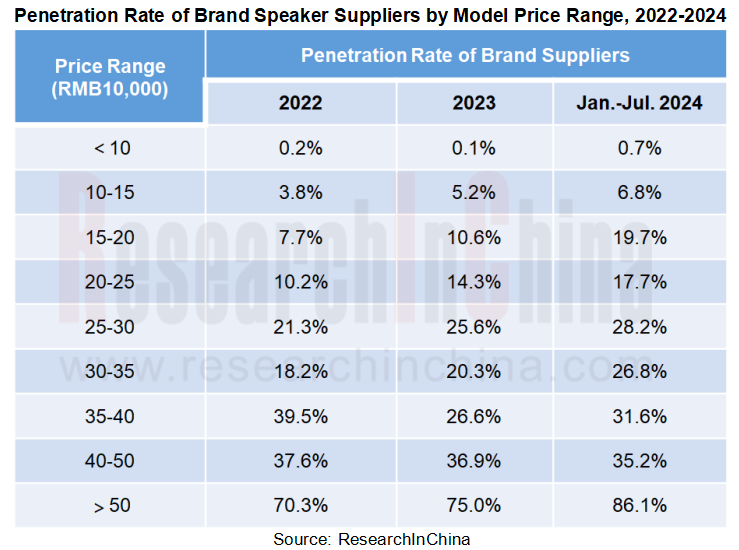
While OEMs are working on in-depth self-development of audio systems, brand speaker suppliers are also optimizing automotive acoustic technology.
Harman
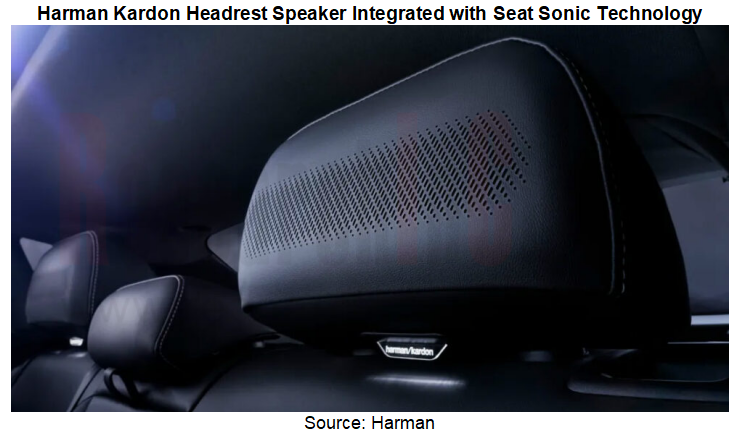
In 2024, Harman announced Seat Sonic, a technology which aims to enhance in-car entertainment by integrating sound into seats. The technology moves hardware components from the doors to the seats, reducing design complexity, and uses vibration sensors embedded in the seats to convert audio signals into vibrations, thereby improving the sound field effect in the cabin.
Yamaha
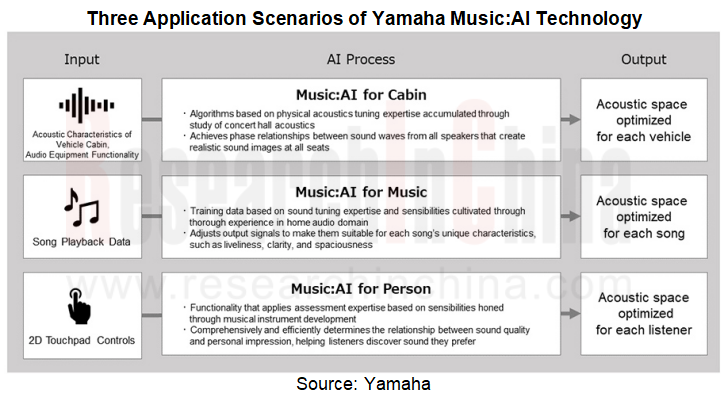
In 2024, Yamaha unveiled Music:AI, a technology which uses AI algorithms to automatically optimize acoustic parameters such as dynamic effect, transparency and volume. The technology is scheduled to come into mass production in 2025 and be promoted globally.
More speakers are not always better, and tuning technology is a way to improve sound effects.
In 2024, the audio system has begun to be deeply integrated with various functions of intelligent cockpits, such as music recommendation and audio-visual linkage. AI algorithms and models allow the sound effect mode to be automatically adjusted according to the user's preferences and the current environment, providing users with more intimate and personalized services. Multi-channel audio systems find broader application, including more ceiling speakers and subwoofer configurations, to achieve better 3D sound effects. To ensure user experience, more speakers in an automotive audio system are inevitable, so are the more speakers and microphones in a car audio system, the better?
ResearchInChina’s research shows that after speakers in a car reach a number, blindly adding speakers will not only increase hardware costs, but will also have a very limited effect in improving in-car sound effect. It will also have some impact on audio architecture design and sound field layout.
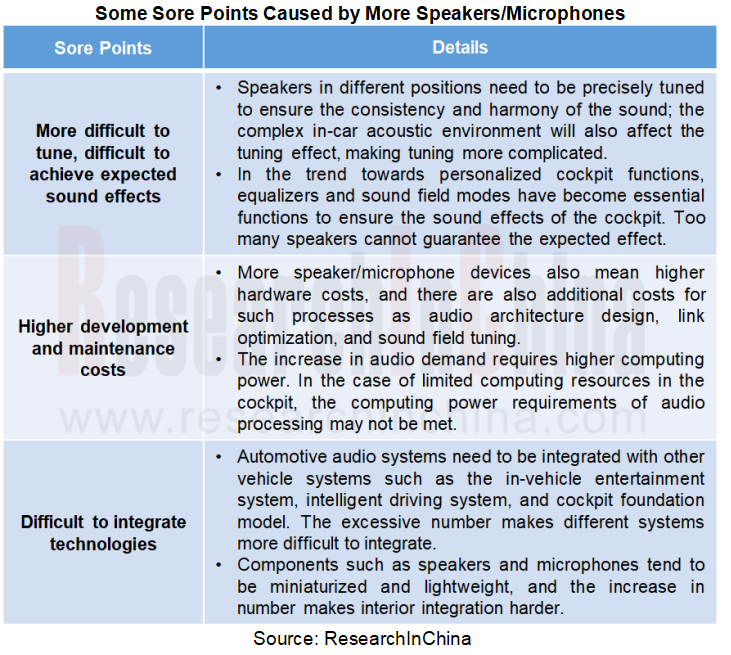
In involution on increasing the number of hardware, in 2024 OEMs pay ever more attention to tuning technologies that can optimize acoustic effects, and cooperate with established tuning suppliers or use AI technologies (such as foundation models) for tuning.
Great Wall
In April 2024, Great Wall Motor cooperated with Dirac, a Swedish digital audio tuning supplier, to equip WEY Blue Mountain Intelligent Driving Edition with "Dirac Virtuo Professional". Based on sound separation technology, this technology decodes the spatial information contained in ordinary stereo music, re-positions the spatial dynamics and remixes it, and then allows the more than 20 speakers in the car to play it in the corresponding locations according to the spatial layout. This technology lets the narrow sound movement trajectory originally limited by dual channels extend to the entire cabin space, thereby achieving 100% conversion of audio contents, and enabling all types of sound sources to have a three-dimensional sense of space.
Geely
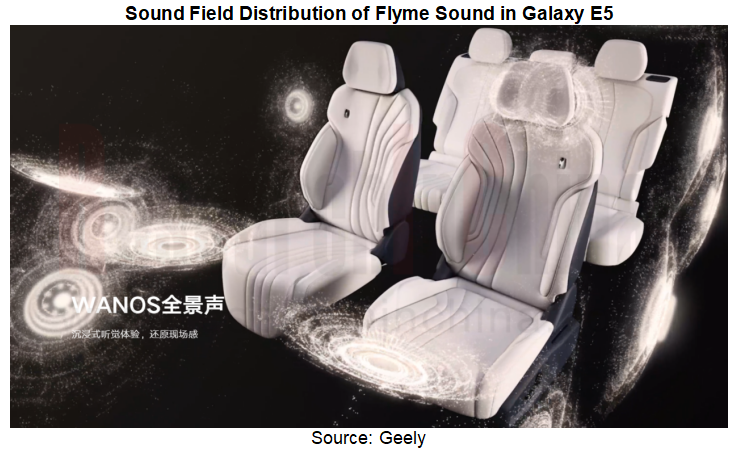
In May 2024, Geely and Flyme Sound Inside jointly released the AI-powered intelligent audio system - "Flyme Sound". The system supports 9.1.6 channels and panoramic surround sound. The entire architecture design can accommodate up to 27 speakers, and uses AI algorithms to enable the audio system with intelligent optimization capabilities. It can automatically optimize the sound field distribution, intelligently match the sound effects, and automatically switch virtual venues according to the in-car space, the number of passengers, what to play, etc., in a bid to ensure that every location is the best for listening.
This technology is first installed on Galaxy E5. It is equipped with a total of 16 speakers, including 2 headrest speakers with 4 modes, and can simulate 4 mixing effects and support WANOS panoramic sound.
Automotive Microcontroller Unit (MCU) and Application Scenario Research Report, 2026
Automotive MCU Research: Increased demand for redundant security drives ASIL D-compliant MCU shipments to exceed 100 million units
In a vehicle EEA, MCUs are widely distributed in various functional ...
China Intelligent Cockpit Patent Analysis Report, 2026
Intelligent Cockpit Patent Research: Cockpit AI, In?vehicle Health, and Infotainment Are Upgrade to Scenario?based and Proactive Functions
From a patent perspective, this report explores the cutting?...
Research Report on Application of VLA Large Model in Automobiles and Robots, 2026
Research on Automotive and Robot VLA: Hybrid Architectures Become Mainstream, VLA Integrates with General World Models, and Reinforcement Learning Serves as Core Engine
Vision?Language?Action (VLA) m...
China Charging Infrastructure (Supercharging, Battery Swapping, V2G, etc.) and High-Performance Supercharging Battery Research Report, 2026
Charging and battery swapping research: as 5C+ supercharging vehicle models go into mass production, the pace of OEMs self-building supercharging networks quickens
800-1000V high-voltage platforms ar...
China Passenger Car Electronic Controlled Suspension Industry Report, 2026
Electronic Controlled Suspension Industry Research: As the First Year of Full Active Suspension Unfolds, Three Technical Routes Race Forward
1. Penetration Rate Surges Three Times, and Electronic Con...
Intelligent Driving SoC Research Report, 2026
Research on Intelligent Driving SoCs: Competition Focus Shifts to L3/L4 Embedded Hardware, and Computing Power of Flagship Vehicle Models Exceeds 1,000 TOPS
In terms of intelligent driving system in...
Automotive AI Large Model Technology Research Report, 2026
Automotive AI Large Model Research: Competition Shifts from "Who Has the Stronger Model" to "Who Boasts Higher Link Efficiency"
ResearchInChina released the Automotive AI Large Model Technology Resea...
Intelligent Vehicle Cockpit Domain Controller Research Report, 2026
Cockpit domain controller research: L3 AIDV intelligent cockpit domain controllers are entering a boom period
Driven by multiple factors such as the continuous evolution of the automotive central int...
Automotive Acoustic System (Audio, Multi-Channel) Industry Report, 2026
Automotive Acoustics Research: Multiple Channels, AI Tuning, and Self-Developed Algorithms Drive the Transformation of High-End Cockpit Sound Fields
I. Automotive Audio Hardware Solutions with 6–9 S...
Autonomous Driving Sensor Chip Research Report, 2026
Research on Autonomous Driving Sensor Chips: Deeply Perceiving the Physical World, Sensor Chips Are Playing A “Leading Role” in Intelligence
In 2026, the autonomous driving sensor chip industr...
Passenger Car Corner Module and Wheel‑Side Control System Research Report, 2026
Wheel-side control research: the “last mile” chassis innovation
Wheel-side control dismantles the traditional drive, braking, steering, and suspension control of the chassis from a "centralized" styl...
Embodied Artificial Intelligence (& Humanoid Robot) MCU Research Report, 2026
Research on Humanoid Robot MCUs: Evolution from General-Purpose Control to High-Value Dedicated Chip Solutions Integrated with Edge AI Functions
MCU (Microcontroller Unit) refers to a compact integra...
Intelligent Vehicle Zone Control Unit (ZCU) Research Report, 2026
ZCU Research: Cross-domain integrated ZCUs are becoming the edge computing nodes of the next-generation zonal architecture
Currently, the mainstream zonal architecture is mainly the quasi-central + z...
Automotive Cybersecurity and Data Security Research Report, 2026
Cybersecurity & Data Security Research: Intelligent Connected Vehicles Enter the Era of “Systematic Offense-Defense and AI-Defined Security”.
Centering on the panorama of intelligent connect...
Report on Breakthrough Strategies of OEMs and ADAS Tier 1 Suppliers for Overseas Layout of Intelligent Driving, 2026
Regulatory Breakthrough, Local System Establishment, OEMs Competing for NOA Layout: Overall Trends of China’s Intelligent Driving Overseas Layout in 2026
Research on overseas intelligent driving layo...
OEMs and Tier1s’ Intelligent Cockpit Platform (Hardware and Software) Innovation Strategy Research Report, 2026
Intelligent Cockpit Platform Research: multi-dimensional cockpit system architecture reconstruction for multi-agent collaboration and proactive intelligent services
The intelligent cockpit software s...
Automotive AIOS Research Report, 2026
Automotive AIOS Research: Mass Production Solutions Are Implemented
Mass Production Solutions Are Implemented on A Small Scale.
In 2026, AIOS starts small-scale implementation, helping to improve v...
Automotive Telematics Service Provider (TSP) Research Report, 2026
TSP Research: Leading providers collectively turn to AI agents to provide all-scenario active services
Telematics Service Providers (TSPs) are the core hub of the telematics industry chain, connectin...