China Automotive Multimodal Interaction Development Research Report, 2024
Multimodal interaction research: AI foundation models deeply integrate into the cockpit, helping perceptual intelligence evolve into cognitive intelligence
China Automotive Multimodal Interaction Development Research Report, 2024 released by ResearchInChina combs through the interaction modes of mainstream cockpits, the application of interaction modes in key vehicle models launched in 2024, and the cockpit interaction solutions of OEMs/suppliers, and summarizes the development trends of cockpit multimodal interaction fusion.
1. Voice recognition dominates cockpit interaction, and integrates with multiple modes to create a new interaction experience.
Among current cockpit interaction applications, voice interaction is used most widely and most frequently in intelligent cockpits. According to the latest statistics from ResearchInChina, from January to August 2024, the automate voice systems were installed in about 11 million vehicles, a year-on-year increase of 10.9%, with an installation rate of 83%. Li Tao, General Manager of Baidu Apollo's intelligent cockpit business, pointed out that "the frequency of people using cockpits has increased from 3-5 times a day at the beginning to double digits today, and has even reached nearly three digits on some models with leading voice interaction technology."
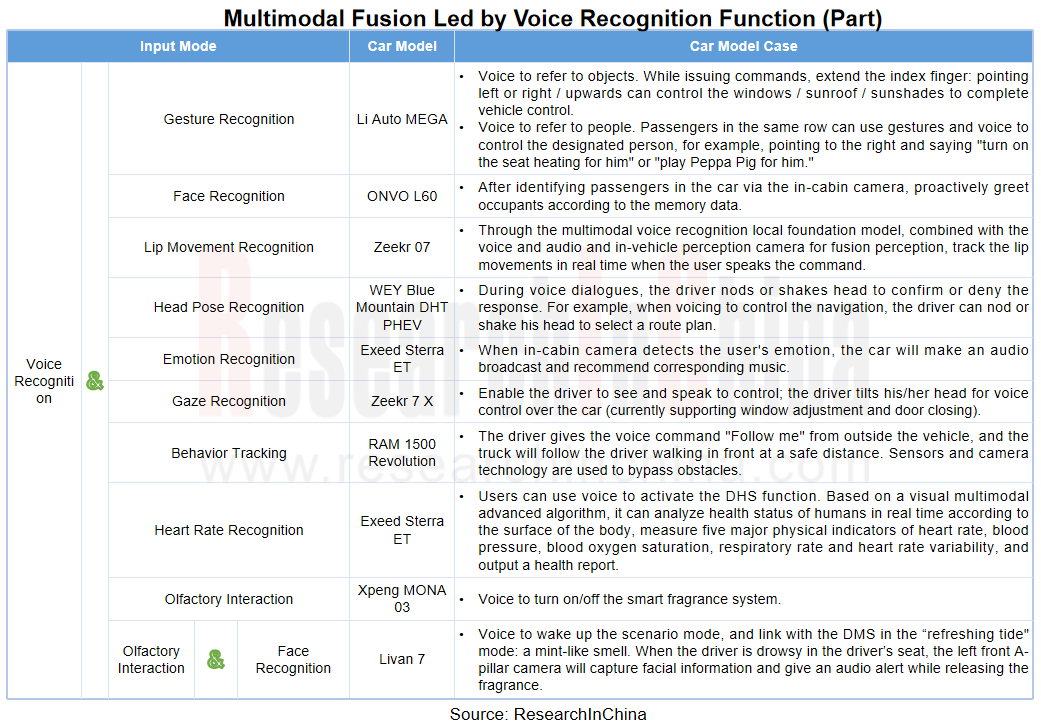
The frequent use of voice recognition function not only greatly optimizes user interactive experience, but also promotes the development trend of fusing with other interactive modes such as touch and face recognition. For example, the full-cabin memory function of NIO Banyan 2.4.0 is based on face recognition, and NOMI actively greets occupants who have recorded information (e.g., "Good morning, Doudou"); Zeekr 7X integrates voice recognition with eye contact to enable the driver to see and speak to control, and tilt his/her head to control the car via voice.
2. BYD launched palm vein recognition, and Sterra in-cabin health monitoring debuted
Compared with the mature interaction modes such as voice and face recognition, biometric technologies such as fingerprint, vein, and heart rate are still in the early stage of exploration and development, but they are gradually being mass-produced and applied. For example, BYD launched a palm vein recognition function in 2024, which can realize convenient vehicle unlocking; Genesis and Mercedes-Benz introduced fingerprint recognition systems in the 2025 Genesis GV70 and 2025 Mercedes-Benz EQE BEV respectively, allowing users to complete a range of operations such as identification, vehicle start and payment only with fingerprints; in addition, Exeed Sterra still uses visual perception technology provided by ArcSoft in new ET model, realizing in-cabin intelligent health monitoring function, and outputting health reports for users including five major physical indicators, i.e., heart rate, blood pressure, blood oxygen saturation, respiratory rate and heart rate variability.
Introduction of biometric technology not only improves driving convenience, but also significantly enhances the safety protection performance of vehicles, effectively preventing potential safety hazards such as tired driving and car theft. In the future, these biometric technologies will be more widely integrated into the development of intelligent and connected vehicles, providing drivers with a safer and more personalized mobility experience.
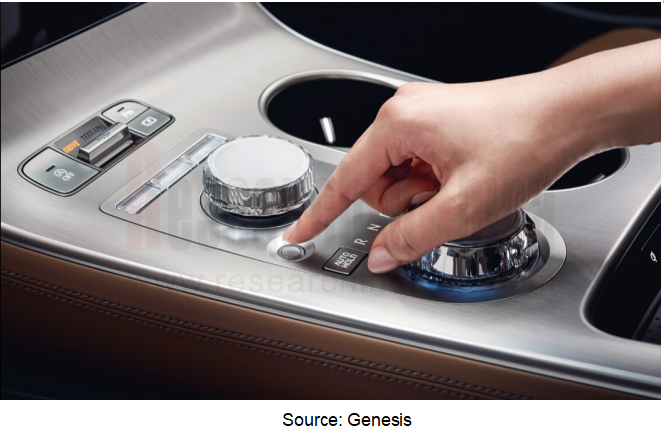
Case 1: Fingerprint recognition system of Genesis 2025 GV70 allows users to quickly apply personalized settings (seats, positions, etc.) through fingerprint authentication, and also supports vehicle start/drive. In addition, there are personalized linkage functions such as easy to use, fingerprint payment, and valet mode.
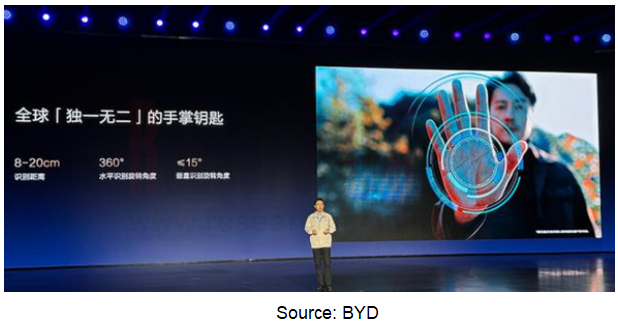
Case 2: BYD's palm vein recognition system uses a camera to read palm vein data for recognition at a distance of 8-20cm, 360 degrees horizontally and 15 degrees vertically. It uses professional image acquisition module to obtain images of vein patterns, extracts characteristics through algorithms and stores them, and finally realizes identification and recognition. In the future, it may be first installed in high-end brand Yangwang models.
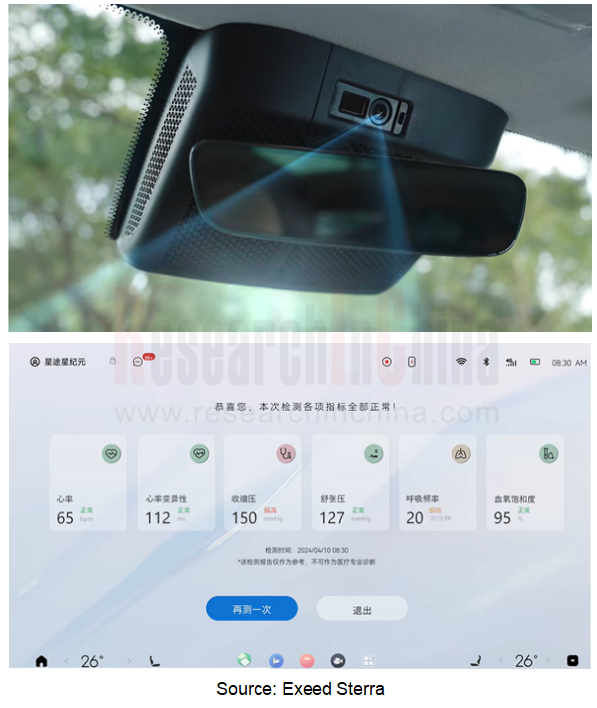
Case 3: Exeed Sterra ET model is equipped with DHS intelligent health monitoring function. Based on advanced visual multimodal algorithm, it can analyze health status in real time according to the surface of the human body, measure the five major physical indicators of heart rate, blood pressure, blood oxygen saturation, respiratory rate and heart rate variability, and output a health report.
3. AI foundation models lead cockpit interaction innovation, and perceptual intelligence evolves into cognitive intelligence
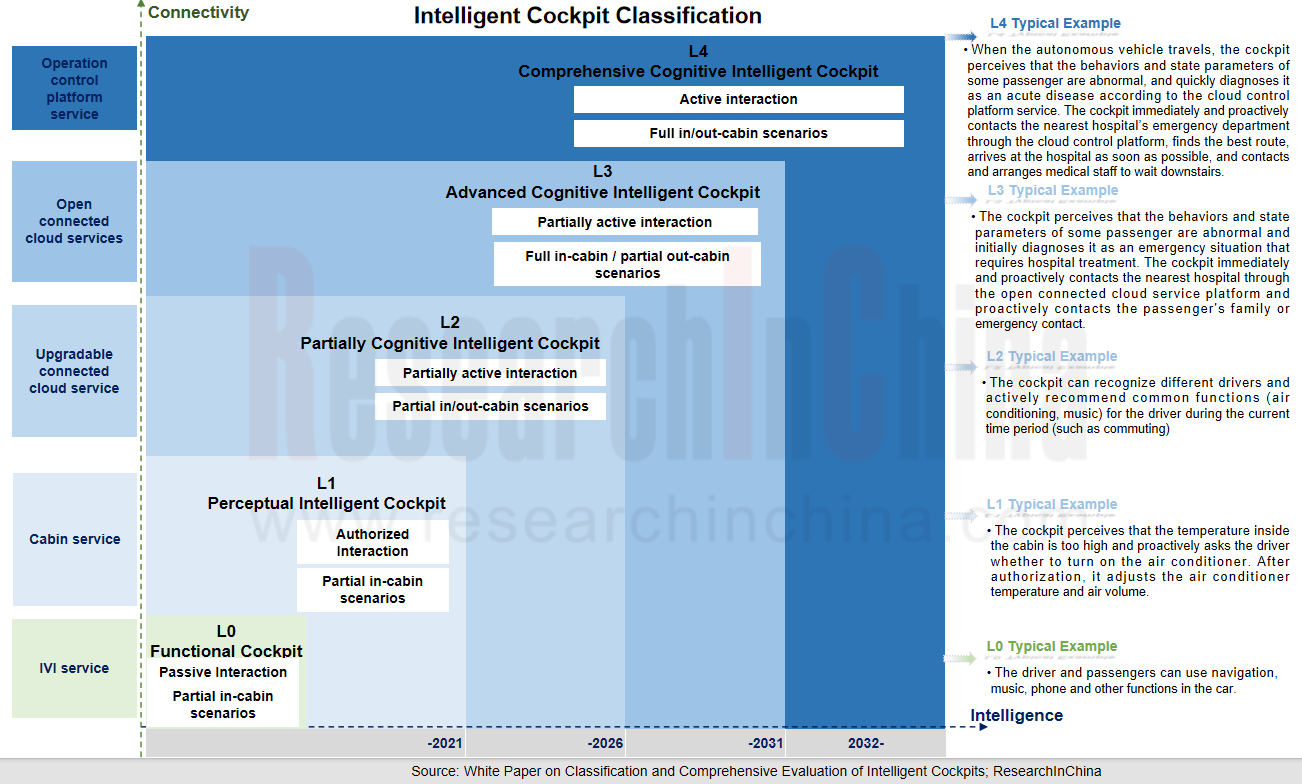
China Society of Automotive Engineers clearly defines and classifies intelligent cockpits in its jointly released white paper. The classification system is based on capabilities achieved by intelligent cockpits, comprehensively considers the three dimensions of human-machine interaction capabilities, scenario expansion capabilities, and connected service capabilities, and subdivides intelligent cockpits into five levels from L0 to L4.
With the wide adoption of AI foundation models in intelligent cockpits, HMI capabilities have crossed the boundary of L1 perceptual intelligence and entered a new stage of L2 cognitive intelligence.
Specifically, in the stage of perceptual intelligence, intelligent cockpit mainly relies on the in-cabin sensor system, such as cameras, microphones and touch screens, to capture and identify the behavior, voice and gesture information of driver and passengers, and then convert the information into machine-recognizable data. However, limited by established rules and algorithm framework, the cockpit interaction system in this stage still lacks the capability of independent decision and self-optimization, which is mainly reflected in the passive response to input information.
After entering the cognitive intelligence stage, intelligent cockpits can comprehensively analyze multiple data types such as voice, vision and touch by virtue of powerful multimodal processing capabilities of foundation model technology. This feature makes intelligent cockpits highly intelligent and humanized, able to actively think and serve, as well as keenly perceive actual needs of the driver and passengers, providing users with personalized HMI services. perceives
Case 1: SenseAuto introduced an intelligent cockpit AI foundation model product, A New Member For U, at the 2024 SenseAuto AI DAY. It can be regarded as the "Jarvis" on the vehicle, which can weigh up occupants’ words and observe their expressions, actively think, serve, and plan. For example, on the road, it can actively turn up the air conditioner temperature and lower music volume for the sleeping children in the rear seat, and adjust the chassis and driving mode to the comfort mode to create a more comfortable sleeping environment. In addition, it can actively detect the physical condition of occupants, find the nearest hospital for the sick ones, and plan the route.

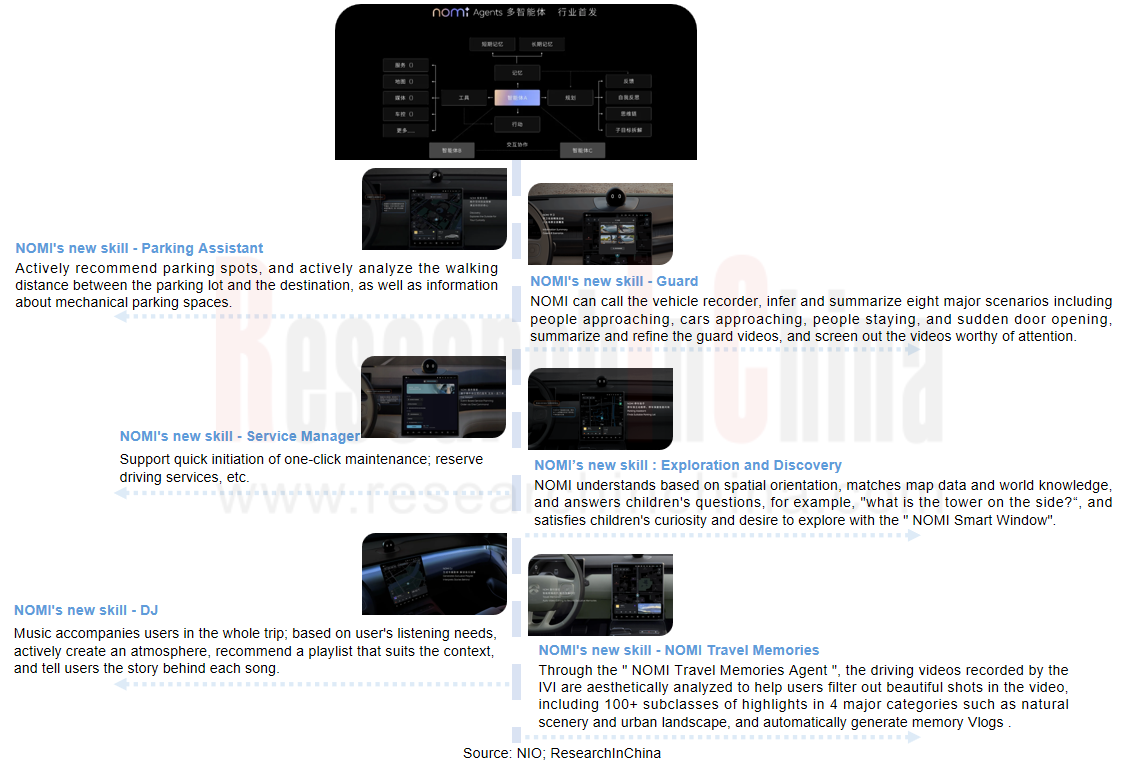
Case 2: NOMI Agents, NIO's multi-agent framework, uses AI foundation models to reconstruct NOMI's cognition and complex task processing capabilities, allowing it to learn to use tools, for example, calling search, navigation, and reservation services. Meanwhile, according to complexity and time span of the task, NOMI is able to perform complex planning and scheduling. For example, among NOMI's six core multi-agent functions, "NOMI DJ" recommends a playlist that suits the context to users based on their needs, and actively creates an atmosphere; "NOMI Exploration" understands based on spatial orientation, matches map data and world knowledge, and answers children's questions, for example, "what is the tower on the side?".
Automotive Microcontroller Unit (MCU) and Application Scenario Research Report, 2026
Automotive MCU Research: Increased demand for redundant security drives ASIL D-compliant MCU shipments to exceed 100 million units
In a vehicle EEA, MCUs are widely distributed in various functional ...
China Intelligent Cockpit Patent Analysis Report, 2026
Intelligent Cockpit Patent Research: Cockpit AI, In?vehicle Health, and Infotainment Are Upgrade to Scenario?based and Proactive Functions
From a patent perspective, this report explores the cutting?...
Research Report on Application of VLA Large Model in Automobiles and Robots, 2026
Research on Automotive and Robot VLA: Hybrid Architectures Become Mainstream, VLA Integrates with General World Models, and Reinforcement Learning Serves as Core Engine
Vision?Language?Action (VLA) m...
China Charging Infrastructure (Supercharging, Battery Swapping, V2G, etc.) and High-Performance Supercharging Battery Research Report, 2026
Charging and battery swapping research: as 5C+ supercharging vehicle models go into mass production, the pace of OEMs self-building supercharging networks quickens
800-1000V high-voltage platforms ar...
China Passenger Car Electronic Controlled Suspension Industry Report, 2026
Electronic Controlled Suspension Industry Research: As the First Year of Full Active Suspension Unfolds, Three Technical Routes Race Forward
1. Penetration Rate Surges Three Times, and Electronic Con...
Intelligent Driving SoC Research Report, 2026
Research on Intelligent Driving SoCs: Competition Focus Shifts to L3/L4 Embedded Hardware, and Computing Power of Flagship Vehicle Models Exceeds 1,000 TOPS
In terms of intelligent driving system in...
Automotive AI Large Model Technology Research Report, 2026
Automotive AI Large Model Research: Competition Shifts from "Who Has the Stronger Model" to "Who Boasts Higher Link Efficiency"
ResearchInChina released the Automotive AI Large Model Technology Resea...
Intelligent Vehicle Cockpit Domain Controller Research Report, 2026
Cockpit domain controller research: L3 AIDV intelligent cockpit domain controllers are entering a boom period
Driven by multiple factors such as the continuous evolution of the automotive central int...
Automotive Acoustic System (Audio, Multi-Channel) Industry Report, 2026
Automotive Acoustics Research: Multiple Channels, AI Tuning, and Self-Developed Algorithms Drive the Transformation of High-End Cockpit Sound Fields
I. Automotive Audio Hardware Solutions with 6–9 S...
Autonomous Driving Sensor Chip Research Report, 2026
Research on Autonomous Driving Sensor Chips: Deeply Perceiving the Physical World, Sensor Chips Are Playing A “Leading Role” in Intelligence
In 2026, the autonomous driving sensor chip industr...
Passenger Car Corner Module and Wheel‑Side Control System Research Report, 2026
Wheel-side control research: the “last mile” chassis innovation
Wheel-side control dismantles the traditional drive, braking, steering, and suspension control of the chassis from a "centralized" styl...
Embodied Artificial Intelligence (& Humanoid Robot) MCU Research Report, 2026
Research on Humanoid Robot MCUs: Evolution from General-Purpose Control to High-Value Dedicated Chip Solutions Integrated with Edge AI Functions
MCU (Microcontroller Unit) refers to a compact integra...
Intelligent Vehicle Zone Control Unit (ZCU) Research Report, 2026
ZCU Research: Cross-domain integrated ZCUs are becoming the edge computing nodes of the next-generation zonal architecture
Currently, the mainstream zonal architecture is mainly the quasi-central + z...
Automotive Cybersecurity and Data Security Research Report, 2026
Cybersecurity & Data Security Research: Intelligent Connected Vehicles Enter the Era of “Systematic Offense-Defense and AI-Defined Security”.
Centering on the panorama of intelligent connect...
Report on Breakthrough Strategies of OEMs and ADAS Tier 1 Suppliers for Overseas Layout of Intelligent Driving, 2026
Regulatory Breakthrough, Local System Establishment, OEMs Competing for NOA Layout: Overall Trends of China’s Intelligent Driving Overseas Layout in 2026
Research on overseas intelligent driving layo...
OEMs and Tier1s’ Intelligent Cockpit Platform (Hardware and Software) Innovation Strategy Research Report, 2026
Intelligent Cockpit Platform Research: multi-dimensional cockpit system architecture reconstruction for multi-agent collaboration and proactive intelligent services
The intelligent cockpit software s...
Automotive AIOS Research Report, 2026
Automotive AIOS Research: Mass Production Solutions Are Implemented
Mass Production Solutions Are Implemented on A Small Scale.
In 2026, AIOS starts small-scale implementation, helping to improve v...
Automotive Telematics Service Provider (TSP) Research Report, 2026
TSP Research: Leading providers collectively turn to AI agents to provide all-scenario active services
Telematics Service Providers (TSPs) are the core hub of the telematics industry chain, connectin...