|
 |
Global and China Automotive Seating Industry Report, 2016
|
The report covers the following:
1. Composition and function of automotive seating
2. Size and Trends of global and Chinese automotive seating market
3. Competitive landscape and trends of global and China’s automotive seating industry
4. Automotive seating supply chain of major global and Chinese carmakers
5. Global and Chinese automotive seating manufacturers
Automotive seating industry, seemingly without technological barriers, is actually a capital-intensive business that does with high-tech expertise. First, automotive seating plants are usually adjacent to car factories, for the products are too large to be transported easily. Therefore, as carmakers add a new production base, automotive seating manufacturers need to follow up. In this case, substantial funds become a must. Second, safety, comfort, and light weight- three requirements on automotive seating- need rich technological accumulation and present high technological threshold. Moreover, a huge number of employees in automotive seating industry pose great challenges to managerial competencies.
Global automotive seating market has grown steadily on account of the two aspects. First, higher barriers in automotive seating industry lead to high market concentration and little competition. Automotive seating manufacturers have a greater say which enables them to raise prices constantly. Second, consumption is upgraded, a phenomenon starkly seen in China where consumers have higher requirements on automotive seating. Automotive seating saw an ASP of USD723 in 2010 with a market size of USD54 billion. The figures for 2015 were USD790 and USD70.1 billion. It is expected the market size will be valued at USD72.9 billion in 2016, and USD84.3 billion in 2020 when ASP arrives at USD865.
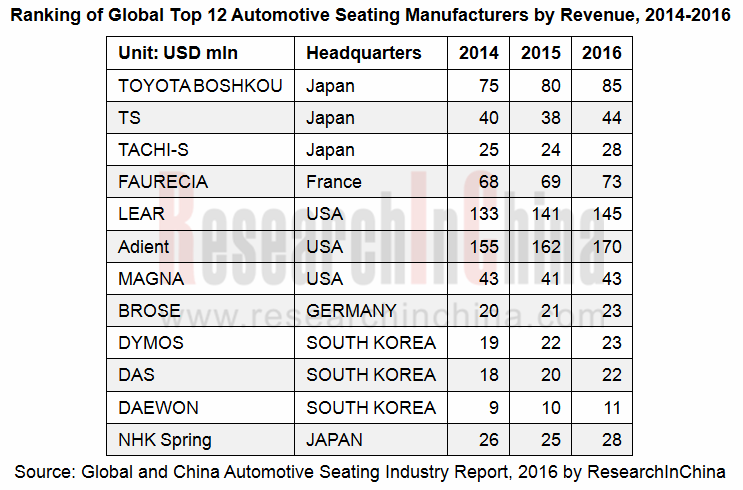
In automotive seating industry, Adient (a spin-off of Johnson Controls) and Lear are in the first camp, together holding about 48% of passenger car market. Adient has a broad customer base with almost all carmakers being its customers, while Lear provides products mainly for Ford, GM, BMW, and FCA and operates chiefly in North America and Europe but gets far less involved in the Asian-Pacific region. Adient seizes a dominant position in China with a market share of 40%.
Toyota Boshoku (a member of Toyota Group) and Faurecia (a subsidiary of PSA) fall into the second camp. Toyota Boshoku has been actively developing new customers outside Toyota in recent years. Faurecia serves mainly VW, PSA, and Renault-Nissan with its operations concentrated in Europe.
In the Chinese automotive seating market, almost all American cars and German cars are equipped with automotive seats from Adient and Lear, and among Japanese cars, all Honda cars carry automotive seats from TS, the majority of Toyota cars with automotive seats from Toyota Boshoku, and Nissan cars with automotive seats from a number of suppliers. Most of Chinese car brands use seats from joint ventures. Great Wall, BYD, Chery, and Geely adopt the model of partial own production and partial purchase from joint ventures. The joint ventures deliver cost-competitive products with better performance by relying on economy of scale and complete supply chain, while local brands retain their seating businesses just for enough say in negotiation with JVs and greater resilience in supply chain.
Most of Great Wall car seats come from its own seating business division and a few are provided by the joint venture between Great Wall and Yanfeng Johnson Controls. BYD’s car seats are largely supplied by its No. 16 business division and partly by Tachi-S, a three-party joint venture. Chery has low-end seats furnished by Wuhu Ruitai Auto Parts (a subsidiary of Chery) and high-end seats by Lear, making less and less purchase from Johnson Controls and GSK. Major suppliers of seats for Geely are Johnson Controls, Zhejiang Xindaimei Automotive Seating, and Zhejiang Jujin Automobile & Motor-cycle Accessories. Cooperation with South Korean Das provides solid support for Zhejiang Xindaimei Automotive Seating to gain a foothold in Geely. Zhejiang Jujin Automobile & Motor-cycle Accessories has investment from Geely and is also backed by Tachi-S.
As consumers pursue high-quality products, the ratio of home-grown seats will gradually fall, while that of JV seats will rise.
1 Brief Introduction to Automotive Seating
1.1 Structure
1.1.1 Cushion Frame
1.1.2 Back Frame
1.1.3 Head Restaint
1.1.4 Lever Control
1.1.5 Slide
1.1.6 Covering
1.1.7 Pad Foam
1.1.8 Recliner
1.1.9 Lumbar Support
1.2 Seat Frame
1.3 Seat Motor
1.4 Seat Covering
2 Global Automotive Seating Market and Industry
2.1 Global Automotive Seating Market Size, 2013-2020E
2.2 Ranking of Global Top 12 Automotive Seating Manufacturers by Revenue, 2014-2016
2.3 Market Share of Major Seating Manufacturers for Passenger Car in North America, 2016
2.4 Market Share of Major Seating Manufacturers for Passenger Car in Europe, 2016
2.5 Share of Automotive Seating Suppliers for Toyota/Honda/Renault-Nissan, 2015
2.6 Share of Automotive Seating Suppliers for VW/BMW/BENZ, 2015
2.7 Share of Automotive Seating Suppliers for GM/Ford/Hyundai, 2015
3 China Automotive Seating Market and Industry
3.1 China Automobile Sales Volume, 2010-2020E
3.2 Recent Developments of Chinese Automotive Market
3.3 Brand Structure of Chinese Automotive Market
3.4 China New Energy Vehicle Market
3.5 Top Ten Passenger Car Brands by Sales Volume, Jan.-Sep.2016
3.6 Market Share of Major Manufacturers in Chinese Passenger Car Seating Market, 2016
3.7 Share of Automotive Seating Suppliers for SAIC/FAW/CHANGAN, 2015
3.8 Share of Automotive Seating Suppliers for DONGFENG, 2015
3.9 Share of Automotive Seating Suppliers for BAIC, 2015
3.10 Automotive Seating Supply Strategies of Chinese Local Brands
4 Automotive Seating Manufacturers
4.1 Adient
4.2 Lear
4.3 Toyota Boshkou
4.4 Faurecia
4.5 TS
4.6 TACHI-S
4.7 Magna
4.8 Brose
4.9 NHK Spring
4.10 Sitech
4.11Wuhan New Yunhe Automotive Seating
4.12 GSK
4.13 DAS
4.14 Daewon
4.15 DYMOS
AI-Defined Vehicle (AIDV) OEMs' Deployment Strategies Research Report, 2026 AIDV Research: Deployment Strategies of 22 OEMs
The AI-Defined Vehicle (AIDV) OEMs' Deployment Strategies Research Report, 2026, released by ResearchInChina, analyzes the AI deployment strategies of ... OEMs’ Passenger Car Model Planning Research Report, 2026 Vehicle Model Planning Research: Chinese OEMs Launch Sub-Brands Intensively, While Multinational OEMs Apply the Brakes to Electrification Strategies
ResearchInChina released the OEMs’ Passenger Car M... Autonomous Driving Simulation and World Model Research Report, 2026 Autonomous driving simulation research: "Simulation test + world model"-driven test system has become R&D infrastructure.
The "Autonomous Driving Simulation and World Model Research Report, 2026"... Cockpit-Driving Integration Central Domain Controller SoC and AI Supercomputing Architecture Research Report, 2026 Cockpit-Driving integration and AI supercomputing research: The One Chip solution is rapidly installed in vehicles, and AI supercomputing architectures are moving towards full-domain integration.
AI ... Intelligent Driving End-to-End Large Model Research Report, 2026 Research on Intelligent Driving Large Models: A Critical Period for Technological Competition and Paradigm Integration
As autonomous driving technology rapidly iterates from L2 to L3?L4, intelligent... Automotive Digital Key Industry Trend Report, 2026 Digital Key Research: Automotive BLE, UWB and SLE Hardware Layout
The Automotive Digital Key Industry Trend Report, 2026, released by ResearchInChina, analyzes and predicts the digital key market, co... Monthly Report on Automotive New Technology (May 2026) UHD gaze technology, full-color LiDAR, UWB, etc. promote the upgrade of intelligent driving perception capabilities
This report is published once a month and is available for annual subscription.The... In-Cabin Monitoring Systems (DMS, OMS, etc.) Research Report, 2026 In-Cabin Monitoring System Research: DMS to Become Mandatory in 2027, Expected to be Installed in Over 14 Million Vehicles
ResearchInChina released the In-Cabin Monitoring Systems (DMS, OMS, etc.) Re... Automotive Service-Oriented Architecture (SOA) and Cross-Domain Middleware Industry Report, 2026 Research on automotive SOA and cross-domain middleware: The era of AI atomic services and AI cross-domain fusion agents is coming.
Automotive SOA evolves towards AI + full SOA servitization Driv... Automotive Display, Center Console and Cluster Industry Report, 2026 Automotive Display Research: Multi-Screen Application Slows Down, While OLED and MiniLED Are Introduced in Vehicles Quickly
In 2026, automotive displays will no longer excessively pursue the number a... Global and China Intelligent Vehicle Standard System Construction and Certification Research Report, 2026 Intelligent Driving Standards and Certification: With the Maturing Standardization System, China Will Participate in Formulation of Global Standards
China's automotive industry is transforming from ... Automotive Intelligent Diagnosis Industry Report, 2026 Automotive Intelligent Diagnosis Research: Powered by AI, Remote Diagnosis Is Being Upgraded towards Intelligence.
ResearchInChina released the Automotive Intelligent Diagnosis Industry Report, 2026.... Automotive Cloud Service Platform Research Report, 2026 Research on automotive cloud service platform: with architecture upgrade and computing power improvement, cloud services enter a new stage
In 2026, the Internet of Vehicles industry generates petaby... Integrated Battery and Innovative Battery Technology Research Report, 2026 Power Battery Research: Sales of High-Capacity Vehicles Keep Rising, and Solid-State Batteries Begin to Be Installed in Vehicles
I. Sales of High-Capacity Vehicles Sustain Growth, and Those with A C... Chinese Independent OEMs’ ADAS and Autonomous Driving Report, 2026 Research on OEMs' Intelligent Driving: Era of Physical AI, Standard Configuration of D2D, and Initial Exploration of L3 Commercial Pilot Projects
From 2023 to 2025, the intelligent driving installati... Intelligent Vehicle New Technology Application Analysis Report, 2025-2026 New Technology Research: Innovative Products such as Bionic Cameras, Vision-LiDAR Fusion Sensors, Auditory Sensors Further Enhance Vehicle Perception Capabilities
ForewordResearchInChina released th... Automotive Optical Fiber Communication (Optical Fiber Ethernet, PON) and Supply Chain Research Report, 2026 Research on Automotive Optical Fiber Communication: Introduction of Optical Fiber in Vehicles Accelerates, with Priority Deployment in High-Speed Communication Link (10+Gbps) Scenarios
Automotive opt... Automotive Intelligent Cockpit SoC Research Report, 2026 Automotive Cockpit SoC Research: Passenger Cars in the Price Range of RMB100,000–200,000 Account for Nearly 50% of Total Sales, and New-Generation Cockpit SoC Products Largely Enter Mass Production
P...
|